Unlock the secrets to local SEO with our SEO trends 2026 guide. Drive more leads, boost visibility, and adapt to the latest changes today!
Why use social media ads: a local business guide for 2026
You post regularly on Facebook and Instagram, share helpful tips, showcase your work, and engage with your community. Yet your posts barely reach anyone. Organic reach on Facebook has collapsed to 1.37%, meaning only around 137 people see your posts if you have 10,000 followers. For local service businesses, this makes free social media marketing nearly ineffective. Paid social media ads solve this visibility crisis by putting your business directly in front of nearby customers who need your services. This guide explains why social media ads are essential for local businesses in 2026, how they compare to other advertising platforms, and practical strategies to maximize your ad spend.
Table of Contents
Table of Contents
- How Organic Reach Decline Makes Social Media Ads Essential
- Targeting Local Customers: The Power Of Geo-Targeted Social Media Ads
- Visual Storytelling: Why Facebook And Instagram Ads Work For Service Businesses
- Social Media Ads Vs. Google Ads For Local Businesses: Understanding Your Options
- Ready To Boost Your Local Business With Targeted Social Media Advertising?
- Why Use Social Media Ads: Frequently Asked Questions
Key takeaways
| Point | Details |
|---|---|
| Organic reach collapsed | Facebook organic posts reach less than 2% of followers, making paid ads necessary for visibility |
| Geo-targeting precision | Social media ads let you target specific zip codes and neighborhoods to reach only local customers |
| Visual storytelling power | Image and video ads showcase services effectively, building trust through before-and-after results |
| Complement Google Ads | Social ads build brand awareness while Google Ads capture high-intent searches for emergency services |
| Combined strategy wins | Using both platforms maximizes local marketing impact across the customer decision journey |
How organic reach decline makes social media ads essential
The collapse of organic reach on social platforms has fundamentally changed how local businesses must approach social media marketing. If you have 10,000 followers on Facebook, your organic posts now reach approximately 137 people. This dramatic decline means the free marketing strategy you relied on five years ago no longer delivers results.
Low engagement rates compound this problem. Even the followers who do see your posts often scroll past without interacting, further limiting your content’s spread through Facebook’s algorithm. For local service businesses competing for attention in crowded feeds, organic content alone cannot generate the visibility needed to attract new customers consistently.
Paid social media ads overcome this challenge by guaranteeing your message reaches your target audience. Instead of hoping the algorithm favors your post, you pay to place your business directly in front of people who match your ideal customer profile. This shift from hoping for organic reach to paying for guaranteed visibility represents the new reality of social media marketing in 2026.
Without paid amplification, local businesses risk becoming invisible to potential customers who would benefit from their services but never see their organic posts in increasingly crowded social feeds.
Posting organic content still serves important purposes. It builds credibility when potential customers visit your profile, demonstrates your expertise, and maintains relationships with existing clients. However, relying solely on organic posts means missing the vast majority of your potential local audience.
The competitive landscape has shifted dramatically. Your competitors who invest in online advertising for local services appear consistently in local feeds while businesses depending only on organic reach fade into obscurity. Paid social media ads level the playing field, allowing smaller local businesses to compete effectively for attention and customers.
Targeting local customers: the power of geo-targeted social media ads
Geo-targeting transforms how effectively you spend advertising dollars by ensuring only nearby potential customers see your ads. You can specify exact cities, zip codes, or draw a radius around your business location to focus ad delivery. This precision eliminates wasted impressions on people outside your service area who could never become customers.
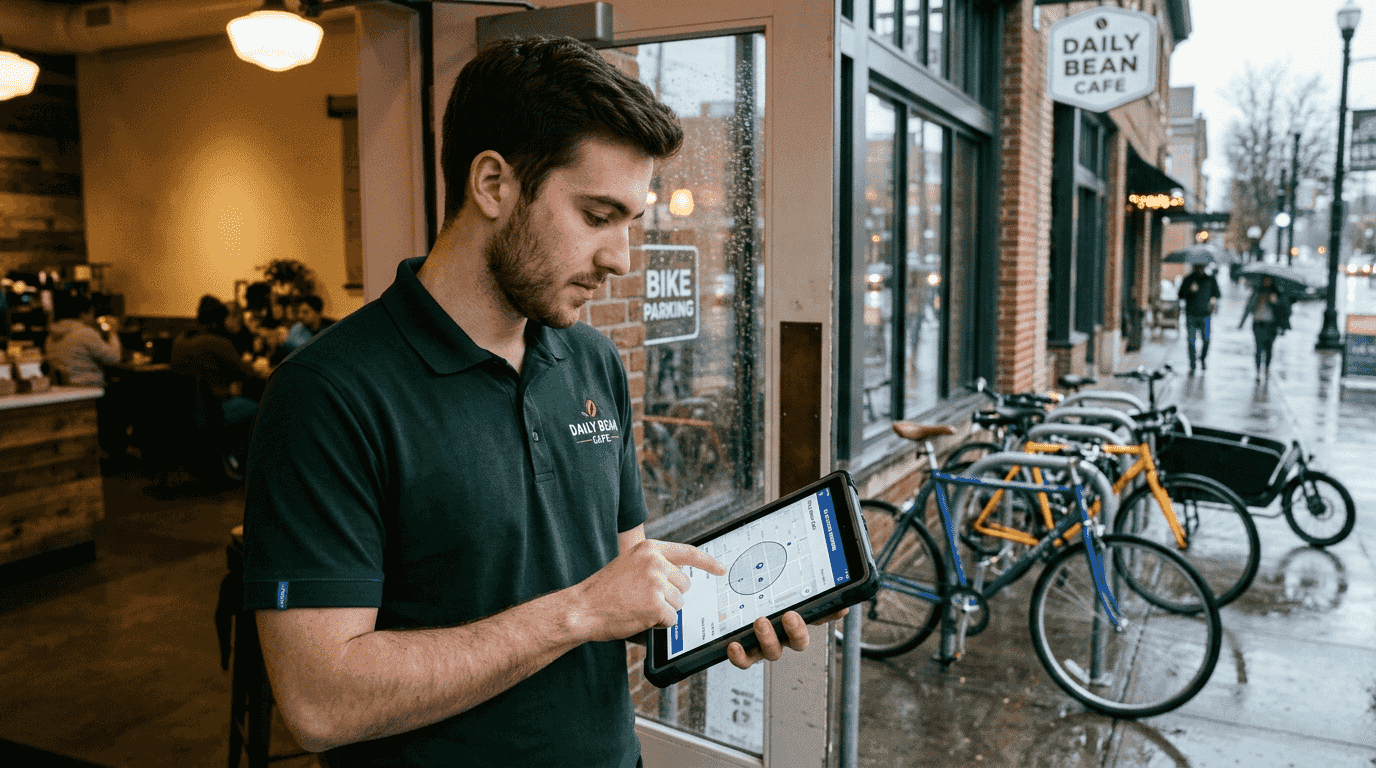
Geo-targeting is critical for maximizing ad spend impact. By focusing advertising efforts on potential customers within your specific geographic area, you increase relevance and response rates. A plumbing company in Austin gains nothing from impressions in Dallas, but geo-targeting ensures every dollar reaches Austin residents who might need emergency repairs.
You can layer demographic and interest filters on top of geographic targeting to refine your audience further. Target homeowners aged 35 to 55 within five miles of your office who have shown interest in home improvement. This combination produces higher quality leads than broad geographic targeting alone.
Testing different radius sizes reveals optimal coverage areas. Start with a 10-mile radius, then test 5-mile and 15-mile variations to identify which produces the best cost per lead. Urban businesses often perform better with tighter radiuses, while rural service providers may need wider coverage to reach sufficient audience volume.
Pro Tip: Review your geo-targeting settings monthly and analyze which neighborhoods produce the highest conversion rates, then adjust your targeting and budget allocation to focus on the most profitable areas while reducing spend on underperforming locations.
The ability to tailor messages to specific communities enhances ad effectiveness. Create separate ad sets for different neighborhoods, highlighting community-specific testimonials or addressing local concerns. A roofing company might emphasize hail damage repair in areas recently affected by storms while focusing on routine maintenance in unaffected neighborhoods.
Key geo-targeting benefits for local businesses:
- Eliminate wasted impressions outside your service area
- Increase ad relevance by focusing on nearby potential customers
- Adjust targeting radius based on service capacity and competition
- Layer demographic filters to reach ideal customer profiles
- Test neighborhood-specific messaging for better resonance
Effective social media ads for local service brands leverage geo-targeting as their foundation, ensuring every advertising dollar works toward reaching people who can actually become customers.
Visual storytelling: why Facebook and Instagram ads work for service businesses
Service businesses face a unique marketing challenge. You cannot hand potential customers a physical product to examine. Visual content on Facebook and Instagram solves this by showing your work, team, and results in action. High-quality images and videos capture attention and encourage potential customers to learn more about your business.
Videos demonstrating how services work build trust faster than text descriptions. A 30-second video showing your HVAC technician diagnosing and fixing a furnace problem communicates competence more effectively than paragraphs explaining your expertise. Customer testimonial videos add emotional connection, letting satisfied clients explain in their own words why they recommend your business.
Before-and-after photos provide compelling proof of your capabilities. Landscapers showcase overgrown yards transformed into beautiful outdoor spaces. Dental practices display smile transformations. These visual comparisons communicate value instantly, making potential customers imagine similar results for themselves.
Professional visuals differentiate your brand from competitors using stock photos or amateur snapshots. Quality matters because your ads compete for attention against polished content from national brands. Investing in professional photography and videography signals that you take your business seriously.
Compelling visual content in social media ads generates significantly higher engagement rates and customer interest compared to text-only advertisements, particularly for service businesses where seeing results builds confidence in hiring decisions.
Follow this framework for effective service business visuals:
- Use professional photos of your team and work in action to build familiarity and trust
- Create short videos explaining key services or common customer questions
- Highlight before-and-after results or customer success stories with permission
- Include clear calls-to-action in ad copy directing viewers to book consultations
- Refresh creatives every 4 to 6 weeks to avoid ad fatigue and maintain engagement
Ad fatigue occurs when your audience sees the same creative repeatedly, causing engagement rates to drop. Combat this by maintaining a library of diverse visual assets and rotating them regularly. Test different angles, settings, and messaging to identify which combinations resonate most with your local audience.
Pro Tip: Create a simple monthly content calendar for capturing new photos and videos of your work, then batch-edit them quarterly to build a rotating library of fresh ad creatives that prevent audience fatigue while maintaining consistent brand quality.
Browse examples of online advertising for local businesses to see how effective visual storytelling translates abstract services into concrete, compelling ad content that drives customer action.
Social media ads vs. Google Ads for local businesses: understanding your options
Choosing between social media ads and Google Ads requires understanding how each platform serves different stages of the customer journey. Google Ads dominates when people have high purchase intent, actively searching for immediate solutions. Someone typing “emergency plumber near me” at 2 AM needs help now, making Google Ads ideal for capturing that urgent demand.
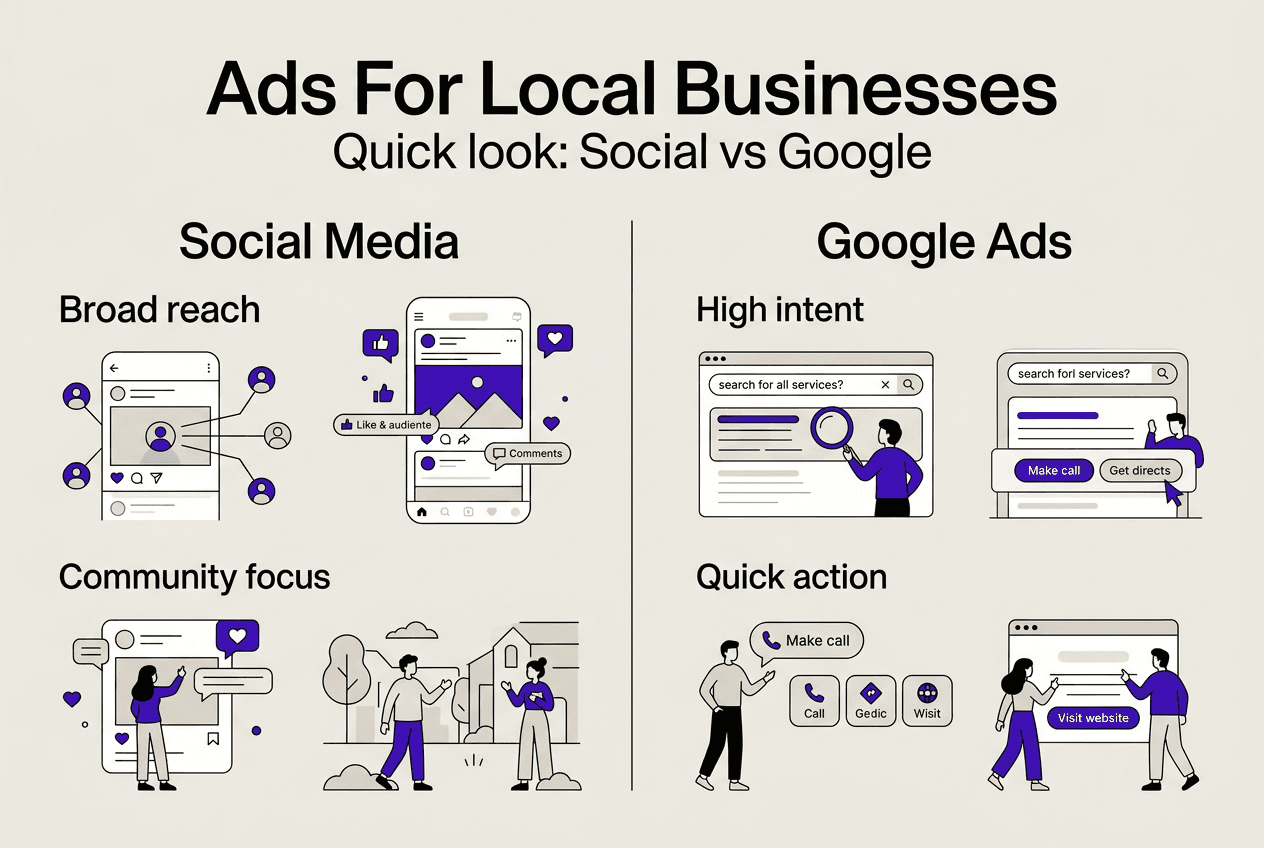
Social media ads excel at building brand awareness and community engagement before customers need your services. They introduce your business to local residents who may require your services eventually, keeping your brand top-of-mind for future needs. This passive discovery differs fundamentally from active search behavior.
Most successful local businesses use Facebook as a complement to Google, not a replacement. The platforms serve different purposes within a comprehensive marketing strategy. Google captures immediate demand while social media cultivates ongoing relationships and builds the pipeline of future customers.
| Feature | Google Ads | Social Media Ads |
|---|---|---|
| User intent | High, actively searching for solutions | Low to medium, passive browsing |
| Best for | Emergency services, immediate needs | Brand building, long sales cycles |
| Targeting method | Keywords and search queries | Demographics, interests, behaviors |
| Average cost | Higher CPC, lower volume | Lower CPC, higher volume |
| Visual emphasis | Text-focused with some images | Image and video-centric |
| Ideal businesses | Plumbers, locksmiths, urgent care | Landscapers, contractors, wellness |
Emergency services should primarily use Google Ads because customers need immediate solutions and actively search for providers. However, even emergency service businesses benefit from social media ads for building brand recognition, so when emergencies occur, local residents remember your business name and search for you specifically.
Pros and cons from a local business perspective:
- Google Ads captures high-intent customers ready to buy or book immediately
- Google Ads typically costs more per click but converts at higher rates
- Social media ads build brand awareness among potential future customers
- Social media ads allow precise demographic and interest targeting
- Social media ads cost less per click but may require longer nurture periods
- Combined strategies leverage strengths of both platforms for maximum coverage
Budget allocation should reflect your service urgency and customer decision timeline. Businesses with longer sales cycles, like kitchen remodeling or landscaping design, benefit from heavier social media investment to nurture relationships over weeks or months. Services with immediate need, like locksmith or towing, should prioritize Google Ads while maintaining modest social presence.
Pro Tip: Start with a 70/30 budget split favoring your primary platform based on service urgency, then adjust monthly based on cost per lead and customer lifetime value data to find your optimal mix between immediate conversions and long-term brand building.
Explore Google Ads explained and review the comprehensive Google Ads guide for local businesses to understand how integrating both platforms creates a complete local marketing system.
Ready to boost your local business with targeted social media advertising?
Navigating social media advertising requires expertise, time, and ongoing optimization to maximize results. City Web Company specializes in digital marketing strategies tailored specifically for local service businesses like yours, combining local SEO services for small businesses with targeted social media campaigns that generate qualified leads.
Our team understands your community and knows how to craft geo-targeted campaigns that reach nearby customers actively seeking your services. We handle everything from ad creative development to performance tracking, ensuring your advertising budget delivers measurable returns.
Partner with experts who deliver:
- Customized local SEO strategies that improve search visibility
- Targeted social media campaigns optimized for your service area
- Expert ad management across Facebook, Instagram, and Google platforms
- Ongoing performance tracking with transparent reporting and optimization
Ready to grow your local customer base with proven digital marketing strategies? Review our complete digital marketing guide for local business growth or contact City Web Company today to schedule a consultation and discover how targeted advertising can transform your local business results.
Why use social media ads: frequently asked questions
What is the main benefit of social media ads for local businesses?
The primary benefit is overcoming the collapse of organic reach to guarantee your business appears in front of nearby potential customers. Geo-targeting ensures you only pay for impressions within your service area, maximizing ad spend efficiency while building brand awareness among local residents who may need your services now or in the future.
How much should I budget for social media advertising?
Start with $500 to $1,000 monthly to gather meaningful performance data and optimize your campaigns. This allows testing different audiences, creatives, and messaging to identify what works best for your specific business. Scale budget up as you identify profitable campaigns, allocating more to top-performing ad sets while pausing underperformers.
Can social media ads replace Google Ads for my business?
Social media ads should complement, not replace, Google Ads for most local businesses. Google captures high-intent customers actively searching for immediate solutions, while social media builds brand awareness and nurtures potential future customers. Emergency service businesses should prioritize Google Ads, while businesses with longer sales cycles can weight social media more heavily in their overall strategy.
How often should I update my social media ad creatives?
Refresh your ad creatives every 4 to 6 weeks to prevent ad fatigue, which occurs when your audience sees the same content repeatedly and stops engaging. Monitor frequency metrics in your ad platform. When the same person sees your ad more than 3 times without converting, engagement typically drops, signaling time for new visuals and messaging.
Is it worth posting organic content if paid ads are needed?
Yes, organic content remains valuable for building credibility and maintaining relationships with existing customers. When potential customers click your ads and visit your profile, active organic content demonstrates expertise and legitimacy. However, do not expect organic posts alone to generate significant new customer acquisition given current reach limitations. Learn more about effective social media ads for local service brands to balance organic and paid strategies effectively.
Recommended
These articles were popular with other readers too: