

Discover 15 effective ways to improve online visibility in 2026. Boost your SEO, social media, and ads for rapid growth!
SEO trends guide: Boost local visibility and leads in 2026
TL;DR:
- Local SEO in 2026 demands mobile-first optimization and personalized AI-driven results to stay competitive. Businesses must focus on hyper-local content, consistent reviews, and accurate directory listings to build real community authority. Measuring success involves tracking organic traffic, lead generation, and ranking improvements over time for tangible ROI.
If your phone used to ring constantly from online leads but lately it feels quieter, you are not imagining it. Search behavior is shifting fast, and the local businesses that understand 2026’s SEO landscape are pulling ahead while everyone else scrambles. This guide breaks down exactly what has changed, what you need to prepare, which tactics work right now, and how to measure whether your investment is paying off. Whether you run a plumbing company, a landscaping crew, an HVAC business, or a med spa, the playbook here gives you concrete steps to win more visibility and turn clicks into customers.
Table of Contents
Table of Contents
- What’s changed in SEO for 2026?
- Preparing your business for SEO success
- Step-by-step: Implementing top SEO strategies in 2026
- Avoiding common mistakes and troubleshooting results
- How to measure your SEO results in 2026
- Our perspective: What most guides miss about local SEO in 2026
- Enhance your local SEO results with expert support
- Frequently asked questions
Key Takeaways
| Point | Details |
|---|---|
| Local SEO is evolving | Staying updated on 2026 trends is key to keeping your business visible and competitive. |
| Preparation drives results | Having the right tools and assets ready makes it easier to implement new SEO strategies successfully. |
| Avoid common mistakes | Regularly review your efforts to fix errors and keep your SEO campaigns effective. |
| Measure and adapt | Track your data consistently so you can adjust and improve your approach for better lead generation. |
What’s changed in SEO for 2026?
The rules of local SEO keep evolving, and 2026 has brought some of the most significant shifts in years. Understanding them is not optional if you want your business to show up when customers search.
Mobile-first is non-negotiable. Google has fully committed to mobile-first indexing, meaning it judges your website almost entirely based on how it performs on a phone. If your site loads slowly on mobile or forces visitors to pinch and zoom, your rankings suffer directly. This is not a future concern; it is happening right now to businesses that have not updated their sites.
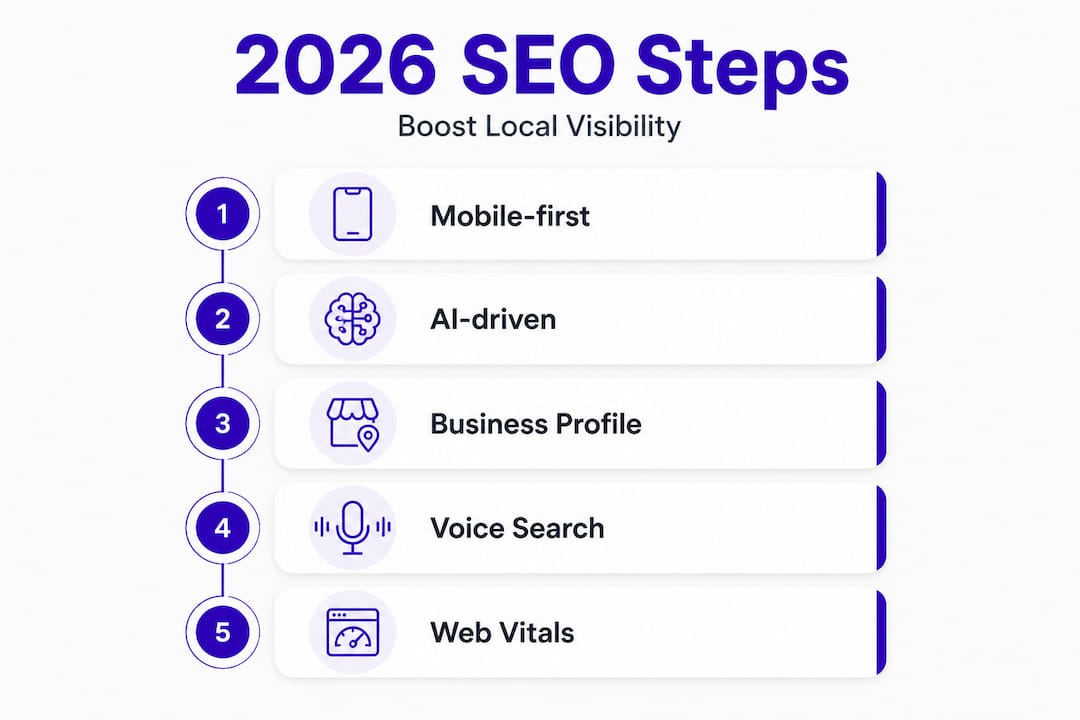
AI-driven personalization is reshaping results. Google now uses sophisticated AI models to understand search intent and deliver highly personalized results. Two people in the same city searching for “plumber near me” might see different results based on their search history, device, and behavior patterns. That means generic, one-size-fits-all content no longer cuts it. Your pages need to clearly signal relevance to specific neighborhoods, services, and customer needs.
Google Business Profile has become your most valuable digital asset. It is often the very first thing a potential customer sees before they ever reach your website. Local search trends in 2026 confirm that 46% of U.S. searches are local, and the click-through rate for top-ranking local businesses has hit 60%. That gap between first place and everything else has never been wider.
Voice search is no longer a novelty. People are asking Siri, Alexa, and Google Assistant questions like “Who fixes air conditioners near downtown?” These conversational queries demand a different keyword approach. Short, choppy keywords are less effective. Natural language phrases and question-based content now drive more qualified traffic.
Core Web Vitals matter more than ever. These are Google’s technical performance scores covering page loading speed, visual stability, and interactivity. Think of them as a report card for your website’s user experience. Sites that score well tend to rank higher, and 2026 SEO best practices show they also deliver higher conversion rates for local businesses.
Here is a quick snapshot of how the SEO landscape has shifted compared to previous years:
| SEO factor | Before 2024 | 2026 priority level |
|---|---|---|
| Mobile optimization | Important | Critical |
| Google Business Profile | Helpful | Essential |
| Voice search content | Optional | High priority |
| Core Web Vitals | Emerging | Strongly influences rankings |
| Localized community content | Nice to have | Competitive advantage |
| AI-assisted content tools | Rare | Standard practice |
Key trends every local service business should watch:
- Hyper-local content targeting specific neighborhoods and communities
- Review volume and recency as a ranking signal
- Zero-click searches where Google answers the question directly
- Video content appearing in local search results
- Schema markup (structured data) helping Google understand your services
Stat to remember: With 60% CTR for top-ranking local businesses, the difference between ranking first and ranking third is not just vanity. It is a measurable revenue gap.
Preparing your business for SEO success
Understanding the trends is critical, but now let’s get your business ready to put them into action.
Before you execute any new strategy, you need the right foundation. Think of it like renovating a kitchen. You would not install new cabinets before fixing the plumbing. The same logic applies here.
Get your tools in order. You need access to Google Analytics 4 and Google Search Console. These are free and essential. Google Analytics tells you who is visiting your site and what they do when they get there. Search Console shows you which search queries bring people to your pages and flags any technical errors Google finds. If you do not have these set up, stop everything and do that first.
A solid local website optimization guide will confirm what the data already shows: website speed and platform tools are the non-negotiable foundation of modern SEO. Every extra second of load time costs you conversions.
Audit your Google Business Profile. Claim it if you have not. Verify it. Then fill out every single field. Add your correct business name, address, phone number, hours, services, photos, and a keyword-rich description. Missing or inconsistent information here sends mixed signals to Google and customers alike.


Check your directory consistency. Your business name, address, and phone number must be identical across Yelp, Facebook, Angi, HomeAdvisor, the Better Business Bureau, and every other directory where you appear. Even small differences like “St.” vs “Street” can dilute your local authority. Use top local SEO platforms to audit and manage your listings from one place.
Here is a comparison of the tools you will want in your toolkit:
| Tool | Primary use | Cost |
|---|---|---|
| Google Analytics 4 | Traffic and behavior tracking | Free |
| Google Search Console | Search performance and errors | Free |
| BrightLocal or Whitespark | Local citation and ranking tracking | Paid |
| SEMrush or Ahrefs | Keyword research and competitor analysis | Paid |
| Google Business Profile | Local search presence | Free |
| PageSpeed Insights | Mobile and desktop speed testing | Free |
Set your baseline. Before you make any changes, record your current metrics. Write down your average monthly website visitors, your current rankings for your most important keywords, how many calls or form fills you get per month, and your Google Business Profile views. This baseline is how you will measure whether your efforts at improving local rankings are actually working.
Pro Tip: Screenshot your Google Business Profile insights and your Search Console impressions report on the first day of every month. It takes two minutes and gives you a clean historical record that makes trend analysis much easier later.
Step-by-step: Implementing top SEO strategies in 2026
Now that you’re ready with the right prep, it’s time to take action with these exact tactics.
This is where many business owners get overwhelmed and either do nothing or try everything at once. Neither approach works. Follow this sequence instead.
-
Fully optimize your Google Business Profile. Go beyond the basics. Post weekly updates, add photos of your team and completed work, answer every question in the Q&A section, and respond to every review. Google rewards activity. An active, complete profile signals that your business is legitimate, engaged, and trustworthy.
-
Create localized content consistently. Write blog posts and service pages that mention the specific cities, neighborhoods, and communities you serve. A roofing company in Phoenix should have pages targeting Scottsdale, Tempe, and Chandler, not just a generic “Phoenix roofing” page. Feature local events, mention landmarks, and write about problems specific to your area’s climate or housing stock. This hyper-local approach is one of the biggest factors in digital marketing tips for growth right now.
-
Build your review strategy. After every completed job, ask your customer for a Google review. Make it easy. Send a text message with a direct link to your review page. Aim for a steady flow of new reviews rather than a burst followed by nothing. Recency matters. Ten reviews posted last month carry more weight than fifty reviews from three years ago.
-
Build geo-targeted landing pages. These are pages on your website built specifically for each city or region you serve. Each page should include that location’s name in the title tag, the URL, the headings, and naturally throughout the content. Geo-targeted SEO confirms that geo-specific content directly drives customer engagement and leads in 2026. Do not duplicate the content across pages. Write each one uniquely.
-
Use AI tools strategically. Tools like ChatGPT, Jasper, and Surfer SEO can help you research competitors, generate content outlines, and identify keyword gaps. The key word is “strategically.” AI can speed up your research and give you starting points, but a real human who knows your business and community should always review and refine the output. Generic AI content that sounds like it could apply to any business in any city will not win local search.
“The local businesses seeing the strongest results in 2026 are the ones combining smart technology with genuine community knowledge. You can’t automate authenticity.” — City Web Company
Pro Tip: When building geo-targeted pages, interview one of your technicians or installers about what makes that specific neighborhood’s homes or businesses unique. Their real-world knowledge gives your content a texture that no competitor can easily copy.
Avoiding common mistakes and troubleshooting results
You’re executing like a pro, but let’s make sure you steer clear of the most common pitfalls and know what to do if rankings drop.
Even when businesses invest time and money into SEO, certain mistakes quietly cancel out the progress. Here are the ones we see most often.
-
Ignoring mobile speed. A site that loads in 5 seconds loses customers fast. Use Google’s PageSpeed Insights to check your score. Anything under 70 on mobile needs attention. Common fixes include compressing images, reducing unnecessary plugins, and upgrading your hosting plan.
-
Inconsistent NAP (name, address, phone number). If your address shows as “Suite 200” on your website but “Ste. 200” on Yelp and is missing entirely on Facebook, Google cannot confidently connect those profiles to one business. Inconsistency kills local authority.
-
Keyword stuffing. Cramming your target phrase into every other sentence looks unnatural to readers and triggers penalties from Google. Write for humans first. Use keywords naturally, and let the context and structure of your page signal relevance.
-
Buying cheap links. Low-quality backlinks from irrelevant or spammy sites can result in a Google penalty that tanks your rankings overnight. Earn links by being genuinely useful. Sponsor a local event, get listed in local business associations, or earn press coverage.
-
Not checking your data. A surprising number of business owners spend money on SEO and never look at their analytics. If you do not monitor your dashboard, you will not catch problems before they become expensive. Algorithm updates can cause rankings to fluctuate quickly, so checking your performance at least biweekly keeps you ahead of surprises.
“If your rankings drop suddenly, do not panic and start making random changes. First, check whether Google released an algorithm update. Then look at your mobile performance and your Google Business Profile status before changing anything else.” — City Web Company
Pro Tip: Set up Google Search Console email alerts so you receive a notification if your site gets a manual penalty or if a significant coverage issue appears. Catching problems early can save weeks of recovery time.
How to measure your SEO results in 2026
After implementation and troubleshooting, let’s make sure you’re accurately tracking what matters most for your SEO investment.
One of the most common frustrations we hear from local business owners is this: “We’ve been doing SEO for months. Is it working?” The honest answer is that you can only know if you are measuring the right things.
Google Analytics 4 is your primary traffic dashboard. Look at organic search traffic specifically, not total visits. Organic traffic is the number of visitors who found you through unpaid search results. Track whether that number grows month over month. Also watch which pages get the most organic traffic, because that tells you which topics resonate.
Google Search Console shows your visibility. Look at total impressions (how many times your pages appeared in search results), clicks, and average position for your top keywords. Tracking these monthly shows you whether your rankings are improving even before traffic increases.
Track leads directly. Rankings are a means to an end. The real goal is phone calls, form submissions, and booked appointments. Set up call tracking (many CRM tools and even Google provide this) and form submission goals in Analytics. Results-driven SEO means tracking local traffic and lead engagement for transparent ROI, not just vanity metrics.
Here is a simple measurement framework to use every month:
| Metric | Where to find it | What to watch for |
|---|---|---|
| Organic traffic | Google Analytics 4 | Month-over-month growth |
| Keyword rankings | Search Console or rank tracker | Movement on target keywords |
| Phone calls from search | Call tracking tool or GBP insights | Volume and lead quality |
| Form submissions | Google Analytics goal tracking | Conversion rate trends |
| Google Business Profile views | GBP dashboard | Impressions and direction requests |
| Bounce rate | Google Analytics 4 | High rate signals content mismatch |
Calculate your SEO ROI. Take the total revenue from leads generated through organic search. Subtract what you spent on SEO (tools, agency fees, your own time valued at your hourly rate). Divide the net gain by your total investment. A 300% ROI means you made three dollars for every dollar spent. Most businesses working on improving your local rankings with a clear strategy reach positive ROI within four to six months.
Key measurement insight: Do not judge SEO purely on rankings. A page ranked fourth that generates ten calls per month is more valuable than a page ranked first that generates none. Always connect rankings back to real business outcomes.
Our perspective: What most guides miss about local SEO in 2026
Most articles about local SEO in 2026 give you a clean list of tactics and send you on your way. That is useful. But there is something important that the checklist approach consistently misses.
The businesses winning at local SEO right now are not the ones chasing every shiny new tactic. They are the ones building genuine local authority, week after week, without cutting corners. Here is what that actually looks like in practice.
Short-term hacks almost always backfire. Buying reviews, spinning duplicate content across location pages, or using link farms might boost rankings briefly. But Google’s detection capabilities in 2026 are far more sophisticated than they were even two years ago. The penalty that follows a manual or algorithmic action can take months to recover from. The businesses that stay consistent with 2026 SEO best practices always outlast the ones trying to game the system.
Hyper-local content and real relationships still outperform automation alone. We have seen landscaping companies write one blog post about preparing lawns for a local freeze warning and generate more calls in a week than six months of generic “lawn care tips” posts. That kind of specificity cannot be fully automated. It requires knowing your community.
Relationships matter too. Partnering with a local charity, getting mentioned in a neighborhood Facebook group, or earning a link from the local Chamber of Commerce website are things that AI tools cannot manufacture. They signal to Google that your business is a real, embedded part of the community.
Incremental wins compound faster than you expect. Many business owners give up on SEO after two months because they do not see dramatic overnight results. But moving from position twelve to position eight on a key search term is a meaningful win. Moving from thirty Google reviews to sixty is meaningful. Moving from two hundred monthly organic visitors to three hundred is meaningful. These small improvements stack on top of each other, and by month six or eight, the curve starts bending sharply upward.
SEO is not a light switch. It is a flywheel. The work you put in now creates compounding momentum. The businesses that understand this are the ones still at the top of local search a year from now.
Enhance your local SEO results with expert support
Understanding local SEO strategy is one thing. Executing it consistently while running a service business is another challenge entirely.
At City Web Company, we work with local service businesses every day, from HVAC companies to pest control operators to disaster restoration firms, helping them show up where it counts and convert searchers into customers. If you want faster results without the trial and error, our team can audit your current setup, build a custom strategy, and manage execution for you. Explore our resources on driving more local leads and review our comprehensive ranking guide to see how the right support system accelerates growth. You can also get started immediately by reviewing how to optimize your Google Business Profile with our specialized local SEO services.
Frequently asked questions
What’s the most important SEO change for local businesses in 2026?
The biggest change is the growing weight of AI-driven personalization and localized search results shaped by Google’s algorithm updates. Businesses that create specific, community-relevant content will outperform those relying on generic service pages.
How long does it take to see SEO results from these new strategies?
Most local businesses see measurable change in two to three months when they follow the latest SEO best practices and track their data consistently. Competitive markets may take slightly longer, but steady execution always produces results.
What is the best way to handle a sudden drop in search rankings?
First, check whether Google released a recent algorithm update, then audit your site’s mobile speed and verify your Google Business Profile information is accurate and complete.
How do I know if my local SEO is working?
Monitor Google Analytics for organic traffic growth, track form submissions and call volume, and check keyword ranking movement monthly. Data-driven tracking removes the guesswork and shows you exactly where your investment is producing returns.
Recommended
These articles were popular with other readers too: