Explore the impact of social media ads for local service businesses: ad types, targeting strategies, costs, performance metrics, and compliance issues.

Online Advertising Guide 2026: Boost Local Leads Easily
Trying to grow your American home service or legal business can feel like chasing the wrong crowd with every dollar spent. Knowing exactly who you want to reach and managing your budget wisely can mean the difference between wasted ad spend and steady new leads. This guide explains how a clear focus on your target audience and budget lays the groundwork for smarter advertising and better results.
Table of Contents
Table of Contents
- Step 1: Define Target Audience And Budget
- Step 2: Select Best Advertising Platforms
- Step 3: Craft Compelling Ad Creative And Offers
- Step 4: Launch Targeted Campaigns With Tracking
- Step 5: Monitor Performance And Optimize Results
Quick Summary
| Key Point | Explanation |
|---|---|
| 1. Define Your Audience Precisely | Understand demographics and behaviors to create targeted marketing campaigns that effectively reach potential clients. |
| 2. Allocate Your Marketing Budget Wisely | Use 5-12% of annual revenue for marketing to ensure you can effectively reach your target audience. |
| 3. Choose Optimal Advertising Platforms | Focus on 2-3 platforms that align with where your audience spends time, maximizing your lead generation efforts. |
| 4. Create Compelling Ad Content | Use clear messaging that highlights benefits and urgency, capturing your audience’s attention through effective storytelling. |
| 5. Continuously Monitor and Optimize Campaigns | Regularly track performance metrics and make data-driven adjustments to improve advertising results over time. |
Step 1: Define target audience and budget
Successfully generating local leads starts with precision targeting. Your goal here is to map out who will most likely purchase your services and how much you can invest to reach them.
Defining your target audience requires understanding key demographic details. Analyzing customer characteristics helps you create laser-focused marketing campaigns that convert. Start by breaking down your ideal customer profile through these strategic steps:
- Identify core customer age range
- Determine income bracket
- Pinpoint geographic location
- Outline specific pain points and motivations
- Research typical online behavior patterns
Budget allocation plays an equally critical role in your advertising strategy. Strategic budget management determines how effectively you can reach potential clients. Most local service businesses should allocate 5-12% of projected annual revenue toward marketing efforts.
To calculate your specific budget, multiply your average customer lifetime value by your desired customer acquisition rate. This gives you a data-driven framework for spending that aligns with your growth objectives.
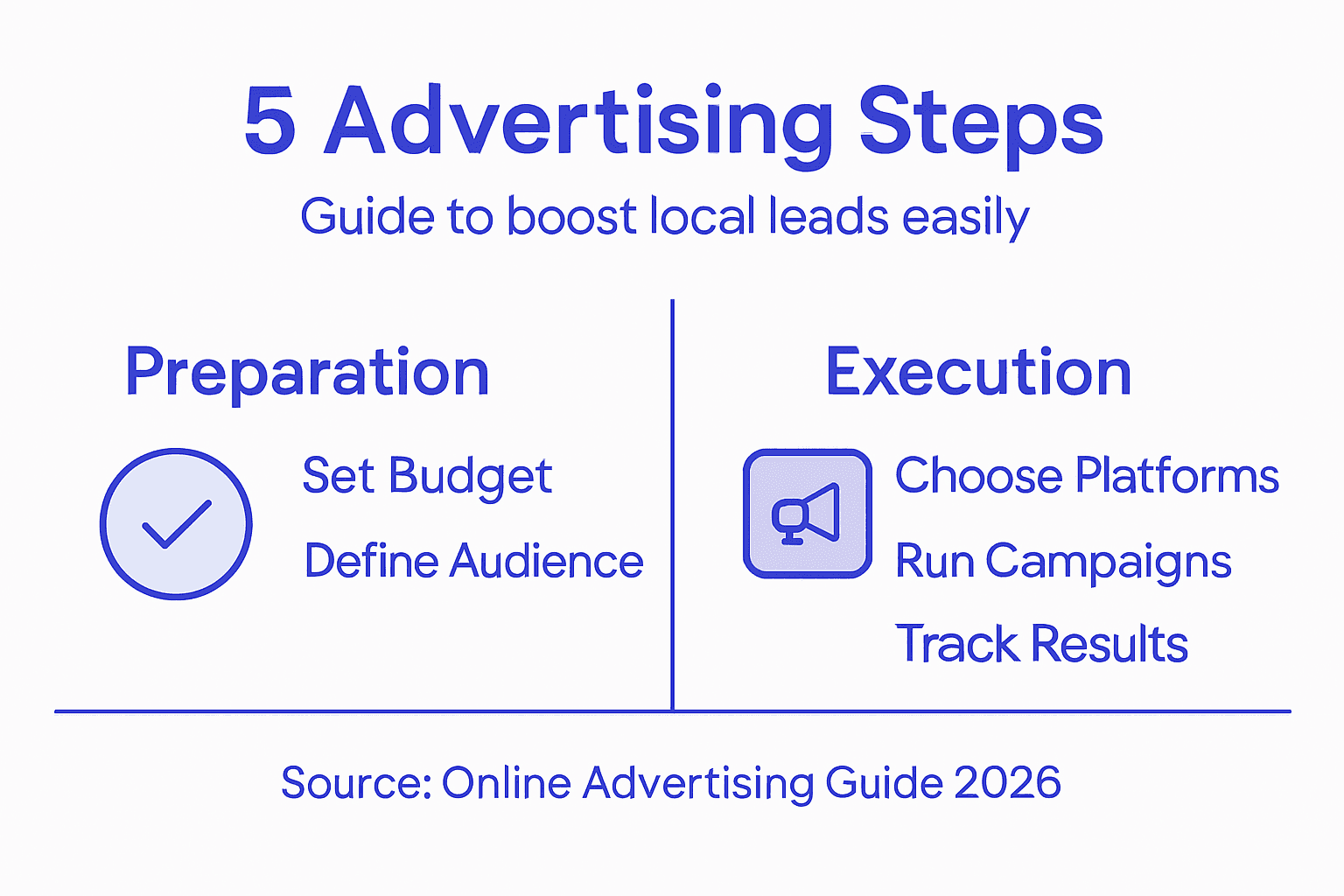
Here’s a quick overview of budgeting methods for local service businesses:
| Budgeting Approach | Calculation Method | Benefits |
|---|---|---|
| Percentage of Revenue | Allocate 5–12% of annual revenue | Simple, scalable |
| Lifetime Value-Based | Multiply customer lifetime value by volume | Data-driven, growth-oriented |
| Flat Monthly Allocation | Set fixed monthly marketing spend | Predictable, easy to track |
Target the right audience with the right budget, and you’ll transform advertising from an expense into an investment.
Pro tip: Use free analytics tools like Google Analytics to track audience demographics and refine your targeting strategy continuously.
Step 2: Select best advertising platforms
Choosing the right advertising platforms can make or break your local lead generation strategy. Your mission is to identify the digital channels that will connect you most effectively with potential customers.
Advertising strategy selection requires a thoughtful approach that matches your specific business goals. Different platforms offer unique advantages for local service businesses:
- Google Ads: Capture high-intent search traffic
- Facebook Ads: Target precise demographic segments
- LinkedIn Ads: Connect with professional service seekers
- Instagram: Showcase visual portfolio and brand personality
- Local streaming TV platforms: Reach geographically targeted audiences
Prioritize platforms where your ideal customers spend most of their online time. For home services and legal firms, this typically means combining search-based advertising like Google Ads with targeted social media campaigns.
The most successful advertising strategy isn’t about being everywhere, but being precisely where your potential customers are looking.
Consider your budget allocation across platforms. Start with 2-3 channels and track performance meticulously. Adjust your spend based on which platforms generate the most qualified leads at the lowest acquisition cost.
Here’s a summary comparing major advertising platforms for local lead generation:
| Platform | Target Audience Focus | Best Use Case | Average Cost Level |
|---|---|---|---|
| Google Ads | High-intent searchers | Immediate service needs | Moderate to high |
| Facebook Ads | Custom demographic groups | Community engagement | Moderate |
| LinkedIn Ads | Professionals, businesses | B2B and legal services | Higher than others |
| Visual-driven users | Showing portfolios and branding | Low to moderate | |
| Streaming TV | Local households | Broad geographic awareness | Variable |
Pro tip: Create platform-specific landing pages that match the ad’s messaging to improve conversion rates and reduce advertising costs.
Step 3: Craft compelling ad creative and offers
Transforming casual browsers into committed customers requires ad creative that stops scrolling and sparks immediate interest. Your advertisements need to cut through digital noise and speak directly to your potential clients’ most pressing needs.
Crafting effective ad creative involves strategic storytelling and precise messaging. Award-winning ad campaign strategies demonstrate that powerful advertising connects emotionally while solving specific problems:
- Highlight immediate customer benefits
- Use clear, concise language
- Create urgency with limited-time offers
- Showcase real customer testimonials
- Include specific, measurable promises
For home service and legal professionals, your ad creative should address common pain points directly. A plumbing ad might emphasize fast emergency response, while a legal advertisement could stress compassionate representation and proven case success rates.
Your advertisement isn’t just selling a service. It’s solving a problem and offering peace of mind.
Each platform requires slightly different creative approaches. Instagram demands visually striking imagery, Google Ads need keyword-rich headlines, and Facebook allows more storytelling-driven content.

Pro tip: A/B test at least three different ad variations to discover which messaging and visual style generates the highest engagement and conversion rates.
Step 4: Launch targeted campaigns with tracking
Successful local advertising requires more than just creating ads. You need a strategic approach that tracks performance, measures results, and continuously optimizes your marketing investment.
Tracking ROI from advertising campaigns helps you understand exactly how your marketing dollars convert into real business opportunities. Implement these critical tracking strategies:
- Set up conversion tracking in Google Ads and Facebook
- Create unique phone numbers for each campaign
- Use UTM parameters to track traffic sources
- Install pixel tracking on your website
- Configure goal tracking in Google Analytics
Local service businesses should focus on tracking meaningful metrics beyond simple clicks. Look for indicators like phone calls generated, form submissions, and appointment bookings that directly translate to potential revenue.
Effective campaign tracking transforms your advertising from a cost center into a predictable revenue generation system.
Start with small budget allocations and gradually increase spending as you validate which targeting and messaging combinations deliver the best results. Monitor your campaigns weekly, making data-driven adjustments to improve performance continuously.
Pro tip: Implement a simple spreadsheet to compare campaign performance across different platforms, tracking cost per lead and conversion rates to quickly identify your most effective marketing channels.
Step 5: Monitor performance and optimize results
Transforming your advertising from a shot in the dark to a precision instrument requires consistent performance tracking and strategic optimization. Your goal is to continuously improve campaign effectiveness and maximize return on investment.
Marketing campaign performance strategies reveal that successful optimization involves deep data analysis and agile adjustments. Track these critical performance indicators:
- Conversion rate for each campaign
- Cost per lead across different platforms
- Click-through rates by ad variation
- Audience engagement metrics
- Return on ad spend calculation
For local service businesses, focus on metrics that directly impact revenue. Phone call quality, appointment booking rates, and customer acquisition costs provide more meaningful insights than generic engagement statistics.
Small, consistent optimizations compound into significant performance improvements over time.
Establish a weekly review cycle where you analyze campaign data, identify underperforming elements, and make targeted adjustments. This might involve refining audience targeting, adjusting ad creative, or reallocating budget to top-performing channels.
Pro tip: Create a performance dashboard that automatically aggregates key metrics from different platforms, allowing you to quickly spot trends and make data-driven decisions without manual data compilation.
Unlock the Power of Targeted Local Advertising Today
Struggling to turn your local service leads into loyal customers? The detailed steps in the “Online Advertising Guide 2026: Boost Local Leads Easily” reveal how essential precise audience targeting, smart budget allocation, and compelling ad creative are for meaningful growth. If you are ready to stop wasting money on unproductive ads and start generating quality leads that convert, expert support can make all the difference.
At City Web Company, our tailored PPC & Paid Ad Strategies bring scientific precision to your marketing campaigns. We specialize in transforming your advertising budget into predictable revenue by combining data-driven targeting with creative messaging that resonates with your ideal customers. Explore advanced techniques and proven frameworks with our Digital Advertising Tips & Strategies to stay ahead of the competition. Don’t let ineffective ads hold your business back. Take action now and connect with our team at City Web Company Contact to unlock your local market potential and see real results fast.
Frequently Asked Questions
How do I define my target audience for local advertising?
To define your target audience, identify key demographics like age range, income bracket, geographic location, and pain points. Start by analyzing customer characteristics within your market to create laser-focused marketing campaigns.
What budget should I allocate for my local online advertising?
Typically, local service businesses should allocate 5-12% of projected annual revenue toward marketing. Calculate your specific budget by multiplying your average customer lifetime value by your desired customer acquisition rate to align spending with your growth objectives.
Which advertising platforms are best for reaching local leads?
To effectively reach local leads, prioritize platforms like Google Ads for high-intent search traffic and Facebook Ads for demographic targeting. Start with 2-3 channels where your audience spends most of their time, and track performance to see which provides the best return on investment.
How can I create compelling ad creative that converts?
Craft compelling ads by highlighting immediate customer benefits and using clear, concise language. Incorporate urgency with limited-time offers and real customer testimonials to resonate with potential clients.
What tracking methods should I use for my online advertising campaigns?
Implement conversion tracking in advertising platforms, use unique phone numbers for each campaign, and apply UTM parameters to analyze traffic sources. Set up a simple tracking system to monitor phone calls and leads generated to assess performance accurately.
How often should I monitor and optimize my advertising performance?
Monitor your advertising performance at least weekly to track key metrics like conversion rates and cost per lead. Make small, consistent optimizations based on your findings, which can lead to significant performance improvements over time.
Recommended
- Local Business Advertising: The Ultimate Guide to Getting Customers – City Web Company | Digital Marketing Agency
- Why Choose Local Marketing for Service Businesses
- Role of Social Media Ads for Local Service Brands
- Why Choose Digital Campaigns for Local Growth
- Come funziona la pubblicità immobiliare in Italia
These articles were popular with other readers too: