

Discover 15 effective ways to improve online visibility in 2026. Boost your SEO, social media, and ads for rapid growth!
Online Advertising Explained: Boosting Local Business
Every local business owner knows the challenge of getting noticed in a crowded online space. Competition for consumer attention is constant, and traditional marketing often misses the mark with today’s digital-first audiences. Online advertising gives local businesses the power to reach potential customers more precisely and measure results in real time, leading to smarter decisions and better returns. Explore how these tailored strategies can help your business attract more of the right customers and stand out in your community.
Table of Contents
Table of Contents
- What Is Online Advertising for Local Businesses
- Different Types of Online Advertising Channels
- How Targeting and Ad Placement Works
- Common Costs and Pricing Models Explained
- Risks, Mistakes, and How to Avoid Them
Key Takeaways
| Point | Details |
|---|---|
| Online Advertising Effectiveness | Online advertising allows local businesses to reach targeted audiences more precisely than traditional methods, with measurable insights for optimization. |
| Diverse Advertising Channels | Local businesses should utilize various online advertising channels, including Search Engine, Social Media, and Video Advertising, each tailored to specific goals. |
| Cost Management Strategies | Understanding pricing models like CPC and CPM enables local businesses to manage budgets effectively and test channel performance. |
| Risk Mitigation | Businesses must be aware of common risks such as ad fraud and targeting errors, implementing verification processes to maintain campaign effectiveness. |
What Is Online Advertising for Local Businesses
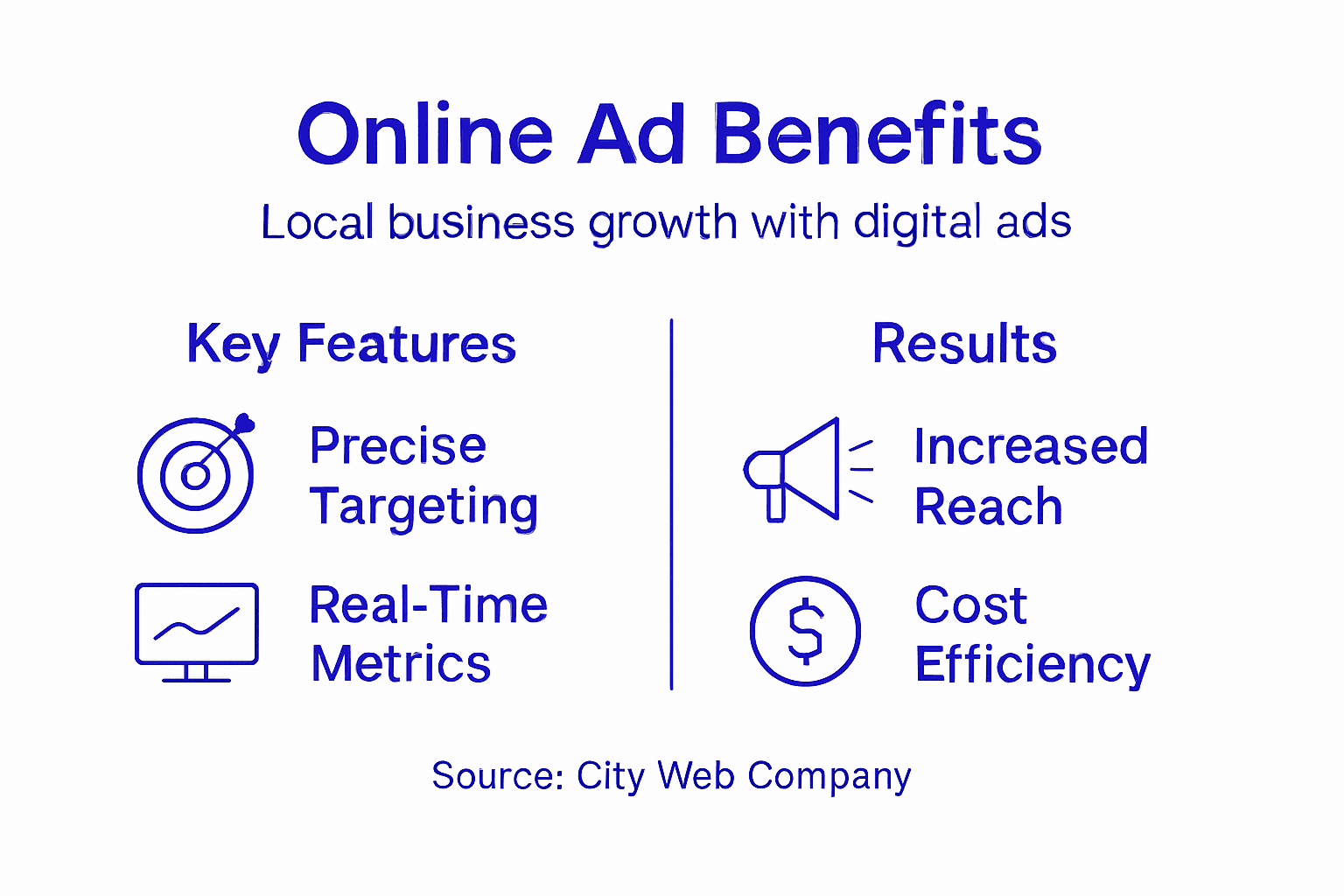
Online advertising represents a powerful digital marketing strategy that enables local businesses to reach potential customers through internet-based platforms. Digital marketing channels allow service providers to connect with targeted audiences more precisely than traditional advertising methods.
At its core, online advertising involves strategically placing promotional content across digital platforms to attract and engage potential customers. This approach differs significantly from traditional marketing by offering granular targeting capabilities and real-time performance tracking. Local businesses can leverage multiple advertising formats to increase visibility and drive customer acquisition.
The key online advertising channels for local businesses include:
- Search Engine Advertising: Placing ads within search results
- Social Media Advertising: Targeting users on platforms like Facebook and Instagram
- Display Network Advertising: Visual ads across websites and apps
- Local Listing Ads: Promoting business profiles on mapping and directory services
- Video Advertising: Short promotional videos on platforms like YouTube
These digital advertising methods provide measurable insights that traditional advertising cannot match. Targeted advertising strategies enable businesses to optimize marketing spend by reaching consumers most likely to become customers.
Pro tip: Start with a small budget and test multiple advertising platforms to determine which delivers the best return on investment for your specific local business.
Different Types of Online Advertising Channels
Local businesses have multiple online advertising channels to choose from, each offering unique opportunities to connect with potential customers. Online advertising channels provide diverse strategies for reaching target audiences across digital platforms.


The most prominent online advertising channels include search engine marketing, social media advertising, display advertising, and specialized targeting methods. Each channel offers distinct advantages and can be tailored to specific business goals and customer demographics.
Here are the primary online advertising channels for local businesses:
- Search Engine Advertising: Targeted ads appearing in search results
- Google Ads
- Bing Ads
- Local search placement
- Social Media Advertising: Platform-specific targeted advertising
- Facebook Ads
- Instagram Ads
- LinkedIn Ads
- Display Network Advertising: Visual ads across websites and apps
- Banner ads
- Remarketing campaigns
- Responsive display ads
- Video Advertising: Promotional videos on digital platforms
- YouTube Ads
- Streaming platform advertisements
- Native Advertising: Ads that blend with website content
- Sponsored articles
- Recommended content widgets
Targeted advertising strategies enable businesses to optimize their marketing efforts by reaching specific customer segments with precision and efficiency. The key is selecting the right mix of channels that align with your business objectives and target audience.
Pro tip: Experiment with multiple advertising channels and track performance metrics to identify the most cost-effective platforms for your specific local business.
Here’s how popular online advertising channels differ on key business benefits:
| Channel Type | Best For | Typical Budget Need | Speed of Results |
|---|---|---|---|
| Search Engine Ads | High-intent users | Medium to high | Fast (days to weeks) |
| Social Media Ads | Local brand awareness | Flexible, any budget | Moderate speed |
| Display Ads | Visual promotion | Small to medium | Gradual |
| Video Ads | Storytelling | Medium to high | Slower (weeks) |
| Native Ads | Content engagement | Medium | Moderate speed |
How Targeting and Ad Placement Works
Consumer targeting technologies enable local businesses to deliver precise advertising messages to specific audience segments. By analyzing user data and behavioral patterns, online advertising platforms help businesses reach potential customers with unprecedented accuracy.
The targeting process involves several sophisticated mechanisms that break down audience characteristics into actionable segments. Businesses can now segment their audience based on multiple dimensions including:
- Demographic Targeting
- Age
- Gender
- Income level
- Education
- Behavioral Targeting
- Online browsing history
- Purchase patterns
- App usage
- Previous interactions
- Geographic Targeting
- City
- Region
- Neighborhood
- Zip code
- Interest-Based Targeting
- Hobby categories
- Professional interests
- Content preferences
- Lifestyle segments
Digital ad placement strategies allow advertisers to display ads in specific contexts that maximize relevance and engagement. This approach ensures that ads appear on websites, apps, and platforms most likely to reach ideal customer profiles.
The sophisticated targeting technologies continuously refine ad delivery, reducing wasted advertising spend and improving overall campaign performance. By matching user characteristics with precise advertising messages, local businesses can achieve higher conversion rates and more efficient marketing investments.
Pro tip: Create multiple audience segments and test different targeting parameters to discover the most responsive customer groups for your specific business.
Use this table to understand how targeting options impact online ad performance:
| Targeting Method | Example Usage | Business Impact |
|---|---|---|
| Demographic | Age filters for offers | Higher relevance, better ROI |
| Behavioral | Past browser activity | Personalized messages, more leads |
| Geographic | ZIP code targeting | Attracts nearby shoppers |
| Interest-Based | Hobby or topic alignment | Builds loyalty among niche users |
Common Costs and Pricing Models Explained
Online advertising pricing models provide local businesses with flexible strategies to manage marketing budgets and measure advertising effectiveness. Understanding these pricing structures is crucial for making informed decisions about digital marketing investments.
The primary online advertising pricing models include:
- Cost-Per-Click (CPC)
- Pay only when someone clicks your ad
- Ideal for driving website traffic
- Gives direct control over spending
- Cost-Per-Thousand (CPM)
- Pay for every 1,000 ad impressions
- Best for brand awareness campaigns
- Predictable pricing structure
- Cost-Per-Acquisition (CPA)
- Pay only when a specific action occurs
- Includes sales, sign-ups, or leads
- Lowest financial risk for advertisers
- Flat-Rate Pricing
- Fixed cost for ad placement
- Predictable monthly budgeting
- Common on smaller platforms
Dynamic pricing strategies allow real-time adjustments based on market conditions, competition, and ad performance. These algorithmic approaches help businesses optimize their advertising spend by automatically adjusting prices and targeting.
The choice of pricing model depends on specific business goals, budget constraints, and desired marketing outcomes. Some advertisers combine multiple models to create comprehensive, cost-effective strategies.
Pro tip: Start with a small budget using CPC models to test different targeting approaches before scaling your advertising investment.
Risks, Mistakes, and How to Avoid Them
Online ad fraud prevention represents a critical challenge for local businesses investing in digital marketing. Understanding potential pitfalls can help entrepreneurs protect their advertising investments and maintain campaign effectiveness.
Common risks and mistakes in online advertising include:
- Budget Drainage Risks
- Fraudulent traffic
- Click fraud
- Bot-generated impressions
- Unverified ad placements
- Targeting Errors
- Inappropriate audience selection
- Overly broad targeting
- Insufficient audience research
- Demographic misalignment
- Compliance Violations
- Misleading advertising claims
- Lack of transparent disclosures
- Privacy regulation breaches
- Inappropriate content targeting
Legal advertising standards require businesses to maintain transparency, accuracy, and ethical practices in their digital marketing efforts. Regulatory compliance is not optional but a fundamental requirement for sustainable online advertising.
Successful businesses mitigate risks by implementing robust verification processes, working with reputable advertising platforms, and maintaining strict adherence to legal and ethical guidelines. Continuous monitoring and adaptation are key to navigating the complex digital advertising landscape.
Pro tip: Conduct monthly audits of your advertising campaigns, tracking performance metrics and verifying traffic sources to quickly identify and address potential fraudulent activities.
Unlock Your Local Business Potential with Expert Online Advertising
Understanding the challenges of reaching the right audience and maximizing your marketing budget is essential for local businesses aiming to grow. This article highlighted how targeted advertising, precise audience segmentation, and choosing the right pricing models can drive incredible results. If you want to stop guessing and start seeing measurable growth from your online ads, you need expert guidance tailored to your unique service industry needs.
Take control of your digital marketing with proven strategies in PPC & Paid Ad Strategies and actionable insights from Digital Advertising Tips & Strategies.

Don’t let ineffective campaigns drain your budget. Partner with City Web Company to leverage sophisticated targeting technologies and optimize your advertising spend today. Reach out now to transform your online presence and boost local customer engagement by visiting our contact page at City Web Company Contact. Your next new customer is just one smart ad away.
Frequently Asked Questions
What is online advertising for local businesses?
Online advertising for local businesses involves using digital platforms to promote products and services, allowing businesses to connect with potential customers through targeted advertising strategies.
What are the different types of online advertising channels?
The primary online advertising channels include search engine advertising, social media advertising, display network advertising, video advertising, and native advertising, each offering unique opportunities to reach potential customers.
How does targeting and ad placement work in online advertising?
Targeting and ad placement in online advertising involve analyzing user data and behavioral patterns to segment audiences based on demographics, behaviors, geography, and interests, ensuring that ads reach the right potential customers effectively.
What are common pricing models for online advertising?
Common pricing models for online advertising include Cost-Per-Click (CPC), Cost-Per-Thousand (CPM), Cost-Per-Acquisition (CPA), and flat-rate pricing, allowing businesses to choose a model that best fits their marketing goals and budget.
Recommended
- Local Business Advertising: The Ultimate Guide to Getting Customers – City Web Company | Digital Marketing Agency
- Why Choose Local Marketing for Service Businesses
- Online Advertising Guide 2026: Boost Local Leads Easily
- Role of Social Media Ads for Local Service Brands
- Why Optimise Business Growth for Nigerian SMEs
- 7 Essential Cheap Local Taxi Near Me Tips for 2026 – Capital Cars
These articles were popular with other readers too: