Pass Google Business verification with a video-first checklist. Film one continuous 30 second take, fix flagged issues, and know when to hire help.
7 Benefits of Online Ads for Local Service Businesses
TL;DR:
- Online advertising offers local service businesses precise targeting, enabling them to reach high-intent customers efficiently. It also reduces costs and increases ROI through measurable campaigns and real-time optimization. Success depends heavily on fast lead response, review management, and aligning intake processes with ad strategies.
Local service businesses — pest control, HVAC, landscaping — pour money into marketing every year and often have no idea what’s actually working. Traditional ads like mailers, radio spots, and local TV feel familiar, but they’re essentially a guessing game. Online advertising changes that equation completely, giving you pinpoint targeting, real-time performance data, and a cost structure that rewards efficiency over volume. This article breaks down seven concrete benefits, backed by current industry data, and explains exactly how each one helps you win more customers in your own backyard.
Table of Contents
Table of Contents
- Pinpoint targeting: Reach your ideal local customers
- Cost efficiency: Lower cost per lead and higher ROI
- Measurability and control: Campaigns you can actually optimize
- Urgency advantage: Capture high-intent leads when it matters most
- Flexibility and scalability: Tailor your growth plan and budget
- Real results: Proof of ROI for local service businesses
- Perspective: How to maximize your online advertising beyond just ads
- Take your next step: Turn online advertising benefits into business growth
- Frequently asked questions
Key Takeaways
| Point | Details |
|---|---|
| Precision targeting | Online ads help you reach local customers exactly when and where they need your service. |
| Superior ROI | Digital campaigns deliver more qualified leads at a lower cost compared to traditional methods. |
| Real-time results | You can track, adjust, and optimize campaigns quickly using live performance data. |
| Scalable growth | Online ads allow you to adjust your budget and campaign scope at any time to fit your business needs. |
| Operational readiness | Quick responses and strong customer reviews are crucial for maximizing the impact of your ads. |
Pinpoint targeting: Reach your ideal local customers
The biggest waste in traditional advertising is paying to reach people who will never call you. A radio ad for pest control in a city of 200,000 reaches homeowners, renters, apartment dwellers, and people three counties away. You pay for all of them, but maybe only 2% are relevant prospects.
Online advertising flips that model on its head. Google Local Service Ads let you show up exclusively to searchers in your service area who are actively looking for exactly what you offer. If someone in your zip code types “termite treatment near me” at 9 PM on a Tuesday, your ad appears at the top of their results. That’s not luck. That’s targeting working exactly as it should.
Here’s what makes digital targeting so powerful for local services:
- Geo-fencing restricts your ads to specific neighborhoods, zip codes, or a radius around your office.
- Keyword intent captures buyers who are ready to act, not just browse.
- Time-of-day scheduling lets you run ads during business hours or specifically during evening emergency windows.
- Device targeting allows you to prioritize mobile users, who are more likely to call immediately.
Targeted geo-fencing and precise keyword matching enable local service businesses to reach high-intent customers efficiently. That phrase “high-intent” matters more than most business owners realize. Someone searching “AC not cooling fix same day” is not researching. They are buying. Online ads put you in front of that person and no one else.
“The old way was casting the widest possible net. The new way is spearing exactly the fish you want.”
Pro Tip: Combine Google LSAs with a fully updated Google Business Profile. The more complete your profile (photos, service areas, reviews), the higher your ad placement and the lower your cost per lead.
With targeting tools in mind, it’s time to examine how these precise campaigns drive superior value for your budget.
Cost efficiency: Lower cost per lead and higher ROI
Every dollar you spend on advertising has one job: bring you a customer worth more than that dollar. The problem with traditional advertising is that this math is nearly impossible to verify. Online advertising makes it straightforward.
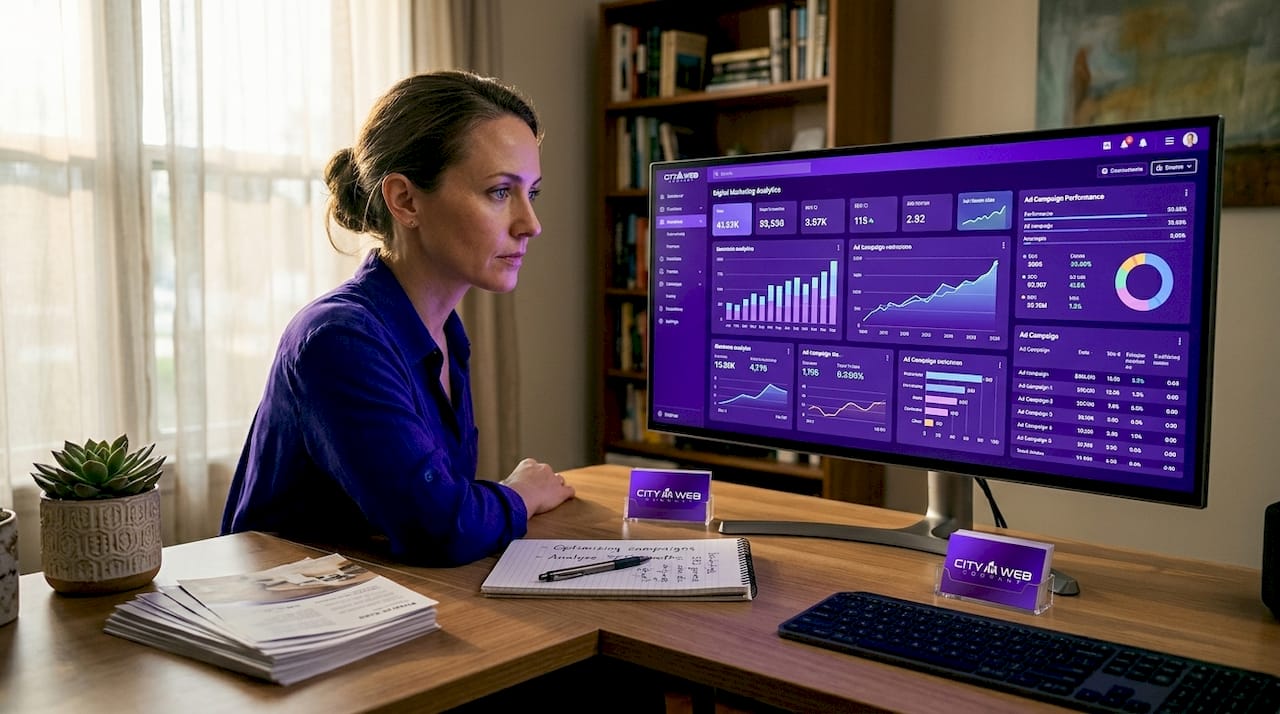
Let’s look at real benchmark numbers. Google LSAs for pest control deliver a cost per lead (CPL) of $20 to $30 for high-intent emergency services, compared to traditional PPC’s $40 to $60 range. That’s a savings of $10 to $30 per lead before you even begin optimizing. For HVAC, LSAs deliver a CPL of $50 to $100 with a return on ad spend (ROAS, meaning revenue earned per dollar spent) of 4.0x to 5.2x.
Here’s a quick comparison of average CPL and ROAS across three common service industries:
| Industry | LSA CPL | PPC CPL | Social CPL | ROAS (Digital) | ROAS (Traditional) |
|---|---|---|---|---|---|
| Pest control | $20–$30 | $40–$60 | $15–$35 | 4.0x–5.0x | 1.5x–2.0x |
| HVAC | $50–$100 | $40–$95 | $18–$60 | 4.0x–5.2x | 1.8x–2.2x |
| Landscaping | $35–$75 | $30–$80 | $20–$50 | 3.5x–4.5x | 1.5x–2.0x |
Search ads deliver a CPL of $29 to $101 across home service categories, which still beats the average cost of a direct mail campaign when you factor in design, printing, postage, and the impossibility of tracking results.
The broader industry comparison is even more striking. Digital ads consistently deliver a 5:1 ROAS versus traditional advertising’s 2:1 return. That means for every $1,000 you put into a well-run Google Ads campaign, you earn $5,000 in revenue. Put that same $1,000 into a mailer, and you’re looking at $2,000 in revenue, assuming you could even track it.
Here are a few more advantages worth calling out:
- You only pay when someone clicks or contacts you, not for impressions that never convert.
- Budgets can be paused instantly if your schedule fills up, no waste on leads you can’t service.
- You can redirect money from underperforming ads to high-converting ones the same day.
Understanding why invest in online advertising matters because it shifts your thinking from “how much does this cost?” to “what return does this generate?” That mental shift alone changes how you run your business. If you want to boost your Google Ads ROI, the starting point is always understanding what you’re spending and what it’s producing.
Armed with financial benchmarks, let’s explore the hidden strengths of online ads in real-time measurement and control.
Measurability and control: Campaigns you can actually optimize
Imagine running a TV ad and not knowing whether it brought in five calls or five hundred. That’s the reality for most traditional advertising. Online advertising is the opposite. Every impression, click, call, and form submission is recorded, timestamped, and attributed to a specific campaign.
This level of visibility lets you stop guessing and start managing. Here’s how a systematic approach to monitoring and improving ad campaigns actually works:
- Set up conversion tracking before your campaign launches. Define what counts as a lead (phone call, form fill, chat message) and attach a tracking code to each action.
- Review your dashboard weekly for cost per conversion, click-through rate (CTR), and quality score. These three numbers tell most of the story.
- Identify underperforming keywords by sorting by cost and zero conversions. Pause or adjust those terms.
- A/B test your ad copy. Run two versions of the same ad with different headlines and compare which gets more clicks and calls over two weeks.
- Scale what’s working. Once you find a keyword, ad, or time window producing cheap leads, increase that budget by 20 to 30% and monitor the results.
- Monthly review against goals. Compare CPL this month against last month and against your target. Adjust your bidding strategy if you’re overpaying.
Online ads outperform traditional in targeting, measurability, and cost-efficiency with a ROAS of 5:1 versus 2:1 for traditional channels. The reason that gap exists isn’t just technology — it’s feedback loops. When you can see what works, you improve it. Traditional advertising offers no such loop.
One of the most underused tools is call tracking. By using a unique phone number for each campaign, you can see exactly which ad generated each call. Learning how to track ROI from ads this precisely is what separates businesses that grow predictably from those that constantly wonder if their marketing is working.
Pro Tip: Use conversion tracking to see not just clicks, but real customer inquiries. A click means nothing if nobody calls. Set up call tracking and form submission goals so you’re optimizing for actual leads, not vanity metrics. Tools like a streamlined ad workflow help you manage all of this without getting buried in spreadsheets.
Now that you see the power of real-time optimization, consider how online platforms drive business during critical moments.
Urgency advantage: Capture high-intent leads when it matters most
Some service calls cannot wait. A family dealing with a wasp nest, a broken furnace in February, or a basement flooding on a Sunday morning is not comparison shopping. They are calling the first business that appears and answers.
Online ads are uniquely built to capture this urgency. When someone searches “emergency AC repair near me” at midnight, a well-configured Google LSA campaign puts your business at the very top of the results with your phone number front and center. There’s no print ad, no radio spot, and no billboard that can match that moment.
Why urgency searches convert so much better:
- The searcher has already made the buying decision. They just need a business that answers.
- Mobile searches for emergency services spike during evenings and weekends, exactly when traditional advertising can’t pivot.
- “Near me” and “same day” keywords indicate a customer who will not wait for a callback.
- Emergency leads typically carry higher average ticket values because the job needs to be done now.
Here’s the number that should stop you in your tracks: responding to a Google LSA lead within 5 minutes delivers a 100x higher conversion rate compared to waiting 30 minutes or more. That’s not a modest improvement. That is a complete transformation of your results from the exact same ad spend.
This stat comes with an important implication. Your ads are only half of the equation. The other half is your intake process. If leads hit a voicemail, you’ve lost most of them before the conversation even starts. Strong reviews and an operationally ready front desk dramatically multiply the ROI of every dollar you put into ads.
To see how this plays out in practice, check real-world online ad examples from local businesses that have built their systems around urgency capture. The pattern is always the same: fast response, consistent reviews, and ads that match what customers are actually searching.
Speed isn’t the only differentiator; let’s see how online ads can fit any growth strategy.
Flexibility and scalability: Tailor your growth plan and budget
One of the most punishing things about traditional advertising is the contract. You commit to a six-month radio buy, business slows in November, and you’re still paying for spots nobody hears. Digital advertising doesn’t work that way.
You can adjust your Google Ads budget on a Monday morning, pause it Thursday when your schedule fills, and restart it the following Monday. That kind of control is genuinely new, and it changes how local businesses plan for growth. Diversifying channels across LSAs, PPC, and SEO for compounded ROI is the smartest way to think about your digital mix.
Here’s a comparison of when each channel makes the most sense:
| Channel | Best for | Strength | Limitation |
|---|---|---|---|
| Google LSAs | Emergency/high-intent calls | Pay per lead, verified reviews | Limited service categories |
| PPC (Google Ads) | Niche and preventive services | Full keyword control | Requires active optimization |
| SEO | Long-term organic growth | Lowest long-term CAC | Takes 6 to 12 months to build |
| Social Ads | Brand awareness, seasonal offers | Visual targeting, retargeting | Lower purchase intent |
Strategic situations where you should scale up or pause your campaigns:
- Scale up before your busiest season (pre-summer for pest control, fall for HVAC heating).
- Pause or reduce when your schedule is booked 2 to 3 weeks out. No point generating leads you can’t service.
- Add new geo-targeting when you expand to a new service area. Start with a small test budget before committing.
- Increase budget after a strong review month. More reviews lift your LSA ranking, which lowers your cost per lead.
Learning the art of maximizing your local ad spend is fundamentally about matching your investment to your capacity. More spend when you can handle volume, less when you can’t. Traditional advertising simply doesn’t allow this kind of responsiveness.
Smart channel mix is vital, but what does this mean for your bottom line? Let’s examine how all these benefits add up in real-world ROI.
Real results: Proof of ROI for local service businesses
Numbers are persuasive, but case studies are convincing. Here’s what actual local service businesses are achieving with online advertising.
An HVAC company running a focused PPC campaign generated $19,500 in revenue from just $1,700 in ad spend over 90 days. That’s a 1,047% ROI. The same case study highlights 19x ROAS from PPC and 11x ROAS via LSAs. For context, a well-regarded traditional ad campaign might return 2x if you can even measure it.
“A $1,700 investment returned $19,500 in revenue in 90 days. That’s not a fluke. That’s the power of high-intent search advertising paired with a team that picks up the phone.”
SEO rounds out the long game. Long-term SEO delivers 550% to 748% ROI over time, meaning that the content and backlinks you build today compound in value month after month without paying for each click.
Lessons from local service businesses that have cracked this model:
- Start with LSAs if you’re new to digital ads. The pay-per-lead model limits your risk while you learn.
- Add PPC once you understand which services generate the highest ticket value and can justify a higher CPL.
- Invest in SEO as a parallel track, not a replacement. SEO builds your owned audience while ads buy immediate visibility.
- Track everything. Businesses that can’t tell you their CPL from last month can’t improve it.
- Reinvest profits. The businesses with the highest long-term returns treat their ad budget as a revenue multiplier, not a fixed cost.
Understanding how Google Ads delivers leads helps you go beyond blind spending and start managing it like the investment it actually is. For HVAC owners in particular, online marketing for HVAC has become the clearest path from seasonal revenue swings to year-round stability.
The evidence for online ads is clear, but true success means thinking beyond just platforms and budgets.
Perspective: How to maximize your online advertising beyond just ads
Here’s a truth most marketing agencies won’t tell you: ads don’t generate revenue. Answered phones and positive reviews generate revenue. Ads just put your phone number in front of people.
We’ve seen pest control companies spend $3,000 per month on Google Ads and generate almost nothing because their calls went to voicemail after two rings. We’ve also seen HVAC companies spend $800 per month and close nearly every lead because someone always answers, the technician is always professional, and the company follows up with a review request within 24 hours. The second company wins on a fraction of the budget.
The uncomfortable truth is that most businesses would get better returns from fixing their intake process than from doubling their ad spend. Instant response, review management, and accurate profiles are critical for LSA and PPC performance. Google’s algorithm actually rewards businesses with more reviews and faster response times with lower costs and higher placements. It’s not just good business practice. It’s a measurable competitive advantage.
Here’s what that looks like in practice. Before you increase your ad budget by a single dollar, audit these four things:
- Does someone answer your phone every time it rings during business hours?
- Do you have a system to return missed calls within 15 minutes?
- Do you ask every satisfied customer for a Google review?
- Is your Google Business Profile complete with accurate hours, service area, and photos?
If the answer to any of these is no, fix it first. Then scale your ads. The combination of great intake with strong ads is what produces those 1,000% ROI stories. Ads alone produce frustration.
Pro Tip: Audit your intake process before increasing ad budgets. A streamlined lead intake process is the multiplier that makes every ad dollar work harder.
Take your next step: Turn online advertising benefits into business growth
Knowing the benefits of online advertising is one thing. Building campaigns that actually produce leads for your specific service area, your specific services, and your specific budget is another. That’s exactly the kind of work we do at City Web Company every day.
If you’re ready to put these strategies to work, our team builds digital marketing for local leads from the ground up, including LSA setup, PPC management, and local SEO. We follow the same principles covered in this article because we’ve seen what works across pest control, HVAC, landscaping, and dozens of other service industries. You can start by reading our local service SEO guide or explore our detailed online advertising guide to understand the full picture before your first call.
Frequently asked questions
What is the cost per lead for online ads in pest control and HVAC?
Online LSAs for pest control cost $20 to $30 per lead, while HVAC LSA leads run $50 to $100, both beating traditional advertising cost structures significantly.
Which is better for local services: LSAs, PPC, or traditional ads?
Digital ads outperform traditional on targeting, measurability, and ROAS (5:1 vs 2:1), while traditional formats offer little tracking and poor efficiency for local service budgets.
How fast should I respond to leads from online ads?
Responding within five minutes can raise your conversion rate by up to 100 times compared to responding 30 minutes or more after a lead arrives.
Can online advertising help year-round or just in peak seasons?
Digital ads allow you to scale budgets up or down on demand and mix LSAs, PPC, and SEO to capture both seasonal spikes and off-season emergency leads throughout the year.
What else impacts online advertising success besides ad spend?
Instant lead response and review management are just as important as your ad budget since Google rewards fast, well-reviewed businesses with lower costs and higher ad placement.
Recommended
These articles were popular with other readers too: