

Pass Google Business verification with a video-first checklist. Film one continuous 30 second take, fix flagged issues, and know when to hire help.
Why invest in website design: boost trust and win local leads
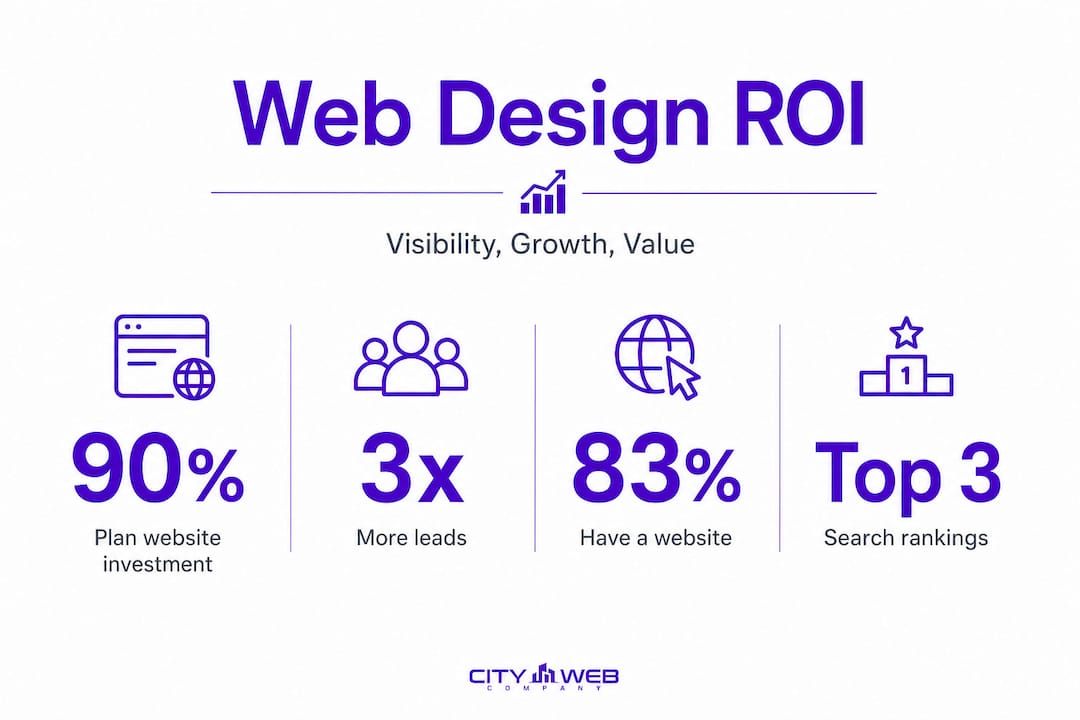
Most home service businesses still treat their website like a digital business card: something to have, not something to leverage. That thinking costs real money. The truth is that 83% of small businesses now have a website, up from just 64% in 2018, and the businesses pulling ahead are the ones treating their site as a lead-generation engine. If you run an HVAC company, a landscaping operation, or any other local service business, your website is often the single most powerful sales tool you own. This article breaks down exactly why investing in professional website design pays off, and what you can do about it starting today.
Table of Contents
Table of Contents
- Website design as a foundation for trust and credibility
- Driving customer acquisition: how design turns visits into leads
- The ROI of web design: visibility, growth, and long-term value
- Avoiding common mistakes: what most local businesses get wrong
- The reality: why local service businesses can’t afford to wait
- Ready to transform your web presence?
- Frequently asked questions
Key Takeaways
| Point | Details |
|---|---|
| Trust starts online | A credible, well-designed website instantly builds trust with potential local customers. |
| Design drives action | Strategic design choices convert more visitors into real leads or bookings. |
| Strong ROI | Investing in your website pays off through improved visibility, ongoing growth, and staying ahead of local competition. |
| Avoid costly mistakes | Outdated, cluttered, or hard-to-navigate websites can lose you business and credibility. |
Website design as a foundation for trust and credibility
Before a potential customer ever calls your number or submits a contact form, they judge you. Not on your years of experience, not on how good your work actually is, but on how your website looks and feels in the first few seconds they spend on it. That snap judgment happens faster than most people realize. Studies on first impressions online consistently show that users form opinions about a website within milliseconds of landing on it. For home service businesses, that moment is critical because the customer is inviting you into their home. The bar for trust is genuinely higher than it is for most other industries.

Think about what a potential customer goes through. They search “roof repair near me” or “best plumber in [city],” and they land on your site. If it looks outdated, loads slowly, or has confusing navigation, they hit the back button. They don’t give you a second chance. That click goes to your competitor. This is why website design for trust is not a luxury feature reserved for big brands. It is a baseline requirement for any local business that wants to compete online.
Websites strongly correlate with credibility, visibility, and customer acquisition goals, according to research on small business web presence. Credibility is not just about having a fancy logo or attractive photos. It’s about the signals your site sends to a visitor. Those signals include:
- A clean, organized layout that makes it easy to find what matters most: your services, your service area, and how to contact you
- Consistent branding including your logo, colors, and tone of voice throughout every page
- Visible contact information on every page, especially your phone number and local address
- Real photos of your work, your team, or your equipment rather than generic stock images
- Customer reviews and testimonials placed where visitors naturally look for social proof
- Trust badges and licenses that confirm you are a legitimate, insured business operating in your area
“Your website is your handshake before the handshake. If it’s weak, most customers won’t stick around long enough to learn how good you actually are at your trade.”
The good news is that making your website trustworthy does not require a complete overhaul every year. Once the foundational design elements are in place and aligned with your brand, those trust signals work for you around the clock. Every visitor who finds your site at 11 PM looking for emergency HVAC repair encounters the same professional presentation as someone browsing on a Tuesday afternoon.
Driving customer acquisition: how design turns visits into leads
A beautiful website that nobody converts on is just an expensive online brochure. The real payoff from professional web design comes when design choices actively guide visitors toward taking action. That means calling you, filling out a quote form, or scheduling a service online. This is where the difference between a templated DIY site and a professionally designed website becomes most visible, and most measurable.
39% of small businesses cite increasing sales and revenue as a primary motivation for investing in their website. That number makes complete sense when you map out how a visitor becomes a customer.
Here is how the path typically looks for a home service business:
- The search: A homeowner types in a problem or service they need. Your site appears in search results because it is optimized for local queries.
- The landing: They click through and land on your homepage or a service page. Within three seconds, they see what you do, where you operate, and how to reach you.
- The trust check: They scan for reviews, credentials, photos of real work, and signs that you are a local business and not a national chain or fly-by-night operation.
- The call to action: A clear, visible button or form invites them to “Get a Free Quote,” “Call Now,” or “Schedule Today.” The fewer steps required, the better.
- The conversion: They fill out the form or tap to call. You have a new lead.
Each step in that path can either be supported or undermined by design decisions. A cluttered homepage breaks step two. Missing trust signals break step three. A buried or confusing contact form breaks step four. Professional website design and website optimization work together to ensure each step flows naturally into the next.
Comparing website types for lead generation:
| Feature | DIY or template site | Professionally designed site |
|---|---|---|
| Mobile responsiveness | Inconsistent | Built-in and tested |
| Page load speed | Often slow | Optimized for performance |
| Call-to-action placement | Generic or missing | Strategic and conversion-focused |
| Local SEO structure | Minimal | Structured for local search |
| Custom trust signals | Limited | Testimonials, badges, real photos |
| Quote form functionality | Basic or absent | Tailored to your service workflow |
DIY website builders have made it easier than ever to put something online, but easier is not the same as effective. A template gives you a starting point. A professionally designed site gives you a system built around how your specific customers make decisions.
Pro Tip: Add a click-to-call button that is permanently visible on mobile screens. Home service customers searching on their phones are often ready to book immediately. Making your number one tap away can dramatically increase your call volume without any other changes to your marketing budget.
Learning how to approach growing your business online means understanding that design and conversion go hand in hand. You cannot separate the look of your site from how well it performs. Every font choice, button color, image placement, and page structure either helps or hurts your ability to turn a visitor into a paying customer.
The ROI of web design: visibility, growth, and long-term value
Let’s talk about money. Because at the end of the day, every dollar you put into your website needs to come back to you multiplied. The return on investment from professional web design is not always immediate, but it is real, measurable, and compounding over time.
The first layer of ROI is visibility. A well-designed website is not just a destination. It is a signal to search engines like Google that your business is legitimate, local, and relevant to the searches your potential customers are making. Search engines reward sites that load fast, work well on mobile, are easy to navigate, and contain well-structured content. All of those factors are design and development decisions. A poorly built site can actually suppress your rankings, pushing you below competitors who have invested in their web presence.

How website design investment impacts local business performance:
| Business outcome | Impact of poor design | Impact of strong design |
|---|---|---|
| Search ranking | Lower visibility in local results | Higher placement in local search |
| Bounce rate | Visitors leave quickly | Visitors explore and convert |
| Lead volume | Fewer inquiries per 100 visitors | More inquiries per 100 visitors |
| Customer trust | Skepticism and hesitation | Confidence and faster decisions |
| Repeat business | Lower retention | Higher brand recall and loyalty |
The second layer of ROI is growth. When your site converts better, you get more leads from the same amount of traffic. That means every dollar you spend on Google Ads, social media ads, or local SEO goes further because the site those visitors land on is built to turn them into customers. A weak site bleeds ad spend. A strong site amplifies it.
The third and most underappreciated layer is sustained value. A professionally designed website is not an expense you absorb once and forget. It is a long-term asset. Over time, as your site builds domain authority, accumulates local SEO equity, and collects positive user behavior signals, it becomes more valuable. Your ranking improves, your cost per lead drops, and your competitive position strengthens. Following an optimization guide for local businesses helps you maintain and grow that value consistently.
It is worth noting that 90% of small businesses plan to invest in their website over the next 12 months. That statistic tells you something important: your competitors are already moving. The businesses in your area that currently rank below you on Google will not stay there if they invest in better design and better SEO while you stand still.
Pro Tip: Track your website’s lead conversion rate, meaning what percentage of visitors actually contact you. Even modest improvements to that number through better design can produce significant revenue gains. If 1,000 people visit your site monthly and 2% contact you, that’s 20 leads. Improve conversion to 4% and you double your leads with no increase in ad spend. Understanding SEO for small business alongside good design gives you both more traffic and a better rate of converting that traffic.
Avoiding common mistakes: what most local businesses get wrong
Even businesses that invest in a website often make the same predictable errors that undermine their results. Understanding these mistakes helps you avoid wasting money and time on a site that looks decent but fails to perform.
Many small businesses focus on credibility and revenue when improving their web presence, yet still fall into design traps that directly contradict those goals. Here are the most common ones:
-
Cluttered or outdated design: When a homepage tries to say everything at once, it ends up communicating nothing. Cluttered layouts with too many fonts, colors, and competing messages create cognitive overload. Visitors cannot figure out where to look or what to do. Similarly, a site that looks like it was built years ago signals to visitors that your business might be equally out of date.
-
No mobile optimization: This is the single most damaging mistake a local service business can make in 2026. More than half of all web searches happen on mobile devices, and for urgent home service needs like a burst pipe or a broken furnace, the vast majority happen on phones. A site that does not adapt to mobile screens becomes nearly unusable on the device your customers are most likely using. Text becomes tiny, buttons become impossible to tap, and forms become frustrating to fill out. Most visitors leave without converting.
-
Generic or missing contact information: Your business serves a specific geographic area. Your website needs to make that crystal clear. A generic contact page with just an email form and no phone number, no address, and no mention of your service area tells local customers nothing they need to know. It also signals to search engines that your business may not be truly local, which hurts your rankings in map results and local packs.
-
No social proof on the right pages: Reviews and testimonials are most effective when they appear on the pages where customers are making decisions, not just on a dedicated testimonials page nobody visits. Placing a few strong reviews on your homepage, your service pages, and your contact page can meaningfully increase the number of visitors who take action.
-
Slow page loading speeds: Design is not only visual. A site with large uncompressed images, bloated code, or cheap hosting loads slowly, and slow sites lose visitors fast. Google uses page speed as a ranking signal, so slow sites also rank lower.
Pro Tip: Run your website through Google’s PageSpeed Insights tool. It gives you a free, detailed breakdown of what is slowing your site down and how to fix it. Fixing even two or three of the top issues can meaningfully improve both your load time and your search ranking.
Following a step by step website optimization process helps you address these problems systematically rather than guessing at what to fix first. The order in which you tackle improvements matters, and starting with mobile optimization and page speed typically produces the fastest visible gains.
The reality: why local service businesses can’t afford to wait
Here is a perspective we share based on watching local home service businesses succeed and struggle over years of working in this space: the biggest mistake is not having a bad website. It is believing that a bad website does not matter because referrals are working fine.
Referrals are real, and they are valuable. We are not dismissing them. But here is what happens to referral-based businesses when they neglect their website. A satisfied customer refers your business to their neighbor. That neighbor, before they ever call you, searches your name online. They land on an outdated, hard-to-navigate site with no reviews, no clear contact information, and photos that look like they were taken in 2010. They start to wonder. They search again and find a competitor who looks more professional online. That competitor gets the call. You lost a warm, referred lead because your website failed the final trust check.
Online discovery has quietly overtaken word-of-mouth as the primary way customers find home service businesses in most markets. People still ask neighbors and friends for recommendations, but even those recommendations almost always lead to an online search before a call is made. Your website is now part of the referral conversation whether you like it or not.
The competitive advantage of acting now is real and measurable. Local search results have limited space. The top few positions in Google Maps and organic search capture the overwhelming majority of clicks. Every month you delay a website upgrade is a month your better-designed competitors spend building the search authority that earns those positions. The gap widens, and catching up becomes harder.
We have seen businesses in competitive local markets turn things around dramatically by committing to why website design matters and acting on it. The businesses that treat their website as a living, strategic asset, not a set-and-forget task, are the ones consistently generating leads and growing their customer base year over year.
Waiting for a better time is a strategy that consistently benefits your competitors, not you.
Ready to transform your web presence?
If this article has clarified what a professionally designed website can do for your home service business, the next step is getting specific about what your own site needs.
At City Web Company, we work exclusively with local and regional service businesses to build websites that generate real leads, not just online presence for its own sake. Our website design services are built around the trust signals, conversion elements, and local SEO structure that home service customers respond to. Whether you need a full rebuild or targeted improvements for driving local leads, we tailor the approach to your market and your goals. Explore the full range of our digital marketing services and see how we help businesses like yours compete and win online.
Frequently asked questions
How much should local home service businesses invest in website design?
Investing in a professionally designed website typically starts from a few thousand dollars, but the long-term return comes through increased trust and lead generation, since websites correlate directly with credibility and customer acquisition.
Do most small businesses already have a website?
Yes. 83% of small businesses have a website today, and 90% plan to invest further in their online presence over the next 12 months, meaning competition for local visibility is only increasing.
What is the return on investment for upgrading a business website?
An upgraded website drives higher search visibility, stronger customer trust, and more inquiries, because websites directly correlate with credibility and customer acquisition goals for small businesses.
Why is mobile-friendly design essential today?
More than half of all web searches now happen on mobile devices, and a site that does not adapt to smaller screens pushes away potential customers before they ever reach your contact information.
Which website features convert the most leads in the home services industry?
Clear call-to-action buttons, simple quote forms, and visible click-to-call phone numbers are the highest-impact features for turning home service website visitors into actual customer inquiries.
Recommended
These articles were popular with other readers too: