

Pass Google Business verification with a video-first checklist. Film one continuous 30 second take, fix flagged issues, and know when to hire help.
Website Optimization: Boosting Local Business Growth
Finding new clients often starts online. For American HVAC and plumbing business owners, the challenge is making your website easy to find and easy to use. When emergency calls are at stake, a well-optimized site can mean the difference between getting the job or losing a lead. Website optimization blends technical fixes, content updates, and user experience improvements so your services stand out where people search. This article clarifies the main strategies, helping you capture high-intent customers and steady growth.
Table of Contents
Table of Contents
- Defining Website Optimization And Its Role
- Types Of Website Optimization Strategies
- Key Elements: Seo, Speed, And Usability
- Common Challenges And Mistakes To Avoid
- Measuring Success And Ongoing Improvement
Key Takeaways
| Point | Details |
|---|---|
| Website Optimization is Essential | Ensuring your website is optimized increases visibility, attracts qualified leads, and drives conversions for local service businesses. |
| Focus on Local SEO | Local SEO strategies help capture demand for services in specific geographical areas, crucial for businesses like HVAC and plumbing. |
| Continuous Improvement is Key | Website optimization should be an ongoing process, with regular monitoring and modifications based on performance data to sustain lead generation. |
| Balancing Speed, Usability, and SEO | A well-optimized website blends search engine optimization, fast loading speeds, and excellent user experience to convert visitors into customers. |
Defining Website Optimization and Its Role
Website optimization means making your site faster, more visible, and easier for both search engines and customers to use. For local service businesses like HVAC and plumbing companies, this is where leads originate online.
Website optimization encompasses technical improvements, content strategy, and user experience enhancements that work together to increase your visibility in search results and drive qualified traffic to your site.
Think of your website like a storefront. A pretty display window means nothing if customers can’t find your location. The same applies online. Website positioning through search engine optimization ensures potential clients discover your business when searching for services in your area.
Why This Matters for Your Service Business
Local service companies depend on immediate customer action. When someone needs emergency plumbing at midnight, they search for “24-hour plumber near me,” not browse local directories. Website optimization ensures you appear in those critical moments when customers actively need your services.
Optimization directly affects revenue because it:
- Increases organic traffic from Google without paying per click
- Attracts high-intent customers already searching for your specific services
- Builds trust through professional website design and content
- Improves mobile experience where most local searches happen
- Generates consistent leads even outside business hours
The Core Components
Website optimization combines three essential areas. First, technical optimization includes site speed, mobile responsiveness, security, and code structure that search engines evaluate. Second, content strategy involves keyword research, service descriptions, and information that answers customer questions. Third, user experience focuses on navigation, clear calls-to-action, and conversion paths that turn visitors into customers.
Measures to improve webpage visibility and ranking balance between making content discoverable and avoiding manipulative tactics. Legitimate optimization improves both search visibility and genuine customer value.
How It Connects to Business Growth
Optimization isn’t just about rankings. Rankings are the vehicle. What matters is that homeowners searching for HVAC repair find you, trust your website, and call your number. A well-optimized site captures demand that already exists in your market.
Many local businesses invest thousands in advertising while neglecting organic search potential. Your website optimization builds a foundation that generates leads consistently, year after year, with minimal ongoing cost compared to paid ads.
Website optimization is your foundation for sustainable local growth because it reaches customers actively searching for your services with high buying intent.
Pro tip: Start by identifying the exact phrases your customers search for (“emergency AC repair near me” or “commercial plumbing services”) and ensure your website clearly addresses those specific needs throughout your pages.
Types of Website Optimization Strategies
Website optimization isn’t one single tactic. It’s a combination of strategies working together to improve visibility, drive traffic, and convert visitors into customers. Understanding each type helps you prioritize where to focus your effort and budget.
Multiple SEO approaches address different aspects of your website and online presence. Some focus on the content and structure of your site itself, while others build authority and trust through external signals.
On-Page Optimization
On-page optimization means improving the elements you control directly on your website. This includes keyword placement in titles, headings, and content that matches what customers search for.
On-page tactics include:
- Writing service descriptions that answer customer questions
- Optimizing page titles and meta descriptions for search results
- Using headers and formatting that help both users and search engines understand content
- Improving page load speed and mobile responsiveness
- Creating clear calls-to-action that drive phone calls or appointment requests
For a plumbing company, on-page optimization means your “emergency water heater repair” page contains those exact words naturally throughout the content, not hidden in code.
Technical Optimization
Technical SEO focuses on the backend infrastructure that search engines evaluate when crawling your site. A well-built website technically tells search engines it’s trustworthy and authoritative.
Technical elements matter because they:
- Allow search engines to crawl and index all your pages effectively
- Ensure your site loads quickly on mobile devices
- Provide secure connections that protect customer data
- Create clear navigation structures that help visitors find information
Think of technical optimization as building a solid foundation. Without it, even great content struggles to rank.
Local SEO Optimization
Local SEO targets customers searching for services in specific geographic areas. For HVAC and plumbing businesses, this is often where qualified leads originate.
Local optimization includes:
- Claiming and optimizing your Google Business Profile
- Building citations in local directories
- Getting reviews from satisfied customers
- Using location-specific keywords on your website
- Creating service area pages that target surrounding neighborhoods
When someone searches “24-hour emergency plumber in Charlotte,” local SEO determines whether your business appears.
Off-Page Optimization
Off-page optimization involves building authority and trust outside your website. Backlinks from reputable sites signal to search engines that your business is credible.
Quality backlink building and external authority development require consistency and legitimacy. Industry directories, community partnerships, and earned media mentions build genuine authority that improves rankings.
Which Strategy Do You Need?
Most service businesses benefit from all three approaches working together. Local SEO forms your foundation because that’s where customers search. On-page optimization ensures your pages rank for the right keywords. Technical optimization supports everything else by providing a fast, functional website.
Here’s a summary table comparing website optimization strategies and their main business impact:
| Strategy Type | Main Focus | Impact on Business | Example Benefit |
|---|---|---|---|
| On-Page Optimization | Content and site structure | Improves search rankings | More qualified website traffic |
| Technical Optimization | Site speed and backend efficiency | Enhances site reliability | Lower bounce rate, higher trust |
| Local SEO | Geographic targeting | Attracts nearby customers | Increased local leads |
| Off-Page Optimization | Building external authority | Boosts credibility | Higher search visibility |
Effective website optimization combines on-page, technical, and local strategies because each addresses different parts of how search engines evaluate and rank your business.
Pro tip: Start with local SEO and on-page optimization for your most popular services, then layer in technical improvements and backlink building as you have resources available.
Key Elements: SEO, Speed, and Usability
Three core elements determine whether your website attracts customers and converts them into paying clients: search engine optimization, loading speed, and user experience. These work together, not separately.
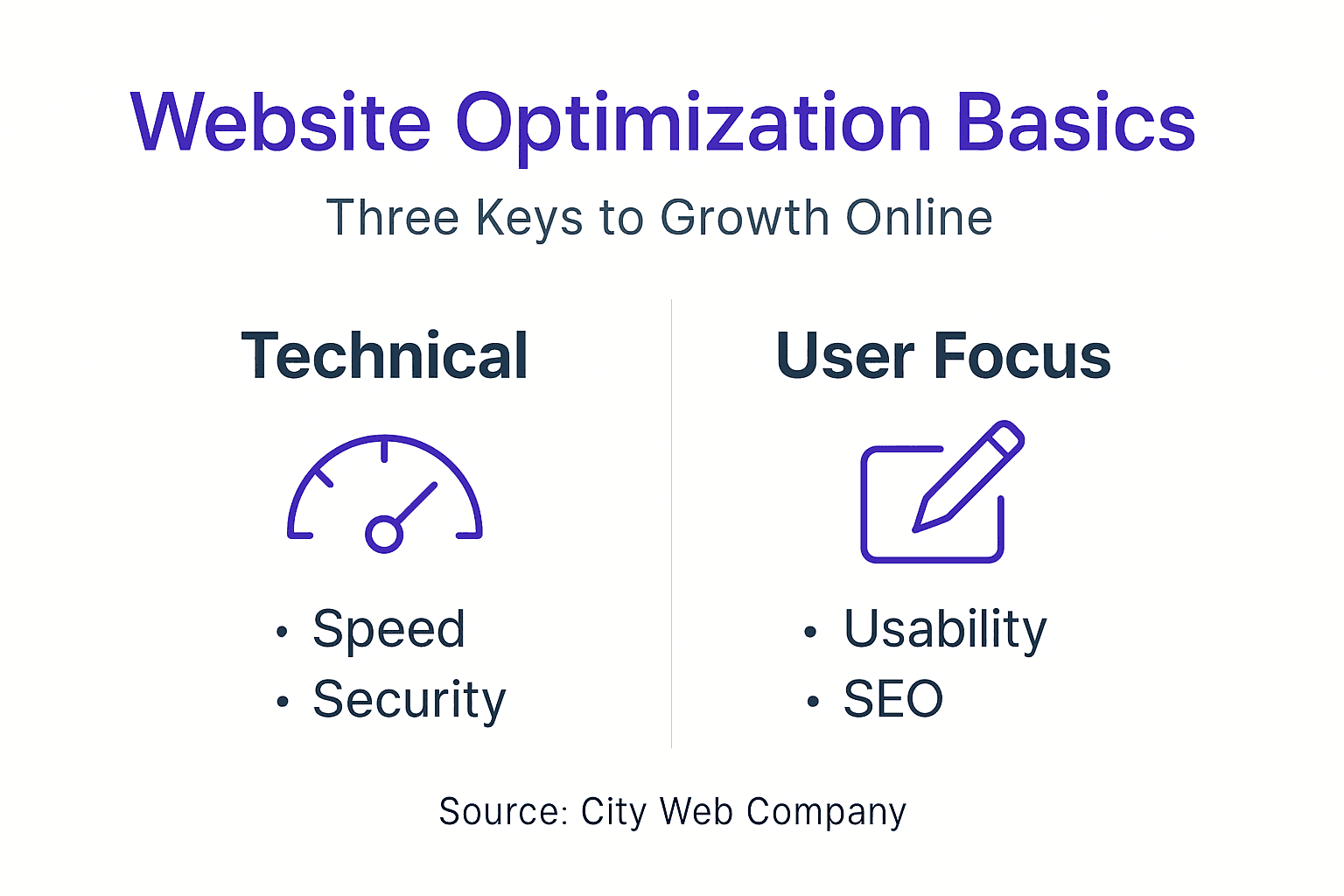

Ignore any one of these three, and your website struggles. Build all three well, and your site becomes a lead-generating machine for your service business.
SEO: Making Your Site Discoverable
Search engine optimization ensures customers searching for your services actually find you. Without SEO, even a beautiful website sits invisible in search results.
SEO requires attention to three areas:
- Technical structure that helps Google crawl and index your pages
- Relevant content written for the keywords customers search
- Authority built through backlinks and local citations
For an HVAC company, SEO means your website ranks when someone searches “emergency heating repair near me” in your service area. That visibility directly generates leads.
Speed: The Performance Factor
Website speed affects both users and search rankings. A fast-loading site keeps visitors engaged. A slow site sends them to your competitors.
Google measures page load speed as a ranking factor. More importantly, studies show that every second of delay costs you conversions. A plumber’s website that loads in two seconds gets more calls than one taking five seconds.
Speed matters because:
- Mobile users expect pages to load in under three seconds
- Slow sites frustrate visitors and increase bounce rates
- Google penalizes slow websites in search rankings
- Fast sites improve conversion rates by 10 to 40 percent
You can’t ignore this metric if you want to compete locally.
Usability: User Experience Design
Usability means your website works smoothly for visitors. Clear navigation, readable text, obvious calls-to-action, and mobile responsiveness create an experience that converts.
Mobile responsiveness and easy navigation enhance user engagement and directly improve SEO outcomes. When visitors find what they need quickly, they stay longer, engage more, and take action.
Good usability includes:
- Mobile-first design that works perfectly on phones
- Clear service descriptions and pricing information
- Easy-to-find contact buttons and appointment scheduling
- Fast load times on all devices
- Readable fonts and logical page structure
Think about your customer’s perspective. They search for your service on their phone while sitting at home. They need to understand what you offer, trust that you’re legitimate, and contact you immediately. Your website must make this easy.
How These Three Work Together
Technical optimization for crawling, content relevance, and link management combine with speed and usability to create a complete optimization strategy. None stands alone.
SEO gets people to your site. Speed keeps them there. Usability converts them into customers.
The strongest websites balance SEO visibility with fast load times and intuitive design because all three directly impact your ability to generate qualified leads.
Pro tip: Test your website speed right now using Google PageSpeed Insights, then prioritize fixing issues that affect mobile users, since that’s where most local service searches happen.
Common Challenges and Mistakes to Avoid
Most local service businesses make the same website optimization mistakes. Understanding these pitfalls helps you avoid years of lost leads and wasted effort.
Many business owners treat website optimization as a one-time project rather than an ongoing process. They build a site, launch it, then ignore it for years. This approach costs you visibility and revenue.
Neglecting Mobile Optimization
Mobile neglect is the biggest mistake. More than 70 percent of local searches happen on mobile devices. If your website doesn’t work smoothly on phones, you lose customers before they even call.
Mobile mistakes include:
- Slow loading times on cellular networks
- Text that’s too small to read without zooming
- Buttons and links that are difficult to tap
- Forms requiring too much typing
- Unresponsive design that breaks on different screen sizes
Your HVAC customers search for emergency service at 2 AM on their phones. Your site must work perfectly on mobile or you lose that call.
Ignoring Site Speed Issues
Slow websites bleed customers. Website performance challenges including load time optimization directly impact user experience and business outcomes.
You might not realize your site loads slowly because your office internet is fast. Your customers on 4G networks experience frustrating delays that cause them to leave.
Speed problems stem from:
- Large uncompressed images
- Outdated hosting that can’t handle traffic
- Too many plugins and tracking scripts
- Unoptimized video content
- Poor code structure that bogs down pages
Test your actual site speed using free tools. Don’t guess.
Writing for Search Engines, Not Customers
Keyword stuffing kills conversions. Some businesses pack so many keywords into their content that it reads like robot gibberish. Customers won’t trust you, and Google penalizes obvious manipulation.
Your content must satisfy both humans and search algorithms. Write naturally about your services while including relevant keywords. Answer the questions your customers actually ask.
Poor Call-to-Action Strategy
Visitors won’t contact you unless you make it obvious. Buried phone numbers, unclear contact buttons, and missing appointment scheduling links cost you leads every day.
Your strongest pages need:
- Visible phone number in the header
- Click-to-call buttons on mobile
- Easy appointment scheduling
- Clear service descriptions
- Multiple contact options
Outdated Design and Information
Old-looking websites destroy credibility. If your site looks like it was built in 2010, customers assume your business is outdated too. People judge your professionalism in seconds.
Also update service descriptions, pricing, and testimonials regularly. Outdated information damages trust.
The costliest mistake is treating your website as finished rather than continuously improving it based on how customers interact with it.
Pro tip: Ask three customers this week: “Did you look at our website before calling?” Their feedback reveals exactly which pages need improvement and which problems cost you business.
Measuring Success and Ongoing Improvement
Website optimization only works if you measure what’s actually happening. Without data, you’re making decisions based on guesses rather than facts.
Many business owners check their website traffic once a year, if at all. This approach means you miss opportunities to improve and optimize continuously.
Define Your Success Metrics First
Before you optimize, know what success looks like. Clear website goals aligned with business objectives drive effective measurement and sustainable growth.
For local service businesses, success metrics typically include:
- Number of phone calls generated from the website
- Online appointment bookings completed
- Website traffic from local searches
- Click-through rates from search results
- Customer inquiries from specific service pages
- Cost per lead compared to advertising spend
Pick metrics directly connected to revenue. Phone calls matter. Page views don’t.
Key Performance Indicators to Track
KPIs tell you whether your optimization efforts are working. Start tracking these immediately.
Critical KPIs for service businesses include:
- Organic traffic (visitors from Google search)
- Mobile traffic percentage (should be 60 percent or higher)
- Bounce rate (visitors who leave without taking action)
- Conversion rate (visitors who call or request service)
- Average time on site (indicates engagement)
- Top performing pages (which services drive interest)
Web performance metrics like load time and response time directly impact user experience and business outcomes. Slower pages lose customers.
To help monitor ongoing website success, here’s a reference table of key performance indicators (KPIs) and what they reveal:
| KPI | What It Measures | Why It Matters |
|---|---|---|
| Organic traffic | Visitors via Google/search | Indicates SEO effectiveness |
| Mobile traffic percentage | Visits from mobile devices | Reveals mobile optimization |
| Conversion rate | Actions per visitor | Shows lead generation |
| Bounce rate | Visitors who leave quickly | Points to usability issues |
| Average time on site | Visitor engagement level | Indicates content relevance |
Regular Monitoring and Analysis
Check your data weekly, not yearly. Use Google Analytics (free) to see how customers interact with your site.
Set up automated reports that arrive in your inbox every week. You’ll spot trends quickly and catch problems before they cost you leads. When you notice a drop in phone calls, investigate immediately.
Monitor these patterns:
- Which pages send the most qualified visitors
- Where visitors leave without contacting you
- Which keywords bring the best customers
- How mobile users behave differently than desktop users
Continuous Improvement Through Testing
Small changes compound into major results. Test one element at a time so you know what actually works.
Test these elements:
- Call-to-action button color and placement
- Page headlines and descriptions
- Phone number visibility and prominence
- Form fields (fewer fields = more submissions)
- Service page layouts
Make one change, measure for two weeks, then evaluate results. A 10 percent improvement in conversion rate on your highest-traffic page doubles your leads without increasing ad spend.
The Ongoing Optimization Cycle
Website optimization never stops. Your competitors are improving constantly, and customer behavior changes seasonally.
Follow this monthly process:
- Review the past month’s data
- Identify pages with low performance
- Test one improvement
- Measure results
- Keep what works, discard what doesn’t
Successful websites aren’t built once and forgotten; they’re continuously refined based on real customer behavior and measurable results.
Pro tip: Set a calendar reminder for the first Monday of each month to review your analytics; spending just 30 minutes examining data reveals which improvements will generate the most leads.
Unlock Your Local Business Potential with Expert Website Optimization
If you recognize the challenges of improving your website’s discoverability, speed, and usability from the article, you are not alone. Local service businesses often struggle with attracting high-intent customers and converting their site visitors into valuable leads. Key pain points like the need for fast mobile loading, clear calls-to-action, and effective local SEO demand a strategic and continuous approach rather than a one-time fix.
At City Web Company, we specialize in tailored digital marketing strategies that address exactly these critical issues. By combining proven techniques from our Digital Marketing Strategy Guides | City Web Company and the latest insights from our Web Design & Development Insights | City Web Company, we help your business stand out in local search results while providing a fast and user-friendly website experience.

Don’t let slow load times, weak local presence, or poor user experience cost you another customer. Take action today with a partnership dedicated to growing your leads and revenue. Visit City Web Company Contact to connect with our experts and start turning your website into a 24/7 lead-generating machine.
Frequently Asked Questions
What is website optimization?
Website optimization involves enhancing your site to make it faster, more visible on search engines, and easier for customers to use. This helps local service businesses attract more qualified leads online.
Why is website optimization important for local businesses?
Website optimization is crucial for local businesses as it ensures they appear in relevant search results when potential customers are actively looking for their services. It maximizes visibility and helps generate leads at critical moments.
What are the core components of website optimization?
The core components of website optimization include technical optimization, content strategy, and user experience enhancements. These work together to improve a website’s visibility in search results and conversion rates.
How can local SEO help my business?
Local SEO focuses on targeting customers searching for services in specific geographic areas. It helps your business rank for location-based searches, increasing your chances of attracting nearby customers and generating leads.
Recommended
These articles were popular with other readers too: