

Pass Google Business verification with a video-first checklist. Film one continuous 30 second take, fix flagged issues, and know when to hire help.
Role of SEO in Small Business Success
Every local service business owner wants more customers calling, booking, or walking through the door. With so many choices appearing in Google results, standing out in your city can feel impossible. Search engine optimization (SEO) helps level the playing field by earning your place at the top of search results where high-intent customers are looking for services like yours. This guide explains what SEO really means for small businesses and shows how it drives steady, qualified leads you can count on.
Table of Contents
Table of Contents
- Defining SEO for Small Businesses
- Types of SEO: Local, On-Page, and Off-Page
- How SEO Drives Customer Acquisition
- Common Pitfalls in Small Business SEO
- Measuring SEO ROI and Growth
Key Takeaways
| Point | Details |
|---|---|
| SEO is Essential for Small Businesses | It helps improve local visibility and connect with customers actively searching for services. |
| Focus on Local SEO | Prioritize optimizing your Google Business Profile and targeting location-specific keywords. |
| Integrate On-Page and Off-Page SEO | Enhance website content and build external authority through backlinks to improve rankings. |
| Measure and Track SEO Success | Use tools like Google Analytics to monitor organic traffic and conversions for better ROI assessment. |
Defining SEO for Small Businesses
Search engine optimization (SEO) is the practice of improving your website so it ranks higher in search results when potential customers look for your services. For local service businesses, SEO means getting found by people actively searching for what you offer, right in your area.
Think of SEO like this: if someone searches “plumber near me” or “dental cleaning in [your city],” SEO ensures your business appears at the top of those results instead of buried on page five. SEO helps search engines discover and rank your content based on relevance and quality, which directly impacts how many customers find you online.
Unlike paid ads that disappear when you stop paying, SEO builds long-term visibility. You’re not renting space on search results. You’re earning it.
How SEO Works for Small Businesses
Search engines use three core processes to determine what shows up in results:
- Crawling: Search engine bots visit your website and follow links to understand what content you have
- Indexing: Those bots catalog your pages in Google’s database so they can be retrieved later
- Ranking: When someone searches, the engine ranks your pages based on relevance, authority, and user experience signals
Your job is to make each of these steps easier for search engines while providing value to customers.
Why Small Businesses Need SEO
Local service businesses compete against larger brands with bigger advertising budgets. SEO levels the playing field. A well-optimized website can rank above national competitors in local search results because SEO enables search engines to surface relevant, local content efficiently to users searching in your specific area.
Here’s what SEO delivers for service businesses:
- Organic traffic from high-intent searches (people actively looking for your service)
- Credibility through visible rankings and customer reviews
- Local discovery that drives foot traffic and phone calls
- Cost savings compared to ongoing paid advertising
- Long-term visibility that compounds over time
SEO for small service businesses is about connecting with customers who are actively searching for exactly what you offer, right now, in your area.
SEO vs. Other Marketing Channels
Paid ads deliver immediate visibility but stop working the moment you stop paying. Social media reaches existing followers, not necessarily new customers. SEO builds sustainable visibility that continues generating leads months and years after the initial optimization work.
For service businesses with tight budgets, this matters. You need marketing that works consistently and compounds.
Pro tip: Start with keyword research specific to your service area. Find what local customers actually search for (“emergency AC repair” instead of just “air conditioning”), then build your website content around those real search terms.
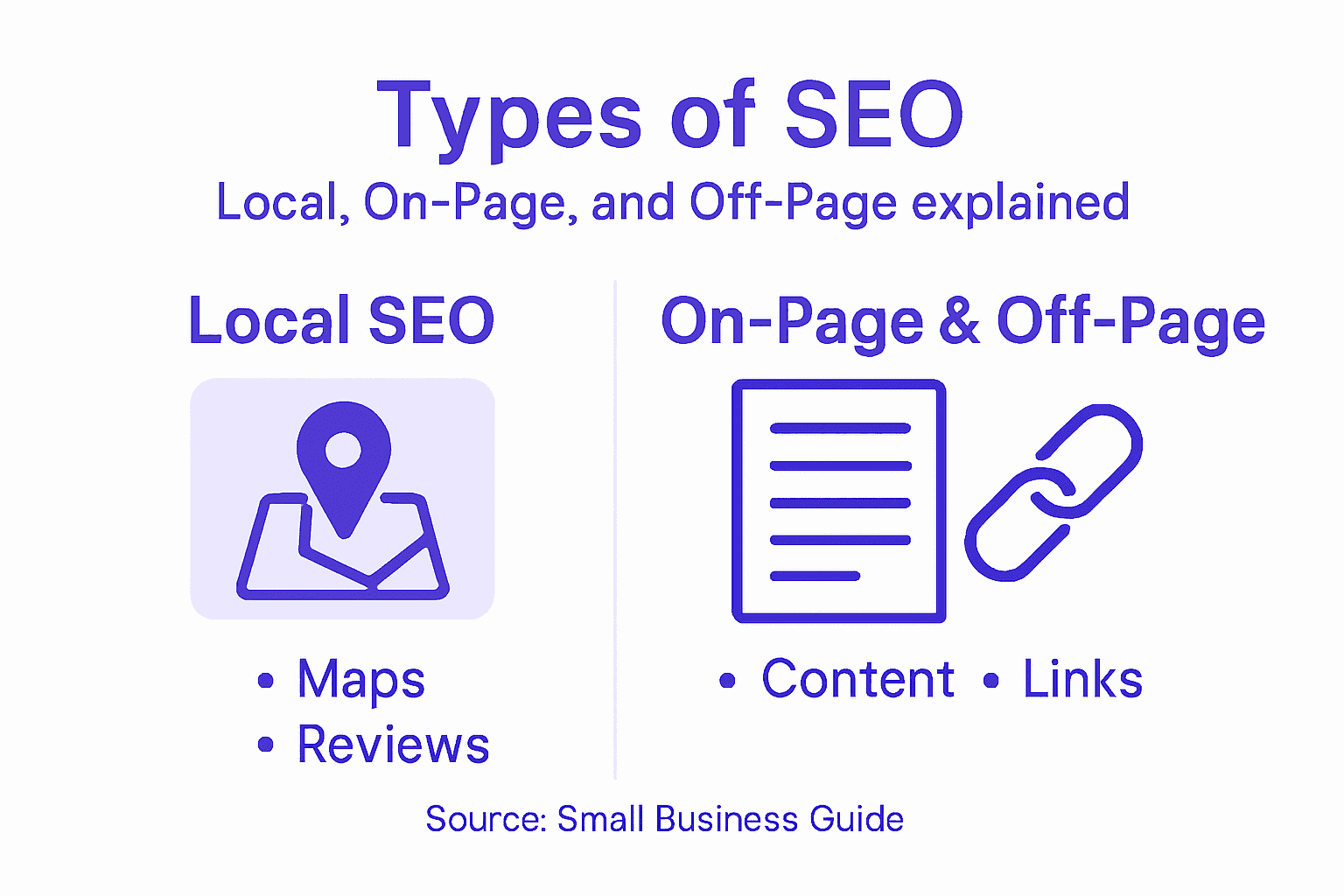
Types of SEO: Local, On-Page, and Off-Page
SEO isn’t one-size-fits-all. Different tactics target different ranking factors. Understanding the three main types helps you build a complete strategy that actually works for your service business.
The main SEO types address different mechanisms to improve your visibility: local SEO targets customers in your geographic area, on-page SEO optimizes your website content and structure, and off-page SEO builds your authority through external signals like backlinks and reviews.

Each type plays a specific role. Skip one and you’re leaving customers on the table.
Here’s a side-by-side comparison of the main SEO types for small businesses:
| SEO Type | What It Targets | Control Level | Typical Impact |
|---|---|---|---|
| Local SEO | Geographic-based queries | High (profiles, citations) | Increases local visibility |
| On-Page SEO | Website content and structure | High (content, titles) | Boosts relevance and user experience |
| Off-Page SEO | External reputation and links | Moderate (influences, not direct control) | Builds authority and trust |
Local SEO for Service Businesses
Local SEO is your primary focus as a service business. It ensures customers in your area find you when they search for your services.
Local SEO includes:
- Google Business Profile optimization with accurate address, phone, hours, and service areas
- Local citations on directories like Yelp, Home Advisor, and industry-specific sites
- Customer reviews and ratings that build trust and improve rankings
- Location-specific content that targets “near me” searches
- Local backlinks from community organizations or local media
A plumber in Chicago needs to rank for “plumbing services in Chicago,” not just “plumbing.” Local SEO makes that happen.
On-Page SEO: Content and Structure
On-page SEO is what you control directly on your website. It involves optimizing your content, headings, images, and page structure so search engines understand what your pages are about.
Key on-page elements include:
- Relevant keywords naturally integrated into page titles, headings, and body content
- Clear, descriptive meta descriptions that appear in search results
- Internal links connecting related service pages and information
- Fast page load speeds and mobile-friendly design
- Proper heading hierarchy that organizes content logically
When someone searches “roof repair near me,” your roof repair page needs to clearly communicate that’s what you offer.
Off-Page SEO: Authority and Reputation
Off-page SEO happens outside your website. It’s primarily about building authority and reputation through mentions, backlinks, and social signals.
Off-page tactics include:
- Backlinks from reputable websites in your industry
- Local business citations and directory listings
- Customer reviews and testimonials
- Social media mentions and shares
- Brand mentions on news sites or industry publications
When other trusted websites link to yours or mention your business, search engines view you as more credible. This directly impacts rankings.
The three SEO types work together. Local SEO gets customers searching in your area, on-page SEO makes your site relevant to their search, and off-page SEO signals that you’re trustworthy enough to rank.
Which Type Should You Focus On First?
For local service businesses, prioritize in this order:
- Local SEO first (this is where your customers search)
- On-page SEO second (make your website clear and optimized)
- Off-page SEO third (build authority over time)
All three matter, but local SEO delivers the fastest results for service businesses.
Pro tip: Start by claiming and fully optimizing your Google Business Profile with complete information, recent photos, and regular posts. This single action often produces noticeable results within weeks for local searches.
How SEO Drives Customer Acquisition
SEO doesn’t just improve rankings. It directly fills your sales pipeline by connecting you with customers actively searching for your services. This is fundamentally different from other marketing channels that hope to catch someone’s attention.
When someone searches “emergency plumber near me” or “dental implants in [city],” they’ve already decided they need your service. SEO optimizes your website to attract these high-intent customers, making your business the visible solution at the exact moment they’re ready to hire.
That timing advantage is what makes SEO so effective for customer acquisition.
The Customer Journey and SEO
Potential customers don’t arrive randomly. They follow a predictable path that SEO directly influences.
- Awareness stage: Someone realizes they need your service and searches for solutions
- Consideration stage: They compare options by reading reviews, visiting websites, and gathering information
- Decision stage: They choose which business to hire based on trust, credibility, and convenience
SEO positions you at every stage. Better rankings mean you’re visible during the awareness phase, your optimized content builds trust during consideration, and your local SEO listings make you easy to contact during the decision phase.
Why SEO Leads Are More Valuable
Not all customers are equal. SEO builds brand authority and drives long-term customer acquisition by aligning with what people are actively searching for, making these leads inherently different from cold prospects.
SEO-generated customers come with advantages:
- High purchase intent: They searched for your service, not the other way around
- Lower acquisition cost: No pay-per-click fees; organic traffic is essentially free after initial optimization
- Ongoing results: Customers continue finding you months and years after the work is done
- Trusted source: People view organic search results as more credible than ads
- Qualified leads: They’re looking for exactly what you offer in your area
Compare this to paid ads where you pay for every click, whether they convert or not.
Converting SEO Traffic Into Customers
Ranking for keywords doesn’t guarantee sales. The visitor experience matters just as much.
Once someone lands on your website from a search result, they need a reason to call or request a quote:
- Clear information about your services and expertise
- Proof of your credibility through reviews, testimonials, or case studies
- Easy ways to contact you (phone number, contact form, booking system)
- Fast page load speeds so they don’t get frustrated and leave
- Mobile-friendly design since most local searches happen on phones
SEO brings qualified customers to your door, but your website and service quality keep them there and convert them into paying clients.
Long-Term Customer Acquisition
Paid advertising stops working the moment you stop paying. SEO compounds over time. Every optimized page, positive review, and backlink builds your authority permanently.
A service business that invests in SEO today will acquire customers for years without ongoing ad spend. The customer acquisition cost decreases the longer you maintain your SEO effort.
Pro tip: Focus SEO efforts on service pages that directly match customer search intent. A page titled “Furnace Repair Services” ranked for “furnace repair near me” will generate far more qualified leads than a generic homepage targeting the same keyword.
Common Pitfalls in Small Business SEO
Many small business owners jump into SEO without a plan, then wonder why their rankings don’t improve. These mistakes are preventable. Understanding what goes wrong helps you avoid wasting time and money on tactics that don’t work.
The difference between success and failure in SEO often comes down to avoiding these foundational errors. Small businesses frequently overlook keyword research, neglect internal linking, fail to optimize images and metadata, and skip local SEO strategies entirely, all of which reduce search visibility and hinder growth.
Let’s walk through the most common pitfalls so you don’t repeat them.
Pitfall 1: No Keyword Research Strategy
Keyword research is the foundation of SEO. Without it, you’re guessing what customers search for.
Many small businesses optimize their websites for terms that sound right but nobody actually searches. A pest control company might write about “pest elimination services” when local customers search “exterminator near me.” The ranking effort produces zero traffic.
Invest time understanding:
- What exact phrases your target customers use
- Monthly search volume for those terms
- Competition level for each keyword
- Geographic variations in your area
Free tools like Google Keyword Planner and Ubersuggest provide solid starting points.
Pitfall 2: Ignoring Local SEO
For service businesses, local SEO matters more than national rankings. Yet many owners focus exclusively on generic terms.
Your Google Business Profile is critical infrastructure. An incomplete or poorly optimized profile means:
- Customers can’t find your hours or phone number
- Reviews pile up without your responses
- You appear less credible than competitors
- “Near me” searches skip you entirely
Claim your profile. Fill every field. Update it regularly. This single step produces measurable results.
Pitfall 3: Weak or Missing Internal Linking
Internal links connect your pages and help search engines understand your site structure. They also distribute authority across your website.
Skipping internal linking means:
- Each page competes independently instead of supporting each other
- Customers can’t find related services easily
- Search engines take longer to crawl your content
Link your service pages to relevant blog posts. Link from your homepage to your best-performing pages. Simple connections improve results significantly.
Pitfall 4: Not Tracking Results
You can’t improve what you don’t measure. Many small businesses make SEO changes but never check if they worked.
Set up Google Analytics and Google Search Console immediately. Monitor:
- Which pages rank for which keywords
- How much organic traffic you receive
- Click-through rates from search results
- Customer behavior on your website
Without this data, you’re working blind.
The costliest SEO mistake isn’t making errors. It’s not knowing you made them because you never measured results.
Pitfall 5: Expecting Overnight Results
SEO takes time. New websites typically need three to six months to see meaningful results. Established businesses may see improvements faster, but patience is still required.
Business owners who expect immediate results often abandon SEO too early. They switch tactics constantly, never giving any strategy time to work.
SEO compounds. The longer you maintain consistent effort, the better your results become.
Pro tip: Start with a single high-value keyword that matches your primary service and location. Optimize one strong page for that keyword, gather reviews, and build one solid ranking. Success on one keyword builds momentum and teaches you what works before scaling.
Measuring SEO ROI and Growth
You can’t manage what you don’t measure. Many business owners invest in SEO but never calculate whether it’s actually paying off. Without clear metrics, you’re essentially flying blind.
SEO ROI measures the revenue generated by SEO activities versus the costs invested, helping you link your optimization efforts directly to financial performance. This isn’t theoretical. It’s about knowing exactly how much money SEO brings in.
Let’s cover the metrics that matter.
The Core SEO ROI Formula
SEO ROI is straightforward math: (Revenue from SEO minus SEO costs) divided by SEO costs, then multiplied by 100 for a percentage.
Example: If you spent $2,000 on SEO and generated $10,000 in revenue from organic search, your ROI is 400 percent.
The challenge is identifying which revenue actually came from SEO versus other channels. This requires proper tracking from the start.
Key Metrics to Track
You need data to calculate ROI accurately. Start monitoring these metrics immediately:
- Organic traffic: Visitors coming from search results (tracked in Google Analytics)
- Keyword rankings: Positions for your target keywords in search results
- Click-through rate: Percentage of people clicking your link from search results
- Conversion rate: Percentage of visitors who call, submit forms, or book appointments
- Revenue attributed to organic: Total customer value from organic search traffic
Google Analytics 4 makes this easier. Set up conversion tracking so you can connect organic visitors to actual business outcomes.
For reference, here are core metrics to monitor when measuring SEO ROI:
| Metric | What It Measures | Why It Matters |
|---|---|---|
| Organic Traffic | Visitors from search engines | Indicates reach growth |
| Keyword Rankings | Position in search results | Tracks progress for keywords |
| Conversion Rate | Actions taken by visitors | Shows lead generation |
| Revenue from SEO | Sales attributed to organic | Reveals financial impact |
Multi-Touch Attribution
Customers rarely convert on their first visit. Effective SEO ROI measurement considers multiple KPIs and realistic multi-touch attribution models that recognize customers may search multiple times before deciding.
A customer might search “plumber near me,” find you, then search again two weeks later before calling. Both searches matter. Both contributed to the conversion.
Google Analytics tracks this through assisted conversions. A page gets credit as an assist even if another channel closes the sale.
Timeline Expectations
SEO ROI compounds over time. Most businesses see positive ROI within 6 to 12 months, but early months often show costs outweighing revenue.
This is normal. You’re building authority and rankings that generate leads for years. Calculate long-term ROI, not just first-month results.
A service business that achieves 150 percent ROI in year two typically hits 300 to 500 percent by year three as rankings solidify and organic traffic compounds.
Revenue Attribution Models
Three approaches to assigning revenue to SEO:
- Last-click attribution: Credit goes to the final touchpoint before conversion (simplest but incomplete)
- First-click attribution: Credit goes to the first search that brought someone to your site
- Multi-touch attribution: Distributes credit across all touchpoints proportionally (most accurate)
Google Analytics 4 supports all three. Use multi-touch for the most realistic picture of SEO’s contribution.
What Success Looks Like
For local service businesses, realistic year-one goals include:
- 30 to 50 percent increase in organic traffic
- 15 to 20 new high-intent customers from organic search
- Positive ROI after six months
- 5 to 10 keywords ranking on the first page
These numbers vary by industry and competition level. Heating and cooling services might see faster results than competitive legal services.
Pro tip: Set up Google Analytics conversion goals for phone calls, form submissions, and online bookings before you start SEO. You cannot measure ROI accurately without knowing which actions customers take after finding you through search.
Unlock Your Small Business Potential with Expert SEO and Analytics
Struggling to turn website visits into real customers is one of the biggest challenges for small businesses focused on local service markets. This article highlights how mastering SEO fundamentals like local optimization and conversion tracking is key to connecting with high-intent customers and building sustained revenue. If you want to move beyond guesswork and attract qualified leads consistently, implementing proven digital marketing strategies is critical. Explore practical strategies on Analytics & Conversion Tracking Tips | City Web Company to learn how data can transform your SEO efforts into measurable growth.

Ready to put these insights into action today and see your search rankings convert into paying customers? City Web Company specializes in tailored SEO, local marketing, and paid media management designed specifically for service-based industries. Our team helps you build authority, optimize your presence, and use powerful tools like AI-supported chatbots to enhance customer engagement. Don’t wait until your competitors take the lead. Contact us now at https://citywebcompany.com/contact and start growing your business with strategies proven to deliver results.
Frequently Asked Questions
How does SEO help small businesses?
SEO improves a small business’s visibility in search engine results, ensuring potential customers can find their services when actively searching online. This leads to increased organic traffic and higher credibility.
What are the main types of SEO that small businesses should focus on?
Small businesses should focus on three main types of SEO: Local SEO for geographic-based searches, On-Page SEO to optimize website content and structure, and Off-Page SEO to build authority through backlinks and reviews.
Why is local SEO particularly important for service businesses?
Local SEO is crucial for service businesses because it targets customers who are searching for services in their immediate geographic area, ensuring they are visible when potential clients perform location-specific searches.
What are common mistakes small businesses make in their SEO strategy?
Common mistakes include neglecting keyword research, ignoring local SEO optimizations, failing to implement internal linking, not tracking SEO results, and expecting immediate results rather than giving efforts time to yield outcomes.
Recommended
- SEO Services for Small Businesses: A Complete Starter Guide – City Web Company | Digital Marketing Agency
- Why Invest in SEO: Growth for Local Service Businesses
- Local SEO Services for Small Businesses: Drive More Traffic – City Web Company | Digital Marketing Agency
- Local SEO Secrets Every Small Business Must Know Now – City Web Company | Digital Marketing Agency
These articles were popular with other readers too: