

Use website DNI, connect call reports to Google Ads and your Google Business Profile, then tie calls to booked jobs. City Web Company can handle setup.
Search Rankings: 46% of U.S. Searches Are Local in 2026
Google attributes nearly 46% of all searches in the U.S. to local intent, making your local search ranking position critical for customer discovery. If potential clients can’t find your business in those first few search results, you’re losing leads to competitors every single day. This guide reveals the ranking factors that matter most, clears up common misconceptions, and shows you exactly how to improve your visibility in growing leads with local search optimization for 2026.
Table of Contents
Table of Contents
- Introduction To Search Engine Rankings For Local Businesses
- Key Ranking Factors For Local Service Businesses
- Common Misconceptions About Search Engine Rankings
- Comparison Of Ranking Factors And Framework
- Timeline And Expectations For Ranking Improvements
- Practical Application And Case Studies
- How City Web Company Can Boost Your Local Search Rankings
- Frequently Asked Questions
Key Takeaways
| Point | Details |
|---|---|
| Local search dominance | Nearly half of U.S. searches target local businesses, making rankings essential for customer acquisition. |
| Top ranking factors | Proximity accounts for 27%, content relevance 18%, and online reputation 15% of local ranking influence. |
| Timeline expectations | SEO improvements typically require 3 to 6 months before visible ranking gains appear. |
| Ranking versus conversion | High rankings drive traffic, but user experience and website quality determine actual lead conversion. |
| Balanced SEO approach | On-page optimization (55%) and off-page signals (45%) work together for sustained ranking success. |
Introduction to Search Engine Rankings for Local Businesses
Local search rankings determine whether potential customers find your business or scroll past to a competitor. When someone searches for a plumber, lawyer, or contractor near them, search engines prioritize businesses that match their location and needs. Understanding how these rankings work gives you a competitive edge in capturing local leads.
The numbers tell a compelling story. Google attributes nearly 46% of all searches in the U.S. to local intent, meaning nearly half of all search activity focuses on finding nearby services. Even more striking, the top three local pack results capture approximately 75% of clicks, concentrating customer attention on businesses that rank highest. Your position in these results directly impacts how many potential customers visit your website or call your business.
Local rankings influence both the map pack that appears at the top of search results and the organic listings below it. Common search formats include “near me” queries and city-specific searches like “dentist in Austin” or “roofing contractor Dallas.” Each format presents an opportunity to connect with customers actively seeking your services right now.
Here’s what local search rankings control:
- Visibility in Google’s local three-pack map results
- Position in organic search listings for location-based queries
- Likelihood customers will click through to your website
- Volume of phone calls and direction requests from search
- Competitive advantage over nearby service providers
Higher rankings translate directly into increased traffic and customer engagement. When you appear in those top positions, you’re meeting customers at the exact moment they need your services. Boosting local leads fast becomes achievable when you understand and optimize for the factors that move your business up in search results. The Moz local search ranking data provides ongoing insights into how search engines evaluate and rank local businesses.
Key Ranking Factors for Local Service Businesses
Search engines evaluate local businesses using three primary signals, each carrying different weight in determining your position. Understanding these factors helps you allocate your SEO efforts effectively and avoid wasting time on tactics that deliver minimal impact.
Proximity influences 27% of local ranking signals, making physical location your most powerful ranking factor. When someone searches for a service, Google prioritizes businesses closest to their current location or the area they specify in their search. You can’t change your business address, but you can optimize how search engines understand and display your location through accurate business listings and location-specific content.
Relevance accounts for 18% of ranking influence and measures how well your business matches what the searcher needs. Search engines analyze your website content, business categories, services listed, and keywords to determine relevance. A plumber who clearly lists emergency services, pipe repair, and water heater installation ranks higher for those specific queries than a general contractor with vague service descriptions.

Prominence contributes 15% of ranking weight and reflects your business’s reputation and authority online. Search engines evaluate the quantity and quality of your reviews, the strength of your citation profile across directories, and the backlinks pointing to your website. Businesses with consistent positive reviews and mentions across the web signal trustworthiness to both search engines and potential customers.
The balance between on-page and off-page factors shapes your overall SEO strategy:
| Factor Type | Components | Influence Weight | Optimization Effort |
|---|---|---|---|
| On-Page SEO | Website content, local keywords, Google Business Profile optimization, site structure | Approximately 55% | High initial effort, moderate maintenance |
| Off-Page SEO | Backlinks, local citations, online reviews, social signals, brand mentions | Approximately 45% | Ongoing relationship building and reputation management |
Balanced strategies combining on-page and off-page tactics yield the best results because search engines look for consistency across all signals. A perfectly optimized website with no reviews or citations won’t rank as well as a good website with strong community presence and positive reputation.
Pro Tip: Review and update your Google Business Profile categories and service descriptions quarterly to maintain relevance as search algorithms evolve and customer search patterns shift.
Focus your efforts on building content that answers specific customer questions while simultaneously developing your online reputation through reviews and citations. The local service business ranking guide explores these factors in greater depth, and detailed ranking factors from Moz provides annual updates on how these weights shift over time.
Common Misconceptions About Search Engine Rankings
Several persistent myths about search rankings lead local businesses to waste resources on ineffective tactics or harbor unrealistic expectations. Clearing up these misconceptions helps you focus on strategies that actually move the needle.
Ranking first doesn’t guarantee business success if your website provides a poor user experience. A top ranking position drives traffic to your site, but slow loading times, confusing navigation, or missing contact information sends potential customers back to search results to try your competitors. Conversion happens on your website, not in the search results.
Many business owners expect immediate results from SEO efforts, but search engines need time to discover, evaluate, and trust changes you make. It typically takes 3 to 6 months to see meaningful ranking improvements after implementing SEO changes. Quick ranking jumps usually indicate low competition rather than exceptional optimization.
Common ranking misconceptions to avoid:
- Backlinks alone will fix poor rankings (local SEO depends heavily on proximity, relevance signals, and engagement metrics)
- Keyword stuffing improves rankings (search engines penalize over-optimization and reward natural, helpful content)
- Paid advertising directly boosts organic rankings (ads increase visibility but don’t influence organic search positions)
- More content always equals better rankings (quality and relevance matter more than quantity)
- SEO is a one-time project (ongoing optimization and adaptation are essential for sustained success)
- Ranking for generic terms is more valuable than specific local queries (local service keywords convert better)
The relationship between paid ads and organic rankings particularly confuses many business owners. Running Google Ads campaigns increases your overall visibility and can drive immediate traffic, but clicks on paid ads don’t send positive signals to organic ranking algorithms. The two channels operate independently, though both contribute to overall business growth.
Pro Tip: Track your conversion rate and lead quality alongside rankings because moving from position five to position three means nothing if those visitors don’t become customers.
Understanding why invest in SEO requires looking beyond simple ranking positions to the complete customer journey. Focus on building a sustainable presence that combines good rankings with excellent user experience and clear calls to action that convert visitors into leads.
Comparison of Ranking Factors and Framework
Breaking down local SEO into on-page versus off-page components helps you understand where to invest time and resources for maximum ranking impact. Each approach contributes differently to your overall search visibility and requires distinct skill sets and ongoing attention.
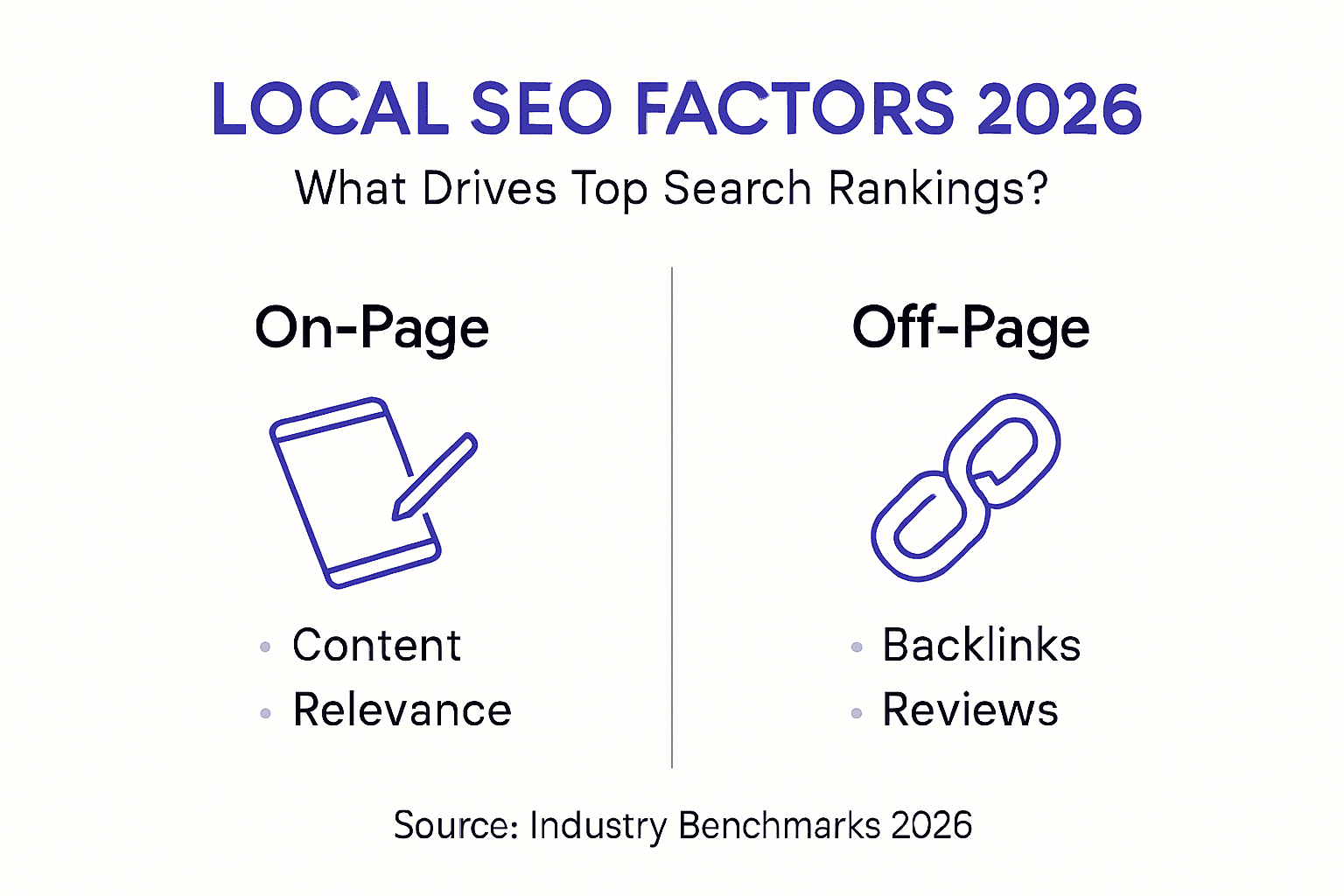

On-page SEO encompasses everything you control directly on your website and business profiles. This includes optimizing your site content with relevant local keywords, structuring pages for easy navigation, ensuring fast load times, and maintaining an accurate, complete Google Business Profile. These factors account for approximately 55% of ranking influence because they directly signal relevance to search engines.
Off-page SEO covers signals from external sources that validate your business’s authority and reputation. Backlinks from other reputable websites, consistent citations across online directories, customer reviews on multiple platforms, and social media engagement all contribute to search engines’ trust in your business. These elements make up roughly 45% of ranking weight and require ongoing relationship building and reputation management.
| SEO Type | Key Elements | Primary Benefit | Typical Effort Required |
|---|---|---|---|
| On-Page | Website content, meta tags, local keywords, site speed, Google Business Profile | Direct control over relevance signals | High initial setup, moderate ongoing updates |
| Off-Page | Backlinks, local citations, reviews, directory listings, social mentions | Builds authority and trust signals | Continuous outreach and reputation management |
The Local SEO Impact Cycle demonstrates how these factors interact:
- Proximity determines which businesses appear for location-based searches
- Relevance filters results to match specific service needs
- Prominence elevates businesses with stronger reputations and authority
- Engagement metrics confirm which businesses searchers find most helpful
Advantages and considerations for each approach:
- On-page SEO delivers faster initial improvements because you control the changes directly
- Off-page SEO builds lasting authority that’s harder for competitors to replicate
- On-page optimization requires technical knowledge or professional help
- Off-page success depends on consistent effort over months and years
- Combined strategies create compounding benefits as signals reinforce each other
A balanced approach maximizes both immediate visibility gains and long-term ranking sustainability. Start with thorough on-page optimization to establish your relevance foundation, then build off-page authority through strategic citation building, review generation, and community engagement. Neither approach alone delivers optimal results.
Local SEO explained provides detailed implementation guidance for both on-page and off-page strategies tailored specifically for service businesses competing in local markets.
Timeline and Expectations for Ranking Improvements
Understanding SEO timelines prevents frustration and helps you maintain consistent efforts long enough to see results. Search engines need time to crawl your changes, evaluate their impact, and adjust rankings accordingly. Expecting overnight success leads to premature strategy changes that sabotage long-term progress.
It typically takes 3 to 6 months to see meaningful local search ranking improvements after implementing SEO changes. This timeline varies based on your market’s competition intensity, the current state of your online presence, and how consistently you execute optimization tactics. Highly competitive markets with established players require longer timelines, while businesses in smaller markets might see faster movement.
Several factors influence how quickly rankings improve. Starting from zero with no website history or citations takes longer than improving an existing but underoptimized presence. The frequency and quality of your optimization efforts matter more than occasional big pushes. Search engines reward consistent, sustained improvement over sporadic activity.
Most local businesses see initial ranking movement within 60 to 90 days, with substantial improvements materializing between months four and six. Patience during this period separates businesses that succeed from those that abandon effective strategies too early.
Maintain SEO momentum with these ongoing actions:
- Publish fresh, locally relevant content monthly to signal active business presence
- Request reviews from satisfied customers consistently, not just during campaigns
- Monitor rankings weekly to identify trends and respond to algorithm changes
- Update business information across all platforms when services or details change
- Build new citations and backlinks continuously rather than in isolated bursts
- Analyze competitor strategies to identify new opportunities and threats
SEO operates as an iterative process requiring regular monitoring and adjustment. Rankings fluctuate as search engines test new algorithms, competitors improve their presence, and customer search patterns evolve. What works today might need refinement next quarter, making ongoing attention essential.
The typical SEO timelines from Ahrefs provides industry benchmark data showing that businesses maintaining consistent SEO efforts for 12 months see significantly better results than those pursuing short-term campaigns. Local SEO tips for lead generation offers specific tactics you can implement immediately while building toward long-term ranking success.
Practical Application and Case Studies
Real-world examples demonstrate how local businesses translate ranking improvements into tangible business growth. These case studies illustrate the strategies discussed earlier and show the direct connection between better search positions and increased customer acquisition.
One service business client improved their local map pack ranking from position seven to position two over five months, resulting in a 40% increase in inbound phone calls. The improvement came from a combination of Google Business Profile optimization, targeted local content creation, and systematic review generation. Google Business Profile optimization can increase visibility by 20% and lead to substantial jumps in customer contact when paired with other ranking factors.
The optimization process focused on three key areas. First, the business completely rewrote their profile description to include specific services, coverage areas, and customer benefits. Second, they published weekly posts to their profile highlighting completed projects and seasonal tips. Third, they implemented a review request system that generated 15 to 20 new reviews monthly, building prominence signals search engines trust.
Another client in a competitive metropolitan market saw their organic search traffic double after six months of consistent citation building and content optimization. They started with only 12 directory listings and expanded to 45 high-quality citations while simultaneously publishing neighborhood-specific service pages. The combination of broader citation coverage and hyper-local content helped them compete against established competitors with larger budgets.
Actionable steps you can implement immediately:
- Audit your current Google Business Profile for completeness and accuracy
- Identify your top five service offerings and create dedicated landing pages for each
- Research where competitors have citations and claim those same listings
- Implement a review request process as part of your customer follow-up
- Create content answering the most common questions customers ask
- Monitor your rankings monthly and adjust tactics based on what moves the needle
Pro Tip: Review velocity matters more than total review count, so generate new reviews consistently rather than in occasional bursts that look suspicious to search algorithms.
The iterative nature of SEO becomes clear in these examples. Neither business achieved results from a single tactic or one-time effort. Instead, they built momentum through consistent execution across multiple ranking factors, adjusting their approach based on what produced the strongest results in their specific market.
Local SEO services for small businesses can accelerate this process by applying proven strategies tailored to your industry and market. The SEO case studies from Search Engine Journal showcases additional examples across various service industries, demonstrating consistent principles that work regardless of your specific business type.
How City Web Company Can Boost Your Local Search Rankings
Understanding local search rankings is valuable, but implementing comprehensive optimization requires expertise and consistent execution. City Web Company specializes in local SEO services for small businesses across the U.S., helping service businesses climb search rankings and capture more local leads.
We handle the complete local SEO process from initial audit through ongoing optimization.

Our team optimizes your Google Business Profile, builds authoritative citations across relevant directories, creates locally-focused content that ranks, and implements review generation systems that build your online reputation. We understand the ranking factors discussed in this guide and apply them strategically based on your specific market conditions and competition.
Partner with an experienced digital marketing agency for small business growth that delivers measurable results. Our Google Business Profile optimization services focus on the factors that drive rankings while our ongoing monitoring ensures your visibility continues improving as search algorithms evolve. We accelerate the timeline from months to weeks by applying concentrated expertise and proven strategies that align perfectly with the principles covered throughout this guide.
Frequently Asked Questions
What is the most important factor in local search rankings?
Proximity to the searcher carries the most weight, accounting for approximately 27% of local ranking influence. Your physical location relative to where someone searches or the area they specify matters more than any other single factor. Relevance through optimized content and prominence from reviews and citations follow as secondary but still significant ranking signals.
How long does it take to see results from local SEO improvements?
SEO improvements generally take between 3 to 6 months to show measurable ranking progress. Markets with lower competition might see faster movement, while highly competitive areas require longer sustained effort. Consistency in applying optimization tactics significantly impacts how quickly results appear, with businesses maintaining regular efforts seeing better outcomes than those pursuing sporadic campaigns. The SEO timeline article provides detailed benchmarks across different industries and competition levels.
Can paid ads improve my organic search rankings?
Paid advertising operates independently from organic search rankings and doesn’t directly influence your position in unpaid results. Running Google Ads or social media campaigns increases overall visibility and can drive immediate traffic, but clicks on paid ads don’t send positive signals to organic ranking algorithms. However, increased brand awareness from ads can lead to more direct searches for your business name, which indirectly supports your overall online presence.
Do I need to optimize for mobile search specifically?
Search engines now use mobile-first indexing, meaning they primarily evaluate your website based on its mobile version when determining rankings. Your site must load quickly, display properly, and provide easy navigation on smartphones and tablets. Since most local searches happen on mobile devices, poor mobile experience directly hurts both your rankings and your ability to convert visitors into customers even when you do rank well.
How many reviews do I need to rank well locally?
Review quantity matters less than review velocity and overall rating consistency. Generating 3 to 5 new reviews monthly signals active customer engagement more effectively than having 200 old reviews with nothing recent. Maintain an average rating above 4.0 stars while focusing on steady review growth rather than chasing an arbitrary number. Quality reviews that mention specific services and locations provide more ranking value than generic praise.
Recommended
These articles were popular with other readers too: