

Use website DNI, connect call reports to Google Ads and your Google Business Profile, then tie calls to booked jobs. City Web Company can handle setup.
Why Invest in SEO: Growth for Local Service Businesses
Running a small plumbing business in Texas or a law firm in Florida brings daily challenges, but gaining attention online should not be one of them. Standing out against larger competitors requires more than just a website, especially when potential clients rely on search engines like Google to find trusted local experts. Effective search engine optimization strategies can transform your online presence into a steady source of qualified leads by increasing both your visibility and credibility.
Table of Contents
Table of Contents
- What SEO Means for Service Businesses
- SEO Types and Strategies in 2026
- How SEO Drives Qualified Leads and Trust
- Comparing SEO to Paid Advertising
- Costs, Risks, and Common SEO Pitfalls
Key Takeaways
| Point | Details |
|---|---|
| Importance of SEO | SEO is crucial for service businesses to enhance online visibility and compete effectively against larger competitors. |
| Local Search Focus | Emphasizing local targeting in SEO strategies connects businesses with nearby potential customers. |
| Trust and Credibility | Consistent presence in top search results builds trust with prospects, turning visitors into leads. |
| Long-Term Investment | SEO requires ongoing investment and strategy adaptation for sustained growth and online visibility. |
What SEO Means for Service Businesses
Search engine optimization (SEO) represents a strategic approach to increasing online visibility for local service businesses by improving their website’s ability to rank higher in search results. Search engine optimization techniques help smaller businesses compete effectively against larger competitors by attracting potential customers actively searching for specific services.
For service-based businesses like plumbers, lawyers, electricians, and home repair specialists, SEO means creating a targeted digital strategy that connects them directly with local customers. The core objective is transforming websites from passive online brochures into dynamic lead generation platforms that appear prominently when potential clients search for relevant services.
SEO involves several critical components that service businesses must understand:
- Website Content Optimization: Creating informative, keyword-rich content that answers customer questions
- Local Search Targeting: Focusing on geographically specific search terms
- Technical Website Performance: Ensuring fast loading speeds and mobile responsiveness
- Google Business Profile Management: Maintaining accurate business listings and collecting customer reviews
By implementing strategic SEO practices, service businesses can achieve significant advantages:
- Increased organic website traffic
- Higher credibility and trust with potential customers
- Cost-effective marketing compared to traditional advertising
- Better targeting of ideal local customer demographics
Search engines like Google prioritize websites that demonstrate expertise, authority, and relevance in their specific service categories. This means service businesses must consistently produce high-quality content, maintain accurate online information, and provide clear signals about their professional capabilities.
Here’s a summary of how core SEO components impact service businesses:
| SEO Component | Function | Impact on Service Business |
|---|---|---|
| Website Content | Attracts relevant visitors | Increases lead generation potential |
| Local Search Targeting | Reaches customers nearby | Improves local client base growth |
| Technical Performance | Improves site usability | Boosts engagement and retention |
| Business Profile Management | Builds online reputation | Raises trust with prospects |
Pro tip: Invest at least 2-3 hours weekly in updating your website content and monitoring your local search rankings to stay competitive in your service market.
SEO Types and Strategies in 2026
As digital marketing continues to evolve, service businesses must adapt to increasingly sophisticated search engine optimization approaches. SEO strategies are transforming to incorporate advanced technologies and more nuanced targeting techniques that go far beyond traditional keyword optimization.
In 2026, SEO encompasses multiple specialized disciplines designed to help businesses improve their online visibility and attract targeted customers. The primary SEO types businesses should focus on include:
- On-Page SEO: Creating semantically rich, deeply informative content that answers specific user queries
- Off-Page SEO: Building authoritative external references and digital reputation
- Technical SEO: Ensuring website infrastructure supports optimal search engine crawling and indexing
- Local SEO: Targeting geographically specific search results for service-based businesses
- AI-Driven SEO: Optimizing content for intelligent search algorithms and personalized results
The emergence of AI-powered search environments is fundamentally reshaping SEO strategies. Businesses must now focus on creating comprehensive content ecosystems that demonstrate expertise, maintain topical authority, and provide personalized user experiences. This means developing content that not only includes relevant keywords but also addresses complex user intent and provides substantive, contextually rich information.
Successful SEO in 2026 requires a holistic approach that integrates multiple optimization techniques. Businesses must balance technical performance, content quality, user experience, and strategic keyword targeting to achieve meaningful search engine visibility.
Pro tip: Invest in creating a comprehensive content strategy that addresses multiple SEO dimensions, focusing on depth of information and genuine user value rather than superficial optimization techniques.
How SEO Drives Qualified Leads and Trust
Search engine optimization fundamentally transforms how local service businesses attract and convert potential customers. SEO improves lead generation by increasing website visibility for targeted, high-intent search queries, creating a direct pathway between service providers and customers seeking specific solutions.
The lead generation process through SEO involves several strategic mechanisms that build credibility and trust:
- Targeted Keyword Optimization: Connecting directly with users searching for specific services
- Content Relevance: Demonstrating expertise through informative, solution-oriented content
- Search Result Positioning: Building perceived authority through higher search rankings
- User Experience Signals: Improving website performance and engagement metrics
Qualified leads emerge when businesses strategically align their online presence with user search intent. This means creating content that not only ranks well but also directly addresses potential customers’ specific needs, pain points, and questions. The more precisely a website matches user expectations, the higher the likelihood of converting search traffic into genuine business opportunities.

Trust is a critical byproduct of effective SEO. When businesses consistently appear in top search results, provide valuable information, and maintain a professional online presence, potential customers perceive them as credible and reliable. This perception transforms passive website visitors into engaged prospects who are more likely to request services or make contact.
Pro tip: Develop a content strategy that answers the most common questions in your service industry, using clear, authoritative language that demonstrates your expertise and builds customer confidence.
Comparing SEO to Paid Advertising
Local service businesses face a critical decision when choosing between search engine optimization and paid advertising strategies. Tracking advertising metrics reveals the fundamental differences in how these marketing approaches generate leads and drive business growth.
The key distinctions between SEO and paid advertising can be understood through several critical dimensions:
- Cost Structure:
- SEO: Long-term investment with compounding returns
- Paid Ads: Immediate but continuous expense
- Visibility Duration:
- SEO: Sustainable visibility that builds over time
- Paid Ads: Visibility exists only while actively paying
- Audience Trust:
- SEO: Higher credibility through organic rankings
- Paid Ads: Perceived as promotional content
- Targeting Precision:
- SEO: Broader, intent-based audience matching
- Paid Ads: Highly specific demographic targeting
Paid advertising provides immediate visibility by placing businesses at the top of search results through targeted ads. However, these placements disappear the moment advertising spending stops. In contrast, SEO builds a sustainable online presence that continues generating leads even after initial optimization efforts, creating a more stable and cost-effective marketing strategy for long-term growth.
Unlike paid advertising’s pay-per-click model, SEO offers compounding benefits. As businesses consistently produce high-quality content and improve their website’s technical performance, they build digital assets that continue attracting potential customers organically. This approach not only reduces ongoing marketing expenses but also establishes the business as an authoritative source in its industry.
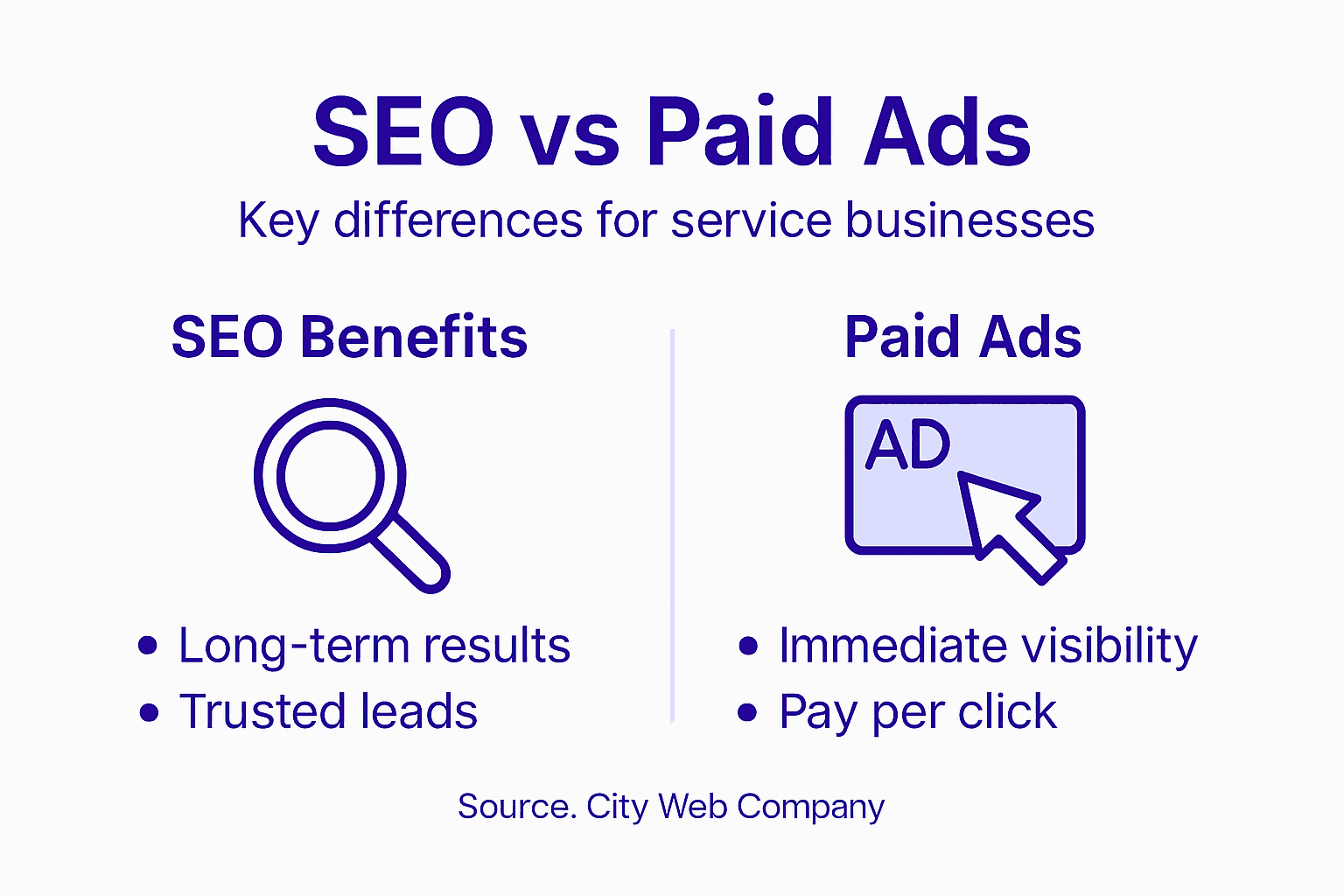

Compare the long-term value of SEO versus paid advertising for service businesses:
| Factor | SEO | Paid Advertising |
|---|---|---|
| Marketing Longevity | Grows over time | Stops when payment stops |
| Customer Trust | Builds organically | Relies on ad placements |
| Cost Efficiency | Improves with scale | Remains constant or increases |
| Lead Consistency | More stable flows | Fluctuates with budget changes |
Pro tip: Develop a hybrid marketing strategy that leverages both SEO and paid advertising, using paid ads for immediate visibility while simultaneously building long-term organic search presence.
Costs, Risks, and Common SEO Pitfalls
Investing in search engine optimization requires understanding the potential challenges and strategic risks involved in digital marketing. SEO professionals face significant challenges that demand continuous adaptation and strategic planning for sustainable online visibility.
The primary risks and costs associated with SEO implementation include:
- Financial Investment:
- Initial website optimization expenses
- Ongoing content creation costs
- Potential professional service fees
- Technical Challenges:
- Complex algorithm understanding
- Website performance optimization
- Mobile responsiveness requirements
- Content Development:
- High-quality, original content production
- Consistent content strategy maintenance
- Topical expertise demonstration
- Competitive Landscape:
- Constant industry evolution
- Emerging search technology adaptation
- Competitor strategy monitoring
Many local service businesses underestimate the complexity of search engine optimization. Successful SEO is not a one-time project but a continuous process of refinement, content development, and technical optimization. Businesses must invest time in understanding search engine algorithms, user behavior, and creating genuinely valuable online experiences.
The most common SEO pitfalls include keyword stuffing, neglecting mobile optimization, purchasing low-quality backlinks, and failing to produce genuinely informative content. These mistakes can result in search engine penalties, reduced visibility, and wasted marketing resources. Sustainable SEO requires a holistic approach that balances technical performance, content quality, and user experience.
Pro tip: Allocate a consistent monthly budget for SEO improvement and treat it as a long-term investment in your digital marketing infrastructure, not a short-term expense.
Unlock Sustainable Growth with Expert SEO and Paid Ads for Local Service Businesses
Many local service businesses struggle to build a lasting digital presence that drives qualified leads and trust while navigating the complex landscape of SEO and paid advertising. If you want to avoid common pitfalls like low-quality content or ineffective spending, a strategic, data-driven approach is essential. By focusing on proven SEO tactics such as local search targeting, technical website performance, and comprehensive content strategies, you can boost your online visibility and convert search traffic into real business.
At City Web Company, we specialize in tailored solutions designed specifically for service industries like home services, legal, and healthcare. From developing sustainable organic search growth through effective local SEO to deploying precise paid ad campaigns, our services create a balanced marketing strategy that maximizes your ROI. Discover expert techniques in our Digital Marketing Strategy Guides and enhance your lead generation with targeted PPC & Paid Ad Strategies.

Take control of your business growth today by partnering with a team committed to your long-term success. Visit City Web Company now to get started on transforming your online presence into a powerful lead generation engine with proven SEO and advertising expertise.
Frequently Asked Questions
What is SEO and how does it benefit local service businesses?
SEO, or search engine optimization, is a strategic approach to improving a business’s online visibility to attract more potential customers actively searching for services. By optimizing their websites, local service businesses can achieve higher search rankings, generate more organic traffic, and ultimately increase lead generation.
How do local search targeting techniques work in SEO?
Local search targeting involves using geographically specific keywords to attract customers in a defined area. This approach helps service businesses connect with local clients searching for their specific services, making it easier to grow their client base in their service area.
What are the costs associated with investing in SEO for my service business?
Investing in SEO typically includes costs for website optimization, ongoing content creation, professional service fees, and potentially technical improvements. It’s important to view these expenditures as a long-term investment in your marketing strategy rather than just a short-term cost.
What are common pitfalls to avoid when implementing an SEO strategy?
Common SEO pitfalls include keyword stuffing, neglecting mobile optimization, purchasing low-quality backlinks, and failing to consistently produce informative content. Avoiding these mistakes can help maintain your website’s visibility and improve your search engine rankings.
Recommended
- Local SEO Explained: Driving Growth for Service Businesses
- Why Choose Local Marketing for Service Businesses
- SEO Services for Small Businesses: A Complete Starter Guide – City Web Company | Digital Marketing Agency
- 7 Key Benefits of Local SEO for Service Businesses
- Top 4 Marketing Strategies for Small Businesses with Rekla.AI
These articles were popular with other readers too: