

Use website DNI, connect call reports to Google Ads and your Google Business Profile, then tie calls to booked jobs. City Web Company can handle setup.
What Is Service-Based SEO? 78% Local Leads Boost in 2026
Did you know 78% of local mobile searches result in an offline purchase within 24 hours? That statistic reveals the enormous potential waiting for service businesses that master local search visibility. Service-based SEO is the strategic optimization of your online presence to attract clients actively searching for services in your area. This article explains how service-based SEO works and why it is essential for law firms, healthcare providers, home service contractors, and other service businesses looking to dominate their local markets in 2026.
Table of Contents
Table of Contents
- Understanding Service-Based SEO: Definition and Scope
- The Importance of Local SEO for Service Businesses
- Keyword Research Best Practices for Service-Based SEO
- Optimizing Websites for Conversion in Service SEO
- Common Misconceptions About Service-Based SEO
- Case Studies Demonstrating Service-Based SEO Success
- Actionable Steps and Tools for Implementing Service-Based SEO
- Maximize Your Local Leads with Expert Digital Marketing
- Frequently Asked Questions About Service-Based SEO
Key Takeaways
| Point | Details |
|---|---|
| Service-based SEO targets local service keywords | This approach focuses on location-specific searches that bring qualified leads ready to hire. |
| Google My Business optimization is essential | A fully optimized profile dramatically increases visibility in local search results and map listings. |
| Conversion-focused content drives client acquisition | Clear calls to action and service descriptions tailored to local needs convert visitors into clients. |
| Common SEO myths waste time and money | Understanding the differences between service and product SEO prevents costly mistakes. |
| Results typically appear within 3 to 6 months | Patience and consistent optimization are necessary for sustainable ranking improvements. |
Understanding Service-Based SEO: Definition and Scope
Service-based SEO optimizes for local search intent and client conversion rather than product sales. While e-commerce businesses focus on driving transactions through product listings and inventory management, service businesses need to build trust and demonstrate expertise to convert searchers into clients. Service-based SEO prioritizes visibility when potential clients search for solutions to their immediate problems.
The fundamental difference lies in search intent. Someone searching for “emergency plumber near me” needs immediate help and is ready to hire. Someone browsing for products online may be in research mode for weeks. Service SEO recognizes this urgency and optimizes for high-intent, location-specific queries that signal readiness to engage.
Effective local SEO for service businesses includes several distinct elements:
- Optimizing for service-specific keywords with location qualifiers
- Building local citations and directory listings
- Managing online reviews and reputation
- Creating location pages and service-specific content
- Implementing local schema markup
- Establishing authority through content that answers client questions
Service-based SEO demands a completely different strategy than product marketing. You are not selling items that can be added to a shopping cart. You are positioning your expertise and availability to solve problems for people in your geographic area. Every optimization decision should support this goal of connecting qualified local leads with your services.
The Importance of Local SEO for Service Businesses
Local search behavior drives the majority of service business revenue. Over 78% of local mobile searches lead to an offline purchase within 24 hours, demonstrating that people searching for services are ready to take action immediately. When someone needs legal advice, medical care, or home repairs, they turn to search engines to find local providers they can trust.
The benefits of local SEO extend beyond simple visibility. Local optimization builds credibility by showcasing reviews, establishing your physical presence, and demonstrating community involvement. When potential clients see your business consistently appearing in local search results with positive reviews and detailed service information, they perceive you as an established, trustworthy option.
Practical local SEO techniques deliver measurable results:
- Claiming and optimizing your Google My Business profile with complete information
- Actively soliciting and responding to customer reviews
- Building citations in local directories and industry-specific platforms
- Creating location-specific content that addresses local concerns
- Using local keywords naturally throughout your website
- Implementing local schema markup to help search engines understand your service area
Pro Tip: Update your Google My Business profile weekly with posts, photos, and service updates. Active profiles rank higher and attract more clicks than static listings.
Local SEO creates a virtuous cycle. Better visibility leads to more clients, which generates more reviews, which improves visibility further. Service businesses that invest in local SEO tips for service businesses consistently outperform competitors who neglect their local online presence. The proximity factor in local search means you are competing primarily against businesses in your immediate area, not national corporations, making local SEO an achievable competitive advantage.
Keyword Research Best Practices for Service-Based SEO
Effective keyword research for service businesses starts with understanding how your potential clients describe their problems. People rarely search for your business name initially. They search for solutions: “divorce lawyer in Chicago,” “emergency AC repair near me,” or “pediatric dentist accepting new patients.”
Targeted service-specific keywords increase click-through rates by up to 32%. This improvement comes from matching search intent precisely. When your content addresses exactly what someone is searching for, they click through and engage with your website.
Follow this strategic process for keyword research for service SEO:
- List every service you offer in plain language that clients would use
- Add location qualifiers to each service term
- Include problem-focused variations that describe what clients need fixed
- Use Google Keyword Planner to identify search volume for each term
- Prioritize keywords with commercial intent over informational queries
- Focus on terms where you can realistically compete based on your domain authority
- Create dedicated landing pages for your highest-value keywords
Consider the difference between broad and specific service keywords. “Lawyer” has massive search volume but low conversion potential. “Personal injury lawyer in Austin Texas” has far less volume but attracts people ready to hire. Service businesses succeed by dominating specific, location-qualified keywords rather than competing for impossible broad terms.
Pro Tip: Search your target keywords and analyze the top 10 results. Note the content format, length, and specific questions they answer. Create content that matches or exceeds the quality of current top rankings.
Long-tail service keywords often deliver the best ROI because they capture specific intent. Someone searching “24 hour emergency plumber broken pipe” is in crisis mode and ready to call immediately. Build your keyword strategy around these high-intent, specific queries that indicate readiness to hire your services.
Optimizing Websites for Conversion in Service SEO
Attracting visitors means nothing if they leave without contacting you. Conversion-focused website optimizations significantly increase client acquisition rates for service firms. Every page should guide visitors toward one clear action: calling, scheduling, or submitting a contact form.

Your website must immediately communicate three things: what services you offer, where you serve, and why someone should choose you. Visitors make snap judgments within seconds. Clear headlines, prominent phone numbers, and obvious calls to action prevent bounces and capture leads.
Implement these conversion strategies for service websites:
- Place click-to-call phone numbers prominently on every page
- Use action-oriented CTAs like “Schedule Your Free Consultation” instead of generic “Contact Us”
- Include trust signals such as certifications, awards, and years in business
- Add client testimonials with photos and full names for authenticity
- Display service area clearly to confirm you serve the visitor’s location
- Minimize form fields to reduce friction in the contact process
- Use local imagery that reflects your community
Service descriptions should focus on benefits and outcomes rather than features. A potential client cares less about your process and more about how you will solve their problem. Instead of “We use advanced diagnostic equipment,” write “We identify the exact cause of your AC failure and fix it right the first time.”
Local relevance throughout your website reinforces that you serve the visitor’s area. Mention neighborhoods, landmarks, and local concerns naturally in your content. This localization helps with rankings while building trust with visitors who want to hire someone familiar with their community.
Mobile optimization is non-negotiable for service businesses because most local searches happen on smartphones. Your website must load quickly, display properly on small screens, and make calling or requesting service effortless with a single tap.
Common Misconceptions About Service-Based SEO
Many service business owners waste time and money on SEO approaches that worked for product businesses but fail for services. Understanding what does not work saves resources and prevents frustration.
The biggest mistake is targeting broad, generic keywords without location qualifiers. Ranking for “plumber” nationally is nearly impossible and pointless. You only serve specific areas, so your SEO should reflect that geographic focus. Broad keywords attract unqualified traffic from people outside your service area who cannot become clients.
Another misconception is that service SEO and product SEO use the same tactics. Product SEO emphasizes shopping features, inventory, and transaction optimization. Service SEO prioritizes trust building, local visibility, and contact conversion. Applying e-commerce strategies to service businesses leads to poor results.
Unrealistic timeline expectations derail many SEO efforts. SEO results for service businesses typically take 3 to 6 months to materialize due to indexing and competition. Search engines need time to crawl your site, evaluate changes, and adjust rankings. Businesses that abandon SEO after a few weeks miss the compounding benefits that appear with sustained effort.
Additional misconceptions about service SEO include:
- Believing SEO is a one-time project rather than ongoing optimization
- Ignoring online reviews because they seem outside of SEO scope
- Focusing only on website optimization while neglecting Google My Business
- Assuming paid ads eliminate the need for organic SEO
- Thinking local SEO only matters for businesses with physical storefronts
Reputation management is often underestimated as an SEO factor. Reviews directly influence local rankings and dramatically affect conversion rates. A business with 50 positive reviews will outperform a competitor with better technical SEO but only 5 reviews. Managing your online reputation is core to service-based SEO success, not a separate activity.
Case Studies Demonstrating Service-Based SEO Success
Real results prove the value of service-based SEO strategies. A regional healthcare provider implemented comprehensive local SEO including Google My Business optimization, location pages for each office, and a review generation campaign. Within six months, appointment requests increased 65% and they dominated local search results for their specialty in three cities.
Law firms increased client calls by over 40% after local SEO optimization. One personal injury practice focused on creating content answering common legal questions, building local citations, and actively managing reviews. Their website traffic from local searches tripled, but more importantly, consultation requests from qualified leads increased dramatically.
These service SEO case studies share common success factors: consistent optimization over several months, focus on local intent keywords, active reputation management, and conversion-optimized websites. The businesses that see the best results treat SEO as an ongoing marketing channel rather than a one-time project.
| Metric | Before SEO | After 6 Months | Improvement |
|---|---|---|---|
| Local search visibility | Page 3-4 | Page 1 | 200% |
| Website traffic from local searches | 500/month | 1,800/month | 260% |
| Qualified leads | 15/month | 38/month | 153% |
| Client acquisition cost | $420 | $180 | 57% reduction |
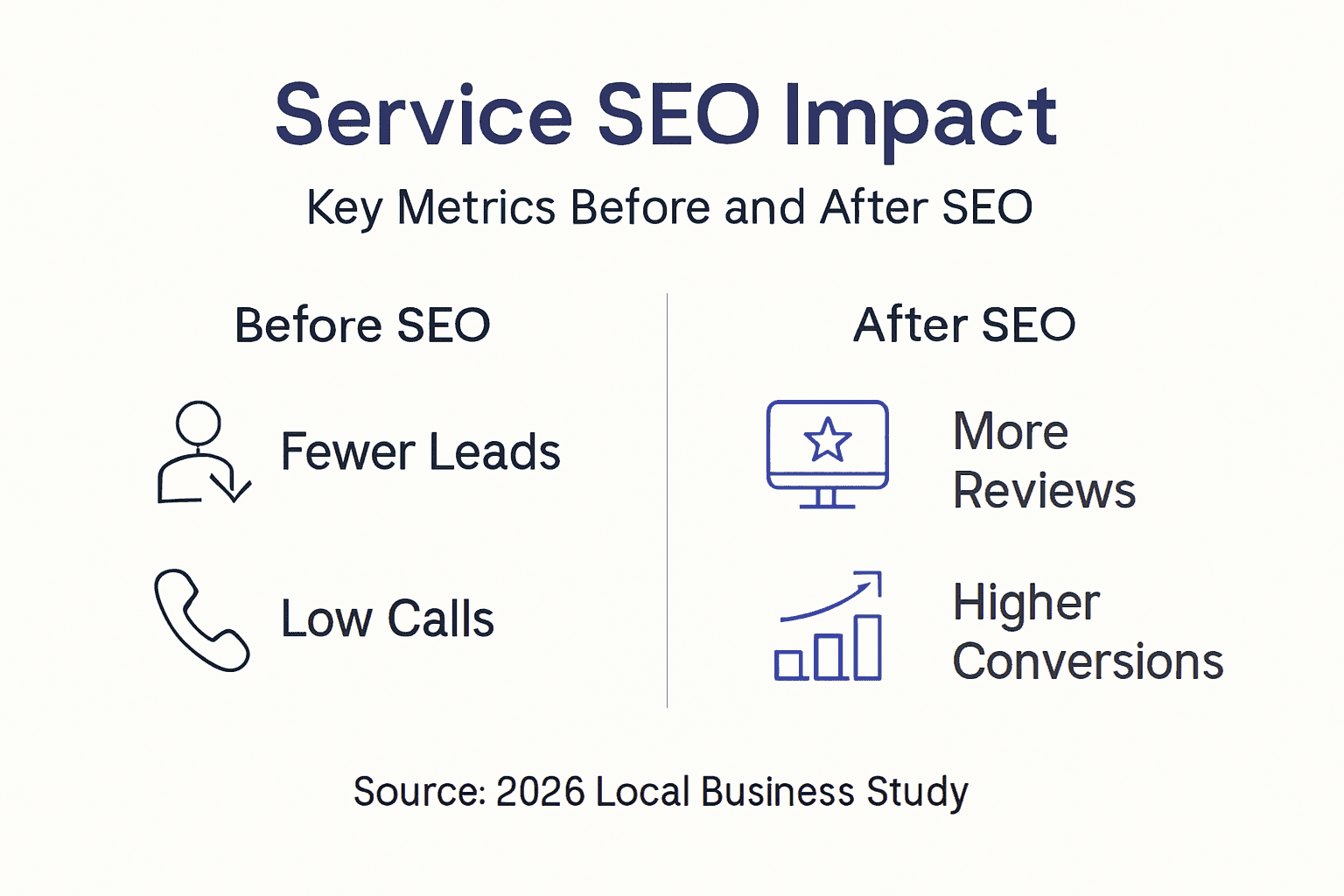

The most successful service businesses view SEO as an investment that compounds over time. Initial efforts require patience, but once rankings improve and reviews accumulate, the lead generation engine runs more efficiently than any paid advertising campaign. Organic visibility builds long-term value that paid ads cannot match.
Actionable Steps and Tools for Implementing Service-Based SEO
You can start improving your service-based SEO today by following this systematic approach. Service businesses see SEO ranking improvements within 3 to 6 months with proper local keyword targeting and optimization. Consistent implementation of these steps will position your business for sustainable growth.
Follow these service SEO implementation steps:
- Claim and fully complete your Google My Business profile with accurate hours, services, and photos
- Build citations by listing your business in relevant directories with consistent NAP information
- Create location-specific landing pages for each area you serve
- Implement local schema markup on your website to help search engines understand your service area
- Develop service pages targeting your priority keywords with clear CTAs
- Start a systematic review generation process to gather client testimonials
- Create helpful content that answers common questions your potential clients search for
- Monitor your rankings and traffic using Google Search Console and Google Analytics
Pro Tip: Set calendar reminders to update your Google My Business profile weekly. Fresh content signals active management and improves your visibility in local search results.
Useful tools for service SEO include Google Keyword Planner for keyword research, BrightLocal or Moz Local for citation management, and SEMrush or Ahrefs for competitive analysis and rank tracking. Google Search Console provides free insights into how people find your website and which queries drive traffic.
Expect to invest ongoing effort into content creation, review management, and technical optimization. Service-based SEO is not a set-it-and-forget-it activity. The businesses that consistently update content, respond to reviews, and refine their local presence maintain top rankings while competitors with static websites gradually lose visibility. Commit to treating SEO as a core marketing channel that requires regular attention, and you will see compounding returns over time.
Maximize Your Local Leads with Expert Digital Marketing
You now understand how service-based SEO works and why it matters for your business growth. Putting these strategies into action consistently requires expertise and dedicated time.

City Web Company specializes in digital marketing for local leads, helping service businesses like yours dominate local search results and convert more visitors into clients. Our local SEO services include Google My Business optimization, strategic keyword targeting, reputation management, and conversion-focused website improvements. We handle the technical complexity while you focus on serving clients. Ready to accelerate your local visibility and lead generation? Contact us today for a consultation and discover how our proven strategies can transform your online presence into a consistent source of qualified local leads.
Frequently Asked Questions About Service-Based SEO
What makes service-based SEO different from regular SEO?
Service-based SEO focuses specifically on local search intent and conversion optimization rather than product sales or national visibility. It prioritizes location-qualified keywords, local citations, Google My Business optimization, and reputation management to connect service providers with nearby clients ready to hire.
How long before I see results from service-based SEO?
Most service businesses see meaningful improvements in local rankings and lead generation within 3 to 6 months of consistent optimization. Initial changes may appear sooner, but sustainable results require time for search engines to index changes and for accumulated reviews and content to build authority.
Do I need to manage online reviews for SEO benefits?
Yes, online reviews directly influence local search rankings and dramatically affect conversion rates. Google considers review quantity, quality, and recency when determining local rankings. Businesses with more positive recent reviews consistently outrank competitors with fewer reviews, even when other SEO factors are similar.
Which keywords should I focus on for my service business?
Focus on service-specific keywords with location qualifiers that match how potential clients search when ready to hire. Target phrases like “emergency plumber in Dallas” or “family law attorney near me” rather than broad terms. Prioritize keywords that indicate commercial intent and geographic relevance to your service area.
Can service-based SEO help my healthcare or legal practice?
Absolutely. Healthcare providers and legal practices benefit enormously from local SEO because potential clients search for these services with high intent and urgency. Local visibility, positive reviews, and authoritative content establish trust and credibility, which are essential for professional services where reputation matters most.
Recommended
These articles were popular with other readers too: