In the AI era, multi location local SEO depends on each branch earning trust through accurate profiles, crawlable pages, and third party signals.
Facebook Ads for Plumbers: Turn Scrolls Into Scheduled Jobs
Yes, Facebook ads can generate plumbing leads, and they work best for scheduled work: drain cleaning, maintenance plans, seasonal tune-ups and flat-rate promotions. Emergency calls still lean on search. The ads only pay off when you pair a clear offer with fast follow-up by phone or CRM. Below you get the offers, targeting, setup, tracking and budget to run a proper test.
TL;DR:
- Start with a 10 to 15 mile radius around your shop, tighten it in dense cities, and keep audiences broad enough for Meta to learn.
- Pair a clear offer, such as flat rate drain cleaning or a seasonal inspection, with footage of your technician rather than a stock plumbing image.
- Call new leads within a few minutes during business hours, assign each one an owner, and route missed calls to a technician or answering service.
- Connect a dedicated call tracking number, UTM tags, and CRM records to each ad; lead cost alone cannot show whether campaigns produce booked work.
- Run a test for at least 30 days, review results weekly, and change one variable at a time so early learning remains interpretable.
Table of Contents
Table of Contents
- Why Facebook ads can work for plumbers
- High-converting offers and creatives for plumbers
- Targeting: geo, audiences, and Advantage+ for local homeowners
- Campaign setup and budget playbook
- Lead capture and follow-up systems that turn Facebook leads into booked jobs
- Retargeting and frequency: bringing back people who showed interest
- Measuring success: KPIs, attribution, and reporting for plumbing campaigns
- Legal and compliance considerations for Facebook ads
- Optimizing ads for mobile devices
- Seasonality and timing factors affecting plumbing ad performance
- Facebook ads versus other paid channels: when to choose Facebook
- Tips for integrating Facebook ads with SEO, Google Ads and other channels
- Common pitfalls specific to plumbing ads on Facebook
- Our take: what helps plumbers get profitable faster
- How we can help plumbers run profitable Facebook campaigns
- FAQ
- Sources
Why Facebook ads can work for plumbers
Most plumbing marketing starts with intent. Someone types “burst pipe” into a search box, and whoever shows up first gets the call. Facebook works the other way around. Your ad interrupts someone who was not looking for a plumber, and it succeeds only if the offer is strong enough to turn a passing glance into a booking. That sounds like a handicap, but it opens a door that search leaves mostly closed: homeowners who have a slow drain, an aging water heater or a dripping faucet and have been putting it off.
Scale is not the problem. Meta’s advertising business is large enough that Facebook’s worldwide advertising revenue is tracked as its own Statista series, which tells you advertisers of all sizes keep spending there. For a local trade, the useful point is simpler: your future customers are already on the platform, scrolling on their phones in the evening when they think about household chores.
Meta tends to perform best for these service types:
- Drain cleaning, because a slow drain is annoying but rarely urgent.
- Water heater checks and replacements, especially for older units.
- Seasonal tune-ups, such as winterizing outdoor spigots or checking sump pumps before spring.
- Flat-rate offers, where the price removes the biggest fear homeowners have about calling a plumber.
- Maintenance plans, which turn a single visit into recurring revenue.
Three levers decide whether any of this works. The first is the offer: a specific deal beats “Call your local plumber.” The second is creative that shows proof, meaning a real technician, a real truck or a real before and after, not a stock photo of a wrench. The third is immediate lead routing, because a lead that waits two hours for a callback has usually called someone else. Fix those three and the rest of this guide is tuning. Skip them and no targeting trick will save the campaign.
High-converting offers and creatives for plumbers
Start with the offer, because creative cannot rescue a weak one. An offer works when a homeowner can understand it in two seconds and picture exactly what happens next. These are the templates plumbing advertisers lean on most:
- Same-day service discount. “Book today, save on any repair completed this week.” It creates urgency without pretending to be an emergency.
- Fixed-price service call. “Drain cleared for one flat price, no surprises.” Price certainty is the biggest trust builder in the trade.
- Free or low-cost inspection. “Whole-home plumbing check, includes water pressure and leak test.” It gets a technician in the door, where upsells happen honestly.
- Seasonal tune-up. “Fall water heater flush and safety check.” It gives people a reason to act now rather than someday.
- Maintenance plan. “Join our annual plan: one visit per year plus priority scheduling.” It sells peace of mind and builds repeat revenue.
Pair the offer with a format that fits how people scroll:
- A 15 to 30 second video shot on a phone. A technician introduces himself, shows the van, explains the offer in one sentence and says the phone number out loud. Authentic beats polished here.
- A before and after carousel. Swipe through a clogged line, the camera inspection and the clean result. Visual proof does the persuading.
- A single image with a clear phone call to action. Put the offer in plain words on the image and keep the text short.
- An Instant Experience, Meta’s full-screen mobile format, for a short offer page that loads without leaving the app.
Copy should be short and written like a person talks. A pattern that works: lead with the problem (“Slow drain in the kitchen?”), state the offer (“Flat-rate drain cleaning this week”), then give one action (“Tap to call or book online”). Favor calls and quick booking over vague clicks.
Pro Tip: Show your own technician’s face early in every video. Homeowners are letting a stranger into their house, and a familiar face in the ad lowers that barrier before they ever call.
Targeting: geo, audiences, and Advantage+ for local homeowners
Plumbing is local, so geography is your most important setting. Everything else is secondary to making sure the ad only reaches people you can reach in a truck.
Geographic targeting
- Use a radius around your shop or main service area, not a whole metro. A 10 to 15 mile radius is a reasonable starting point for most shops, tightened in dense cities and widened in rural areas where drive times are longer.
- Use ZIP code clusters when your service area is irregular, for example when a river, highway or county line splits your coverage.
- Exclude low-value areas. If a neighborhood has mostly renters or newer construction with little plumbing trouble, remove it and see whether cost per lead improves.
- Target people living in the area, not people recently passing through, since you want homeowners, not visitors.
Audience strategy
Meta’s automated tools, branded Advantage+, have become strong at finding likely responders when you give them good creative and clean conversion data. A sensible path is to start broad, with only your geography and a minimum age that fits homeowners, and let the system learn from early results. Layer in tests only after you have data:
- Lookalike audiences built from your past customers, which Meta uses to find people with similar traits.
- Homeowner and recent mover interest layers, since new homeowners often need inspections and repairs.
- Age bands that match your real customer base, checked against your own job history rather than guesses.
Practical guardrails keep this from going wrong:
- Keep audiences big enough to learn. Overnarrowing with stacked interests can limit the algorithm and raise costs.
- Exclude existing customers with an uploaded customer list so you are not paying to advertise to people who already call you, unless you are deliberately promoting a maintenance plan to them.
- Change one thing at a time. If you swap the audience and the creative together, you will not know which one helped.
The platform’s reach is real. Statista’s ranking of countries by Facebook users shows how many people the platform reaches, which is why a modest local radius still contains plenty of homeowners to test against.
Campaign setup and budget playbook
A clean first campaign is simple. The goal at the start is not profit at any cost. It is learning which offer and which audience produce booked jobs at a price you can afford.
Choosing an objective. Pick lead generation if you want a fast form fill inside Facebook, traffic if you want visitors on a landing page you control, and messages if your team can reply quickly in Messenger. For most plumbers, leads or a landing page with a click-to-call button works best. Messages can be strong when someone is always at a phone, and weak when replies lag.
Follow these steps to build the campaign:
- Create one campaign with your chosen objective and a clear name, such as “Drain Cleaning, Flat Rate, Test 1.”
- Build a few audience buckets: broad geography, a lookalike of past customers and one interest layer. Keep each large enough to exit the learning phase.
- Prepare creative buckets: one video, one image or carousel and one offer variation. That gives you a few clean tests rather than a dozen messy ones.
- Set a daily budget you can sustain for at least 30 days, so the system has time to learn.
- Launch and avoid making premature changes. Edits during early learning reset progress.
- Review weekly. Cut the weakest ad, keep the strongest and introduce one new variation at a time.
Budget guidance. Treat this as an illustrative example, not market data. Say you set aside a total test budget. Divide it across the test period to establish a daily budget. If the average job is worth several hundred dollars and you book even a handful of jobs from the spend, the test can pay for itself, but your real numbers will differ by market and season. Decide in advance what you can afford to lose while learning.
When to scale or pause. Increase spend gradually once cost per booked job holds steady. Pause or rethink an ad if leads come in but nobody answers the phone, if cost per lead climbs for several days in a row or if the leads are mostly out of area.
Lead capture and follow-up systems that turn Facebook leads into booked jobs
A lead is not a job. Most plumbing campaigns that disappoint have a follow-up problem, not an ad problem. The click costs money, and the money is wasted if the response is slow.
You have two main ways to capture the lead, and each has trade-offs:
- Instant Forms keep people inside Facebook and are easy to fill out on a phone, which tends to raise volume. They also tend to bring more casual submissions, so quality can dip and you need to call fast.
- Landing pages with a booking widget take an extra step, which usually lowers volume but raises intent, and they let you track visitors and run retargeting more cleanly.
- Click-to-call buttons work well for homeowners who would rather talk than type, and they pair naturally with a tracking number.
Speed is the part you control. Set a response target, ideally a few minutes during business hours, and build a system around it:
- Automatic text message the moment a form comes in, confirming receipt and offering a time to talk.
- Call routing that rings your dispatcher or office manager first and rolls to a technician or answering service if no one picks up.
- CRM integration so each lead lands in one place with the source, the offer and the ad that produced it.
- A clear owner for every lead, so nobody assumes someone else is calling.
Measurement depends on matching leads to jobs. Use a dedicated call tracking number on your ads, add UTM parameters to every landing page link and record the source when a lead books. Without that chain you will see cost per lead but never cost per job, and cost per job is the only number that tells you whether to keep spending.
Practitioners in plumbing marketing communities describe the same pattern. A Facebook group thread of plumbing marketers shares tips on improving ad results and handling leads, and the recurring theme is that lead handling matters as much as the ad.
Pro Tip: Call every new lead yourself at first, even if you plan to hand it off later. You will hear exactly which offers attract real jobs and which attract tire-kickers, and no dashboard shows you that.
Retargeting and frequency: bringing back people who showed interest
Most people do not book on the first impression. Retargeting reaches the ones who showed some interest, and it is usually the cheapest traffic you will buy because these people already know who you are.
A simple funnel looks like this:
- Video viewers: people who watched a good portion of your technician video. Follow up with a proof-based ad, such as a short customer story or a before and after.
- Website visitors: people who landed on your page but did not book. Show a reminder of the offer with a clear call to book.
- Form abandoners: people who started an Instant Form but did not submit. Offer an easier path, such as a click-to-call button or a shorter form.
- Call-to-book ad: a final, direct ad for anyone who has engaged more than once, with a plain request to call or schedule.
Match the window to how recent the interest is, and cap how often people see you:
- 0 to 7 days: the hottest group. Use urgency, and keep frequency modest, around one impression a day at most.
- 7 to 21 days: use social proof and testimonials, with lighter frequency.
- 21 to 90 days: use a gentle reminder, a seasonal tip or a maintenance plan pitch, at low frequency.
If your frequency climbs while results fall, rotate the creative or shrink the window. Ad fatigue is real, and it looks like rising costs and falling click rates.
Measuring success: KPIs, attribution, and reporting for plumbing campaigns
Track a short list of numbers and ignore vanity metrics. Impressions and likes do not pay for trucks.
The metrics that matter:
- Cost per lead (CPL): what you pay for each form fill or call.
- Cost per booked job: your true acquisition cost, and the number to optimize.
- Phone-call volume: especially important if many customers call instead of filling out forms.
- Lead-to-book rate: the share of leads that become scheduled jobs, which reveals follow-up quality.
Build the tracking stack in this order:
- Meta pixel on your website to record visits and actions.
- Conversions API, which sends events from your server to Meta and helps recover data lost to browser privacy limits.
- Call tracking numbers so phone leads are credited to the right ad.
- UTM tags on every link so your analytics tool can tell sources apart.
Early data is noisy. Early on, the system is still learning, so judge trends rather than individual days. Look at the numbers weekly, make one change per review and run a fuller monthly report that ties spend to booked jobs and revenue.
Scale gives context for why the platform is worth testing: Facebook’s worldwide advertising revenue is published as a long-running Statista series, and it reflects how widely advertisers rely on the platform.
Legal and compliance considerations for Facebook ads
Plumbing ads are low-risk in terms of content, but a few rules still trip up local advertisers.
Meta’s advertising policies govern what you can say and show. Avoid claims you cannot back up, such as “guaranteed the lowest price” or “cheapest in town,” and keep before and after images honest. If you run a price offer, make sure the ad states the real terms, and honor them when someone calls.
Privacy matters whenever you collect information. If you use Instant Forms, the form links to a privacy policy, so have a real one on your website that says how you store and use contact details. Be careful with texts and calls: before you send automated messages or make marketing calls, make sure you have the consent the law requires for your area. Federal and state rules on texting and calling are strict, and penalties can be steep.
Licensing is another quiet issue. Many states expect your license number on advertising, so check what your state or local board requires and include it on landing pages and ads where it applies.
Because rules vary and change, confirm the details with your state licensing board or an attorney, and review Meta’s current ad policies before you launch. A few minutes of checking now is cheaper than a disapproved ad account.
Optimizing ads for mobile devices
Most people will see your ad on a phone, so design for a thumb, not a mouse. If the ad or the next page is awkward on a small screen, the click is wasted.
Start with the creative. Shoot video vertically or square so it fills the screen, put the offer in the first few seconds and add captions, since many people scroll with the sound off. Keep any text on images large and short enough to read at a glance.
Then make the next step easy:
- Use a click-to-call button so a homeowner with a leaking sink can reach you with one tap.
- Make landing pages load fast. Compress images, keep the page light and test on a real phone over a normal connection, not office Wi-Fi.
- Keep forms short. Name, phone number and a short description of the problem is often enough. Every extra field costs you leads.
- Put the phone number and booking button above the fold, so no scrolling is needed to act.
Check your numbers by device. If mobile clicks are plentiful but conversions are weak, the problem is usually the landing page, not the ad. A quick test, filling out your own form on a phone while standing in your driveway, finds problems that analytics will not.
Seasonality and timing factors affecting plumbing ad performance
Plumbing demand moves with the weather, and your ads should move with it. Offers that match the moment convert better than generic ones.
Think in seasons. In late fall and winter, frozen or burst pipes, water heater failures and heating-related issues rise, so promote winterization checks early, before the first hard freeze, and shift to emergency-ready messaging when cold hits. In spring, focus on sump pumps, outdoor spigots and drain checks after heavy rain and thaw. Summer tends to bring irrigation, outdoor fixtures and increased water use, and fall is a natural time for water heater flushes and inspections before the cold.
Timing within the week and day matters too. Homeowners often browse in the evening and on weekends, which is when they notice problems, so consider scheduling or bidding more for those windows, then confirm the pattern with your own data. If your team cannot answer on weekends, say so honestly in the ad or set up an answering service, since a missed weekend call is a lost job.
Plan your budget around the calendar. Increase spend ahead of your busy season when interest is rising, and lighten it in slow stretches. Keep a simple log of what you ran and when, so next year you start with proof instead of guesses.
Facebook ads versus other paid channels: when to choose Facebook
No single channel does everything. The right choice depends on what kind of job you want and how fast you need it.
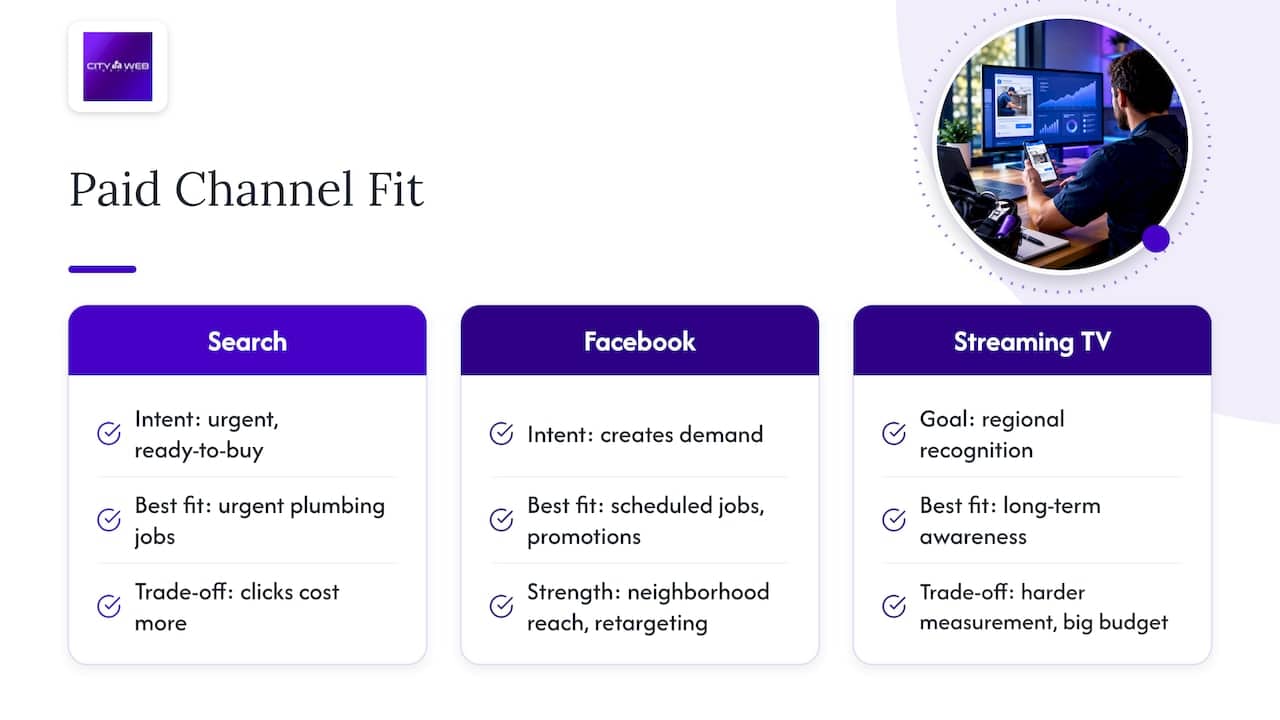
Search ads catch people at the moment of need. Someone typing “emergency plumber near me” is ready to buy, so search is usually the strongest option for urgent, high-intent work, though clicks tend to cost more because everyone competes for them. Our Google Ads management is built for exactly this kind of demand.
Facebook ads create demand instead of catching it. They fit scheduled work, maintenance plans, promotions and brand awareness, and they let you stay in front of a neighborhood week after week. They are also a strong retargeting tool for people who visited your site but did not call.
Streaming TV and other broad channels build recognition across a region, but they are harder to measure and better suited to shops with a larger budget and a goal of long-term awareness.
A practical rule: choose search first if you only have budget for one channel and need calls this week. Add Facebook when you want to fill your schedule with planned jobs, promote a seasonal offer or build a base of repeat customers. Shops with room in the budget often run both, using search for urgent calls and Facebook for everything else.
Tips for integrating Facebook ads with SEO, Google Ads and other channels
Channels work better together than apart. The same homeowner might see your Facebook ad, search your name a few days later and read your reviews before calling. Make that path smooth.
Connect Facebook and search. People who see your ad often search your company name afterward, so make sure your branded search results are strong and your Google Business Profile is complete, with fresh photos and recent reviews. Our local SEO work focuses on making that second step easy to win.
Keep messaging consistent. If the Facebook ad promises a flat-rate drain cleaning, the landing page and the Google ad should say the same thing at the same price. Mismatched offers confuse people and reduce trust.
Reuse what works. A video that performs well on Facebook can become a landing page hero, a Google Business Profile post or an email to past customers. Reviews and photos from completed jobs feed every channel.
Share your data. Use the same call tracking and UTM structure across channels so you can see how they combine, not just how each performs alone. Retarget website visitors from search and SEO traffic on Facebook, since those people have already shown interest.
Add organic posting. Regular posts with tips, team photos and project results keep your page looking active when a curious homeowner checks it, and our social media marketing services cover that organic side alongside paid.
Common pitfalls specific to plumbing ads on Facebook
Most plumbing campaigns fail for a handful of repeat reasons, and nearly all are avoidable.
- Weak or generic offers. “Call us for all your plumbing needs” gives no reason to act. Fix it with a specific, time-bound offer.
- Slow follow-up. Leads that wait hours go cold. Fix it with automatic texts, call routing and a clear response target.
- Targeting too narrow or too wide. Stacking many interests starves learning, while a huge radius brings leads you cannot serve. Start broad within your real service area and refine from data.
- Chasing cheap leads. The lowest cost per lead often brings the lowest quality. Judge campaigns by cost per booked job.
- No tracking. Without call tracking and a connected CRM, you cannot tell which ads make money. Set it up before you spend.
- Changing too much too fast. Editing ads frequently can disrupt learning. Change one thing at a time.
- Ignoring creative fatigue. The same ad shown for months stops working. Refresh creative regularly.
- Advertising emergency service only. Facebook interrupts people who are not in crisis, so lean on scheduled and maintenance offers instead.
- Sending traffic to a slow or confusing page. Test the whole path on a phone before you launch.
Run a regular audit against this list. It takes minutes and catches the problems that quietly drain budgets.
Our take: what helps plumbers get profitable faster
Here is where I land after looking at how these campaigns tend to succeed and fail: most plumbers treat Facebook like a cheaper version of Google, and that is the mistake. Search harvests demand that already exists. Facebook has to earn attention from people thinking about something else, so the winners are the shops with a sharp offer, a human face and a phone that gets answered fast. Targeting tricks matter far less than people hope. The boring parts, the offer and the follow-up, do most of the work.
DIY testing makes sense when you have a modest budget, someone on your team who can check leads daily and the patience to run a clean test. An agency starts to earn its fee when ad spend grows, when nobody has time to build creative and tracking, or when the numbers are unclear and money is leaking.
Use this checklist as a starting plan:
- Set one clear objective, such as booked maintenance visits or drain cleaning jobs, and a cost per job you can afford.
- Launch two creative tests: one video and one image or carousel, each with a specific offer.
- Connect your CRM and call tracking before spending, so every lead is credited to its source.
- Set a response target and an owner for every lead, and test the process yourself.
- Review weekly, cut the weakest ad and change only one variable at a time.
Pro Tip: Before you launch, submit a fake lead through your own ad and time how long it takes someone to call back. If the answer is more than a few minutes, fix that before you spend a dollar on traffic.
— Matt
How we can help plumbers run profitable Facebook campaigns
Running this playbook well takes creative, tracking and daily attention, and most plumbers would rather be on jobs than inside Ads Manager. That is the work we take off your plate. We build and manage paid social for local service businesses, so you get a campaign designed around booked jobs, not clicks.
Here is what we handle:
- Facebook and Instagram ads management, from offer and creative to targeting.
- Landing page setup built for phones, with click-to-call and booking options.
- Lead tracking, so you can assess campaign results.
- Campaign reporting to help assess results.
A typical engagement starts with an audit of your current marketing, followed by a test plan, new creative and lead routing set up before launch. From there we review results with you on a regular schedule and scale what works. Pricing depends on your market and goals, so ask us for a quote.
If you want a team that already knows how to run these campaigns for trades, see our Facebook and Instagram ad services or get started with us here and tell us about your service area.
FAQ
What is the best way to advertise as a plumber?
The best approach combines channels: search ads for urgent calls, Facebook ads for scheduled work and promotions and a strong Google Business Profile for trust. Start with the channel that matches the jobs you want most, then add others as your budget grows.
How much do Facebook ads cost per 1000 views?
Cost per thousand impressions varies by market, season and audience, so there is no single reliable figure for plumbers. Check your own Ads Manager data, and focus on cost per booked job, which tells you more than cost per view.
How do I get more customers as a plumber?
Make a specific offer, show proof of your work and answer every lead fast. Add a steady flow of reviews, a complete Google Business Profile and a simple way to book online or by phone. Consistent follow-up usually beats any single ad trick.
Do Facebook ads work for contractors?
Yes, especially for scheduled, planned and seasonal work where homeowners are not in a rush. They are less reliable for pure emergencies, and they work best when paired with quick lead follow-up and clear tracking.
Sources
These articles were popular with other readers too: