

Google removed Business Profile call history on July 31, 2024. Compare three tracking options, test routing, protect NAP, or hand setup to an agency.
Local SEO ROI for Service Businesses: Track Calls to Booked Jobs
Yes, local SEO ROI is measurable. Take the revenue you can tie to organic and local sources, subtract what you spent, divide by what you spent, and multiply by 100: (revenue attributed to local SEO minus cost) / cost × 100. Count only outcomes that earn money, such as booked jobs and completed sales that began with a call, form, quote request, or direction request.
TL;DR:
- Count booked jobs, qualified calls, forms, quote requests, and direction requests as outcomes; treat profile views and organic sessions as context, not revenue.
- Mark forms and bookings as GA4 key events, tag links, track calls by page, and record booked, quoted, lost, or spam outcomes in your CRM.
- Last click can credit branded search or direct visits after a Maps discovery, while data driven attribution shares credit and may report fractional conversions.
- Compare conservative and optimistic forecasts using lead value, close rate, ticket size, and monthly cost; invest only if the conservative case breaks even on schedule.
- Fix call handling and CRM outcome tracking before buying more optimization, because unanswered calls and unmatched jobs hide whether leads generate revenue.
Table of Contents
Table of Contents
- Which metrics prove local SEO ROI?
- How do you set up measurement step by step?
- How does attribution change your ROI numbers?
- What do local SEO costs and timelines look like?
- What can you do right now to raise local SEO ROI?
- Who is behind this playbook, and what does an example look like?
- Where the conventional advice falls short
- How we help you measure and raise local SEO ROI
- FAQ
- Sources
Which metrics prove local SEO ROI?
Start with the actions that put a customer in front of you. Then add the visibility numbers that explain why those actions rose or fell.
Conversion metrics (the ones that become revenue):
- Phone calls: For most service businesses, the call is the lead. Track total calls and, separately, qualified calls that lasted long enough to be real inquiries.
- Booked jobs: The cleanest proof, because it connects an inquiry to money.
- Form submissions and quote requests: These show intent on your local landing pages.
- Direction requests: Useful for storefronts and clinics, where a visit is the conversion.
Supporting visibility metrics:
- Business Profile views and searches: Google reports views, searches, and actions for each profile, so you can see how customers find and use yours.
- Local landing page organic sessions: Growth here shows your pages are earning traffic that can convert.
Visibility alone is not ROI. Calls, direction requests, and website clicks are outcomes of ranking, and Google is clear that those actions are not ranking factors themselves. Use them to measure performance, not to explain it.
To turn leads into dollars, multiply leads by your close rate and your average ticket. For example, multiply your monthly leads by your close rate and average job value to estimate revenue and value per lead. Your per-lead value is the number every later calculation depends on.
How do you set up measurement step by step?
Work through this checklist in order, or hand it to an agency. Each step feeds the next.
- Create conversion events in Google Analytics 4. Mark form fills, quote requests, and booking completions as key events so they show up in every report.
- Add UTM parameters to local links. Tag the website link on your Business Profile and the URLs on your local landing pages so organic local traffic shows up as its own source instead of blending into “direct.” A simple convention works: source set to google, medium set to organic, campaign set to the profile or page name.
- Install call tracking. Use tracking numbers that map each call to a page or campaign, and keep your main number on the profile as the primary listing so citations stay consistent.
- Pass call outcomes to your CRM. A call is only a lead until someone marks it booked, quoted, lost, or spam. That outcome is what turns activity into revenue.
- Record close rate and average ticket in the CRM. Log the job value on every closed deal so you can compute revenue per lead by source without guessing.
- Review monthly. Compare organic and local leads, closed revenue, and cost in one place.
If you want a broader framework for deciding which numbers deserve a spot on your dashboard, this guide to business performance metrics covers KPI selection tied to revenue.
How does attribution change your ROI numbers?
Attribution decides which touchpoint gets credit for a conversion, so the same quarter can produce two very different ROI figures. Last-click gives all the credit to the final touch. Data-driven attribution, which Google recommends, distributes credit across touchpoints based on how each one contributed to the key event.
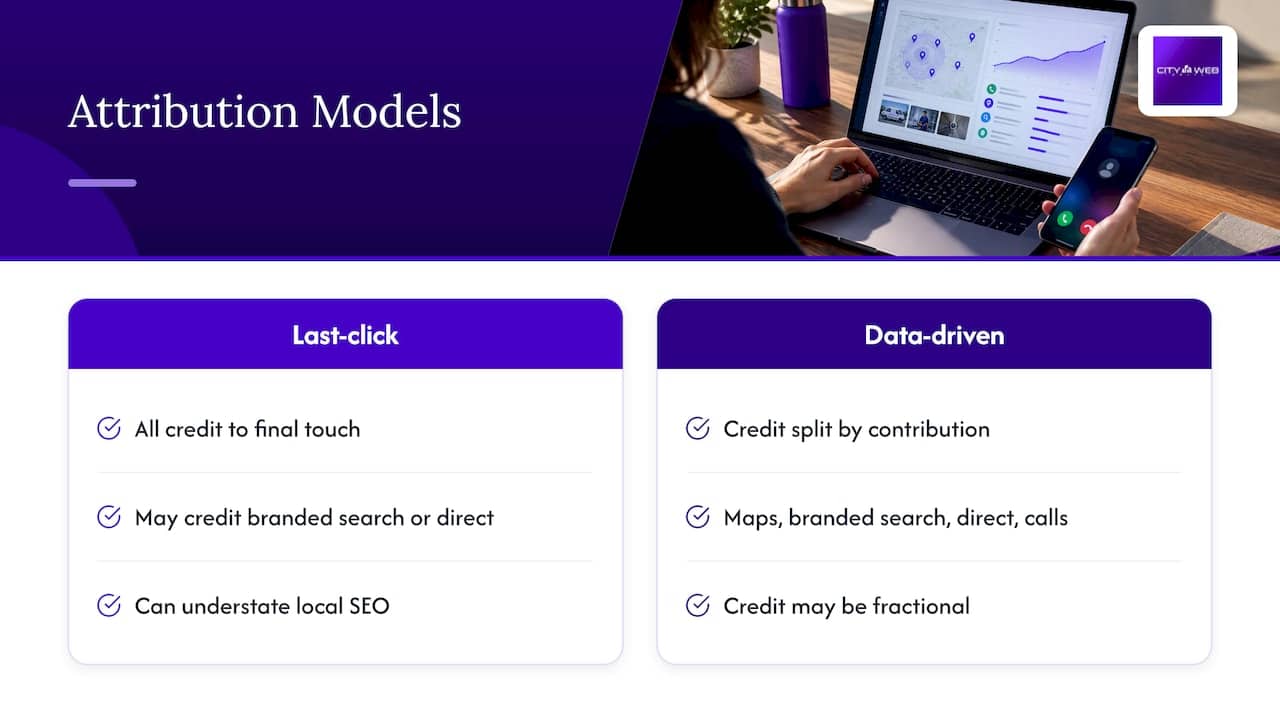
For local SEO this matters because a customer often finds you through Maps, leaves, searches your brand name, and then calls. Last-click may hand the win to a branded search or a direct visit and understate local SEO. You can change the reporting attribution model in Google Analytics to see the difference, though data-driven credit can arrive in fractions rather than whole conversions.
You may also see modeled data. Google estimates key events it cannot observe directly because of privacy or technical limits, and includes them when confidence is high. That is normal, not an error, but note it in your reports.
What do local SEO costs and timelines look like?
We can’t point to a published, sourced price table for local SEO packages, so treat any range you see online as a starting point to verify, and ask every provider for a written scope. What you can rely on is the shape of the commitment.
- Typical deliverables: Business Profile optimization, citation cleanup, review strategy, on-page work for local landing pages, and monthly reporting.
- Time to payoff: Local SEO compounds. Expect early movement in impressions and profile actions first, then leads, then revenue that covers the monthly fee.
- Conservative scenario: Assume modest traffic growth and your current close rate. Use last-click attribution.
- Optimistic scenario: Assume stronger ranking gains and a close rate lifted by better landing pages, and use data-driven attribution.
Plug your per-lead value into both scenarios and compare each against your monthly cost. If even the conservative case clears break-even within your planning window, the investment is easy to defend.
What can you do right now to raise local SEO ROI?
Ranking is only half the equation. These moves lift the revenue each visit produces.
- Make the profile and landing pages convert. Put a clear call to action, a booking link, and click-to-call above the fold. Claim the directories that matter first, as this post on which listings to claim first explains.
- Earn and answer reviews. Fresh reviews support prominence, and replies show prospects you are responsive.
- Add paid search for high-value queries. Run ads on your most profitable local terms while organic rankings build, and compare the lead quality side by side.
- Test continuously. Try new landing page layouts, review your attribution settings, and keep a steady reporting schedule so your signal stays clean.
- Fix call handling. Answering fast and tracking outcomes often lifts revenue more than another ranking position does.
Who is behind this playbook, and what does an example look like?
I’m Matt, and I write this from our work at City Web Company, where we run local SEO, paid media, and web development for service businesses like home services, med spas, and pest control. The example below is illustrative, with inputs chosen for easy math rather than drawn from a client.
| Input or result | Illustrative value |
|---|---|
| Monthly local SEO spend | Your monthly cost |
| Leads per month | Your tracked leads |
| Close rate | Your close rate |
| Average ticket | Your average job value |
| Jobs closed | Leads multiplied by close rate |
| Revenue attributed | Closed jobs multiplied by average ticket |
| ROI | Calculate using the formula above |
The math: (revenue attributed minus cost) / cost × 100. Substitute your own figures to calculate ROI. To copy it, gather five inputs (monthly spend, leads, close rate, average ticket, and attributed revenue), then apply the formula from the top of this article. Run it twice, once with conservative inputs and once with optimistic ones.
Where the conventional advice falls short
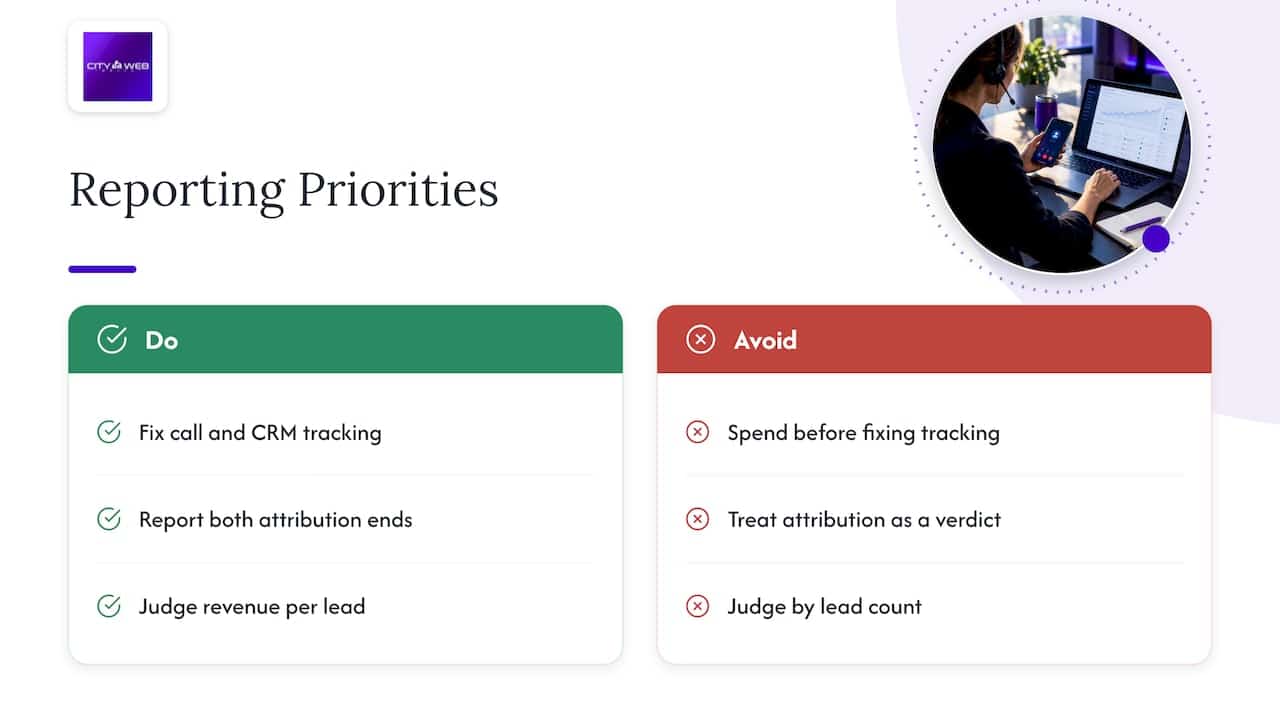

Most local SEO reporting celebrates rankings and impressions, and that is where it goes wrong. A first-page position that produces no calls is a vanity win, and a report full of them lets weak programs survive for years. The measurement problem is rarely traffic. It is missing outcome data: calls nobody tagged, jobs never matched to a source, and close rates that live in someone’s head.
If I could change one habit, it would be this: fix your call and CRM tracking before you spend another dollar on optimization. Without it, you cannot tell a profitable program from a busy one, and every attribution debate becomes a guess. Second, stop treating attribution as a verdict. It is a range, and honest reports show both ends of it. Third, judge the program on revenue per lead, not lead count, since cheap leads that never book are just noise. Do those three things and the rest of the work gets easier to steer.
— Matt
How we help you measure and raise local SEO ROI
We set up the tracking described above and run the optimization behind it: local SEO, Business Profile work, conversion tracking, and Google Ads management to amplify your best local queries. A good first step is an audit of your current tracking and profile. You come away knowing which calls and forms you are actually capturing and where revenue is leaking. Get started with us here.

FAQ
Is local SEO worth it for a small business?
It is worth it when you can tie calls and bookings to the work. Local SEO targets people already searching for what you sell nearby, so the leads tend to be high intent. Measure it with the formula above and judge it on revenue, not rankings.
How much should I pay for local SEO?
Pay an amount your per-lead value can comfortably cover. Work backward from leads, close rate, and average ticket to find the spend that still clears break-even in a conservative scenario. Ask for a written scope so you know what the fee includes.
What is the 80/20 rule in SEO?
It is the idea that a small share of your pages or actions produces most of your results. In local SEO that usually means a few service pages, your Business Profile, and your review profile drive most leads. Find those first and invest there.
How long until local SEO pays off?
It varies by market and competition, so treat any fixed number with caution. Expect profile actions and impressions to move first, then leads, then revenue. Track all three monthly so you can see progress before the payoff arrives.
These articles were popular with other readers too: