
Use website DNI, connect call reports to Google Ads and your Google Business Profile, then tie calls to booked jobs. City Web Company can handle setup.
Local SEO for Service Businesses: Boosting Leads Fast
When a homeowner in Texas needs urgent plumbing, they reach for their phone and search for help nearby. For American service business owners, being the first name they see is not luck. It is the result of Local SEO, where your Google Business Profile, consistent business information, and customer reviews work together to move you to the top. Unlocking local search visibility means your business gets chosen by nearby customers ready to book now.
Table of Contents
Table of Contents
Key Takeaways
| Point | Details |
| Local SEO Focus | Local SEO targets customers searching for services in their specific area, making it essential for service businesses. |
| Google Business Profile Importance | An optimized Google Business Profile significantly enhances visibility and drives leads, leading to increased inquiries and calls. |
| Customer Reviews’ Impact | Accumulating and responding to customer reviews builds trust and helps to improve rankings in local search results. |
| Data Consistency | Maintaining consistent business information across all online platforms is critical to avoid confusing search engines and customers, ensuring better rankings. |
Local SEO Explained for Service Businesses
Local SEO focuses on optimizing your business’s online presence so that potential customers in your geographic area find you first when they search for services you offer. Unlike traditional SEO which casts a wide net across entire regions or countries, local SEO targets the people actively searching for exactly what you do right now in their neighborhood. When someone searches “plumbing near me” or “emergency HVAC repair in Denver,” local SEO is what determines whether your business appears at the top of those results. This matters enormously for service businesses because your customers rarely travel far. A homeowner needing roof repairs isn’t flying across the state to hire a contractor. They want someone local, trustworthy, and available immediately.
Local SEO works by emphasizing specific online signals that Google uses to determine which businesses deserve top placement in local search results. Local search engine optimisation relies heavily on three core components: your Google Business Profile (the listing that shows your hours, photos, and customer reviews directly in search results), consistent business information across online directories, and customer reviews that build credibility and social proof. Your Google Business Profile is essentially your storefront in Google Search and Google Maps. When managed correctly with accurate photos, up-to-date hours, and regular posts, it dramatically increases the chances that someone searching for your service actually picks up the phone and calls. The local pack at the top of search results (those three business listings with a map) is where most clicks happen. Getting your business there is the foundation of effective local SEO for service businesses.
Beyond your Google Business Profile, effective local SEO involves optimizing keywords that include location, maintaining consistent business information across platforms, and engaging customers through reviews and local content. This means if you run an electrician service in Austin, Texas, you want your website and online profiles to clearly indicate you serve Austin and surrounding areas. You should include location-specific keywords naturally throughout your website content, like “Austin electrical repair” or “commercial wiring services in Austin.” Consistency is critical here. If your business name, address, or phone number differs between your website, Google Business Profile, and local directories like Yelp or Angi, Google gets confused and your rankings drop. Think of it as trust signals. Google wants to send customers to businesses that actually exist at the address they claim, with the phone number that works, and the services they advertise. Customer reviews amplify this trust factor significantly. Businesses with higher review ratings and more recent reviews consistently outrank competitors with fewer or older reviews. The quantity of reviews matters, but quality and recency matter more.
For service businesses specifically, local SEO is a lead generation machine when executed correctly. Homeowners and property managers searching for services typically convert faster than cold leads from other sources. They’re already ready to hire. They’re not browsing casually. They found you because they need what you offer right now. When your plumbing company appears in the local pack for “emergency plumber near me” at 2 AM on a Sunday, that’s a qualified lead ready to book your services. The speed matters too. Local SEO results happen faster than national SEO because you’re competing in a smaller pool. A heating and cooling company in a mid-sized city can realistically dominate local search results within 3 to 6 months with consistent effort. That’s dramatically faster than trying to rank nationally.
Here’s a summary comparing Local SEO essentials for service businesses:
| Local SEO Element | Role in Local Search | Business Impact |
| Google Business Profile | Direct search visibility | Drives calls and map leads |
| Citations | Reinforces legitimacy | Improves ranking, builds trust |
| Customer Reviews | Social credibility | Boosts conversions, ranks higher |
| Local Keywords | Targeted traffic | Attracts ready-to-hire leads |
| Local Backlinks | Authority signals | Expands reach, strengthens SEO |
Pro tip: Start by claiming and optimizing your Google Business Profile immediately if you haven’t already, then ask your satisfied customers to leave reviews on Google and your primary review platforms, as these two actions deliver the fastest visible results for local SEO.
Key Ranking Factors and Local Pack Basics
The Local Pack is that prominent three-business listing you see at the very top of Google Search results when someone searches for a service in your area. It’s the real estate that matters most. When a homeowner searches “best plumber near me” or “emergency AC repair,” Google shows a map with three businesses pinned on it, their names, ratings, and phone numbers right there. Getting your business into that Local Pack can increase calls and inquiries by 300 percent or more compared to appearing lower in traditional search results. The Local Pack is so valuable because it appears before organic search results and paid ads on mobile devices. That prime positioning means most potential customers never scroll past it. Understanding how Google decides which three businesses deserve that spot is the foundation of your local SEO strategy.
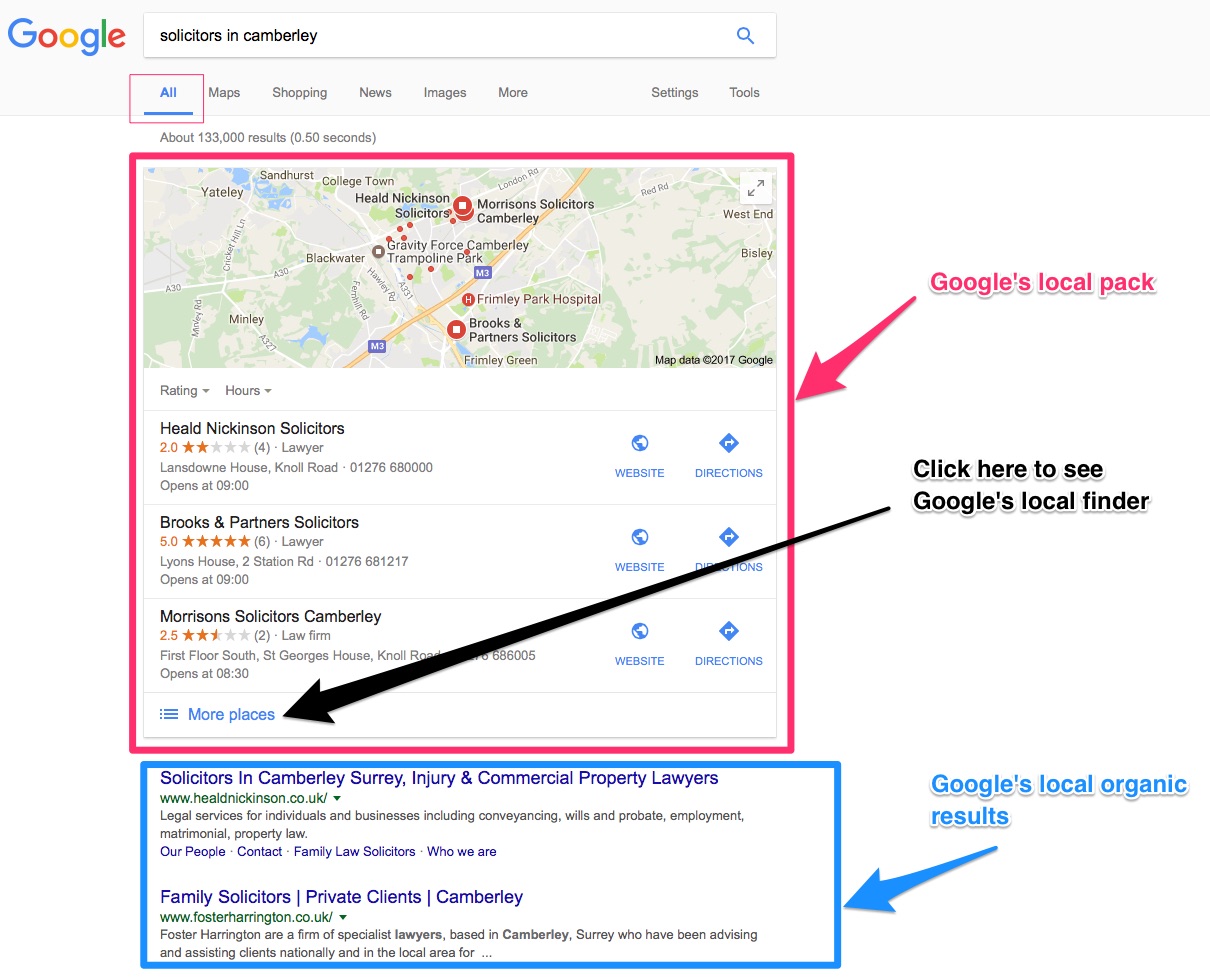
Google’s ranking algorithm for the Local Pack weighs specific signals that indicate your business deserves prominence in that geographic area. The quality and accuracy of your Google Business Profile is the first major factor. This includes having complete profile information with professional photos, accurate hours, detailed service descriptions, and verified contact information. Local search results are also influenced by citation consistency, meaning your business name, address, and phone number must match exactly across Google, Yelp, your website, local directories, and any other platform where you appear. A single typo in your address across one directory can confuse Google’s algorithms and tank your Local Pack ranking. Customer reviews carry enormous weight as well. Google prioritizes businesses with more reviews, higher average ratings, and recent review activity. A business with 47 reviews averaging 4.7 stars will almost always outrank a competitor with 8 reviews and a 4.9 rating. Recency matters too. A review from last week signals that your business is active and serving customers now, not years ago. Beyond these core factors, relevant keywords, high-quality content, backlink quality, and user experience all contribute to how Google evaluates your overall online authority and relevance to local searches.
Proximity to the searcher is another critical but often misunderstood ranking factor. If you’re a contractor in Los Angeles and someone searches for your service type in Los Angeles, being physically located there gives you an advantage. However, proximity isn’t absolute. A highly-rated business 20 miles away may rank above a barely-reviewed business 5 miles away. Google balances location with relevance and reputation. This is why businesses with strong review profiles and complete, optimized Google Business Profiles can rank for searches across a wider geographic area. You can also expand your service area in your Google Business Profile to indicate you serve surrounding neighborhoods or cities. The final ranking factors worth noting are local backlinks from community websites, local news mentions, and on-page content that targets location-specific keywords. A mention of your business on a local chamber of commerce website or a local news article about your services sends signals to Google that you’re an established, trusted part of your community.
Here’s what this means practically. Your Google Business Profile optimization is non-negotiable. It’s the single highest-impact action you can take for Local Pack ranking. After that, customer reviews become your primary focus. Reviews are the differentiator when two similar businesses compete for the same Local Pack spot. Then comes NAP consistency across all directories and your website. Finally, ensure your website content includes location-specific keywords naturally woven throughout your pages and service descriptions. A plumbing company in Phoenix should have content about Phoenix plumbing, Phoenix emergency repairs, and neighborhoods it serves. These elements working together create a local SEO foundation that attracts qualified leads actively searching for your services in your area.
Pro tip: Focus first on getting your Google Business Profile completely filled out with high-quality photos and accurate information, then systematically collect reviews from past customers by sending follow-up emails after each completed job asking them to leave a Google review.
Optimizing Google Business Profiles Effectively
Your Google Business Profile is the control center for how your service business appears across Google Search, Google Maps, and dozens of other Google properties. When potential customers search for your service, Google pulls information directly from your profile to display in search results and maps. If your profile is incomplete, outdated, or inaccurate, you’re essentially telling Google that your business isn’t worth showing to customers. The stakes are real. A business with a completely optimized profile typically receives 5 to 10 times more inquiries than an identical business with a neglected profile. You cannot afford to ignore this. The good news is that optimizing your Google Business Profile doesn’t require technical expertise or expensive software. It requires time, consistency, and attention to detail. Most service businesses can see measurable improvements within 2 to 4 weeks of proper optimization.
The Foundation: Accuracy and Completeness
Start with the basics. To optimize a Google Business Profile effectively, businesses should ensure accurate and complete information including business name, address, phone number, hours, and services. This isn’t just busywork. Every single field matters. Your business name must match exactly what appears on your business license and website. One character difference confuses Google’s algorithm. Your address must include the complete street address, city, state, and ZIP code with correct formatting. Your phone number should be the primary business line that customers actually call. Your hours need to reflect when you actually answer phones and serve customers, including seasonal adjustments or holiday closures. Services are critical too. Don’t just write “plumbing.” Write specific services: “emergency plumbing repair,” “water heater installation,” “drain cleaning,” “sewer line replacement.” Be as specific as possible. The more detailed your service list, the more search queries Google can match to your profile.
Beyond the basic information, you need to upload high-quality photos. Most service businesses make this mistake: they upload 2 to 3 blurry phone photos taken in their garage. That’s not going to cut it. Upload 15 to 25 professional photos that show your team, your work, your vehicles, and your professionalism. A customer making a decision between two plumbers will click on the one with clean, professional photos over the one with none. Photos also increase engagement and signal to Google that your business is active and legitimate. Update your profile every single week if possible. Post updates about seasonal services, special offers, or helpful tips. Keeping consistent information, regularly updating your profile with fresh content and photos, and engaging with customers through reviews are key steps to enhance visibility and attract potential local customers. Regular activity tells Google your business is current and responsive.
The Multiplier: Reviews and Engagement
Having an optimized profile with accurate information is the foundation, but responding to customer reviews is what makes it powerful. Google shows your response rate and tone to potential customers. When someone leaves a one-star review complaining about service, and you respond professionally within hours explaining what happened and offering to make it right, that responsiveness builds trust with future customers. Respond to every review, positive and negative. Thank customers for positive reviews. For negative reviews, acknowledge their concern, apologize sincerely, and offer a solution, preferably moving the conversation offline. Never get defensive or argumentative in your response. People reading reviews are watching how you handle criticism, and a professional response can actually convince them to hire you despite the bad review. Aim to collect at least 2 to 4 new reviews per month. Send follow-up texts or emails after completed jobs asking satisfied customers to leave a Google review. Make it easy by including a direct link to your review page. The businesses dominating their local markets aren’t necessarily the best at their craft. They’re the best at collecting and responding to reviews.
The Amplifier: Categories and Attributes
Google Business Profile categories and attributes are often overlooked, but they’re powerful for ranking. Select the most accurate primary category for your business type, then add secondary categories that apply. For a home services company, you might use “Home Repair Service” as primary and then add “Water Damage Restoration,” “Plumbing Contractor,” or “HVAC Contractor” as secondary categories. Use every relevant attribute Google offers. If you offer emergency services, select that. If you offer free estimates, select that. If you serve multiple neighborhoods or offer service appointments online, indicate those attributes. These details help Google match your business to exactly the right search queries from exactly the right customers.
Pro tip: Schedule a recurring weekly task to add one new Google Business Profile post and respond to any new reviews, treating it like a business obligation rather than something to do when you have free time.
Building Citations and Earning Reviews
Citations and reviews are the twin engines of local SEO for service businesses. Citations are online mentions of your business name, address, and phone number across directories and platforms. Reviews are what customers say about their experience with you. Together, they tell Google that your business is real, trustworthy, and actively serving customers in your community. Without both working in tandem, your local SEO efforts will stall. A service business that invests heavily in Google Business Profile optimization but ignores citations and reviews will never dominate local search results. The businesses that do dominate are relentless about building citations and collecting reviews. They treat it as a core business process, not a side project.
Citations: The Foundation of Trust
Building consistent citations across authoritative and relevant local directories supports trust and improves rankings. Think of citations as proof that you exist. Each time your business name, address, and phone number appear on an authoritative directory like Yelp, Angi, the Better Business Bureau, or industry-specific platforms, you’re adding another data point that confirms your legitimacy to Google. The key word here is consistent. Your NAP information must match perfectly across every directory where you appear. If your business is listed as “Smith Plumbing” on Google, “Smith Plumbing LLC” on Yelp, and “J Smith Plumbing” on Angi, Google sees three different businesses. It gets confused. Your ranking suffers. You need to audit every directory where your business currently appears and correct any inconsistencies immediately. Then you need to add your business to major directories in your industry and geographic area if you’re not already listed.
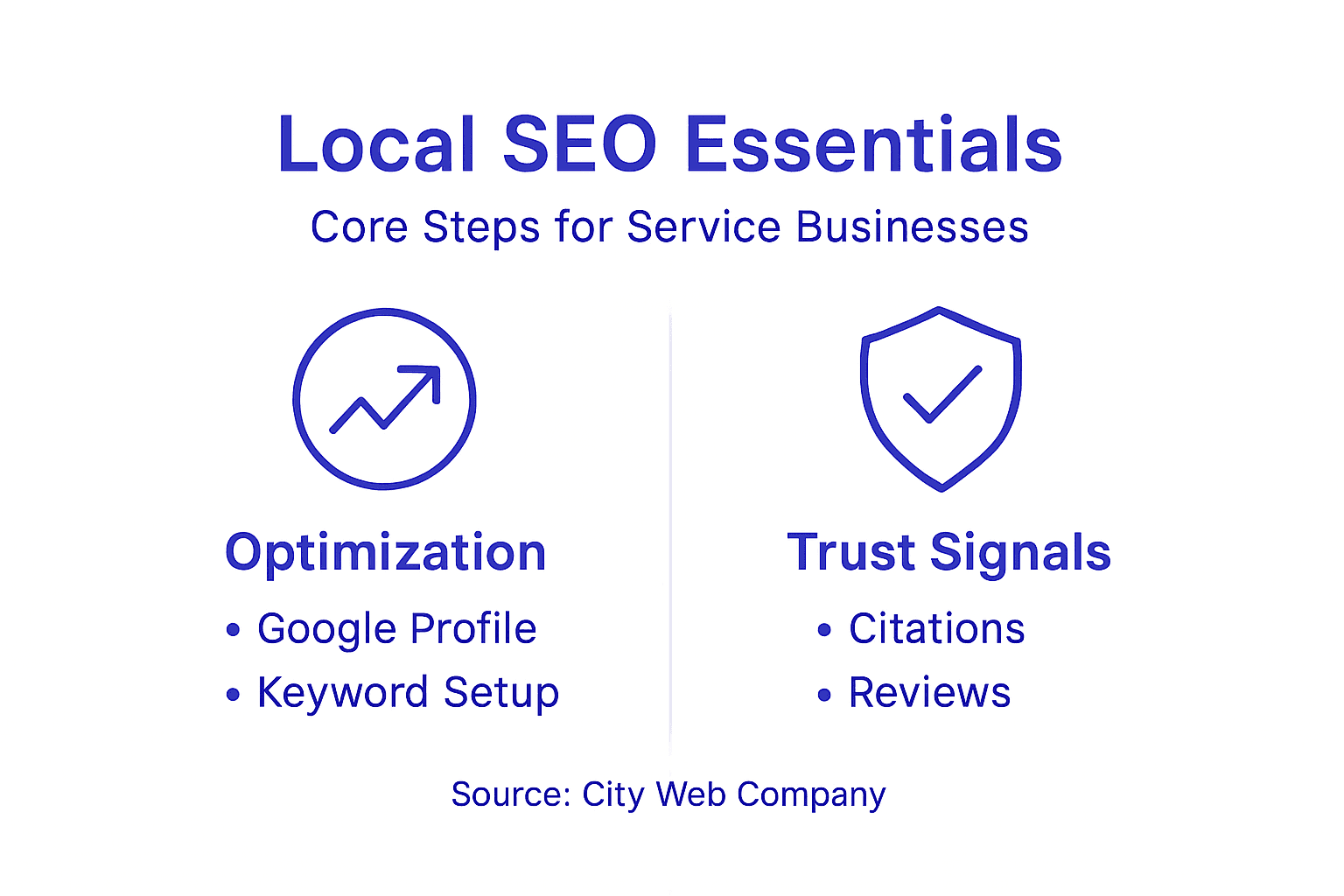

Start with the big directories that matter most for service businesses. Yelp is non-negotiable. Angi (formerly Angie’s List) is critical for home services. The Better Business Bureau adds credibility. Google Maps is already covered through your Google Business Profile. After those, add industry-specific directories. A plumber should be on plumbing association websites. An electrician should be registered with electrical contractor associations. A landscaper should appear on lawn care directories. The exact directories depend on your service type and location, but the principle stays the same: more consistent citations across authoritative sites equals more trust to Google. Aim for at least 10 to 15 quality citations. Quality matters more than quantity. One citation on a highly-authoritative, relevant directory is worth more than 50 citations on spammy or irrelevant sites.
Reviews: The Conversion Multiplier
Citations are online mentions of a business’s NAP details on third-party websites such as directories and social media, while earning reviews through excellent service and proactive requests increases visibility and builds customer trust. Reviews are more powerful than citations because they come from actual customers sharing actual experiences. A potential customer reading five reviews from neighbors who used your service and loved it will call you. A customer reading zero reviews might not take the risk. Google also prioritizes businesses with fresh, ongoing review activity. A business that receives two new reviews every month ranks higher than one that received 50 reviews three years ago and nothing since. The review frequency signal tells Google your business is still active and still serving customers well.
Collecting reviews requires a systematic process. You cannot rely on customers to spontaneously leave reviews. After every completed job, you need to ask for a review. Send an email or text message the day after work completion, thank the customer, and include a direct link to your Google review page. Make it genuinely easy. The link should take them directly to your review form, not require them to search for you and find your business. Track your review requests. If you complete 20 jobs per month, aim for 4 to 8 of those customers to leave reviews. That’s a conversion rate of 20 to 40 percent. Most service businesses achieve this easily when they ask consistently. Remember to respond to every review, positive and negative. A professional, thoughtful response to a negative review often impresses potential customers more than having no negative reviews at all. It shows you care about customer satisfaction and handle problems professionally. Encourage your best customers to leave reviews. They’re typically the ones most willing to do it, and their enthusiasm shows in the tone of their reviews.
Pro tip: Create a simple spreadsheet tracking which customers have been asked for reviews and whether they completed them, then follow up with customers who didn’t respond within a week with a second polite request via a different channel.
Common Mistakes and How to Avoid Them
Most service businesses fail at local SEO not because the strategy is complicated, but because they make preventable mistakes early on and never recover. These errors compound over time. A single inconsistency in your business information across directories might seem minor. But multiply that by five directories with five different versions of your address, and Google gets genuinely confused about where your business actually operates. Your rankings tank. Customers looking for you find your competitors instead. The good news is that the mistakes are predictable and avoidable. Understanding what goes wrong allows you to stay ahead of the 80 percent of service businesses doing local SEO incorrectly.
The Data Consistency Problem
Common local SEO mistakes include inconsistent business information across listings, neglecting to claim or verify Google Business Profiles, ignoring customer reviews, and failing to optimize for mobile devices. Inconsistent data is the most damaging error because it undermines everything else you do. You optimize your Google Business Profile perfectly. You collect reviews consistently. You add citations. Then your office number changes or you move to a slightly different address. You update Google Business Profile but forget to update Yelp, Angi, and your website. Now you have conflicting information across the internet. A customer searching for you might call a number that no longer works or get directions to an old address. Google sees conflicting signals about your location and deprioritizes your rankings.
The fix requires discipline and a tracking system. Create a spreadsheet listing every platform where your business appears: Google Business Profile, Yelp, Angi, Better Business Bureau, your website, industry directories, social media profiles, and anything else. Document the exact business name, address, phone number, and hours listed on each platform. Then verify that every single entry matches perfectly. One character difference creates a data inconsistency. After you’ve corrected everything, establish a quarterly audit process. Every three months, spot-check your top ten platforms to ensure consistency is still maintained. This takes 30 minutes per quarter and prevents disaster.
The Neglected Verification Problem
Many service business owners never formally claim their Google Business Profile. They assume it exists automatically or they set it up years ago and forgot about it. This is a critical mistake. If you haven’t verified your Google Business Profile ownership, you don’t control what customers see. Someone else could claim it. Incorrect information could be added. You can’t post updates or respond to reviews as the business owner. Verification takes 10 minutes. Go to Google Business Profile, search for your business, and follow the verification process. Google will send a postcard to your business address with a verification code, or verify you immediately if you have a sufficient online history. Do this today if you haven’t already. Then ensure you stay logged in and regularly check your profile for accuracy. Set a phone reminder to review your profile the first Monday of every month. Just five minutes of attention prevents major problems.
The Mobile Optimization Oversight
Over 60 percent of local searches happen on mobile devices. A service business whose website or Google Business Profile looks terrible on phones is losing customers before they even call. SEO mistakes often stem from ignoring fundamentals such as not optimizing website structure, missing targeted keywords, duplicating content, neglecting mobile friendliness, and overlooking backlinks quality. Your website must load fast on mobile. Your phone number must be clickable so customers can call with a single tap. Your address must be clearly visible with a link to Google Maps. Your service photos need to display properly on small screens. Test your website on an actual mobile phone, not just the mobile preview in your browser. Call your own business number to verify it works. Click on your address to verify the Google Maps link functions. A customer frustrated by a slow-loading website or unable to find your phone number will call your competitor instead.
The Review Avoidance Trap
Some business owners fear asking for reviews. They worry customers will leave bad reviews or feel pressured. This hesitation is expensive. Businesses with no reviews rank lower than identical businesses with reviews. Full stop. A customer comparing you to a competitor with five reviews will almost always choose the competitor. You’re not asking customers for charity. You’re asking them to share their honest experience if they’re satisfied. Most satisfied customers are happy to leave a quick review when asked. The key is asking systematically and respectfully. After every completed job, send a follow-up message saying you appreciate their business and would genuinely appreciate a review if they had a good experience. Make it easy by including a direct link. That’s not desperate. That’s professional business practice.
To help you identify gaps in your strategy, here’s a comparison of common local SEO mistakes and their outcomes:
| Mistake Type | Typical Cause | Consequence for Business |
| Data Inconsistency | Lack of tracking/updates | Lower rankings, confused customers |
| Unverified Listings | Not claiming profiles | No control over public info |
| Poor Mobile Experience | Ignoring mobile website design | Lost mobile leads, higher bounce |
| Review Inaction | Failing to request/respond | Fewer leads, damaged reputation |
Pro tip: Audit your business information across Google, Yelp, Angi, and your website right now, document any inconsistencies, and create a calendar reminder to verify consistency quarterly to prevent data corruption from derailing your local SEO.
Local SEO Strategies for Maximum Leads
Local SEO success isn’t about doing one thing perfectly. It’s about executing multiple strategies in coordination. Think of it like a construction project. A perfectly poured foundation means nothing if the walls are crooked. A beautiful exterior doesn’t matter if the roof leaks. Every component needs to work together. The same applies to local SEO. Your Google Business Profile optimization, citation building, review generation, and website content all need to work in concert. When they do, the results compound. You don’t get incremental improvements. You get exponential growth in leads. A service business that executes all five core strategies simultaneously will generate 10 times more qualified leads than a competitor executing only one or two.
The Five-Pillar Local SEO Framework
The foundation of any local SEO strategy that generates maximum leads starts with understanding what actually drives results. Effective local SEO strategies combine optimizing Google Business Profiles, accumulating quality citations, earning positive reviews, and producing locally relevant content. Each of these five pillars addresses a different ranking factor or customer trust signal. First, your Google Business Profile must be completely optimized with accurate information, professional photos, and regular updates. This is non-negotiable. Second, you need quality citations across relevant directories with consistent NAP information. Third, you must actively collect customer reviews and respond to them promptly. Fourth, your website content needs to target local keywords and answer questions customers actually ask. Fifth, you need local backlinks from community websites, local news mentions, or industry association websites that signal you’re an established part of your area.
Execute these five pillars simultaneously and watch what happens. Your Google Business Profile ranks higher because it has complete information and regular updates. Your citations reinforce your location legitimacy across the web. Your reviews build customer trust and improve your ranking in the local pack. Your website content captures long-tail local search traffic that Google Business Profile alone can’t address. Your local backlinks signal authority to Google. Together, they create a local SEO machine. A plumbing company executing all five pillars won’t just rank for “plumber” in their city. They’ll rank for “emergency plumber,” “drain cleaning,” “water heater replacement,” “burst pipe repair,” and dozens of other location-specific variations. They’ll appear in the local pack, in organic results, and across Google Maps. Customers searching for their services will find them everywhere.
Measurement and Continuous Refinement
Maximizing leads through local SEO involves a multi-faceted approach: optimizing on-page local keywords, maintaining a comprehensive and verified Google Business Profile, actively getting customer reviews, and creating engaging local content, while building authoritative local backlinks and tracking SEO performance metrics supports informed adjustments. Many service businesses implement local SEO tactics and then abandon them because they don’t see results immediately. This is where most fail. Local SEO doesn’t work like paid advertising. You don’t get leads the day you optimize your Google Business Profile. But you do get leads after 30 days, 60 days, and 90 days as your signals accumulate and Google recognizes your increased relevance. The businesses winning at local SEO track their metrics religiously.
Set up Google Analytics to track how many visitors arrive from local search. Set up Google Search Console to track which local keywords trigger your appearance in search results and how high you rank for those keywords. Track your Google Business Profile impressions and actions monthly. Create a simple spreadsheet tracking your review count and average rating on Google, Yelp, and other key platforms. Set monthly targets. Aim for 5 to 10 new reviews per month. Aim for your Google Business Profile to reach 50, then 100, then 200 monthly impressions. Aim for your website to capture 50, then 100, then 200 organic visits from local search monthly. These metrics might seem small, but they compound. After six months of consistent execution, you’re not measuring single-digit improvement. You’re measuring 200 to 400 percent growth in qualified leads. That’s the power of local SEO when executed correctly.
The Competitive Advantage Window
Right now, most of your competitors are doing local SEO poorly or not at all. This is your advantage window. The service businesses that dominate their local markets five years from now will be the ones that start executing these strategies today. Local SEO isn’t a sprint. It’s a 90-day sprint that turns into a marathon. The first 90 days deliver the most visible results as you catch up to basic best practices. The next 90 days deliver refinement and competitive advantage as you outpace competitors. After that, you’re in maintenance mode, continuously collecting reviews and adding content, but your market position is established. The hardest part isn’t the strategy. The strategy is straightforward. The hardest part is consistency. Pick your five pillars. Execute them. Track your results. Refine based on what’s working. Do this for 90 days without stopping. Most businesses fail at this simple commitment. The ones that don’t will own their local market.
Pro tip: Set up a simple monthly tracking spreadsheet with columns for Google Business Profile impressions, clicks, customer reviews count and rating, website local traffic, and citation consistency audit results, then review it the first Friday of each month to spot trends and identify which strategies need adjustment.
Unlock Powerful Local SEO to Skyrocket Your Service Business Leads
Are you struggling with inconsistent business information, low review counts, or an underperforming Google Business Profile? These are common challenges that hold back many service businesses from capturing the full potential of local search traffic. This article reveals critical insights on optimizing your local SEO foundation—focusing on accurate citations, robust customer reviews, and your Google Business Profile. But knowing the steps is only half the battle. Implementing these strategies consistently while managing your digital presence can feel overwhelming. That is where expert support makes all the difference.
At City Web Company, we specialize in helping service businesses dominate their local markets through tailored Local SEO & Google Business Tips | City Web Company designed specifically for home service providers, legal professionals, healthcare practices, and more. We ensure your business information is flawless everywhere, build your review portfolio actively, and create local content that drives ready-to-hire leads straight to your door. Don’t let your competitors win because of minor SEO mistakes or lack of time to execute the right strategies.
Ready to see your calls and bookings surge? Take control now by connecting with our digital marketing experts. Visit Contact City Web Company to begin your journey to local SEO success and sustainable lead growth. For ongoing marketing insights, explore our Social Media Marketing Tips & Tools | City Web Company to amplify your brand’s voice and customer engagement.
Frequently Asked Questions
What is local SEO, and why is it important for service businesses?
Local SEO is the process of optimizing your business’s online presence to appear prominently in local search results. It’s crucial for service businesses because potential customers typically search for local services, and they prefer to hire nearby companies that can meet their needs promptly.
How can I optimize my Google Business Profile effectively?
To optimize your Google Business Profile, ensure all information is accurate and complete, including your business name, address, phone number, hours, and a detailed list of services. Additionally, upload high-quality photos, post regular updates, and actively engage with customer reviews.
What role do customer reviews play in local SEO?
Customer reviews significantly impact local SEO by enhancing your business’s credibility and trustworthiness. Google prioritizes businesses with more positive reviews, higher ratings, and recent activity, leading to better visibility in local search results.
How can citations improve my local SEO ranking?
Citations are online mentions of your business’s name, address, and phone number across various directories. Consistent citations across authoritative platforms reinforce your legitimacy, improve your SEO ranking, and support trust signals to Google, making it more likely for customers to find your business online.
Recommended
These articles were popular with other readers too: