

Use website DNI, connect call reports to Google Ads and your Google Business Profile, then tie calls to booked jobs. City Web Company can handle setup.
Why Choose Local Marketing for Service Businesses
Connecting with customers right outside your door can be the deciding factor for business growth. For American home service companies, winning local trust means more calls, bookings, and steady repeat clients. Local marketing sits between mass and individual marketing, giving your business the precision to stand out in your target neighborhood. Discover practical steps to shape your marketing for the places and people who matter most, making sure your message feels familiar and your reputation grows stronger.
Table of Contents
Table of Contents
- Defining Local Marketing And Its Core Role
- Key Local Marketing Strategies Explained
- How Local Marketing Drives Client Growth
- Common Pitfalls And How To Avoid Them
- Comparing Local And National Digital Marketing
Key Takeaways
| Point | Details |
|---|---|
| Local Marketing Focuses on Specific Regions | Tailoring marketing efforts to local areas enhances customer engagement and visibility compared to national campaigns. |
| Key Strategies Include Digital and Community Engagement | Utilizing targeted digital advertising and creating local community connections drives customer trust and loyalty. |
| Personalization is Essential for Success | A data-driven approach to customize messaging based on local customer preferences significantly boosts client acquisition. |
| Avoid Common Mistakes for Effective Campaigns | Minimizing generic messaging and investing in digital presence are crucial to resonate with local audiences and avoid disconnect. |
Defining Local Marketing and Its Core Role
Local marketing represents a strategic approach that allows service businesses to target potential customers within a specific geographic area with precision and relevance. Unlike broad national campaigns, this marketing technique focuses on connecting directly with the immediate community surrounding a business location.
At its core, local marketing is about tailoring marketing strategies to geographic segments that are smaller than national markets. It sits strategically between mass marketing and individual marketing approaches, enabling businesses to craft messages that resonate with local preferences, cultural nuances, and community needs. Service businesses like plumbers, landscapers, home repair professionals, and local retailers particularly benefit from this targeted approach.
The primary goal of local marketing is increasing visibility and engagement within a specific radius around a business location. By understanding local customer characteristics, service businesses can develop highly targeted advertising, optimize their online presence for local search results, and create marketing materials that speak directly to neighborhood-specific interests and challenges. Local marketing targets nearby potential customers who are most likely to need and utilize the specific services being offered.
Pro tip: Conduct a detailed demographic analysis of your local community to understand precise customer needs, preferences, and communication channels for maximum marketing effectiveness.
Key Local Marketing Strategies Explained
Successful local marketing requires a multi-dimensional approach that leverages both digital and traditional channels to connect with potential customers. Localised marketing strategies demand a nuanced understanding of community dynamics and targeted communication techniques that resonate with specific geographic audiences.
Key strategies for service businesses include geographically targeted digital advertising, local search engine optimization, and strategic community engagement. Businesses can optimize their online presence by claiming and updating Google Business Profile listings, encouraging customer reviews, and creating location-specific content that addresses local customer needs. Social media platforms offer powerful tools for targeting advertisements to specific zip codes, neighborhoods, and demographic segments, allowing service providers to reach precisely the right audience.
Building authentic community connections is another critical component of effective local marketing. This might involve sponsoring local events, participating in neighborhood associations, collaborating with complementary local businesses, and creating marketing materials that reflect local culture and values. By demonstrating genuine investment in the community, service businesses can establish trust and differentiate themselves from national competitors who lack local understanding.

Pro tip: Develop a hyperlocal content strategy that highlights your business’s unique connection to the community, using specific neighborhood references and locally relevant storytelling.
The table below summarizes key local marketing strategies and their unique business impacts:
| Strategy | Main Focus | Business Impact |
|---|---|---|
| Geotargeted Digital Advertising | Reach local online users | Increases leads in target radius |
| Local Search Optimization | Boost local search presence | Improves local discoverability |
| Community Sponsorship/Events | Real-life neighborhood involvement | Builds trust and positive reputation |
| Customer Reviews Management | Encourage local client feedback | Enhances credibility, drives choices |
| Hyperlocal Content Creation | Share locally relevant stories | Drives engagement and local loyalty |
How Local Marketing Drives Client Growth
Local marketing serves as a powerful engine for client acquisition and business expansion by creating deep, meaningful connections with potential customers in specific geographic markets. Marketing strategies targeting local consumer preferences enable businesses to develop more personalized and emotionally resonant approaches that significantly enhance customer engagement and loyalty.
The client growth mechanism of local marketing operates through multiple strategic channels. By tailoring product offerings, pricing structures, and promotional content to specific neighborhood demographics, service businesses can create a sense of unique value that national competitors cannot easily replicate. Digital platforms like targeted social media advertising, geographically focused Google Ads, and location-specific content marketing allow businesses to reach precisely the right audience with messaging that feels intimate and relevant.
Data-driven personalization represents the most sophisticated approach to driving client growth through local marketing. Advanced analytics enable businesses to segment their local market, understand granular customer preferences, and create hyper-targeted marketing campaigns that speak directly to local consumers’ needs. This approach transforms generic marketing into a precision instrument for attracting and retaining clients by demonstrating an authentic understanding of local market dynamics and individual customer expectations.
Pro tip: Conduct quarterly local market research to continuously refine your understanding of neighborhood customer preferences and adjust your marketing strategies accordingly.
Common Pitfalls and How to Avoid Them
Local marketing success requires strategic awareness of potential missteps that can undermine even the most well-intentioned campaigns. Common local marketing mistakes often stem from a disconnect between business intentions and authentic community engagement, creating barriers to effective client acquisition and brand perception.
One significant pitfall is the tendency to apply generic national marketing strategies without meaningful localization. Service businesses frequently make the error of using standardized messaging that fails to resonate with specific neighborhood characteristics. This approach leads to marketing materials that feel impersonal and disconnected from local customer experiences. Successful local marketing demands deep understanding of community nuances, including local language patterns, cultural references, economic conditions, and specific customer pain points that distinguish one geographic market from another.
Another critical mistake involves insufficient investment in digital infrastructure and local online presence. Many service businesses underestimate the importance of maintaining accurate Google Business Profile listings, generating consistent local customer reviews, and creating location-specific content that signals relevance to both potential customers and search engine algorithms. Businesses must also avoid the trap of sporadic marketing efforts, instead developing consistent, integrated strategies that build trust and demonstrate genuine commitment to the local community.
Pro tip: Develop a comprehensive local marketing audit process that evaluates your strategies quarterly, measuring engagement metrics and community perception to continuously refine your approach.
Comparing Local and National Digital Marketing
Digital marketing strategies differ fundamentally in their approach, scale, and targeted outcomes, with local and national campaigns serving distinct business objectives. Local marketing strategies focus on precision targeting within specific geographic boundaries, offering service businesses an opportunity to create deeply personalized customer experiences that national campaigns cannot replicate.
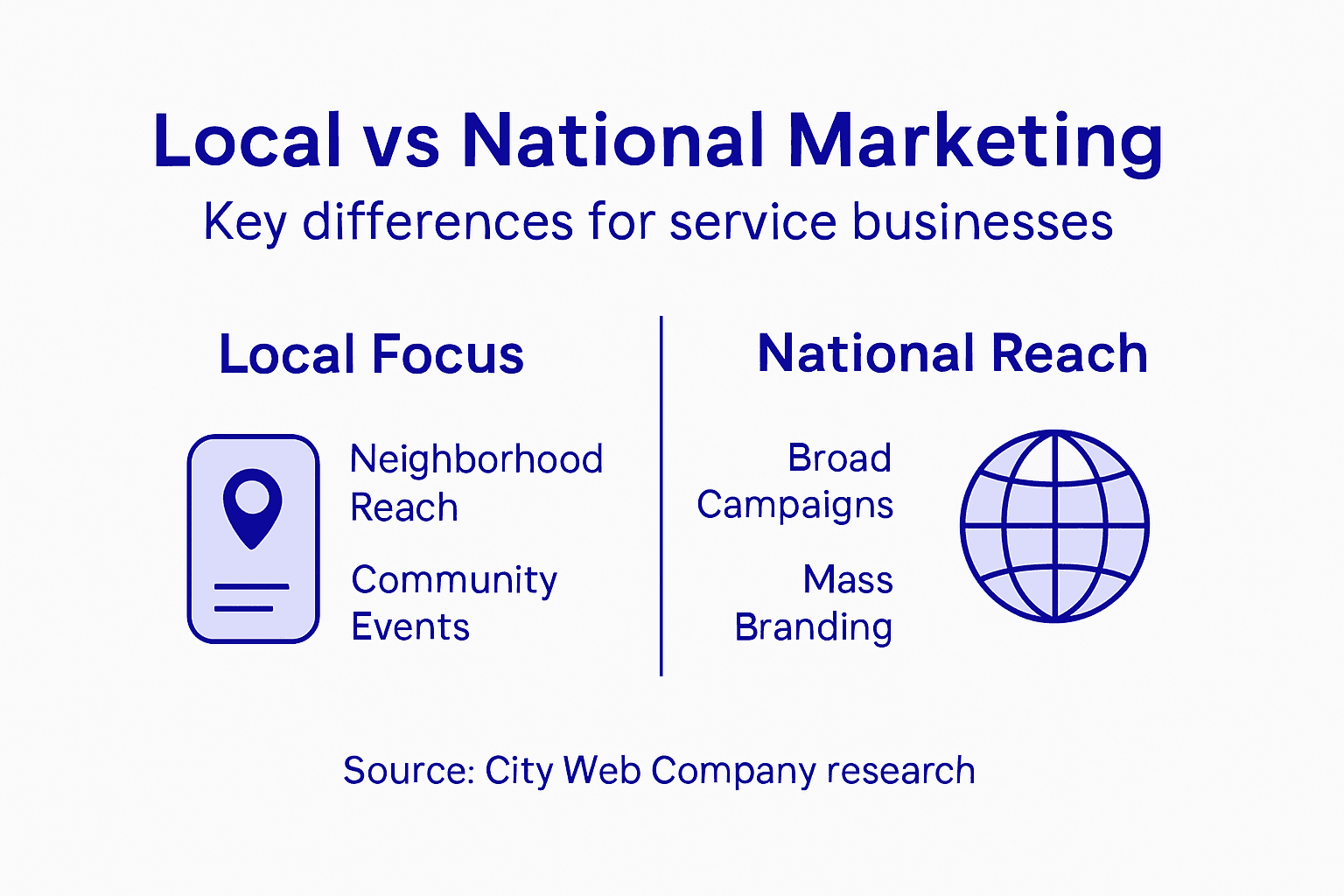

National digital marketing approaches prioritize broad reach and mass communication, utilizing high-budget advertising channels like network television, large-scale social media campaigns, and widespread digital advertising networks. In contrast, local digital marketing operates with surgical precision, leveraging neighborhood-specific keywords, geotargeted social media advertising, and community-centered content that speaks directly to local customer needs. This granular approach allows service businesses to create marketing messages that feel intimate, relevant, and authentically connected to the immediate community.
The most effective digital marketing strategies often incorporate hybrid approaches that blend local and national tactics. While national campaigns provide brand awareness and broader market positioning, local marketing drives immediate customer engagement and conversion. Service businesses can maximize their marketing effectiveness by using national strategies for brand recognition and local strategies for customer acquisition, creating a comprehensive approach that balances broad visibility with targeted, personalized outreach.
Here’s a quick overview of how local marketing compares to national marketing strategies:
| Aspect | Local Marketing | National Marketing |
|---|---|---|
| Target Audience | Specific neighborhoods or regions | Entire country or broad regions |
| Message Personalization | Tailored to local culture | Generic, wide-reaching |
| Cost Efficiency | Lower, highly focused spend | Higher, larger reach |
| Community Engagement | High, relationship-driven | Limited, less personal |
| Speed of Results | Generally faster local results | Slower, scaled outcomes |
Pro tip: Develop a flexible marketing strategy that allocates budget across both local and national channels, continuously measuring performance and adjusting your approach based on real-time engagement metrics.
Unlock the Power of Precision Local Marketing for Your Service Business
If you are struggling to connect with your neighborhood customers or feeling lost in broad, generic marketing campaigns you are not alone. Many service businesses face challenges like low local visibility and weak community engagement. This article highlights the importance of tailoring strategies such as local search optimization and geotargeted advertising to truly resonate with your immediate audience and drive real client growth.
City Web Company specializes in creating customized digital marketing solutions that convert local leads into loyal customers. Explore our Digital Marketing Strategy Guides | City Web Company for expert insights and leverage our PPC & Paid Ad Strategies | City Web Company to promote your business exactly where it matters most.
Take control of your local marketing efforts today and experience the difference focused campaigns make. Visit City Web Company Contact Page to get started with a team dedicated to your service business success in your community.
Frequently Asked Questions
What is local marketing and why is it important for service businesses?
Local marketing is a strategy that focuses on targeting potential customers within a specific geographic area. It is important for service businesses as it allows them to connect directly with their community, increasing visibility and engagement with customers who are most likely to need their services.
How can service businesses effectively implement local marketing strategies?
Service businesses can implement local marketing strategies by optimizing their online presence, claiming Google Business Profile listings, using geotargeted digital advertising, and engaging with the community through sponsorships and events tailored to local interests.
What are some common mistakes to avoid in local marketing?
Common mistakes in local marketing include using generic marketing strategies that lack localization, insufficient investment in maintaining accurate online profiles, and inconsistent marketing efforts that do not build a genuine connection with the community.
How does local marketing contribute to client growth for service businesses?
Local marketing contributes to client growth by enabling businesses to create personalized marketing campaigns tailored to specific neighborhood demographics. This targeted approach fosters greater customer engagement and loyalty, making it easier to attract and retain clients.
Recommended
- 7 Key Benefits of Local SEO for Service Businesses
- Why Digital Marketing Matters for Local Service Businesses
- Local SEO Services for Small Businesses: Drive More Traffic – City Web Company | Digital Marketing Agency
- SEO for Home Services: Driving Local Leads and Growth
- Why Choose Local Detailers for Superior Results
These articles were popular with other readers too: