

Use website DNI, connect call reports to Google Ads and your Google Business Profile, then tie calls to booked jobs. City Web Company can handle setup.
Streamline your online advertising workflow for local leads
Managing online advertising workflows can feel overwhelming for local service business owners juggling customer calls, scheduling, and day-to-day operations. Complex ad platforms, confusing metrics, and constant budget decisions drain valuable time that could be spent growing your business. In 2026, local service businesses need a streamlined, efficient advertising workflow that generates quality leads without requiring a marketing degree. This guide provides a clear, actionable framework to simplify your online advertising process, maximize lead generation, and boost revenue through proven strategies tailored specifically for service-based businesses.
Table of Contents
Table of Contents
- Understanding Local Service Ads And Their Workflow Advantages
- Preparing Your Business For An Effective Online Advertising Workflow
- Executing Your Online Advertising Workflow: Launching And Managing Campaigns
- Verifying Success And Troubleshooting Common Online Advertising Workflow Issues
- Improve Your Online Advertising Workflow With Expert Local SEO Services
- Frequently Asked Questions
Key takeaways
| Point | Details |
|---|---|
| Local Service Ads simplify lead generation | LSAs appear at the very top of Google search results and use a pay-per-lead model, making them ideal for busy service businesses. |
| Streamlined workflows save time and money | Combining LSAs with traditional Search campaigns provides flexibility and control while automating routine tasks. |
| Verification builds customer trust | Passing Google’s screening process earns trust badges that significantly improve ad visibility and lead quality. |
| Reviews directly impact results | Actively managing customer reviews enhances ad ranking and attracts higher-quality leads to your business. |
| Regular optimization maintains performance | Monitoring metrics and reallocating budgets between campaign types ensures sustained lead generation and ROI. |
Understanding local service ads and their workflow advantages
Local Service Ads represent a game-changing opportunity for service businesses seeking simpler, more effective online advertising. Unlike traditional pay-per-click campaigns that charge you for every click regardless of outcome, LSAs use a pay-per-lead model where you pay only when potential customers call or message you directly through the ad. This fundamental difference eliminates wasted spend on tire kickers and focuses your budget exclusively on genuine inquiries.
The workflow advantages become immediately apparent when you compare setup complexity. Traditional Google Search ads require extensive keyword research, ad copy writing, landing page optimization, and ongoing bid management. LSAs automate most of these tasks by pulling information directly from your business profile and matching you with relevant customer searches. Google handles ad creation, keyword targeting, and placement decisions, freeing you to focus on converting leads into paying customers.
LSAs appear at the very top of Google search results, above all other ads and organic listings. This prime real estate provides unparalleled visibility when potential customers search for services in your area. The prominent placement combined with trust badges creates an immediate credibility boost that traditional ads struggle to match.
For local service businesses, LSAs offer several distinct workflow benefits:
- Minimal setup time compared to traditional campaign building
- Automated ad creation eliminates copywriting requirements
- Pay-per-lead pricing protects your budget from click fraud
- Mobile-optimized format captures on-the-go searchers
- Direct connection features like click-to-call streamline customer contact
The trade-off involves less granular control over targeting and messaging. While traditional Search campaigns let you craft specific ad copy, test different headlines, and target precise keyword phrases, LSAs standardize the experience. LSAs are suitable for small budgets and easy for small businesses to manage without dedicated marketing staff.
Earning Google Guaranteed or Google Screened badges through the screening process significantly enhances your LSA performance. These trust indicators appear prominently on your ads and signal to potential customers that Google has verified your credentials. The screening requirement might seem like an extra hurdle, but it actually works in your favor by filtering out unqualified competitors and elevating your business above those unwilling to complete verification.
Pro Tip: Regularly check your LSA profile details during setup to ensure accuracy and maximize performance. Small errors in service descriptions or coverage areas can prevent your ads from showing for relevant searches.
Understanding these fundamental differences helps you build realistic expectations and design a workflow that leverages LSA strengths while compensating for limitations through complementary strategies. Many successful service businesses discover that Google Local Service Ads work best as part of a broader advertising approach rather than a standalone solution.
Preparing your business for an effective online advertising workflow
Before launching any online advertising campaign, proper preparation determines whether you’ll generate quality leads or waste money on poorly targeted ads. The foundation starts with completing Google’s screening process, which validates your business credentials and unlocks the trust badges that dramatically improve ad performance.
LSAs require businesses to pass Google’s screening process, including license, insurance, and background checks, to display a Google Guaranteed or Google Screened badge. Gather these documents before starting your application to avoid delays:
- Current business licenses specific to your trade and location
- Proof of general liability insurance meeting Google’s minimum coverage requirements
- Workers’ compensation insurance if you have employees
- Professional certifications relevant to your industry
- Background check authorization for business owners and employees
The verification process typically takes one to three weeks depending on your industry and location. Plan accordingly and don’t wait until you’re ready to launch campaigns to begin gathering documentation. Some licenses or insurance policies may need updating or renewal, which can add weeks to your timeline.
Once approved, invest time creating a complete and accurate LSA business profile. Google pulls information from this profile to match you with relevant searches and display your services to potential customers. Incomplete or vague profiles limit your visibility and reduce lead volume. Include detailed service descriptions, accurate coverage areas, business hours, and high-quality photos of your team and work.

Reviews play an outsized role in LSA success compared to traditional advertising. Potential customers see your star rating and review count prominently displayed alongside your ad. A strong review profile builds immediate trust and increases the likelihood that searchers will contact you instead of competitors. Start collecting reviews from satisfied customers well before launching ads to establish a solid foundation.
Pro Tip: Double-check all business info and service descriptions during setup and don’t rely solely on Google’s automation. The system sometimes pulls outdated information from other sources or makes incorrect assumptions about your service offerings.
Develop a systematic approach to requesting and managing reviews:
- Ask satisfied customers for reviews immediately after completing excellent work
- Make the review process easy by providing direct links to your Google Business Profile
- Respond professionally to all reviews, both positive and negative
- Address negative feedback quickly and offer solutions publicly
- Monitor review platforms regularly to catch and respond to new feedback
Your step-by-step Google Ads setup should include profile optimization as a critical milestone. Service businesses that skip this preparation phase consistently underperform those that invest time upfront building a strong foundation. The difference between a hastily created profile and a thoughtfully optimized one can mean hundreds of additional leads over the course of a year.
Consider how potential customers search for your services when defining your offerings. Generic descriptions like “plumbing services” miss opportunities to capture specific searches like “emergency pipe repair” or “water heater installation.” The more precisely you define your services, the better Google can match you with high-intent searchers ready to hire.
Finally, ensure your business information remains consistent across all online platforms. Discrepancies between your LSA profile, Google Business Profile, website, and other directories confuse both Google and potential customers. This consistency becomes even more important when you learn how to advertise locally on Google using multiple strategies simultaneously.
Executing your online advertising workflow: launching and managing campaigns
With preparation complete, launching your Local Service Ads becomes straightforward. Log into your LSA dashboard and verify that all profile information appears correct. Set your initial weekly budget conservatively, starting with an amount you’re comfortable spending while learning the platform. You can always increase budgets once you understand lead quality and conversion rates.
Monitor incoming leads closely during your first few weeks. LSAs generate two types of leads: phone calls and messages. Track which services generate the most inquiries, what times of day you receive leads, and most importantly, which leads convert into paying customers. This data informs budget decisions and service prioritization as you optimize your workflow.
While LSAs offer simplicity and automation, most advertisers use both LSAs and Search campaigns and shift budgets based on which delivers better long-term results. Understanding when to use each approach maximizes your advertising effectiveness:
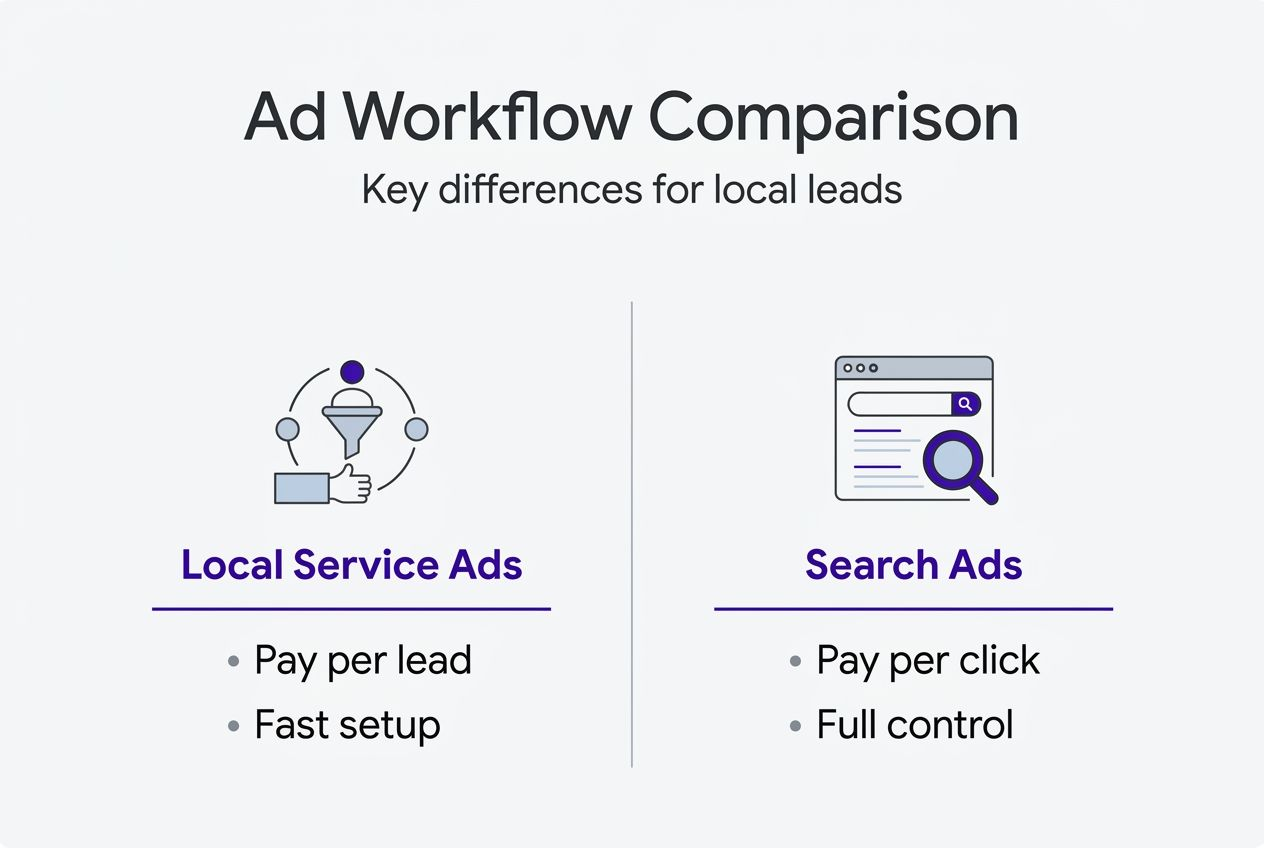

| Feature | Local Service Ads | Traditional Search Ads |
|---|---|---|
| Cost model | Pay per lead | Pay per click |
| Setup complexity | Low, mostly automated | High, requires detailed configuration |
| Control over messaging | Limited, standardized format | Full control over ad copy and landing pages |
| Best use case | Immediate lead generation with minimal management | Brand building and targeting specific customer segments |
| Budget flexibility | Set weekly maximums | Daily budgets with flexible bidding strategies |
Combining both approaches creates a robust advertising workflow. Use LSAs to capture high-intent searchers ready to hire immediately while running Search campaigns to build brand awareness, target specific services, or reach customers earlier in their decision process. This dual strategy provides backup if one channel experiences performance fluctuations and helps you dominate search results across multiple positions.
Common pitfalls derail many service businesses when managing campaigns. Avoid these mistakes:
- Setting budgets too low to generate meaningful lead volume
- Ignoring lead quality metrics and focusing solely on quantity
- Failing to respond quickly to incoming leads
- Neglecting to pause campaigns during busy periods when you can’t handle new work
- Not tracking which leads convert into revenue
Implement these best practices for ongoing campaign optimization:
- Review performance metrics weekly and adjust budgets accordingly
- Test different service offerings to identify your most profitable niches
- Maintain consistent response times to preserve your ad ranking
- Update your profile seasonally to reflect changing service availability
- Monitor competitor activity and adjust your strategy as needed
Pro Tip: Regularly review and reallocate budgets between LSAs and Search campaigns based on performance metrics. What works best often shifts seasonally or as your business grows.
The key to optimizing Google Ads for local leads lies in continuous testing and refinement. Start with conservative budgets, gather data, make informed adjustments, and scale what works. This methodical approach prevents costly mistakes while building a sustainable lead generation system.
Develop a weekly campaign management routine:
- Check lead volume and quality from the previous week
- Review your budget pacing and adjust if needed
- Respond to any pending messages or missed calls
- Monitor your review profile and respond to new feedback
- Compare performance across different services
- Document what’s working and what needs improvement
Consistency matters more than perfection when managing campaigns. Service businesses that dedicate 30 minutes weekly to campaign management consistently outperform those that ignore their ads for weeks then make reactive changes. Understanding why you should invest in Google Ads helps maintain motivation during slower periods when results might temporarily dip.
As you gain experience, you’ll develop intuition about when to increase budgets, which services generate the best leads, and how to balance LSAs with other advertising channels. This knowledge transforms online advertising from a confusing obligation into a reliable business growth engine. The Google Ads ultimate guide provides additional strategies for businesses ready to expand beyond basic LSA management.
Verifying success and troubleshooting common online advertising workflow issues
Tracking the right metrics separates successful advertising workflows from money-wasting experiments. Focus on three key performance indicators: lead volume, lead quality, and cost per lead. Lead volume tells you whether your ads reach enough potential customers. Lead quality reveals whether those leads match your ideal customer profile and convert into revenue. Cost per lead helps you evaluate profitability and make informed budget decisions.
Calculate cost per lead by dividing your total advertising spend by the number of leads received. A $500 weekly budget generating 20 leads costs $25 per lead. Whether that’s profitable depends on your average job value and closing rate. If you close 50% of leads at an average job value of $400, each lead generates $200 in revenue, making $25 per lead highly profitable.
Identifying common problems early prevents wasted spend and frustration. Low lead volume typically indicates one of several issues: budgets set too low for your market, incomplete profile information limiting ad visibility, or service descriptions that don’t match how customers search. Review your profile completeness score and expand service offerings if you’re missing relevant categories.
Poor lead quality manifests as inquiries from outside your service area, requests for services you don’t offer, or tire kickers shopping for unrealistic prices. Tighten your service area boundaries, remove services you no longer want to promote, and ensure your profile clearly communicates your business positioning. Sometimes attracting fewer but better qualified leads improves profitability more than maximizing volume.
Account suspensions occur when businesses violate Google’s advertising policies or fail to maintain required credentials. Common triggers include expired licenses, lapsed insurance, customer complaints about service quality, or attempts to manipulate reviews. Maintain current documentation, deliver excellent service, and follow all platform guidelines to avoid disruptions.
Use this troubleshooting checklist when campaigns underperform:
- Verify all business credentials remain current and valid
- Check that your service area settings match where you actually work
- Review your weekly budget to ensure it’s not exhausting too early
- Confirm you’re responding to leads within recommended timeframes
- Analyze your review profile for recent negative feedback
- Compare your pricing and service offerings to local competitors
Reviews are especially important in LSAs, as they appear prominently and heavily influence results. A single negative review can tank your lead volume if left unaddressed. Respond professionally to criticism, offer to make things right, and demonstrate to future customers that you care about satisfaction.
Quick fixes for common workflow issues:
- Low morning lead volume: Increase budgets or adjust scheduling preferences
- Leads outside service area: Tighten geographic boundaries in your profile
- Spam or unqualified inquiries: Add service minimums or qualifications to your description
- Competitors outranking you: Improve your review count and rating
- Budget exhausting mid-week: Increase weekly maximum or pause lower-performing services
Reviews heavily influence LSA results and appear prominently. Service businesses must actively manage their online reputation to maintain competitive ad performance and attract quality leads.
Develop ongoing maintenance tasks to sustain performance:
- Request reviews from satisfied customers immediately after job completion
- Monitor your LSA dashboard daily for new leads requiring response
- Update service availability based on seasonal demand changes
- Refresh profile photos quarterly to showcase recent work
- Audit competitor profiles monthly to identify positioning opportunities
Pro Tip: Promptly respond to customer reviews to enhance trust and ad ranking. Google prioritizes businesses that actively engage with customer feedback.
Most workflow issues stem from neglect rather than platform limitations. Businesses that treat online advertising as a set-it-and-forget-it solution inevitably see declining results. Commit to regular monitoring and optimization, and your advertising workflow becomes a predictable lead generation system rather than a frustrating expense. Understanding why you should invest in online advertising for local services reinforces the value of this ongoing commitment.
Improve your online advertising workflow with expert local SEO services
Building an effective online advertising workflow requires time, expertise, and constant optimization. Many service business owners find themselves overwhelmed managing campaigns while running day-to-day operations. City Web Company specializes in creating streamlined advertising workflows specifically designed for local service businesses like yours.

Our team handles everything from initial local SEO services for small businesses to ongoing campaign management, freeing you to focus on serving customers. We implement proven strategies that generate qualified local leads while maximizing your advertising ROI. Whether you need help with step-by-step Google Ads setup or want to improve your search engine ranking, our local marketing experts deliver measurable results that grow your business.
Frequently asked questions
What is the main difference between Local Service Ads and traditional Google Search ads?
Local Service Ads use a pay-per-lead model where you pay only when customers contact you directly, while traditional Search ads charge per click regardless of whether visitors become leads. LSAs automate ad creation and keyword targeting, offering less control but simpler management. Search ads provide full control over messaging, targeting, and landing pages but require more expertise to manage effectively.
How can local service businesses ensure they get approved for Local Service Ads?
Businesses must provide valid licenses specific to their trade and location, proof of general liability insurance meeting Google’s requirements, and pass background checks for owners and employees. Gather all documentation before starting the application process to avoid delays. Most approvals take one to three weeks, so plan accordingly and ensure all credentials remain current to maintain your Google Guaranteed or Screened badge.
Why are reviews important for Local Service Ads?
Reviews heavily influence LSA results and appear prominently alongside your ads. Potential customers see your star rating and review count before deciding whether to contact you, making reviews a critical trust signal. Higher review counts and better ratings improve your ad ranking, increase lead volume, and attract higher-quality customers who trust businesses with strong reputations.
How much should local service businesses budget for online advertising in 2026?
Start with a weekly LSA budget between $200 and $500 depending on your market competitiveness and lead value. Monitor cost per lead and conversion rates for at least four weeks before making significant budget changes. Profitable campaigns typically generate leads at 10 to 20% of average job value, so a business with $500 average jobs should target $50 to $100 cost per lead.
Can businesses run Local Service Ads and traditional Search campaigns simultaneously?
Yes, and most successful advertisers use both approaches to maximize reach and control. LSAs capture high-intent searchers ready to hire immediately while Search campaigns build brand awareness and target specific customer segments. Allocate 60 to 70% of your budget to the channel performing best and adjust monthly based on lead quality and conversion data.
Recommended
These articles were popular with other readers too: