

Use website DNI, connect call reports to Google Ads and your Google Business Profile, then tie calls to booked jobs. City Web Company can handle setup.
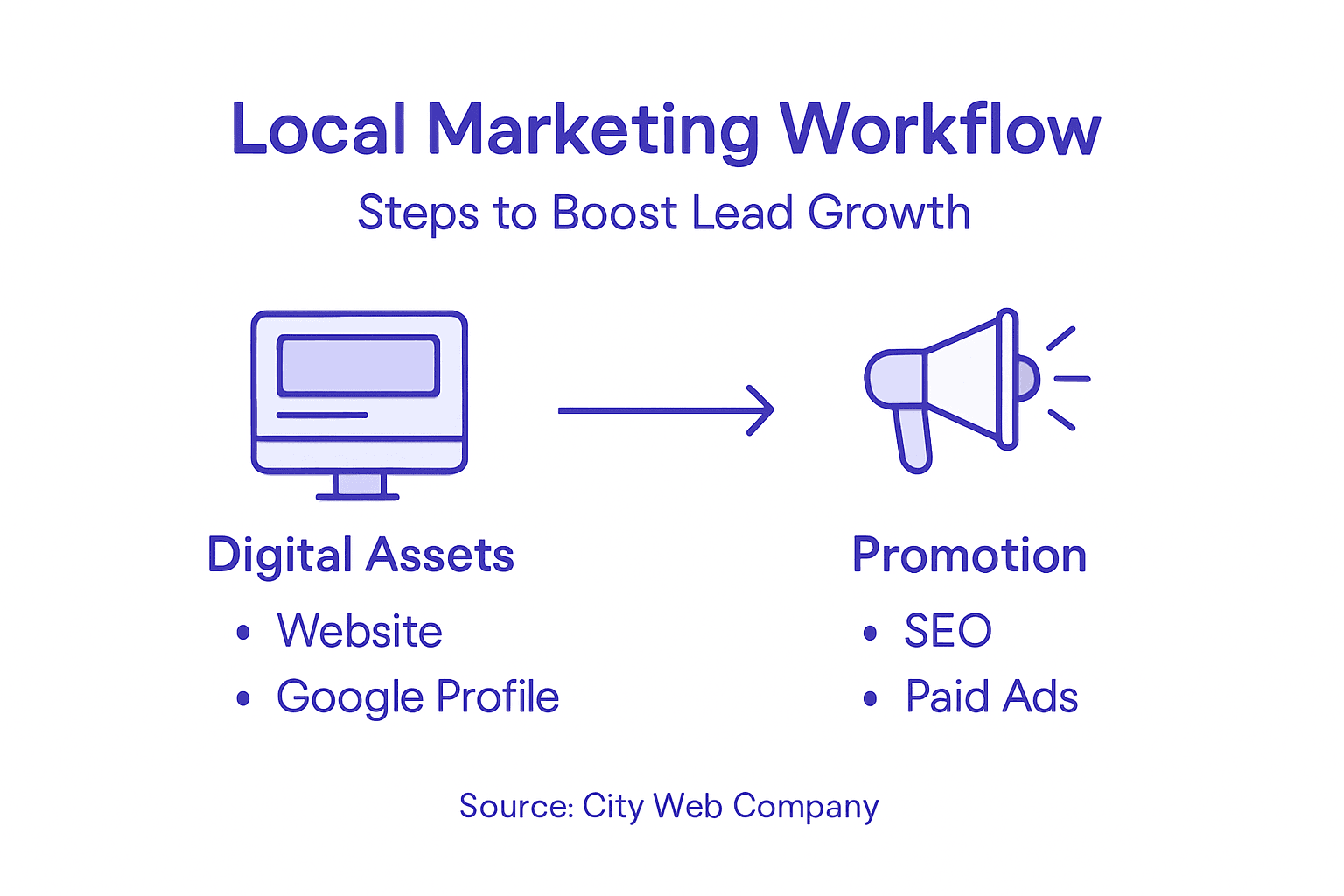
Master Local Business Marketing Workflow for Lead Growth
Getting clear on who your ideal customers are can make or break your local marketing success. Many home service business owners across North America struggle with wasted ad spend and weak messaging simply because their target audience is too broad or undefined. By focusing on demographic, psychographic, and behavioral data, you set the foundation for campaigns that attract the right leads at the right time. This article guides you through the steps to define your audience and set meaningful marketing objectives for sustained growth.
Table of Contents
Table of Contents
- Step 1: Define Target Audience And Set Marketing Objectives
- Step 2: Build Optimized Website And Google Business Profile
- Step 3: Implement Local Seo And Paid Ad Campaigns
- Step 4: Promote Brand With Custom Swag And Content
- Step 5: Monitor Results And Refine Marketing Workflow
Quick Summary
| Main Insight | Detailed Explanation |
|---|---|
| 1. Define Your Target Audience Clearly | Identify specific customer types based on demographics and psychographics to tailor your marketing strategy effectively. |
| 2. Create a Detailed Marketing Objective | Set specific goals linked to your audience to guide marketing decisions and maximize resource efficiency. |
| 3. Optimize Your Website and Business Profile | Ensure your website and Google Business Profile are well-structured with relevant information to attract local customers. |
| 4. Combine Local SEO and Paid Ads | Use local SEO for long-term lead generation and paid ads for immediate results to balance your marketing efforts. |
| 5. Regularly Monitor and Adjust Strategies | Track key performance metrics consistently to refine your approach and improve lead generation continuously. |
Step 1: Define target audience and set marketing objectives
This step determines who you’re marketing to and what you want to accomplish. Getting this right shapes every decision that follows, from where you spend your budget to how you write your messages. Without clarity here, you risk spreading resources thin across the wrong channels to the wrong people.
Start by identifying the specific types of customers most likely to need your home service business. Are you targeting busy professionals who need quick scheduling? Homeowners managing renovation projects? Landlords maintaining multiple properties? Think about the demographic details first: age ranges, income levels, household size, and location. These specifics matter because a 28 year old first time homeowner in the suburbs has different pain points and schedules than a 55 year old managing a commercial property downtown.
Next, dig deeper into psychographic and behavioral data. This is where you understand what actually motivates your ideal customers to buy. What problems keep them awake at night? How do they currently solve those problems? What matters more to them: cost, speed, reliability, or quality? Identifying your target audience involves analyzing demographic, psychographic, and behavioral data to create messaging that genuinely resonates with the people most likely to hire you. For example, someone searching for emergency plumbing at 2 AM has urgency as their top priority, while someone planning a bathroom remodel has time to compare options and read reviews.
With your audience clearly defined, set specific marketing objectives tied directly to them. Don’t say “get more leads.” Instead, say “acquire 12 new HVAC maintenance contracts per month from homeowners aged 40-65 within our service area who have homes built before 1995.” That specificity guides which platforms you use, what your ads say, and how you measure success. Clear marketing objectives aligned with your target audience guide resource allocation and channel selection, which directly improves your return on investment. When you know exactly who you’re reaching and what result you want, every marketing dollar works harder.
Pro tip: Create a detailed customer profile document for your primary target audience, including a name, their typical problem, how they search for solutions, and their budget range. Reference this when making any marketing decision to stay focused and avoid wasting resources on audiences that won’t convert.
Here is a summary of target audience types for home service businesses:
| Audience Type | Key Characteristics | Primary Needs |
|---|---|---|
| Busy Professionals | Limited free time, urban/suburban | Fast scheduling, reliability |
| First-Time Homeowners | Young, learning maintenance routines | Clear guidance, cost-effective solutions |
| Landlords and Property Managers | Oversee multiple properties, diverse tenants | Scalable services, quick response |
| Commercial Property Owners | Older properties, high traffic | Preventative maintenance, long-term contracts |
Step 2: Build optimized website and Google Business Profile
Your website and Google Business Profile are your digital storefront. They’re where potential customers find you, learn about your services, and decide whether to call. Getting both right means more people discover you at exactly the moment they need your help.
Start with your website. Build it around the keywords your customers actually use when searching for your services. If you’re a plumber in Denver, pages should target phrases like “emergency plumber in Denver” and “water heater repair Denver” rather than generic terms. Make sure your contact information, service area, hours, and phone number appear consistently across every page. Local customers want to know you’re real, local, and easy to reach. A well-built website optimized for local keywords combined with proper business information increases chances of being discovered by customers searching in your area. Beyond the basics, add content that answers questions your customers ask. A heating contractor might create a page explaining the difference between furnace repair and replacement, or a handyman service could detail what jobs they handle versus what they won’t. This positions you as knowledgeable and helps you rank for long tail keywords that bring serious leads.
Your Google Business Profile deserves equal attention. This is where Google shows your business to local searchers, and completeness matters. Fill out every field thoroughly. Your business name, address, phone number, and service categories must be accurate and consistent everywhere online. Add high quality photos of your work, your team, and your physical location if you have one. Update your profile regularly with posts about seasonal services, new offerings, or customer testimonials. Photos and frequent updates significantly improve visibility in local search results and engagement with potential customers. When someone searches “electrician near me” or “best HVAC company in my area,” they see your Google Business Profile right at the top. Make sure what they see makes them want to call you.
Connect these two assets. Link from your website to your Google Business Profile, and make sure your profile links back to your website. This creates a web of signals to Google that you’re a legitimate, active business. Your website ranks better in organic search while your profile handles the local pack results. Together, they work as your lead generation foundation.
Pro tip: Add a schema markup plugin to your website to help Google understand your business location, hours, and services better. This technical detail often leads to rich search results showing your phone number, hours, and reviews directly in search results, making it easier for customers to contact you on the spot.
Step 3: Implement local SEO and paid ad campaigns
Now you’ve built your foundation. Time to drive traffic to it through two complementary channels that work best when combined. Local SEO brings consistent, long-term organic traffic while paid ads generate immediate leads while you build authority.
Start with local SEO. Optimize your website content for the specific keywords your customers use in your service area. If you run a HVAC business in Phoenix, target keywords like “furnace repair Phoenix” and “air conditioning maintenance Phoenix” rather than generic national terms. Build local backlinks by getting mentioned on local directories, industry associations, and community websites. Manage your online reputation aggressively by responding to reviews and encouraging satisfied customers to leave them. Local SEO strategies involving optimized website content, local backlinks, and review management create a foundation that sends consistent leads your way month after month. This takes time to compound, but once it’s working, it costs you nothing per lead.

While your SEO efforts build momentum, paid campaigns give you immediate visibility. Google Local Service Ads work differently from traditional ads. You only pay when a qualified lead contacts you directly, not just for clicks. These ads appear at the very top of Google search results when someone searches for your service in your area. Google Local Service Ads target customers searching for nearby services with a pay-per-lead pricing model, reducing wasted spend on people who won’t convert. Beyond Local Service Ads, run targeted search campaigns using both branded terms (your business name) and non-branded terms (“emergency plumber near me”). Target hyperlocal audiences on social media platforms where you can geo-fence specific neighborhoods and reach people with precision. The key with paid campaigns is testing and refinement. Start with a reasonable budget, track which keywords and ad placements bring the most calls, then shift more budget toward what’s working.
The magic happens when these two channels work together. Your paid ads capture the high-intent searchers right now. Your local SEO builds long-term visibility that keeps bringing leads as your investment compounds. Over time, you’ll typically shift more budget toward SEO while maintaining your best performing paid campaigns.
Here is a comparison of Local SEO and Paid Ad campaign features:
| Feature | Local SEO | Paid Ad Campaigns |
|---|---|---|
| Time to Results | Months to build | Immediate after launch |
| Cost per Lead | Lower over time | Varies, usually higher initially |
| Lead Consistency | Sustained, increasing with time | Fluctuates with budget |
| Targeting Precision | Broad local area | Hyperlocal, audience-specific |
| Long-Term Value | High once established | Stops when ads paused |
Pro tip: Track the phone number associated with each campaign separately, and use call recording to understand which keywords and ads bring the highest quality leads. A call that turns into a job matters far more than a cheap lead that wastes your time, so measure quality, not just quantity.
Step 4: Promote brand with custom swag and content
You’ve built visibility through your digital channels. Now it’s time to build brand loyalty and stay top of mind with custom branded products and valuable content. These work together to create a memorable presence that keeps customers thinking of you long after the initial interaction.
Start with custom branded merchandise. When a plumber leaves a branded notepad on your kitchen counter or an electrician gives you a quality t-shirt with their logo, you remember that business. Custom promotional products work because they’re tangible reminders of your professionalism and attention to detail. Choose items your customers will actually use. Work gloves, branded pens, calendars, magnetic refrigerator lists, and tool belts with your logo and phone number are practical items that stay visible in homes. For home service businesses, consider seasonal items like snow shovels with your branding for winter or yard care tools for spring. The investment is modest compared to the impression it creates. Every time a homeowner uses that item, they’re reminded of your quality work. When they need the service again or refer you to a friend, you’re already top of mind.
Content marketing works differently but powerfully. Create blog posts, videos, and social media content that educates your customers about your industry. A HVAC company might publish guides on seasonal maintenance, warning signs of equipment failure, or how to improve efficiency. A plumber could create content about preventing frozen pipes, explaining water pressure issues, or comparing tankless versus traditional water heaters. Content marketing plays a crucial role in driving lead generation because it positions you as an authority customers trust before they even call. This builds credibility that translates into more conversions. Share this content on your social media, email newsletters, and website. When potential customers search for answers to their questions, they find your content and recognize your expertise.

Combine these tactics strategically. Hand out branded merchandise at customer touchpoints. Share content that adds value and builds trust. A customer who reads your educational content and receives your branded merchandise develops a relationship with your business that goes beyond transactional. They become advocates who recommend you to others.
Pro tip: Focus your custom swag on items that genuinely solve customer problems or serve your industry. A magnet with your emergency number, a branded flashlight, or work gloves matter more than generic pens everyone throws away. Quality merchandise reflects quality work.
Step 5: Monitor results and refine marketing workflow
You’ve launched your marketing efforts across multiple channels. Now comes the part that separates businesses that grow from those that spin their wheels. You need to measure what’s working, understand why, and adjust accordingly. This cycle of monitoring and refinement is where real lead growth happens.
Start by tracking the right metrics. Monitoring key performance indicators such as lead volume, conversion rates, and cost per lead allows you to see exactly which parts of your marketing workflow are producing results and which are wasting money. Set up tracking for phone calls from each campaign using unique phone numbers or call tracking software. Use your CRM system to log where each lead came from, which ones converted to paying customers, and the value of those jobs. Track website traffic through Google Analytics to understand which pages attract visitors and where they drop off. Monitor your ad performance daily, looking at click through rates, cost per click, and most importantly, the cost per qualified lead that actually calls or contacts you. Different channels perform differently for different businesses. What works brilliantly for one HVAC company might flop for a plumber in a different market.
Once you have data, use it to refine your approach. Regularly analyzing campaign results through tools like Google Analytics and CRM systems ensures marketing efforts are aligned with goals, with refinement including adjusting targeting based on performance data and optimizing ad spend. If one ad is bringing leads at fifty dollars each while another costs two hundred dollars per lead, shift your budget immediately. If certain keywords consistently bring calls that turn into jobs while others bring tire kickers, pause the underperformers. Test different messaging in your ads. Try offering same day service in one version and twenty year warranty in another. See which resonates with your audience. Adjust your service area targeting if you’re getting calls from places you can’t efficiently reach. This isn’t a one time activity. Commit to reviewing your metrics weekly and making adjustments monthly. Small improvements compound quickly. A ten percent better conversion rate or a fifteen percent lower cost per lead translates to significantly more profit over a year.
Document what you learn. Keep notes on what worked and what didn’t. Your business will grow faster next quarter because you understood this quarter’s data. Your marketing workflow becomes more efficient month after month, turning your initial effort into a lean, high performing system that generates consistent leads with predictable costs.
Pro tip: Create a simple dashboard that shows your three most important metrics at a glance: total leads generated, cost per lead, and conversion rate to paying jobs. Review this weekly and discuss changes with your team so everyone stays focused on what’s actually driving business growth.
Elevate Your Local Business Marketing Workflow Today
Struggling to turn your local marketing efforts into a steady stream of quality leads? The key challenges from the article such as defining your target audience clearly, optimizing your website and Google Business Profile, and effectively combining local SEO with paid ad campaigns can feel overwhelming. Without a tailored and results-driven marketing workflow, your business risks wasting time and budget on tactics that do not convert. If you want to master lead growth with precise audience targeting and measurable campaigns that deliver, you need expert guidance.
City Web Company offers comprehensive solutions to help local service businesses overcome these challenges with tailored strategies that drive real results. Our expertise covers everything from building optimized websites and managing powerful Google Local Service Ads to designing impactful branded merchandise and crafting content marketing plans that build trust and repeat customers. We combine data-driven digital marketing strategies with tools like AI-powered chatbots to capture and nurture leads efficiently.
Discover how the right blend of local SEO and paid advertising can transform your lead generation. Visit our Digital Marketing Strategy Guides to learn more about creating effective marketing workflows. Explore insights on leveraging Social Media Marketing Tips & Tools to reach your local audience where they spend time online. Ready to take control of your lead growth? Connect with our experts now at City Web Company Contact and start building a marketing workflow that consistently delivers leads and revenue.
Frequently Asked Questions
How can I define my target audience for local business marketing?
To define your target audience, start by identifying specific customer types who are most likely to need your services. Create customer profiles that include demographics, psychographics, and behavioral data, focusing on their primary needs and pain points. This clarity will guide your marketing messages effectively.
What are the key components of an optimized website for local business marketing?
An optimized website should include relevant local keywords, consistent contact information, and informative content that answers customer questions. Ensure that your website links to your Google Business Profile and that both platforms reflect accurate business details. Update both consistently to enhance visibility and authority.
How can local SEO and paid ad campaigns work together for lead growth?
Local SEO provides long-term organic visibility, while paid ad campaigns generate immediate leads. Start by optimizing your website for relevant local keywords and build backlinks, then implement targeted paid ads to capture high-intent searchers. Combining these strategies can maximize lead generation efforts over time.
What types of custom branded merchandise can I use to promote my local business?
Consider using practical items, such as work gloves, branded pens, or magnetic refrigerator lists, that customers will use regularly. These items serve as tangible reminders of your business, increasing brand awareness and loyalty every time they’re utilized. Select merchandise that solves customer problems and reflects the quality of your services.
How can I effectively monitor and refine my marketing workflow?
To monitor your marketing workflow, track key metrics such as lead volume, conversion rates, and cost per lead using a simple dashboard. Regularly review this data weekly and make adjustments based on performance, such as reallocating budgets or testing new messaging. Continuous refinement will improve your overall marketing effectiveness and lead growth over time.
Recommended
- What Is a Marketing Funnel? And How It Converts Local Leads – City Web Company | Digital Marketing Agency
- What Role Does Content Marketing Play In Driving Lead Generation For Small Businesses? – City Web Company | Digital Marketing Agency
- Landscaping Services Marketing Company | SEO & Lead Gen
- Roofing Company Marketing Company | SEO & Lead Generation
- Best 4 Gutter Installation Companies Near Me – Expert Comparison 2026
These articles were popular with other readers too: