
Unlock local leads with our social media ads walkthrough! Learn to create effective ads that minimize spend and maximize results for your business.
Search Engine Ranking Guide for Local Service Businesses
Many local service business owners feel frustrated when their competitors show up higher in search results for key phrases. Standing out in the crowded search landscape takes more than just a good website—it requires clear, ongoing strategies that address both technical performance and community relevance. This guide walks you through analyzing your website and optimizing proven local SEO factors so you can increase your visibility, attract more customers, and keep your business prominent in your city.
Table of Contents
Table of Contents
- Step 1: Analyze Your Website And Current Rankings
- Step 2: Optimize On-Page Elements For Local SEO
- Step 3: Build Quality Backlinks And Local Citations
- Step 4: Enhance User Experience And Site Accessibility
- Step 5: Monitor Results And Refine SEO Strategies
Quick Summary
| Key Insight | Explanation |
|---|---|
| 1. Conduct a thorough website audit | Assess your search engine rankings and identify performance gaps to improve visibility and attract customers. |
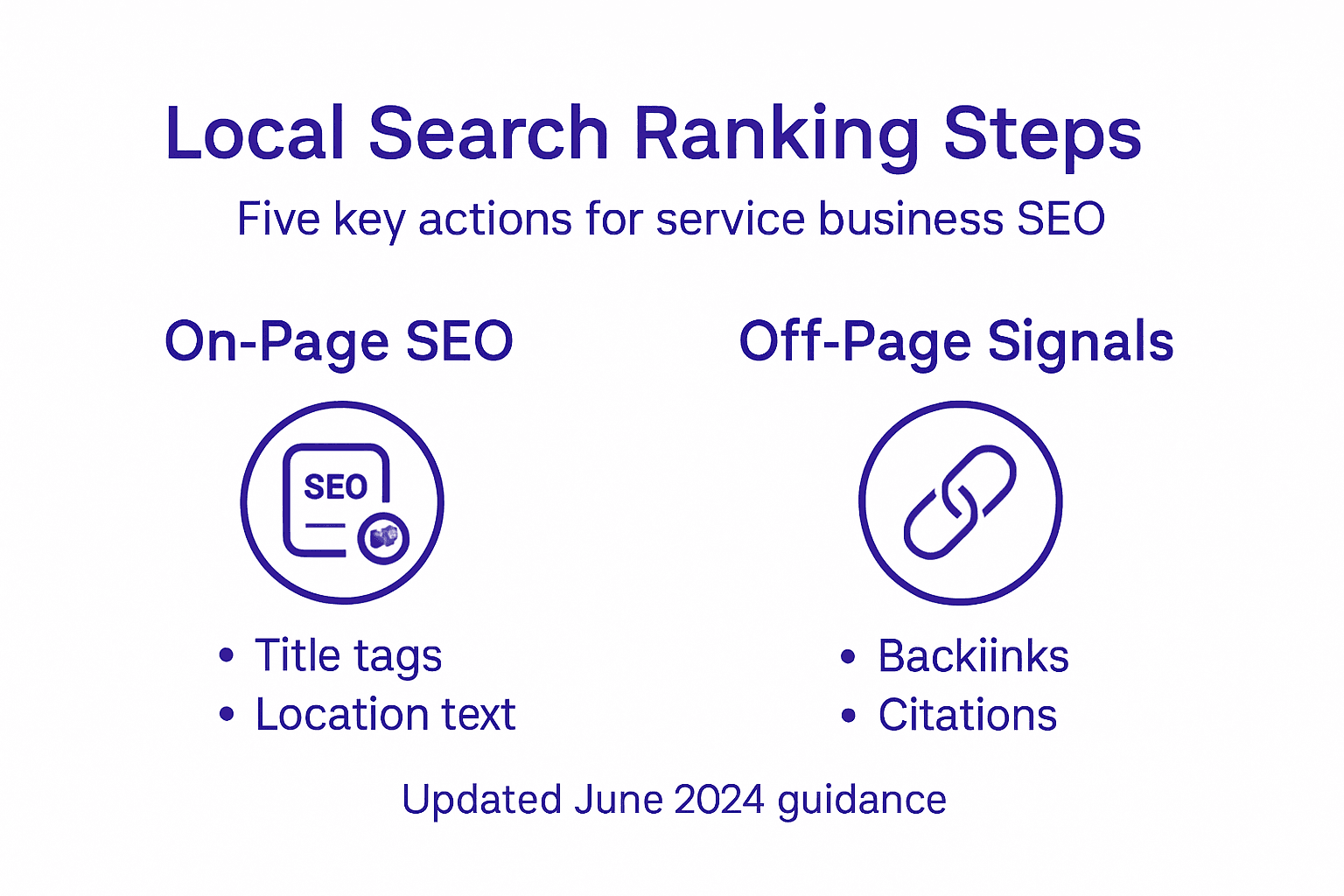
| 2. Optimize on-page elements effectively | Use targeted keywords, consistent NAP, and local schema markup to boost your website’s relevance in search results. |
| 3. Build quality backlinks and citations | Connect with local organizations and ensure consistent online listings to enhance your business’s authority and search rankings. |
| 4. Enhance user experience continually | Focus on site speed, mobile responsiveness, and accessible design to retain and attract customers effectively. |
| 5. Monitor and refine SEO strategies regularly | Use analytics tools to track performance, adapting your tactics based on data to stay competitive in local search results. |
Step 1: Analyze your website and current rankings
Successfully analyzing your local service business’s search engine rankings starts with a comprehensive website audit. Your goal is to uncover performance gaps and opportunities that can boost your online visibility and attract more potential customers.
Begin by conducting a thorough local SEO audit to assess your current digital standing. This process involves several critical steps:
- Check your website’s search engine ranking positions for key service-related keywords
- Review your Google My Business profile accuracy and completeness
- Analyze your website’s on-page SEO elements
- Evaluate your local citation consistency across online directories
- Assess your website’s mobile responsiveness and page loading speed
Start by using free tools like Google Search Console and Google Analytics to understand your current ranking performance. Look closely at metrics such as:
Here’s a summary of essential website audit metrics and their importance:
| Metric | What It Measures | Business Impact |
|---|---|---|
| Average search position | Visibility for local keywords | Drives local customer traffic |
| Click-through rate | Effectiveness of search listings | Increases potential inquiries |
| Organic traffic volume | Number of visitors from search | Indicates brand reach |
| User engagement | Quality of user interactions | Improves conversions and loyalty |
- Average search position for local keywords
- Click-through rates from search results
- Organic traffic volume
- User engagement metrics
The most successful local businesses treat SEO as an ongoing process, not a one-time task.
Carefully document your findings, noting areas where your website underperforms compared to local competitors. This baseline assessment will help you create a targeted strategy for improvement.
Pro tip: Keep a monthly tracking spreadsheet to monitor your ranking progress and identify trends in your search engine performance.
Step 2: Optimize on-page elements for local SEO
Optimizing your local service business’s website for search engines requires strategic on-page enhancements that help search engines understand your local relevance and improve your visibility in search results. By carefully implementing targeted optimization techniques, you can significantly boost your local search rankings.
Local SEO ranking factors demand meticulous attention to several critical on-page elements. Focus on these key optimization strategies:
- Localize your page titles with city and service keywords
- Include your business’s Name, Address, Phone Number (NAP) consistently
- Create location-specific content for each service area
- Optimize meta descriptions with local intent
- Implement local schema markup to provide search engines clear location signals
Prioritize these specific on-page optimization techniques:
To further clarify on-page SEO efforts, compare these local keyword strategies:
| Strategy | Best For | Key Benefit |
|---|---|---|
| Location-based content | Multiple service areas | Targets relevant communities |
| Local schema markup | Clear location signals | Enhances search relevance |
| Optimized headers | Every page type | Connects business to region |
| Alt text with city names | Images of services | Strengthens geographic targeting |
- Use location-based keywords naturally in your content
- Include your city and region in header tags
- Add your service area to image alt text
- Create unique content for each location you serve
Search engines reward websites that provide clear, consistent local signals across their content.
Remember that each page should tell a clear story about your local business, its services, and its geographical relevance. Connect your website’s content directly to the communities you serve.

Pro tip: Conduct a quarterly content audit to ensure your local keywords and location information remain current and accurately reflect your business.
Step 3: Build quality backlinks and local citations
Building a robust network of quality backlinks and local citations is crucial for improving your local service business’s search engine rankings and online visibility. This strategic approach helps establish your business’s credibility and authority within your local market.
Local ranking factors demonstrate that strategic link building can significantly enhance your search engine performance. Focus on these key strategies for acquiring high-quality local backlinks:
- Connect with local Chamber of Commerce memberships
- Engage with community business organizations
- Participate in local sponsorships and events
- Write guest posts for local business blogs
- Request backlinks from trusted local business partners
Implement these systematic citation and backlink building techniques:
- Verify your business listings on key directories
- Ensure consistent Name, Address, Phone Number (NAP) across platforms
- Target industry-specific and local directory submissions
- Create valuable, shareable local content
Quality always trumps quantity when building local business citations and backlinks.
Remember that authentic, relevant local connections matter more than random link accumulation. Focus on building genuine relationships within your business community that naturally support your online visibility.

Pro tip: Audit your existing backlinks quarterly and disavow any low-quality or spammy links that might negatively impact your search rankings.
Step 4: Enhance user experience and site accessibility
Improving your local service business’s website user experience and accessibility is critical for attracting and retaining potential customers. Your website should not only look professional but also provide a seamless, inclusive browsing experience for all visitors.
Local SEO guide recommendations emphasize creating websites that are fast, responsive, and easy to navigate. Focus on these key user experience and accessibility strategies:
- Optimize page loading speed across all devices
- Design a mobile-responsive layout
- Create clear, intuitive navigation menus
- Use high-contrast color schemes
- Implement alt text for images
- Ensure keyboard navigation functionality
Prioritize these specific user experience enhancement techniques:
- Compress images and leverage browser caching
- Use readable fonts and appropriate font sizes
- Minimize complex design elements
- Test website functionality across different devices
Accessible websites not only serve more users but also signal credibility to search engines.
Remember that user experience goes beyond visual design. It encompasses how easily visitors can find information, contact your business, and understand your services.
Pro tip: Conduct monthly user testing and accessibility audits to continuously improve your website’s performance and user-friendliness.
Step 5: Monitor results and refine SEO strategies
Successfully growing your local service business’s online visibility requires continuous monitoring and strategic refinement of your SEO efforts. Think of your SEO strategy as a living, dynamic process that demands regular attention and adjustment.
SEO tracking strategies reveal the critical importance of systematically analyzing your digital performance. Develop a comprehensive monitoring approach by focusing on these key performance indicators:
- Track organic search traffic trends
- Monitor keyword ranking positions
- Analyze website conversion rates
- Review user engagement metrics
- Assess local search visibility
- Compare performance against competitors
Implement these strategic monitoring techniques:
- Set up Google Analytics and Google Search Console
- Create custom dashboards for quick performance insights
- Schedule monthly performance review sessions
- Document changes and their corresponding impact
Data-driven refinement separates successful local businesses from those struggling to gain online visibility.
Remember that SEO is not a one-time task but an ongoing process of learning, adapting, and improving your digital presence based on real-world performance data.
Pro tip: Allocate at least two hours monthly to deeply analyze your SEO metrics and develop targeted improvement strategies.
Take Control of Your Local Search Rankings Today
If you are struggling to improve your local search visibility or feeling overwhelmed by the ongoing demands of local SEO audits, on-page optimization, and backlink building, you are not alone. Many local service businesses face the challenge of maintaining consistent, results-driven digital marketing that truly connects with their community and drives real leads. The key to success lies in strategic monitoring and adapting your approach based on data insights and evolving best practices.

Unlock the full potential of your local service business with expert guidance from our Local SEO & Google Business Tips | City Web Company experts. We specialize in crafting tailored strategies that address common pain points like maintaining NAP consistency, optimizing location-based content, and tracking performance with actionable analytics. Explore our Analytics & Conversion Tracking Tips | City Web Company to see how data-driven decisions can elevate your search rankings and increase customer engagement. Don’t wait for your competitors to get ahead. Visit City Web Company now to start your personalized local SEO transformation and secure your spot in front of your community’s customers.
Frequently Asked Questions
How do I analyze my local service business’s current search engine rankings?
To analyze your current search engine rankings, conduct a comprehensive local SEO audit. Begin by checking your website’s ranking positions for key service-related keywords and reviewing your Google My Business profile for accuracy within the next few days.
What on-page elements should I optimize for local SEO?
Optimize key on-page elements by localizing your page titles with city and service keywords, ensuring consistent Name, Address, Phone Number (NAP) across your site, and implementing local schema markup. Complete these optimizations within a month to enhance your website’s local relevance.
How can I build quality backlinks for my local service business?
You can build quality backlinks by engaging with local Chamber of Commerce memberships, participating in local sponsorships, and writing guest posts for local blogs. Aim to secure at least three new quality backlinks each month to strengthen your online authority.
What steps should I take to improve my website’s user experience?
To improve user experience, focus on optimizing page loading speed, creating a mobile-responsive layout, and ensuring intuitive navigation. Implement these enhancements within a month to provide a seamless browsing experience for your customers.
How do I monitor the results of my local SEO efforts?
Monitor your SEO results by tracking organic search traffic trends, analyzing website conversion rates, and reviewing keyword ranking positions. Schedule monthly performance reviews and aim to document any significant changes within the same timeframe to continuously refine your strategies.
Recommended
These articles were popular with other readers too: