

See how plumbers can turn Facebook scrollers into booked jobs with clear offers, local targeting, a 30 day test budget, fast follow up, and a path to scale.
The Role of Online Reviews for Lawyers: 2026 Guide
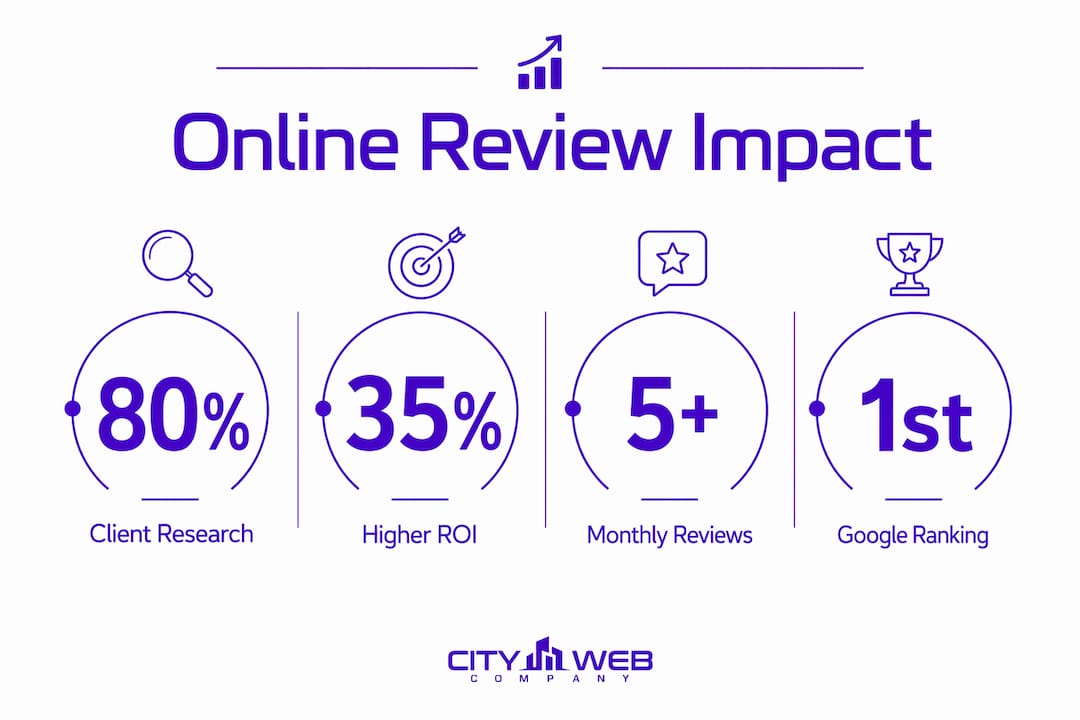
Online reviews are the single most powerful form of social proof available to attorneys today. More than 80% of consumers research attorneys online before making contact, with Google as their primary starting point. That statistic reframes the role of online reviews for lawyers from a nice-to-have into a core business function. Reviews shape whether a potential client clicks your profile, calls your office, or moves on to the next result. They also carry ethical weight that no other marketing channel does. ABA Model Rule 1.6 governs what you can and cannot say in a public response, which means reputation management in law is a compliance exercise as much as a marketing one.
Table of Contents
How online reviews influence client decisions and law firm visibility
Client decisions in legal matters are high-stakes and emotionally charged. A person searching for a divorce attorney or a personal injury lawyer is not browsing casually. They are making a decision that could affect their finances, their family, or their freedom. Reviews reduce that anxiety by giving strangers a window into what working with you actually feels like.
Law firms gain the highest ROI on reviews compared to businesses in most other industries, because client value is high and the decision is complex. A single retained client can generate thousands of dollars in fees. That means even one review that tips a prospect toward calling you pays for itself many times over.

What clients actually read in reviews
Clients focus more on reviews describing communication and how the lawyer managed the process than on specific results. This is a critical insight. A review that says “She kept me informed every step of the way and never made me feel like a burden” carries more weight than one that says “We won.” Outcome-focused reviews also create ethical risk, since they can imply guaranteed results. Process-focused reviews sidestep that problem entirely while being more persuasive to anxious prospects.
How reviews affect your Google ranking
Google uses review quantity, quality, and recency as key ranking factors for local 3-pack listings. The local 3-pack is the map block that appears at the top of Google search results for queries like “personal injury attorney near me.” Ranking there is worth more than a page-one organic result for most local searches. Your star rating, the number of reviews, and how recently those reviews were posted all feed directly into that ranking. A firm with 12 reviews from three years ago will consistently lose ground to a firm with 40 reviews posted over the past 12 months.
The impact of lawyer reviews on visibility works through two separate mechanisms:
- Ranking signals: Review quantity, average rating, and recency tell Google your profile is active and trusted.
- Click-through rate: A 4.8-star rating with 60 reviews earns far more clicks than a 3.9-star rating with 10 reviews, even at the same ranking position.
- Conversion rate: A prospect who reads five detailed, positive reviews before calling is more likely to book a consultation than one who found you through an ad alone.
- Competitive differentiation: In markets where multiple firms share similar practice areas, reviews become the deciding factor when price and location are equal.
Pro Tip: Ask satisfied clients to mention your practice area in their review. “Family law attorney” or “estate planning lawyer” appearing in review text reinforces your relevance for those specific search terms.
Ethical considerations and compliance for managing attorney testimonials

Review management for attorneys is not the same as review management for a restaurant. The attorney-client relationship carries confidentiality obligations that follow you into every public response you write. Ignoring this creates disciplinary risk that no marketing win is worth.
ABA Model Rule 1.6 and what it means for responses
Firm responses to reviews must not confirm client relationships or divulge case details, per ABA Model Rule 1.6. This rule applies even when a client has already disclosed the relationship publicly in their own review. The moment you write “Thank you for trusting us with your custody case,” you have confirmed a client relationship and referenced a matter type. That is a potential ethics violation. Your response must stay generic, warm, and free of any case-specific language.
The rules around soliciting reviews
Soliciting reviews must be neutral, reward-free, and applied consistently across your client base. The following practices cross ethical and legal lines:
- Offering discounts or gifts in exchange for reviews. Incentivized reviews violate FTC guidance and most state bar advertising rules. The FTC requires disclosure of any material connection between a reviewer and a business. State bars treat incentivized reviews as misleading advertising, which can result in reprimands or suspension.
- Asking only clients you know are happy. Selectively soliciting reviews skews your profile and misrepresents your practice. Ethical solicitation means asking all clients, or using a neutral process that does not filter by expected sentiment.
- Posting fake reviews or asking staff to post them. Fabricated reviews violate Google’s policies, FTC rules, and bar advertising standards simultaneously. Platforms actively detect review patterns that look artificial, and the reputational damage from being caught far exceeds any short-term gain.
- Responding to negative reviews with case details. Even if a client posts something factually wrong, you cannot correct the record by referencing what actually happened in their matter. Doing so breaches confidentiality regardless of your intent.
- Threatening legal action against reviewers. This approach almost always backfires publicly and may constitute improper conduct under state bar rules.
Pro Tip: Draft a standard review request message that mentions no case details, no outcomes, and no specific practice area. Use the same message for every client. This keeps your solicitation process neutral and defensible if ever questioned by a bar authority.
The deeper point here is that review management is a long-term compliance function as well as a marketing strategy. Firms that treat it as a one-time campaign rather than an ongoing process create gaps that create risk.
Best practices for requesting and responding to client feedback
The mechanics of getting good reviews ethically are straightforward once you have the right process in place. Timing, language, and follow-through determine whether your request converts into a posted review.
When to ask
The ethically safest and most effective time to request a review is immediately after the matter is fully resolved. Client satisfaction peaks at case closure, and memories of the experience are fresh. A request sent within 48 hours of resolution consistently outperforms one sent weeks later. At that point, the client has received their outcome, the stress has lifted, and they feel goodwill toward you if the experience was positive.
How to guide the review without directing it
You cannot tell a client what to write. You can, however, frame your request in a way that naturally steers them toward experience-based language rather than outcome-based language. A request that says “We’d love to hear about your experience working with our team” produces reviews about communication and professionalism. A request that says “Tell others about your results” invites outcome language that creates ethical exposure.
Practical steps for a compliant review request process:
- Send the request by email or text immediately after case resolution, not during an active matter.
- Include a direct link to your Google Business Profile review page to reduce friction.
- Keep the message brief, personal, and free of any case references.
- Follow up once, no more, if the client has not responded within five days.
- Use a legal marketing checklist to confirm your process meets both bar rules and platform policies before you launch it.
Responding to negative reviews
Negative reviews should be flagged to platforms if fraudulent, but genuine complaints from unhappy clients require professional, confidential responses. The response formula that works is: acknowledge the concern, express that you take feedback seriously, and invite the person to contact you privately. Never confirm they were a client. Never reference their matter. A response like “We take all feedback seriously and would welcome the opportunity to discuss your concerns directly. Please reach out to our office at your convenience” is both ethical and effective.
Pro Tip: Assign one person in your firm to monitor and respond to reviews on a weekly schedule. Inconsistent response timing signals neglect to both Google and prospective clients.
How to leverage review platforms for law firm reputation management
A strong review presence requires more than a Google Business Profile. Attorneys operate in a multi-platform environment where clients cross-reference profiles before deciding to call.
Platform priorities for attorneys
Google Business Profile is the non-negotiable starting point. It feeds directly into local search rankings and the map pack. Every other platform is secondary, but several carry real weight in the legal space.
| Platform | Primary benefit | Key consideration |
|---|---|---|
| Google Business Profile | Local SEO and map pack ranking | Review recency and quantity matter most |
| Avvo | Attorney-specific credibility signals | Peer endorsements and ratings carry weight |
| Martindale-Hubbell | Peer review ratings for B2B referrals | AV Preeminent rating recognized by other attorneys |
| Community trust and referral reach | Useful for family law and consumer-facing practices | |
| Firm website | Full control over testimonial display | Requires proper disclaimers per state bar rules |
Displaying client testimonials with proper disclaimers on firm websites and profiles supports both client trust and SEO. The disclaimer typically states that past results do not guarantee future outcomes. Most state bars require this language whenever testimonials appear in attorney advertising. Placing it clearly near testimonials keeps you compliant while preserving the persuasive value of the review.
Building a steady review cadence
A steady cadence of 2–3 new reviews per month signals to Google a healthy, authentic profile without triggering spam filters. Sudden bursts of 20 reviews in a week look artificial and can result in reviews being suppressed or your profile being flagged. Consistent, organic growth over time is both safer and more effective. Firms that understand how online reviews drive revenue build this cadence into their client offboarding process rather than treating it as a separate campaign.
For attorneys who want to understand how reviews fit into a broader local SEO strategy for attorneys, the connection is direct. Reviews are one of the top three ranking factors for Google’s local pack, alongside proximity and relevance. Ignoring them means ceding ground to competitors who are not ignoring them.
Key Takeaways
Online reviews are a compliance-bound marketing asset that directly determines whether your law firm appears in local search results and whether prospects choose to call you.
| Point | Details |
|---|---|
| Reviews drive client decisions | Over 80% of prospects research attorneys online before making contact, making reviews the first impression. |
| Process beats outcomes in reviews | Clients trust reviews about communication and responsiveness more than case results, reducing ethical risk. |
| ABA Model Rule 1.6 governs responses | Never confirm a client relationship or reference case details in any public review response. |
| Consistent cadence outperforms bursts | Aim for 2–3 new reviews per month to build Google trust without triggering spam filters. |
| Multi-platform presence multiplies credibility | Google, Avvo, Martindale-Hubbell, and your own website each serve a different segment of your prospective client base. |
Why I think most law firms are managing reviews backwards
Most attorneys I work with treat review generation as a campaign. They get motivated, send a batch of requests, collect a dozen reviews, and then stop. Six months later, their profile looks stale and their ranking has slipped. The firms that consistently win on review platforms treat the process like billing. It happens after every closed matter, without exception, as part of a defined workflow.
The second mistake I see constantly is over-engineering the response to negative reviews. Attorneys want to defend themselves, correct the record, and demonstrate competence. That instinct is understandable, but it is exactly wrong. A generic, empathetic response that invites private resolution looks more professional than a detailed rebuttal. Prospective clients reading that exchange are not judging whether you were right. They are judging whether you handle conflict with grace.
The ethical dimension is also underestimated. I have seen firms get so focused on generating five-star ratings that they skip the compliance check entirely. Soliciting reviews selectively, offering gift cards, or letting a paralegal post responses without training creates real disciplinary exposure. The importance of attorney testimonials is real, but not at the cost of your license.
The firms that get this right share one trait: they built a process, trained their staff, and then left it alone to run. They do not chase reviews. They create the conditions for reviews to happen naturally, consistently, and safely.
— Matt
How City Web Company helps law firms build a compliant review presence
Law firm reputation management requires both marketing expertise and an understanding of professional conduct rules. City Web Company works with attorneys to build review generation systems that are ethical, consistent, and designed to improve Google Business Profile rankings over time.
City Web Company’s digital marketing services for law firms include local SEO, review process setup, and ongoing reputation monitoring. The goal is a steady, authentic stream of client feedback that builds your profile without creating compliance risk. If your firm is ready to turn client satisfaction into a measurable marketing asset, City Web Company has the process to make it happen.
FAQ
What is the role of online reviews for lawyers?
Online reviews serve as social proof that directly influences whether prospective clients contact a law firm. They also function as a local SEO ranking signal, affecting how prominently a firm appears in Google search results.
Can lawyers ask clients to leave reviews?
Yes, but the request must be neutral, reward-free, and applied consistently to all clients. Offering incentives or selectively asking only satisfied clients violates FTC guidance and most state bar advertising rules.
How should attorneys respond to negative reviews?
Attorneys must respond without confirming the reviewer was a client or referencing any case details, per ABA Model Rule 1.6. A professional response acknowledges the concern and invites private follow-up without disclosing protected information.
Which review platforms matter most for attorneys?
Google Business Profile is the highest priority because it directly affects local search rankings. Avvo and Martindale-Hubbell carry weight for attorney credibility, while Facebook is useful for consumer-facing practices like family law.
How many reviews does a law firm need to rank well locally?
There is no fixed number, but a consistent cadence of 2–3 new reviews per month signals authenticity to Google and supports steady ranking improvement without triggering spam filters.
Recommended
These articles were popular with other readers too: