

Pass Google Business verification with a video-first checklist. Film one continuous 30 second take, fix flagged issues, and know when to hire help.
The Role of Reviews in Legal Marketing: 2026 Guide
Client reviews are the single most powerful trust signal in legal marketing, directly shaping which law firms prospective clients contact, hire, and recommend. The role of reviews in legal marketing extends far beyond simple star ratings. Reviews now function as structured data inputs that AI-powered search engines like Google, Perplexity, and ChatGPT use to rank, recommend, and summarize law firms for users who never visit a website. Platforms like Google Business Profile, Avvo, and Martindale-Hubbell sit at the center of this process. Firms that understand how review quality, volume, and semantic content interact with modern search algorithms will consistently outperform competitors who treat reviews as an afterthought.
Table of Contents
How reviews shape law firm trust and credibility
Trust is the first barrier a prospective client must cross before contacting any attorney. Reviews lower that barrier faster than any other marketing asset because they deliver third-party validation that no firm can manufacture on its own.
The mechanics of trust-building through reviews are more specific than most firms realize. Testimonials with client photos increase perceived credibility by 35%, and outcome-specific testimonials are three times more persuasive than generic praise like “great attorney” or “highly recommend.” A review that says “Maria helped me recover full custody of my children after a two-year battle” carries exponentially more weight than “five stars, very professional.” The specificity signals authenticity, and authenticity is what converts a skeptical reader into a phone call.

The impact of client testimonials is amplified in legal services because the stakes are unusually high. People searching for a criminal defense attorney, a divorce lawyer, or a personal injury firm are often in the most stressful moments of their lives. They are not comparison shopping the way someone buys a blender. They need to believe the attorney they choose will actually help them. Reviews that describe specific case outcomes, attorney responsiveness, and emotional support during difficult proceedings reduce the perceived risk of hiring. That risk reduction is what drives the decision to reach out.
Here is what separates high-converting reviews from low-converting ones:
- Outcome specificity: Reviews that name the result (“settled for $240,000,” “charges dismissed”) outperform vague praise.
- Emotional narrative: Clients describing how they felt before and after working with the firm create relatable before-and-after contrast.
- Practice area detail: Reviews mentioning “family law,” “DUI defense,” or “workers’ comp” tell both readers and search algorithms exactly what the firm does.
- Reviewer identity: A named reviewer with a photo is significantly more credible than an anonymous post.
- Presence of imperfect reviews: A firm with 47 five-star reviews and zero criticism reads as curated or fake. A 4.7 average with a few honest three-star reviews signals authenticity.
Pro Tip: When a client thanks you verbally after a successful outcome, ask them to describe that same experience in writing on Google. The emotional immediacy produces far more persuasive reviews than a follow-up email sent two weeks later.
How reviews influence law firm SEO and AI-driven visibility
Reviews are not just social proof. They are local ranking signals that Google’s algorithm weighs directly when determining which firms appear in the local pack, Google Maps, and AI-generated search summaries.
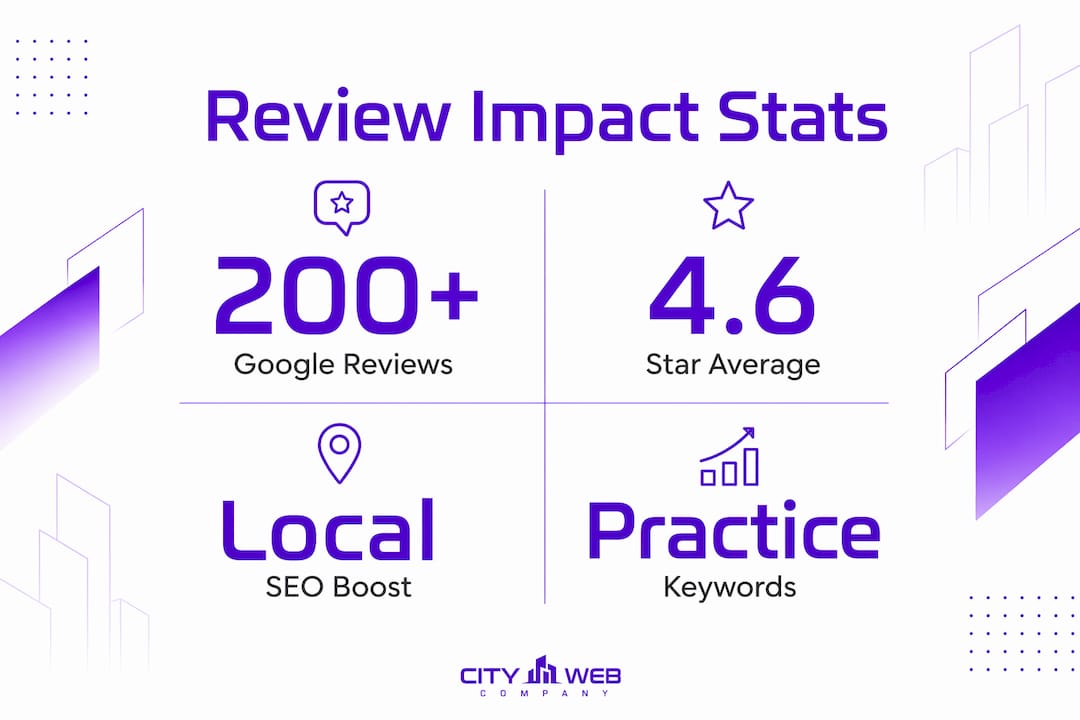
The data on this is concrete. A law firm with 200 Google reviews at a 4.6-star average will consistently outrank a firm with 11 reviews at a perfect 5.0. Volume and recency signal active client engagement, which Google interprets as a marker of a functioning, trustworthy business. Recency matters because a firm with 150 reviews from 2021 and nothing since 2023 sends a negative signal. Google’s algorithm treats review activity as a proxy for business health.

The more significant shift in 2026 is how AI search interfaces use review content. AI systems analyze semantic language in reviews to recommend law firms, meaning richer and more detailed reviews outrank high star-rating but low-detail competitors. When a user asks ChatGPT or Perplexity “who is the best personal injury attorney in Denver,” those systems pull from review content, not just star ratings. A review that mentions “thorough communication throughout my personal injury case” feeds directly into that recommendation engine.
Practice-area keywords in reviews function as user-generated relevance signals. When clients naturally write phrases like “family law attorney,” “estate planning,” or “immigration lawyer” in their reviews, those terms help Google match the firm to corresponding search queries. This is organic keyword placement that no amount of on-page SEO can fully replicate because it comes from third parties.
| Review signal | Impact on local SEO | Impact on AI visibility |
|---|---|---|
| Review volume (200+ reviews) | Strong local pack ranking boost | Higher confidence score for AI recommendations |
| Recency (reviews within 90 days) | Signals active business to Google | Freshness weighting in AI summaries |
| Semantic content (practice-area language) | Keyword relevance for specific queries | AI uses to match firm to user intent |
| Star rating alone | Moderate ranking factor | Insufficient for AI recommendation without detail |
| Multi-platform presence (Google, Avvo, Martindale-Hubbell) | Validates authority across signals | Broadens AI data sources for firm profiling |
Multi-platform reputation across Google, Avvo, Yelp, and Martindale-Hubbell strengthens law firm authority because Google reviews carry the strongest local SEO weight while secondary platforms validate and supplement the overall reputation profile. An AI search engine synthesizing information about your firm pulls from every available source. A firm present on three platforms with consistent positive signals is far more visible than one with a strong Google profile and nothing elsewhere.
Pro Tip: Encourage clients to mention the specific type of legal matter you handled in their review. “Helped me with my Chapter 7 bankruptcy filing” does more SEO work than “great lawyer.” You cannot script it, but you can prompt it by asking clients to describe what brought them to your firm.
Nuances and challenges in managing legal reviews
The importance of lawyer reviews comes with a compliance layer that most industries do not face. State bar associations regulate attorney advertising, and reviews fall within that scope. Understanding where the lines are protects your firm while maximizing review acquisition.
-
Paying for reviews is prohibited. Every state bar prohibits offering incentives, discounts, or gifts in exchange for reviews. This includes gift cards, referral bonuses, and any form of compensation. The rule is absolute, and violations carry disciplinary consequences.
-
Requesting reviews is permitted and encouraged. Most firms are more conservative than necessary. Ethically requesting reviews from satisfied clients following compliance guidelines is both legal and effective. A simple post-matter email asking a client to share their experience on Google is compliant in every jurisdiction.
-
Responding to reviews requires care. Responding to a negative review by disclosing case details, even to defend your firm, can violate attorney-client privilege. The correct approach is to acknowledge the concern, express willingness to resolve it privately, and avoid any case-specific information in the public response.
-
Generic responses waste SEO opportunity. Robotic review responses miss the chance to provide AI with semantic information. A response that says “Thank you for your kind words” adds nothing. A response that says “We appreciate you sharing your experience with our family law team. Helping clients through custody matters is work we take seriously” reinforces practice-area relevance for both readers and search algorithms.
-
Over-polishing testimonials destroys trust. Authentic, unscripted client voices with before-and-after contrasts are the most effective testimonials. When firms edit reviews into press-release language, they lose the rough edges that signal genuine experience. A client who writes “I was terrified going into my hearing and came out with everything I asked for” is more convincing than any polished marketing copy.
-
Negative reviews handled well build more trust than no negative reviews. A thoughtful, professional response to a critical review demonstrates accountability. Prospective clients read negative reviews specifically to see how a firm handles conflict. A graceful response often converts a skeptical reader more effectively than ten five-star reviews.
For firms operating across multiple states, legal marketing compliance rules vary by jurisdiction. What is permissible in Texas may require additional disclosures in New York. Build compliance review into your review management workflow, not as an afterthought.
Practical strategies for generating and leveraging client reviews
Knowing why reviews matter is only half the equation. The other half is building a system that generates them consistently without violating ethics rules or burning out your staff.
The most effective approach is automation within your existing client intake and case management workflow. Pre-drafted review requests based on client results get higher approval rates than blank requests. A CRM like Clio, MyCase, or Lawmatics can trigger a review request email automatically when a matter is closed and marked as resolved. The timing matters. Sending the request within 48 hours of a positive outcome captures the client at peak satisfaction.
Guiding clients toward useful review content without scripting them is a skill worth developing. You cannot tell a client what to write, but you can ask questions that prompt specificity. “What were you most worried about before we started working together?” and “What would you tell a friend who was facing the same situation?” produce far more useful reviews than “Would you mind leaving us a Google review?”
Here is a practical framework for integrating reviews into your broader legal marketing strategies:
- Prioritize Google Business Profile as your primary review platform. It carries the most weight for local SEO and feeds directly into Google’s AI search summaries.
- Maintain active profiles on Avvo and Martindale-Hubbell to build the multi-platform authority that AI systems use to validate firm credibility.
- Embed reviews on your website with schema markup so search engines can crawl and index testimonial content directly. This is a technical step that most firms skip, and it creates a measurable SEO advantage.
- Combine testimonials with case studies on practice-area pages. A review paired with a brief case narrative gives both readers and AI systems richer context about what your firm actually does.
- Respond to every review within 72 hours. Consistent response behavior signals active management to Google and demonstrates professionalism to prospective clients reading your profile.
- Track review velocity monthly. A firm that collects 15 reviews in January and zero in February through June is sending a negative recency signal. Steady acquisition across the year outperforms bursts.
For the technical side of embedding testimonials on your website, schema markup for reviews allows Google to display star ratings directly in search results as rich snippets. This increases click-through rates from organic search before a user even reads your page.
The online marketing for law firms that produces the best results treats reviews as a content channel, not a checkbox. Every new review is a piece of user-generated content that works for your firm 24 hours a day. A firm with 300 detailed, practice-specific reviews has built a content asset that would cost tens of thousands of dollars to replicate through paid advertising.
Pro Tip: Ask your best clients to leave reviews on two platforms, Google first and then Avvo or Martindale-Hubbell. Most clients are willing to do both if you make the process easy by sending direct links to each review page in the same email.
Key takeaways
Reviews in legal marketing function as both trust signals for prospective clients and semantic data inputs for AI-driven search systems, making review quality, volume, and platform diversity the foundation of competitive law firm visibility in 2026.
| Point | Details |
|---|---|
| Quality beats star ratings | Outcome-specific, detailed reviews convert clients and feed AI algorithms better than high ratings with no narrative. |
| Volume and recency drive local SEO | A firm with 200 recent reviews at 4.6 stars outranks one with 11 reviews at 5.0 in local search results. |
| AI reads semantic content | Practice-area language in reviews directly influences AI-powered search recommendations on Google, Perplexity, and ChatGPT. |
| Ethics compliance is non-negotiable | Paying for reviews violates state bar rules; ethical requesting strategies are both permitted and highly effective. |
| Multi-platform presence multiplies authority | Google carries the most SEO weight, but Avvo and Martindale-Hubbell validate and extend your firm’s reputation profile. |
Why star ratings alone will not save your firm’s reputation
I have worked with enough service businesses to know the pattern. A firm collects 50 five-star reviews, assumes the job is done, and stops asking. Two years later, their Google profile shows the last review was posted in 2023, and a competitor with 180 more recent reviews is ranking above them in every local search. The star rating did not change. The recency did.
What I find most underestimated in legal marketing is the shift from ratings as social proof to reviews as structured data. AI search interfaces synthesize sentiment and semantic content from reviews to highlight firm strengths and weaknesses for users, often without those users ever visiting the firm’s website. That is a fundamental change in how clients discover attorneys, and most firms have not adjusted their strategy to account for it.
The firms I see winning in 2026 are not the ones with the most polished websites or the highest ad budgets. They are the ones with 200-plus reviews that read like real human experiences, spread across Google, Avvo, and Martindale-Hubbell, with consistent responses that reinforce practice-area relevance. Their review profiles are doing marketing work that no paid campaign can replicate at the same cost.
My honest advice: stop treating review collection as a task you delegate to a paralegal once a quarter. Build it into your intake and closing workflow as a standard step, the same way you send a final invoice or close a file. The firms that treat reviews as a continuous marketing channel rather than a periodic chore are the ones building compounding reputation advantages that get harder for competitors to close every year.
For firms serious about content marketing for law firms, reviews are not separate from your content strategy. They are the most credible content you will ever publish, and you did not even have to write them.
— Matt
How City Web Company helps law firms turn reviews into growth
Law firms that want to compete on reputation need more than a Google Business Profile and a hope that satisfied clients leave reviews. City Web Company builds review generation systems, profile optimization workflows, and local SEO strategies specifically designed for law firms that need consistent, ethical, and measurable results.
City Web Company’s approach covers the full picture: setting up automated review request workflows, optimizing multi-platform profiles on Google, Avvo, and Martindale-Hubbell, embedding schema-marked testimonials on your website, and training your team on compliant requesting practices. Every step is built around digital marketing for law firms that generates real leads, not just vanity metrics. If your firm is ready to build a review-driven reputation that ranks and converts, contact City Web Company for a customized consultation.
FAQ
Why do reviews matter more than ads for law firms?
Reviews provide third-party validation that paid advertising cannot replicate. Prospective clients in high-stakes legal situations trust peer experiences over firm-produced content, and review volume directly influences local search rankings in ways that ad spend does not.
How many Google reviews does a law firm need to rank locally?
There is no fixed threshold, but firms with 200-plus reviews at a 4.6-star average consistently outrank competitors with fewer reviews at higher ratings. Recency and steady acquisition matter as much as total volume.
Can attorneys legally ask clients for reviews?
Yes. Ethically requesting reviews from satisfied clients is permitted under state bar rules in every jurisdiction. What is prohibited is offering any form of compensation or incentive in exchange for a review.
What makes a law firm review useful for SEO?
Reviews that include practice-area language, specific outcomes, and details about the attorney-client experience function as user-generated relevance signals that help Google match the firm to specific search queries.
How should attorneys respond to negative reviews?
Acknowledge the concern professionally, express willingness to resolve it privately, and avoid disclosing any case-specific information. A measured, respectful response demonstrates accountability and often builds more trust with prospective clients than the negative review costs.
Recommended
These articles were popular with other readers too: