

Pass Google Business verification with a video-first checklist. Film one continuous 30 second take, fix flagged issues, and know when to hire help.
The Role of Keyword Research in SEO and Marketing
Keyword research is the process of discovering and analyzing the exact search terms people type into search engines, and it serves as the foundation for every effective SEO and content marketing strategy. The role of keyword research goes far beyond building a list of phrases. It tells you what your audience actually wants, which pages to create, and where to focus your budget. Roughly 90% of published web pages generate zero organic traffic from Google. That single fact explains why guessing at topics is a losing strategy. Google Search Console, People Also Ask, and community forums like Reddit all feed into a disciplined research process that separates businesses that rank from those that stay invisible.
Table of Contents
Why keyword research is essential for successful SEO
Keyword research is the discipline of identifying what potential customers type into search engines and deciding which queries to target for the best return on your SEO investment. Without it, you are writing content based on internal opinions rather than real demand. That is how businesses end up with blog archives full of posts that nobody reads.
The most direct benefit of keyword research is intent alignment. Every search query carries a signal about what the searcher wants to do next. Someone typing “emergency plumber near me” wants to call someone right now. Someone typing “how to unclog a drain” wants a tutorial. Serving the wrong content format to either searcher means you will not rank, even if your page is technically well-written.
Misclassifying search intent is the most common reason for SEO failure despite good keyword data. Intent dictates content type and SERP success, meaning a page targeting the right keyword but the wrong format will plateau regardless of how well it is written.
The impact of keyword research on traffic compounds over time. Pages that match intent rank faster, earn more clicks, and attract backlinks organically. Pages that miss intent stall, no matter how much effort goes into them. For local service businesses, this distinction is especially costly because every missed ranking is a lead going to a competitor.
Keyword research also informs off-page decisions. When you know which topics carry the most search demand in your market, you can build link-earning assets around those topics rather than guessing what journalists or bloggers might want to reference. The research shapes the entire publishing roadmap, not just the keyword in the title tag.
- Identifies real demand: Confirms that an audience exists for a topic before you invest in creating content.
- Prevents wasted effort: Stops teams from producing content around topics with no search volume.
- Aligns content to intent: Matches the format and depth of a page to what searchers actually expect.
- Informs site structure: Groups related queries into topic clusters that build authority across a subject.
- Guides off-page strategy: Reveals which topics attract links and press coverage in your industry.
How keyword research improves content prioritization and marketing decisions
Keyword research creates a defensible framework for deciding what to publish next. Without it, content decisions become popularity contests inside a marketing team, where the loudest voice wins. With it, every topic choice is backed by data on search volume, competition level, and business value.
The first practical application is keyword gap analysis. This technique compares the queries your competitors rank for against the queries you rank for, then surfaces the gaps. Keyword gap analysis reveals competitor strengths and uncovers opportunities that can broaden your content strategy and market positioning. A landscaping company that discovers a competitor ranks for “lawn aeration cost” but they do not can immediately add that page to their publishing queue.
- Gather raw keyword data from Google Search Console, People Also Ask panels, and community forums to build a comprehensive list of candidate queries.
- Classify intent for each query: informational, navigational, commercial, or transactional. This step determines the correct content format before a single word is written.
- Cluster related queries into topic groups so that one well-structured page can rank for multiple related searches rather than creating dozens of thin pages.
- Score each cluster using weighted factors: search volume, business relevance, competition difficulty, and click potential. This produces a ranked publishing priority list.
- Map clusters to content formats: a transactional cluster becomes a service page; an informational cluster becomes a guide or FAQ; a commercial cluster becomes a comparison or review page.
Pro Tip: When classifying intent, look at the top five Google results for a query before deciding on a content format. If all five results are listicles, a long-form guide will not outrank them regardless of quality.
Keyword clustering is the step most marketers skip, and it is the one that produces the biggest gains. A pest control company might have 40 keyword variations around “ant exterminator.” Clustering them into one authoritative page with proper internal linking beats publishing 40 thin pages every time. The benefits of keyword analysis show up most clearly at this stage, where raw data transforms into a publishing plan with clear priorities.

Content format mapping is the final piece. Keyword research tells you not just what to write about but how to write it. A query like “best HVAC companies in Denver” signals a comparison page. A query like “how often should I service my AC unit” signals an educational article. Getting the format right is as important as getting the keyword right.
How is AI changing keyword research in 2026?
AI Overviews in Google search results have changed the economics of organic traffic in a measurable way. Organic click-through rates drop by an average of 34% for queries where Google AI Overviews are present, compared to queries without them. That is not a minor adjustment. It means a keyword that once drove 1,000 monthly visits might now deliver 660.
This shift does not make keyword research less relevant. 15% of daily queries are new and growing despite AI assistants, which means fresh search demand continues to emerge every day. The research process must now account for click potential as a scoring factor alongside volume and competition.
| Query type | AI Overview likelihood | Estimated CTR impact | Recommended content response |
|---|---|---|---|
| Informational (“how to” queries) | High | Up to 34% reduction | Build for AI citation and authority |
| Commercial (“best X for Y”) | Medium | Moderate reduction | Comparison pages with clear differentiators |
| Transactional (“hire X near me”) | Low | Minimal impact | Service pages with strong local signals |
| Navigational (brand queries) | Very low | Near zero impact | Brand and GMB optimization |
Pages that earn AI Overview citations build topical authority and backlink profiles even when direct click traffic is lower, serving as entity infrastructure for the site. This is a meaningful shift in how to measure keyword success. A page that gets cited in an AI Overview but generates fewer direct clicks is still doing valuable work for your domain’s authority.
Pro Tip: When scoring keywords in 2026, apply a click-potential discount to informational queries where AI Overviews are likely. Weight transactional and local queries higher because they carry lower AI Overview risk and higher conversion value.
The practical response is a portfolio approach to keyword targeting. Prioritize transactional and local queries for direct traffic and leads. Target informational queries to build authority and earn AI citations. Understanding AI’s role in search rankings helps marketers allocate effort across both categories rather than abandoning informational content entirely.
What are the most effective keyword research strategies for marketers?
Effective keyword research in 2026 starts with using multiple data sources rather than relying on a single tool. Cross-referencing sources like Google Search Console, People Also Ask, and community forums uncovers overlooked queries that volume-based tools miss entirely. A moving company that checks Reddit threads about moving to their city will find question-based queries that no keyword tool surfaces.
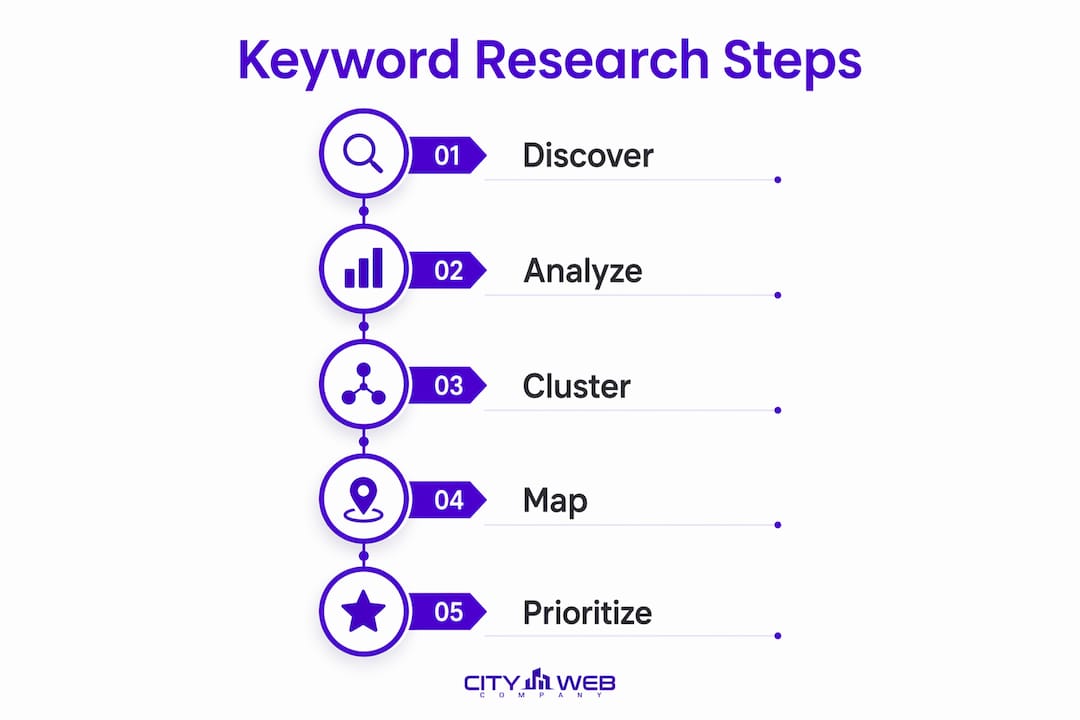

The research phase produces a list. The analysis phase turns that list into a strategy. Keyword research must be followed by analysis: categorizing intent, clustering queries, and evaluating business value to convert raw data into a publishing plan. Skipping the analysis step is the most common reason keyword research fails to produce results.
Data sources to use in your research phase:
- Google Search Console (queries your site already appears for, including low-impression terms)
- People Also Ask panels (question-based queries with clear informational intent)
- Google Autocomplete (real-time query variations based on actual search behavior)
- Community forums like Reddit and Quora (unfiltered language your audience uses)
- Competitor page analysis (topics and formats that already rank in your market)
Steps to build a weighted scoring matrix:
- Assign a score of 1–5 for monthly search volume (higher volume scores higher).
- Assign a score of 1–5 for business relevance (how directly does ranking for this query drive leads or sales?).
- Assign a score of 1–5 for click potential (lower AI Overview risk scores higher).
- Assign a score of 1–5 for competition difficulty (lower competition scores higher).
- Multiply or sum the scores to produce a priority ranking for each keyword cluster.
Not all keywords deserve the same publishing effort. A weighted scoring matrix prevents teams from chasing high-volume queries that are too competitive or too AI-dominated to generate real traffic. It also surfaces mid-volume, high-intent queries that convert at a much better rate than broad informational terms.
Keyword research is not a one-time project. Search behavior shifts as markets change, new competitors enter, and Google updates its algorithms. Scheduling a quarterly review of your keyword clusters against Google Search Console performance data keeps your strategy current. Queries that were low-volume six months ago may have grown significantly, and queries you ranked for may have lost click potential due to new AI Overview coverage. Learning how to boost organic traffic consistently requires treating keyword research as an ongoing process, not a launch-day task.
For local service businesses, long-tail keywords carry outsized value. A query like “emergency roof repair after hail storm Denver” has lower volume than “roof repair,” but the searcher is far more likely to call and hire. Local intent plus specific problem language equals high conversion probability.
Key Takeaways
Keyword research is the single most important input for any SEO or content strategy because it replaces internal opinion with verified data about what your audience actually searches for.
| Point | Details |
|---|---|
| Research prevents wasted effort | Roughly 90% of pages get no organic traffic, making verified demand a prerequisite before publishing. |
| Intent classification drives rankings | Matching content format to search intent matters as much as targeting the right keyword phrase. |
| AI Overviews change traffic math | Organic CTR drops by an average of 34% on AI Overview queries, so click potential must factor into keyword scoring. |
| Analysis converts data into strategy | Clustering, scoring, and intent mapping turn a raw keyword list into a prioritized publishing plan. |
| Quarterly reviews keep strategy current | Search behavior shifts constantly, requiring regular updates to keyword clusters and content priorities. |
What I’ve learned from watching businesses get keyword research wrong
Most businesses treat keyword research as a one-time checkbox. They run a tool, export a list, hand it to a writer, and consider the job done. That approach produces content that ranks for nothing and converts nobody.
The mistake I see most often is targeting keywords by volume alone. A local HVAC company chasing “air conditioning” with 500,000 monthly searches is not competing with other HVAC companies. They are competing with manufacturers, Wikipedia, and national media outlets. The query that actually wins them customers is something like “AC not cooling house Denver,” which has a fraction of the volume but a searcher who is ready to book a service call today.
The second mistake is skipping intent classification. I have watched businesses publish beautifully written guides targeting transactional queries, then wonder why they do not rank. Google knows the searcher wants a service page, not a blog post. The research told them the keyword was valuable. The analysis would have told them what format to use. They did the research and skipped the analysis.
The future of keyword research is not about finding the highest-volume terms. It is about finding the queries where you can win, where the searcher’s intent matches what you offer, and where AI Overviews are unlikely to absorb the click. That requires a more disciplined scoring process than most teams currently use. The businesses that build that process now will have a significant advantage as search continues to evolve.
— Matt
How City Web Company can strengthen your keyword strategy
City Web Company works with local service businesses every day on exactly this problem: turning keyword research into rankings and rankings into leads.
The team at City Web Company builds keyword strategies grounded in local search data, intent classification, and competitive gap analysis. For businesses in home services, pest control, HVAC, landscaping, and other service industries, the difference between ranking and not ranking often comes down to targeting the right queries with the right content format. City Web Company’s local SEO services are built specifically for this. If you want to understand how local and traditional SEO compare for your business, the local vs. traditional SEO guide is a strong starting point.
FAQ
What is the role of keyword research in SEO?
Keyword research identifies the exact queries your audience uses so you can create pages that match their intent and rank in search results. Without it, content decisions are based on guesswork rather than verified demand.
Why do most web pages get no organic traffic?
Roughly 90% of pages fail to generate organic traffic because they target topics with no verified search demand or misalign content format with search intent.
How does AI affect keyword research in 2026?
AI Overviews reduce organic click-through rates by an average of 34% for affected queries, which means keyword scoring must now include click potential as a weighted factor alongside volume and competition.
What is keyword intent classification?
Intent classification is the process of categorizing each query as informational, navigational, commercial, or transactional so you can match the correct content format to what the searcher expects to find.
How often should keyword research be updated?
Keyword research should be reviewed quarterly against Google Search Console performance data. Search behavior shifts as markets change, new competitors enter, and AI Overview coverage expands to new query types.
Recommended
- How to Choose the Right Keywords for Local Business SEO – City Web Company | Digital Marketing Agency
- How to Dominate Your Local Market With Long-Tail Keywords – City Web Company | Digital Marketing Agency
- SEO’s role in branding: boost visibility and trust locally
- Common SEO Myths That Are Hurting Your Rankings – City Web Company | Digital Marketing Agency
These articles were popular with other readers too: