

Pass Google Business verification with a video-first checklist. Film one continuous 30 second take, fix flagged issues, and know when to hire help.
Why Target Local Search: Benefits for Local Businesses
Targeting local search is defined as optimizing your online presence to appear in front of customers in your geographic area who are actively searching for your products or services. Over 46% of all Google searches carry local intent, meaning nearly half of every search is someone looking for a business nearby. Nearly 80% of those local searches convert into a customer action such as a call, visit, or booking. That conversion rate is the core reason why target local search is the most direct path from online visibility to real revenue for local businesses. City Web Company works with service businesses every day that prove this connection.
Table of Contents
Why target local search: the case for local businesses
Local search engine optimization, commonly called local SEO, is the recognized industry term for the practice of improving your ranking in geographically relevant search results. The phrase “why target local search” captures the same concept from a business owner’s perspective. Both terms describe the same goal: showing up when a nearby customer searches for what you sell.
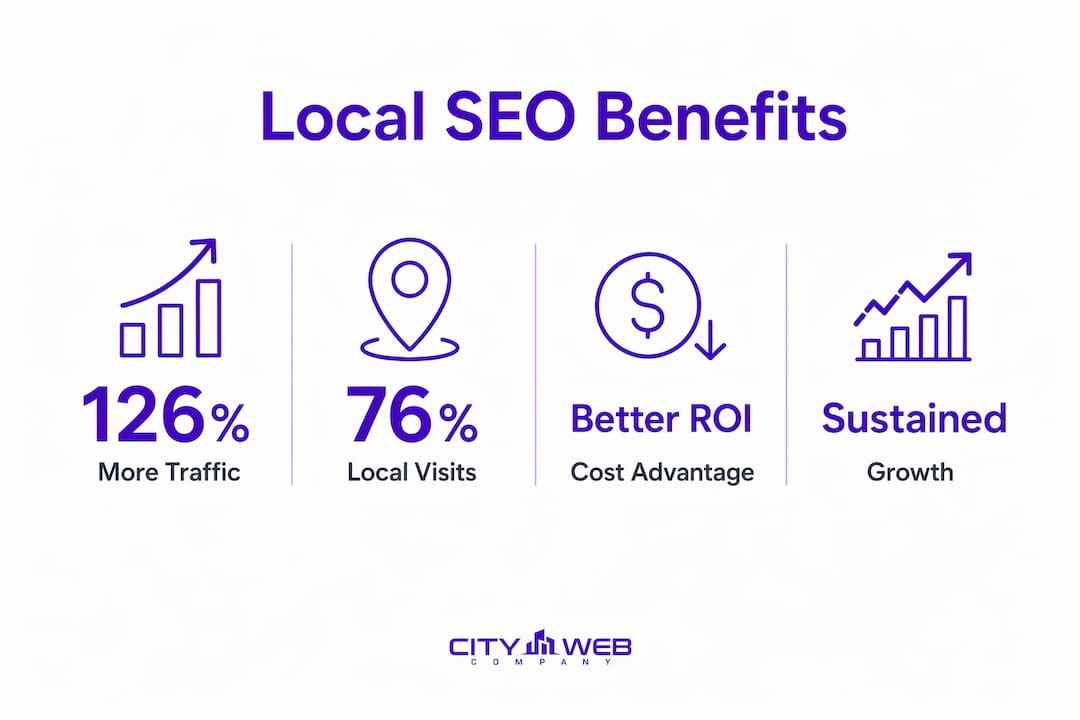
The business case is built on conversion, not just traffic. Ranking in Google’s Local Pack delivers 126% more website traffic than lower organic positions. That is not a marginal gain. It is a doubling of inbound attention from people who are already looking for a business like yours.

Local SEO also produces leads that are ready to act. 76% of local mobile searches lead to a business visit within 24 hours. That speed of conversion is rare in any marketing channel. A customer who searches “plumber near me” at 9:00 AM is often calling someone before noon.
The cost advantage over paid advertising
Local SEO delivers better ROI than paid ads or broad SEO for small businesses over time. Paid ads stop generating leads the moment you stop paying. Local SEO compounds. A well-optimized Google Business Profile, a set of strong reviews, and consistent directory listings keep working for you around the clock without a recurring ad budget.
Small businesses also compete more effectively through local SEO than through broad national campaigns. A local HVAC company cannot outspend a national brand on Google Ads. But it can outrank that brand in the Local Pack for searches in its own city by focusing on proximity, relevance, and prominence. Those three factors are the foundation of how Google ranks local results.

What are the key benefits of targeting local search?
The advantages of targeting local search fall into five clear categories: visibility, conversion speed, cost efficiency, competitive positioning, and trust.
-
Visibility in the Local Pack. Google’s Local Pack shows the top three map-based results for location-specific queries. Businesses that appear here capture a disproportionate share of clicks. Businesses in the top three map results gain 126% more traffic than those ranked below them.
-
Faster conversions. Local searchers act quickly. 28% of local searches result in a same-day purchase. A customer searching for a pest control company on a Tuesday afternoon is not doing research. They have a problem and they want it solved today.
-
Lower customer acquisition cost. Local SEO generates qualified leads at a fraction of the cost of paid search campaigns. Once your rankings are established, the cost per lead drops steadily while paid ad costs stay flat or rise.
-
Competitive edge over larger brands. Google’s local algorithm weights proximity and relevance heavily. A neighborhood landscaper with 80 five-star reviews and a complete Google Business Profile will outrank a national chain with no local presence in that zip code.
-
Trust built through reviews and consistent information. Customers cross-check businesses before they call. A business with accurate hours, recent photos, and a strong review score signals reliability before a single word is spoken.
Pro Tip: Set up a Google Business Profile alert so you know immediately when a new review is posted. Responding within 24 hours signals to both customers and Google that your business is active and engaged.
How does local search engine optimization work to improve online visibility?
Local SEO works through a set of interconnected ranking signals that Google uses to decide which businesses to show for a given location-based query. Understanding these signals helps you prioritize where to put your effort.
-
Google Business Profile optimization. Your Google Business Profile is the single most impactful asset in local SEO. Conversion often happens via map interfaces through click-to-call and directions links, making a complete and accurate profile more valuable for lead generation than your website design alone. Fill in every field: business category, hours, services, photos, and a description that includes your city name.
-
Consistent NAP information. NAP stands for Name, Address, and Phone number. Businesses with consistent NAP listings across platforms earn better trust from both search engines and customers. A mismatch between your Google listing and your Yelp page creates doubt. Google resolves that doubt by ranking you lower.
-
Review quantity, quality, and recency. Listings with 50 or more reviews and a 4.4-star rating or higher see meaningful conversion lift. Review velocity matters too. A business that receives five new reviews this month outperforms one that collected 50 reviews two years ago and has been silent since.
-
Local backlinks. Local backlinks from community sources outweigh national backlinks for local ranking relevance. A link from your city’s chamber of commerce, a local news article, or a community event sponsor page tells Google exactly where you operate and that your community recognizes you.
-
Schema markup and location landing pages. Schema markup is structured code on your website that tells search engines what your business does and where it operates. Location landing pages, one page per city or neighborhood you serve, give Google specific geographic signals that a generic homepage cannot provide.
-
AI and generative search. AI and generative search engines increasingly use structured local data and reviews to recommend businesses. A clean, complete Google Business Profile feeds directly into AI-powered local discovery tools. Businesses that ignore this shift will lose ground to those that treat structured data as a priority.
Pro Tip: Use Google’s free “Business Profile Manager” to add a weekly post or photo update. This signals to Google that your listing is actively managed, which correlates with stronger Local Pack placement.
Why does consistency matter for local search success?
Consistency is the foundation of local search trust. Customers now discover local businesses through multiple platforms beyond Google, including AI assistants, social media, and community forums. That means your business information must be accurate everywhere, not just on Google.
A single inconsistency, such as an old phone number on an industry directory or a different business name spelling on Facebook, creates friction. Search engines interpret conflicting signals as unreliable data. The result is lower rankings and fewer leads. Consistent online listings directly affect your SEO performance across every platform where customers look for you.
Active management amplifies the effect of consistency. Regularly updating your business hours for holidays, adding new service photos, and responding to every review tells Google your business is alive and relevant. Listings that go dormant lose ground to competitors who stay active.
- Update hours proactively. Set holiday hours at least two weeks in advance. Customers who find incorrect hours lose trust immediately and rarely return.
- Add photos monthly. Businesses with fresh photos receive more direction requests and website clicks than those with static or outdated images.
- Respond to every review. Responding to negative reviews professionally is as important as collecting positive ones. It shows future customers how you handle problems.
- Audit your listings quarterly. Check your NAP information on Google, Apple Maps, Yelp, and industry-specific directories every three months.
Local SEO results compound over 4–12 weeks, and sustained efforts like updating business info, managing reviews, and building local backlinks are the engine of long-term ranking. This is not a one-time project. It is a continuous practice that builds momentum over time.
Pro Tip: Use a free tool like Google Search Console to monitor which local search queries are driving impressions and clicks to your site. This data tells you exactly which city or service terms are working and which need more attention.
What practical local search marketing strategies can small businesses implement?
Local search marketing strategies do not require a large budget. They require consistency, attention to detail, and a clear understanding of what Google rewards. The following steps give you a complete starting framework.
-
Claim and complete your Google Business Profile. If you have not claimed your profile, do it today. Add your business category, hours, phone number, website, service areas, and at least 10 photos. A complete profile ranks higher than an incomplete one.
-
Research local keywords. Focus on city-specific terms and “near me” phrases that match your services. A roofing company in Denver should target “roof repair Denver” and “roofer near me” rather than generic terms like “roofing services.” Tools like Google’s Keyword Planner show you search volume for specific local terms.
-
Encourage reviews ethically. Ask satisfied customers to leave a review immediately after a job is complete. A text message with a direct link to your Google review page removes friction. Never offer incentives for reviews. Google penalizes businesses that do.
-
Build location-specific landing pages. If you serve multiple cities, create a dedicated page for each one. Each page should include the city name, a description of your services in that area, and local references that make the content feel genuine rather than templated.
-
Earn local backlinks. Sponsor a local event, join your chamber of commerce, or contribute a guest article to a local news site. Each link from a trusted local source strengthens your geographic relevance in Google’s eyes.
-
Add schema markup to your website. LocalBusiness schema tells search engines your business name, address, phone number, hours, and service area in a format they can read directly. A web developer can implement this in an afternoon, and the ranking benefit is immediate.
-
Monitor your Local Pack performance. Track your ranking in the Google Local Pack for your top five search terms every month. If you drop out of the top three, investigate what changed: a new competitor, a drop in review velocity, or a listing inconsistency.
The benefits of local SEO are most visible when these strategies work together. No single tactic produces the same result as a coordinated approach across your profile, reviews, website, and backlinks.
| Strategy | Primary Benefit | Time to See Results |
|---|---|---|
| Google Business Profile optimization | Local Pack visibility and click-to-call leads | 2–4 weeks |
| Review generation | Trust, conversions, and ranking lift | 4–8 weeks |
| Location landing pages | Organic ranking for city-specific searches | 6–12 weeks |
| Local backlink building | Geographic authority and ranking strength | 8–16 weeks |
| Schema markup | Better AI and search engine understanding | 2–6 weeks |
Key Takeaways
Targeting local search is the highest-converting marketing channel available to small businesses because it connects you with nearby customers at the exact moment they are ready to buy.
| Point | Details |
|---|---|
| Local Pack placement doubles traffic | Ranking in the top three map results drives 126% more traffic than lower positions. |
| Local searches convert fast | 76% of local mobile searches lead to a business visit within 24 hours. |
| Consistency builds rankings | Accurate NAP information across all platforms improves both trust and search visibility. |
| Reviews drive conversions | Listings with 50+ reviews and a 4.4-star rating or higher see measurable conversion lift. |
| Local SEO compounds over time | Sustained effort over 4–12 weeks builds ranking momentum that paid ads cannot replicate. |
What I have learned after years of watching local SEO work and fail
The businesses that win at local search are not always the ones with the best service. They are the ones that show up consistently, everywhere, with accurate information and a steady stream of fresh reviews. That observation sounds simple. Most business owners still do not act on it.
The biggest mistake I see is treating local SEO as a setup task rather than an ongoing practice. A business owner claims their Google Business Profile, fills it out once, and then ignores it for two years. Meanwhile, a competitor with a less polished website but an active listing, 30 new reviews in the past six months, and a fresh photo every week climbs past them in the Local Pack. The algorithm rewards activity. Dormant listings lose ground.
The second mistake is underestimating how much discovery has shifted. Customers no longer search only on Google. They ask AI assistants, check social media recommendations, and read community forums before they call. Multi-platform discovery is now the norm. If your information is inconsistent across those channels, you lose customers before they ever reach your phone number.
The compounding ROI of local SEO is real, but it requires patience. I have watched businesses go from zero Local Pack presence to ranking in the top three within 90 days by doing the basics well: complete profile, consistent NAP, weekly review requests, and two local backlinks per month. The businesses that stick with that rhythm for a year build a lead pipeline that paid ads cannot replicate at the same cost.
Treat local SEO as a foundational revenue channel. It is not optional for a service business that depends on local customers. It is the most direct line between your business and the people in your community who need what you offer.
— Matt
How City Web Company helps you win local search
Local search is where service businesses win or lose customers before a single conversation happens. City Web Company specializes in local SEO for small businesses, covering Google Business Profile optimization, location landing page development, review management, and consistent listing maintenance across every platform that matters.
The result is a lower cost per lead compared to paid advertising and a steadily growing presence in the Local Pack for the searches your customers are already making. City Web Company handles the ongoing work so you can focus on running your business. If capturing “near me” customers and holding a top-three map ranking sounds like the growth you are after, explore City Web Company’s digital marketing services to see what a managed local SEO program looks like in practice.
FAQ
What does it mean to target local search?
Targeting local search means optimizing your online presence so your business appears in geographically relevant results when nearby customers search for your products or services. The primary tools are Google Business Profile, consistent directory listings, local keywords, and customer reviews.
How quickly does local SEO produce results?
Local SEO results typically appear within 4–12 weeks of consistent effort. Google Business Profile updates and review generation tend to show impact fastest, while location landing pages and backlink building take longer to influence rankings.
Why do reviews matter so much for local search rankings?
Review quantity and quality are key ranking factors in local search. Listings with high review volume, strong ratings, and recent activity signal prominence and trustworthiness to both Google and potential customers.
Is local SEO better than paid ads for small businesses?
Local SEO delivers better long-term ROI than paid ads for most small businesses because rankings persist even when you stop actively spending. Paid ads stop generating leads the moment the budget runs out. Local SEO builds a compounding asset.
What is the Google Local Pack and why does it matter?
The Google Local Pack is the set of three map-based business listings that appear at the top of local search results. Businesses in this position receive 126% more traffic than those ranked below it, making it the most valuable real estate in local search.
Recommended
These articles were popular with other readers too: