
See how plumbers can turn Facebook scrollers into booked jobs with clear offers, local targeting, a 30 day test budget, fast follow up, and a path to scale.
What Is Brand Visibility and Why It Matters in 2026
Brand visibility is defined as how often and how prominently your brand appears to your target audience across the channels where buying decisions are made. This is not the same as brand awareness, though the two are closely related. 68% of B2B buyers already have a preferred vendor in mind before they start shopping, and that vendor wins the sale 80% of the time. That single statistic explains why brand visibility is not a vanity metric. It is a commercial asset. This article explains what brand visibility means, how it differs from awareness and perception, why it matters more than ever in an AI-driven search environment, and what you can do to build it sustainably.
Table of Contents
What is brand visibility and how is it measured?
Brand visibility is the frequency and prominence of your brand’s appearances in the channels where your buyers make decisions, measured relative to your competitors. A brand that shows up consistently in Google search results, AI-generated answers, social media feeds, and industry publications has high visibility. A brand that only appears on its own website does not.
Measuring brand visibility requires evaluation across multiple channels, not a single score. Each channel has its own metrics, and no single number captures the full picture.
| Channel | Primary metric | What it tells you |
|---|---|---|
| Search engines | Branded search share, share of voice | How often your brand appears vs. competitors in organic results |
| Social media | Mention volume, engagement rate | How frequently your brand is discussed and shared |
| AI-generated answers | Citation frequency, source diversity | Whether AI tools reference your brand in relevant queries |
| Earned media | Press mentions, backlink volume | How often third parties write about or link to your brand |
| Community forums | Thread appearances, recommendation rate | Whether peers recommend your brand in buying conversations |
Share of voice is the most widely used visibility metric in traditional search. It measures the percentage of total search impressions your brand captures within a defined keyword set. Branded search share tracks how many people search for your company by name, which signals growing recognition over time.
AI-generated visibility is the newest and least understood measurement challenge. AI systems retrieve brand mentions from trusted external sources rather than generating responses from a brand’s own content. This means your visibility in tools like ChatGPT or Perplexity depends heavily on what third parties say about you, not what you say about yourself.
The practical implication is that you need to track visibility across at least three distinct environments: traditional search, social and community platforms, and AI-generated responses. Relying on one channel’s data gives you a partial and often misleading picture of your true market presence.
Pro Tip: Set up Google Alerts for your brand name and your top three competitors. This gives you a free, real-time baseline for earned media visibility before you invest in paid monitoring tools.

How does brand visibility differ from brand awareness and brand perception?
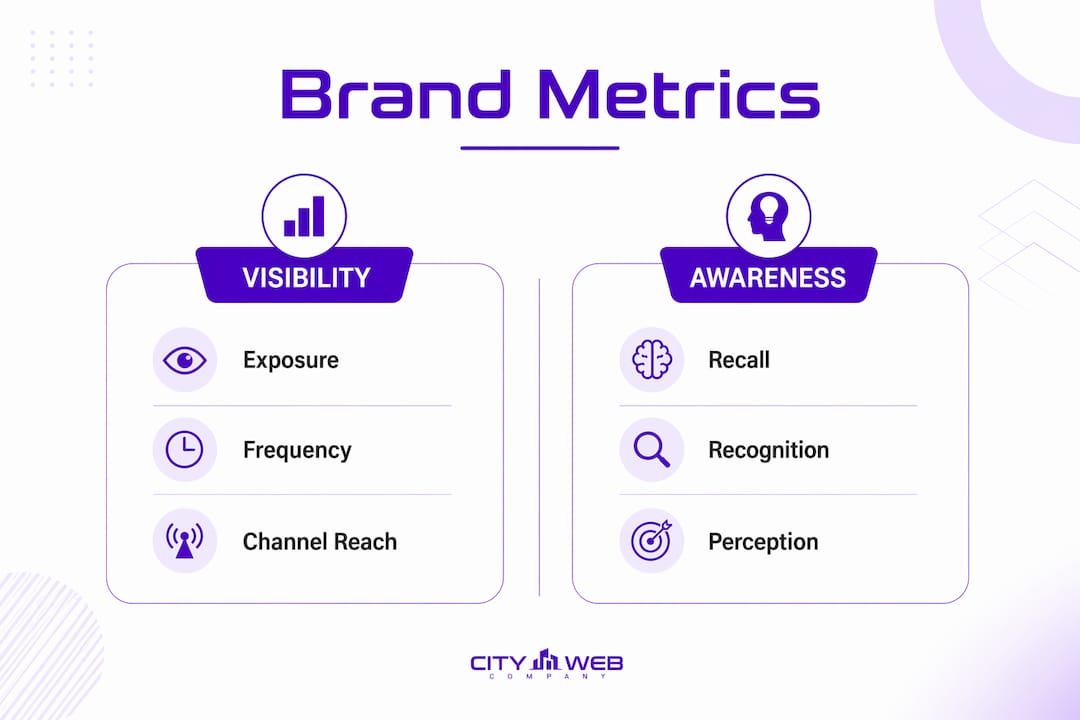
Brand visibility, brand awareness, and brand perception are three distinct concepts that build on each other in sequence. Confusing them leads to misaligned marketing goals and wasted budget.
Visibility is about exposure frequency. Awareness is about recall. Perception is about emotional association. A brand must be visible before it can be remembered, and it must be remembered before it can be trusted.
| Concept | Definition | Business impact |
|---|---|---|
| Brand visibility | How often your brand appears in relevant channels | Determines whether buyers encounter your brand at all |
| Brand awareness | Whether buyers recall or recognize your brand | Influences consideration and shortlisting |
| Brand perception | The emotional and reputational associations buyers hold | Drives preference, loyalty, and price tolerance |
A useful example: a local HVAC company that runs Google Ads achieves visibility every time its ad appears. But if a homeowner sees that ad three times and still cannot recall the company name the next day, awareness has not been built. If they do recall the name but associate it with pushy sales tactics, perception is working against conversion.
Visibility is the prerequisite. Without it, awareness cannot form and perception has no raw material to work with. This is why search rankings matter so much for local service businesses. Ranking on page one creates repeated exposure that eventually converts into recognition.
The sequence also explains why brand-building takes time. Visibility must accumulate before awareness solidifies, and awareness must solidify before perception can be shaped deliberately. Marketers who expect perception shifts within weeks of a new campaign are skipping two steps.
Pro Tip: Track branded search volume monthly. A steady increase in people searching your company name by name is the clearest early signal that visibility is converting into awareness.
Why is brand visibility crucial for business success in 2026?
Brand visibility directly influences which businesses get considered and which get ignored at the earliest stage of the buying process. High visibility shortens sales cycles because prospects arrive at the sales conversation already educated about your expertise. They ask better questions, require less convincing, and close faster.
The commercial logic is straightforward. When a buyer starts researching a service, they gravitate toward names they have already encountered. A pest control company that appears in a local news article, ranks in the top three on Google, and gets mentioned in a neighborhood Facebook group has a structural advantage over a competitor that only appears when someone searches its exact name.
“Brand visibility is not just about being seen. It is about being seen in the right places, by the right people, at the right moment in their decision process. Brands that treat visibility as a managed asset rather than a passive outcome consistently outperform those that leave it to chance.”
The rise of AI-powered search has made this dynamic more pronounced. 85% of brand mentions in AI-generated responses come from third-party sources rather than a brand’s own website. This means a business with strong earned media coverage and community mentions will appear in AI answers even when it has not specifically optimized for AI search. A business with only a polished website and no external citations will not.
Brands must now optimize for visibility across what practitioners call “Search Everywhere,” which includes traditional search engines, AI-powered answer tools, social platforms, and peer forums where buyers ask for recommendations. This is a structural shift, not a trend. Buyers increasingly start their research in AI tools and social communities before they ever reach a search engine.
Paid acquisition creates visibility while the budget runs. The moment you stop paying, the visibility stops. Organic visibility built through content, earned media, and community presence compounds over time and does not disappear when a campaign ends. For local service businesses operating on tight margins, this distinction matters enormously.
Visibility compounds over time as AI systems learn from accumulated citations. A brand that earns consistent third-party mentions today increases the probability that AI tools will cite it tomorrow. Early movers in earned media and content marketing gain a compounding advantage that late entrants cannot easily replicate.
What effective strategies can businesses use to improve brand visibility?
Building brand visibility requires a multi-channel approach executed consistently over time. There is no single tactic that works in isolation. The businesses that grow their visibility fastest combine organic search, content marketing, earned media, and community engagement into a coordinated effort.
Build organic search presence first
Organic search visibility is the foundation. Consistent content and visibility investment requires 2–3 years to materially shorten sales cycles, but the compounding returns make it the highest-value channel for most local service businesses. Start with a well-optimized Google Business Profile, then build out location-specific service pages that target the queries your buyers actually use.
Content marketing supports long-term visibility by creating assets that attract links, mentions, and repeat visits. A roofing company that publishes a detailed guide to storm damage assessment earns links from local news sites, gets shared in neighborhood groups, and appears in AI answers when homeowners ask about roof damage. That single piece of content generates visibility across four channels simultaneously.
Earn third-party citations and mentions
Focused appearances in decision-making channels beat diluted efforts spread across every platform. Identify where your buyers actually research purchases, then concentrate your earned media efforts there. For a local med spa, that might mean local lifestyle publications and Google reviews. For a B2B software company, it might mean industry analyst reports and LinkedIn.
Practical tactics for earning third-party mentions include:
- Submit expert commentary to local news outlets and industry publications
- Participate actively in community forums and neighborhood platforms where your buyers ask questions
- Build relationships with complementary businesses that can reference your work
- Request reviews on platforms your buyers consult, including Google, Yelp, and industry-specific directories
- Sponsor local events or organizations that generate press coverage
Manage visibility relative to competitors
Appearing more frequently and credibly than your top three competitors in relevant channels is more productive than chasing universal presence. You do not need to be everywhere. You need to be more visible than your direct competitors in the specific channels your buyers use.
Audit your competitors’ visibility quarterly. Track their share of voice in search, their mention volume in social media, and their presence in AI-generated answers for your core service queries. Use that data to identify gaps where you can outperform them with focused effort.
- Identify your top three competitors by search visibility in your primary service area
- Map the channels where they appear most frequently
- Assess your current visibility in those same channels
- Prioritize the channels with the largest gap between their visibility and yours
- Allocate content and outreach resources to close those gaps before expanding to new channels
Pro Tip: Search your primary service query in an AI tool like ChatGPT or Perplexity. Note which brands appear in the answer. If your competitors appear and you do not, you have identified your most urgent visibility gap.
The three pillars of digital marketing that underpin visibility are search presence, content authority, and earned trust signals. Neglecting any one of them creates a gap that competitors will fill.
Key Takeaways
Brand visibility is a measurable, manageable asset that determines whether buyers encounter your business before they encounter your competitors, and building it consistently across search, earned media, and AI-generated channels is the most durable path to shorter sales cycles and stronger revenue.
| Point | Details |
|---|---|
| Visibility precedes awareness | Buyers cannot recall or trust a brand they have never encountered. Exposure must come first. |
| AI search changes the rules | 85% of AI brand mentions come from third-party sources, making earned media more valuable than ever. |
| Organic visibility compounds | Content and earned media build lasting presence; paid ads stop the moment the budget pauses. |
| Focus beats breadth | Outperforming competitors in three key channels delivers more commercial value than thin presence everywhere. |
| Patience is required | Sustained visibility investment takes 2–3 years to materially shorten sales cycles and shift buyer behavior. |
Brand visibility is a long game. Here is what I have learned.
Most business owners I work with treat brand visibility as something that happens automatically if they run enough ads or post consistently on social media. That assumption costs them years of compounding growth.
The most important shift I have seen in the past two years is the rise of AI-generated search results as a primary visibility channel. Buyers are asking ChatGPT which local contractor to hire, which med spa to visit, which software to buy. The brands that appear in those answers are not the ones with the biggest ad budgets. They are the ones with the most credible third-party mentions accumulated over time. That is a fundamentally different game than paid search, and most local businesses have not started playing it yet.
The second thing I have learned is that visibility without focus is noise. I have watched businesses spread themselves across eight social platforms, three ad networks, and a podcast, and achieve meaningful presence on none of them. The businesses that grow fastest pick two or three channels where their buyers actually make decisions, then dominate those channels before expanding. Restraint is a competitive advantage.
Tracking matters more than most marketers admit. You cannot manage what you do not measure. Set a baseline for branded search volume, share of voice, and mention frequency before you start any visibility campaign. Then measure monthly. The data will tell you which channels are working and which are wasting your time. Adjust accordingly, and give your efforts at least 12 months before drawing conclusions.
— Matt
How City Web Company helps local businesses build real visibility
Local service businesses face a specific visibility challenge: they need to appear prominently in a defined geographic area, across search, AI answers, and community platforms, without the marketing budgets of national brands.
City Web Company specializes in exactly this problem. The team builds local SEO visibility for service businesses in competitive markets, from HVAC companies and plumbers to med spas and disaster restoration firms. Services include Google Business Profile optimization, location-specific content marketing, and earned media strategies designed to generate the third-party citations that now drive AI-generated visibility. If you want to understand how these services translate into local leads, the local lead generation guide is a practical starting point.
FAQ
What is brand visibility in simple terms?
Brand visibility is how often and how prominently your brand appears in the places where your buyers make decisions. It is measured relative to competitors across channels like search engines, social media, and AI-generated answers.
How is brand visibility different from brand awareness?
Visibility is about exposure frequency. Awareness is about whether buyers recall your brand after that exposure. Visibility must be established first before awareness can develop.
Why do AI search results matter for brand visibility?
85% of brand mentions in AI responses come from third-party sources. A brand with strong earned media coverage appears in AI answers even without specific AI optimization, while brands with no external citations do not.
How long does it take to improve brand visibility?
Sustained visibility investment typically takes 2–3 years to materially shorten sales cycles and shift buyer behavior. Short-term paid campaigns create temporary visibility that disappears when the budget stops.
What metrics should I track to measure brand visibility?
Track branded search volume, share of voice in your primary keyword set, social mention volume, and citation frequency in AI-generated answers. Visibility requires evaluation across multiple channels, not a single score.
Recommended
These articles were popular with other readers too: