

Discover 15 effective ways to improve online visibility in 2026. Boost your SEO, social media, and ads for rapid growth!
Step-by-Step SEO Guide for Home Services: Boost Local Visibility
TL;DR:
- Local SEO helps home service businesses become visible in Google search and map results.
- Creating unique, locally-focused content and optimizing Google profiles build trust and rankings.
- Regular tracking and updates are essential for maintaining and improving search visibility over time.
Finding a reliable plumber, HVAC technician, or pest control company used to mean asking a neighbor. Today, homeowners go straight to Google, and if your business isn’t showing up in those local search results, you’re invisible to the people who need you most. The problem isn’t a lack of quality work. It’s a lack of online visibility. Search engine optimization (SEO) is the process that helps local home service businesses get discovered by nearby homeowners at exactly the right moment. This guide walks you through every practical step, from picking the right keywords to tracking real results, so your business becomes the one homeowners find and trust first.
Table of Contents
Table of Contents
- Preparing for local SEO: Understanding your market and keywords
- Laying the groundwork: Website essentials for home service SEO
- Building authority: Google Business Profile and online citations
- Content and reputation: Building trust with local homeowners
- Track, refine, and stay ahead: Measuring results and continuous SEO improvement
- Our perspective: What most home service SEO guides miss
- Take your home service SEO to the next level
- Frequently asked questions
Key Takeaways
| Point | Details |
|---|---|
| Start with research | Effective local SEO begins by understanding your area’s needs and choosing the right keywords. |
| Optimize your foundation | Your website needs to be user-friendly, mobile-ready, and loaded with clear local service information. |
| Build trust online | Google Business Profile, accurate citations, and strong reviews make you the easy choice for homeowners. |
| Content matters | Fresh, location-specific content and visible testimonials directly boost your SEO and reputation. |
| Monitor and refine | Track results and update your approach regularly to maintain top local rankings. |
Preparing for local SEO: Understanding your market and keywords
Before you touch your website or create a single page, you need to understand who is searching for your services and what words they actually use. This is market and keyword research, and it’s the foundation everything else is built on.
Start by looking at your local competitors. Search for terms like “plumber in [your city]” or “HVAC repair near me” and study who shows up. Notice which businesses appear in the map results and which ones rank in the regular listings below. These are your real competitors online, not just the ones you know from word of mouth. Pay attention to the words they use on their pages, the services they highlight, and whether they have dedicated pages for specific neighborhoods or towns.
Right keyword research is essential for targeting local searches and attracting ideal customers. The goal is to find phrases that homeowners actually type when they need help, not industry jargon that only contractors use. A homeowner doesn’t search for “HVAC system maintenance protocol.” They search for “AC not cooling my house” or “furnace repair cost.”
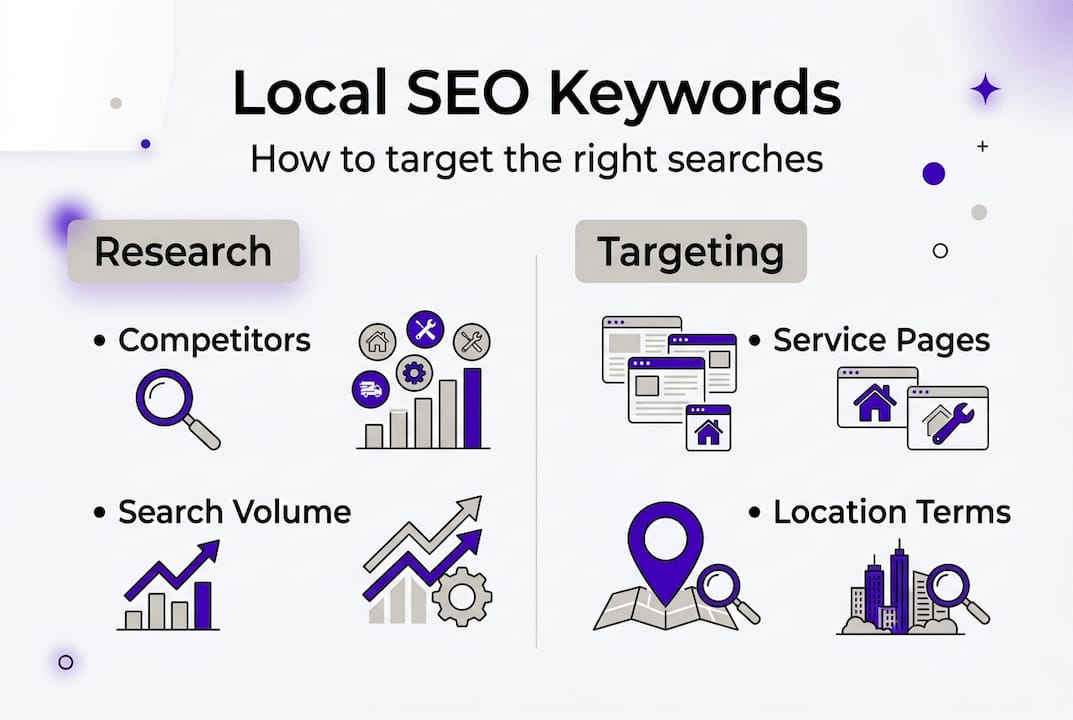
Here’s a quick comparison of keyword types and their typical search volume for home services:
| Keyword type | Example | Search volume | Competition |
|---|---|---|---|
| High-volume broad | “plumber near me” | Very high | Very high |
| Mid-volume local | “emergency plumber Dallas” | Medium | Medium |
| Low-volume specific | “water heater replacement Garland TX” | Lower | Low |
| Long-tail question | “how much does AC repair cost” | Medium | Low |
The sweet spot for most local home service businesses is the middle two rows. You want specific enough terms to attract buyers who are ready to call, but broad enough to generate consistent traffic.
Useful tools for finding these keywords include SEO tools for home services that show search volume and difficulty scores. Google’s own autocomplete feature is also surprisingly powerful. Start typing “plumber in” and let Google suggest the rest. Those suggestions are real searches real people are making.
Here are the core keyword categories every home service business should target:
- Service plus city (“roof repair Austin”)
- Emergency or urgent terms (“24-hour electrician near me”)
- Cost or pricing questions (“how much does pest control cost”)
- Comparison terms (“best HVAC company in [city]”)
- Neighborhood-specific terms for high-demand areas
For city and region specific SEO page strategies, experts recommend building dedicated pages for your highest-volume service areas while grouping smaller towns together to avoid creating thin, low-value content.
Pro Tip: Avoid stuffing keywords unnaturally into your content. Write like you’re explaining your service to a neighbor. Google rewards helpful, natural-sounding language far more than pages crammed with repeated phrases.
Laying the groundwork: Website essentials for home service SEO
With keyword targets clear, your website needs the right foundation to show up in local searches. Think of your website as your digital storefront. If it’s slow, hard to navigate on a phone, or missing key information, visitors leave fast and Google notices.


Having a search engine friendly website forms the foundation for any successful SEO strategy. That means your site needs to load quickly (under three seconds is the standard), display properly on mobile devices, and use a secure HTTPS connection. These aren’t optional extras. They’re baseline requirements.
Here’s a comparison of basic versus enhanced local SEO website features:
| Feature | Basic site | Enhanced local SEO site |
|---|---|---|
| Mobile friendly | Yes | Yes, with click-to-call buttons |
| Service pages | One general page | Separate page per service |
| Location info | Footer address only | Dedicated service area pages |
| Reviews | None | Embedded Google reviews |
| Schema markup | None | Local business schema added |
| Contact form | Basic form | Tracked, with confirmation |
Every home service website should include these must-have elements:
- A clear phone number visible on every page
- A service area page listing every city or zip code you cover
- Individual pages for each major service (plumbing, HVAC, electrical, etc.)
- Customer testimonials with real names and locations
- A fast-loading contact or quote request form
- An “About Us” page with photos of your actual team
One often-overlooked element is unique content for each service and location page. Copying the same paragraph across five city pages and just swapping the city name is a shortcut that backfires. Google recognizes duplicate content and ranks it poorly. Each page should describe what makes your service in that specific area valuable, reference local landmarks or neighborhoods, and answer questions homeowners in that area actually ask.
For website design for local leads, the structure of your pages matters as much as the words on them. Clear headings, logical navigation, and fast-loading images all contribute to both user experience and search rankings.
Pro Tip: Add schema markup to your website’s code. This is a small piece of structured data that tells Google exactly what your business does, where you’re located, and your hours. It can trigger rich results in search, like star ratings and phone numbers, directly in the search listing.
Building authority: Google Business Profile and online citations
With your site ready, local authority takes shape through Google Business Profile and credible citations. Your Google Business Profile (GBP) is arguably the single most powerful free tool available to local home service businesses. It’s what powers the map results that appear at the top of local searches.
Optimized Google Business Profiles directly impact local rankings and trust. Here’s how to set yours up correctly:
- Go to Google Business Profile and search for your business name to claim it or create a new listing.
- Verify your listing using the postcard, phone, or email method Google provides.
- Fill out every single field: business name, address, phone, website, hours, and service categories.
- Add high-quality photos of your team, vehicles, completed projects, and your office if applicable.
- Write a business description that naturally includes your primary service and city.
- List every service you offer using Google’s service menu feature.
- Enable messaging so homeowners can contact you directly from your profile.
Beyond your GBP, citations are online mentions of your business name, address, and phone number across directories like Yelp, Angi, HomeAdvisor, and the Better Business Bureau. You can see examples of business citations to understand what a well-structured citation looks like across different platforms.
Consistency is everything. Your name, address, and phone number (NAP) must be identical everywhere it appears online. Even small differences, like “St.” versus “Street” or a missing suite number, can confuse Google and weaken your local rankings.
Homeowners rely heavily on maps and reviews when choosing a home service provider. A profile with dozens of recent five-star reviews and accurate information signals trustworthiness before a homeowner even visits your website. For deeper Google Business Profile expert help, working with specialists can accelerate the process significantly.
Pro Tip: After completing a job, send a simple follow-up text or email with a direct link to your Google review page. Most happy customers are willing to leave a review but won’t search for the link on their own. Make it effortless for them.
Content and reputation: Building trust with local homeowners
Citation authority is a foundation, but content and reviews convince real people. Here’s how to excel at both.
Helpful, location-specific content and positive reviews increase both search visibility and consumer trust. The types of content that work best for home service businesses are practical, visual, and locally relevant.
Here are the most effective content types for home service providers:
- FAQ pages answering common homeowner questions (“How often should I service my HVAC?”)
- Before-and-after project galleries with brief descriptions
- Seasonal tips (“Winterizing your pipes in [city] before the first freeze”)
- Local guides (“Top signs your [city] home needs a roof inspection”)
- Video walkthroughs of common repairs or maintenance tasks
- Blog posts addressing local weather, regulations, or building codes
For service and location content strategies, the most effective approach ties your expertise to your specific geography. A pest control company in Florida writing about termite prevention during humid summers speaks directly to local homeowners in a way a generic article never could.
Building your review portfolio takes a deliberate system. Here’s a simple process:
- Complete the job and confirm the homeowner is satisfied before leaving.
- Send a thank-you message within 24 hours that includes your review link.
- Follow up once more after 48 hours if no review has been posted.
- Respond to every review, positive or negative, within 48 hours.
- Feature your best reviews prominently on your homepage and service pages.
A striking number shows just how much reviews matter: 88% of consumers trust online reviews as much as personal recommendations when choosing a local service provider. That number should motivate every follow-up message you send.
When a negative review appears, don’t panic and don’t argue. Respond calmly, acknowledge the concern, and offer to resolve it offline. Other homeowners reading that exchange will notice your professionalism far more than the original complaint.
Pro Tip: Feature real project photos with the homeowner’s first name and neighborhood (with permission). A photo of a finished kitchen remodel in “Sarah’s home in Plano” is far more convincing than a stock image. It also adds natural, location-specific keywords to your page.
Track, refine, and stay ahead: Measuring results and continuous SEO improvement
Once you attract attention and earn trust, ongoing tracking and optimization secure your competitive edge. SEO isn’t a one-time task. It’s a continuous process that rewards businesses who pay attention and adjust.
Ongoing SEO improvement relies on tracking rankings and tweaking strategies based on real data. The three tools every home service business should use are Google Analytics, Google Search Console, and a rank tracking tool.
Google Analytics shows you how many people visit your site, which pages they land on, how long they stay, and whether they fill out your contact form. Google Search Console shows you exactly which search terms are bringing people to your site and which pages Google has indexed. A rank tracker shows where your pages appear in search results for your target keywords over time.
Key performance indicators (KPIs) to monitor for local SEO:
- Organic traffic growth month over month
- Number of contact form submissions from organic visitors
- Phone calls tracked through call tracking software
- Google Business Profile views and direction requests
- Average position for target keywords
- New reviews received per month
- Citation accuracy score across directories
For service area SEO strategies, regularly auditing your location pages ensures they stay accurate as your business grows into new neighborhoods or cities.
Adapting your strategy is just as important as measuring it. If a blog post about HVAC maintenance is getting strong traffic, write three more like it. If a city page isn’t ranking, revisit the content, add more local detail, and build a few more citations pointing to it. If a competitor suddenly outranks you, study what changed on their site.
For staying updated on SEO best practices, local SEO communities and forums are surprisingly useful for catching algorithm changes before they affect your rankings.
Pro Tip: Schedule a quarterly SEO review on your calendar right now. Block two hours every three months to check your rankings, review your analytics, update outdated content, and clean up any citation inconsistencies. This one habit separates businesses that grow steadily from those that plateau.
Our perspective: What most home service SEO guides miss
Most SEO guides will tell you to create a separate page for every city, town, and neighborhood you serve. The logic sounds right: more pages equal more chances to rank. But in practice, this strategy often backfires badly.
When you create dozens of nearly identical location pages with only the city name swapped out, Google sees thin, low-value content. It can actually hurt your rankings and damage the trust you’ve worked hard to build. Different approaches suit high-volume vs. low-volume locations, and thin or duplicate location pages can actively hurt your visibility.
What actually works is a tiered approach. Your highest-volume service areas deserve fully developed, unique pages with local photos, specific project examples, and neighborhood-level detail. Smaller towns can be grouped into regional pages that still provide genuine value without duplicating content.
Quality over quantity wins every time. One well-written, genuinely helpful page about your services in a specific city will outperform ten thin, templated pages almost every time.
We’ve seen businesses with fewer pages consistently outrank competitors who have hundreds of location pages because their content is actually useful. For service area business SEO advice, the businesses that win long-term are the ones who treat every page as a real resource for a real homeowner, not just a keyword placeholder. Shortcuts feel efficient until Google updates its algorithm and wipes out everything you built on a weak foundation.
Take your home service SEO to the next level
You now have a clear roadmap: research your market, build a strong website, claim your Google Business Profile, create trustworthy content, and track your results consistently. That’s a powerful foundation. But executing all of it well, while also running your business, is genuinely challenging.
City Web Company specializes in exactly this kind of work for local home service businesses. Whether you want to start with our ranking guide for local service businesses or need a plain-language breakdown through our SEO terminology for business owners, we have resources built specifically for your industry. When you’re ready for hands-on support, our professional SEO services are designed to generate real leads and measurable growth for home service providers just like you. Let’s get your business in front of the homeowners who need you.
Frequently asked questions
What is the first step in SEO for home services?
Keyword research is the first step, specifically identifying the local search terms homeowners use when they need your specific service in your area.
How can I make my home service website show up in local searches?
Optimize your site with dedicated service pages and local keywords, then register and fully complete your Google Business Profile to appear in map results.
How important are reviews and testimonials for SEO?
Extremely important. Location-specific reviews build consumer trust and send strong signals to Google that your business is active and credible in your service area.
Do I need separate SEO pages for every neighborhood or city?
Not always. Create full, unique pages for your busiest markets and group smaller areas together, since thin duplicate location pages can actually reduce your overall rankings.
How often should I update my home service SEO strategy?
At minimum, review your strategy every quarter. Tracking rankings with real data lets you catch algorithm shifts and competitor moves before they cost you leads.
Recommended
- Search Engine Ranking Guide for Local Service Businesses
- Local SEO for Service Businesses: Boosting Leads Fast
- Service area business SEO: Strategies to boost local leads
- Local Search Engine Optimization: A Step-by-Step Guide to Get Found – City Web Company | Digital Marketing Agency
- #1 Best locksmith in Toronto | Top Commercial Locksmith |
- Essential residential moving checklist: streamline your move
These articles were popular with other readers too: