
See how plumbers can turn Facebook scrollers into booked jobs with clear offers, local targeting, a 30 day test budget, fast follow up, and a path to scale.
What Is a Marketing Funnel? Your 2026 Strategy Guide
Table of Contents
What is a marketing funnel and why does it matter?
A marketing funnel is a visual framework that maps the customer journey from the moment someone first hears about your brand to the moment they buy, and ideally, well beyond that. The model breaks that journey into stages, typically awareness, consideration, and conversion, so you can deliver the right message at the right time instead of broadcasting the same pitch to everyone.
Why does the structure matter? Ecommerce brands typically average 2% to 3% conversion rates, meaning the majority of people who encounter your brand do not make a purchase. A funnel tells you exactly where they leave and gives you a place to intervene.
Here is what a well-built funnel gives you:
- A clear picture of where prospects are in their decision process
- Stage-specific messaging that matches what buyers actually need to hear
- Measurable drop-off points so you can fix leaks instead of guessing
- A shared framework that aligns marketing and sales around the same customer journey
- A foundation for testing content, offers, and channels against real conversion data
The funnel is not a magic formula. It is a diagnostic tool. Used well, it turns a scattered marketing effort into a system you can read, adjust, and improve.
How the marketing funnel evolved from AIDA to today

The AIDA model describes four stages: Awareness, Interest, Desire, and Action. William W. Townsend first connected it to the funnel shape in his 1924 book Bond Salesmanship, and the core logic has held up for a century. The idea is simple: people do not go from stranger to buyer in one step. They move through a sequence, and each stage requires a different kind of persuasion.
Modern practitioners simplified AIDA into the TOFU-MOFU-BOFU structure, which stands for Top of Funnel, Middle of Funnel, and Bottom of Funnel. That three-part frame maps cleanly to awareness, consideration, and conversion, and it is easier to assign content types and budgets to three buckets than to four abstract psychological states.

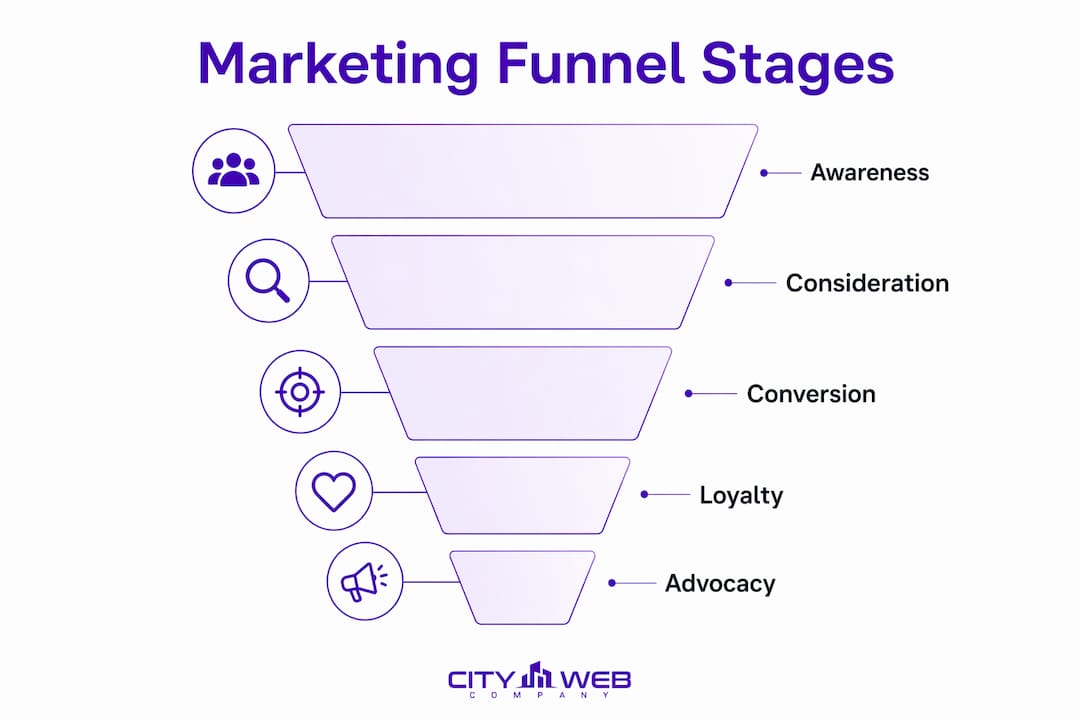
Contemporary models push further. Many now add Loyalty and Advocacy as post-purchase stages, recognizing that a customer who refers two friends is worth far more than a one-time buyer. CRM platforms have made those later stages trackable in ways that were impossible in 1924, which is why the funnel concept keeps expanding rather than being replaced.
What are the stages of a marketing funnel, and what works at each one?
The three primary stages are Top of Funnel (Awareness), Middle of Funnel (Consideration), and Bottom of Funnel (Conversion), with Loyalty and Advocacy often added for post-purchase work. Each stage calls for a different type of content and a different goal.
Top of funnel: awareness
At this stage, your only job is to get noticed by the right people. Tactics include search-optimized blog content, social media posts, YouTube videos, podcast appearances, and paid display ads. The content should educate or entertain, not sell. Someone searching “why does my AC keep shutting off” is not ready to hire an HVAC company yet. They want an answer. Give them one, and you have earned their attention.
Middle of funnel: consideration
Prospects here know they have a problem and are comparing options. This is where trust-building content does its heaviest lifting. Webinars, comparison guides, email nurture sequences, and detailed service pages all fit this stage. The goal is to answer the objections that keep someone from moving forward, whether that is price, credibility, or uncertainty about fit.
- Email sequences that address common objections directly
- Case studies showing real outcomes for similar customers
- FAQ pages that handle the questions prospects are too polite to ask on a sales call
- Free consultations or assessments that lower the risk of taking the next step
Bottom of funnel: conversion
At this stage, the prospect is close. They need a clear reason to act now. Strong calls to action, limited-time offers, testimonials, and frictionless booking or checkout processes all drive conversion. Matching content formats to funnel stage, such as educational blogs at the top and case studies at the bottom, consistently outperforms a one-size-fits-all approach.
Pro Tip: At the bottom of the funnel, reduce friction before adding incentives. A confusing checkout or a buried phone number kills more conversions than a weak offer.
Loyalty and advocacy
Post-purchase engagement through loyalty programs and educational outreach delivers the highest ROI by retaining customers and generating referrals. A plumber who sends a seasonal maintenance reminder and a discount code to past customers is running a loyalty stage, even if they have never heard the term.
How does a marketing funnel differ from a sales funnel?
People use these terms interchangeably, but they describe different scopes of work. Marketing funnels focus on the broader customer journey from initial awareness through lead generation, while sales funnels concentrate on converting qualified leads into paying customers. Both are necessary, and they work best when they are aligned.
| Dimension | Marketing funnel | Sales funnel |
|---|---|---|
| Scope | Full customer journey, awareness to advocacy | Qualified lead to closed sale |
| Primary owner | Marketing team | Sales team |
| Goal | Generate and nurture leads | Convert leads to customers |
| Content types | Blogs, ads, social, email sequences | Proposals, demos, follow-up calls |
| Key metric | Lead volume, cost per lead, engagement | Close rate, deal size, sales cycle length |
The practical implication: if your marketing funnel is generating leads but your close rate is low, the problem is in the sales funnel, not the marketing. Treating them as one system makes it harder to diagnose where the breakdown actually is.
How to measure and optimize your marketing funnel
Marketing funnels provide measurable insights by showing exactly where leads drop off, which gives you a specific problem to solve rather than a vague sense that “marketing isn’t working.” The metrics that matter most are tied to movement between stages.
| Funnel stage | Key metric | Optimization tactic |
|---|---|---|
| Awareness | Impressions, organic traffic, reach | Improve SEO, expand ad targeting |
| Consideration | Email open rate, time on page, return visits | Strengthen nurture sequences, add social proof |
| Conversion | Conversion rate, cost per acquisition | Simplify checkout, sharpen CTA copy |
| Loyalty | Repeat purchase rate, churn rate | Launch loyalty program, send re-engagement emails |
| Advocacy | Referral rate, Net Promoter Score | Create referral incentives, request reviews |
Lead scoring is one of the most underused optimization tools available. By assigning point values to engagement signals, such as email clicks, page visits, and form fills, CRM platforms let you identify which leads are ready for a bottom-funnel push and which ones need more nurturing. That prevents your sales team from wasting time on cold contacts while warm ones go uncontacted.
- Track drop-off rates between each stage, not just overall conversion
- Use Google Analytics 4 or a CRM with funnel reporting to visualize stage transitions
- Run A/B tests on landing pages, subject lines, and CTAs at the conversion stage
- Review funnel data monthly and adjust content or channel mix based on what the numbers show
Pro Tip: Set up goal tracking in Google Analytics 4 before you launch any campaign. Retrofitting measurement after the fact means you lose the baseline data you need to prove improvement.
How local service businesses can tailor their marketing funnel
Local service businesses face a customer journey that looks different from a national e-commerce brand. The awareness stage is often hyperlocal, driven by Google Business Profile visibility, neighborhood Facebook groups, and word-of-mouth referrals rather than broad content marketing. Customer journeys in local markets are rarely linear, and qualitative signals like heatmaps and session recordings often reveal drop-off points that standard analytics miss.
For a pest control company or a disaster restoration service, the consideration stage can compress dramatically. Someone with a flooded basement is not spending two weeks comparing providers. They are calling the first credible result they find. That means the middle of the funnel for emergency services is almost entirely about trust signals: reviews, response time promises, and a phone number that is impossible to miss.
City Web Company works with local service businesses across industries including HVAC, landscaping, med spas, and moving companies, building funnels that reflect how those specific customers actually make decisions. The funnel for local leads looks different from a B2B SaaS funnel, and treating them the same is one of the most common mistakes local businesses make.
Pro Tip: For local service businesses, your Google Business Profile is a funnel stage on its own. A complete profile with recent reviews and accurate hours captures prospects who are already at the consideration or conversion stage before they ever visit your website.
Why marketing funnels matter for your business growth
A funnel gives you something most marketing efforts lack: a structured way to connect activity to outcomes. Without it, you are spending money on ads, content, and email without knowing which investments are actually moving people toward a purchase.
The business case for funnel thinking goes beyond conversion rates. Funnels reveal which customer segments respond to which messages, which channels attract buyers versus browsers, and where your sales process breaks down. That information shapes budget decisions, hiring, and product development, not just marketing copy.
Funnels also create organizational alignment. When marketing and sales share the same stage definitions and handoff criteria, fewer leads fall through the cracks. A lead that marketing considers “ready” and sales considers “cold” is a symptom of misaligned funnel definitions, and it costs real revenue.
Common challenges when implementing a marketing funnel
The most common mistake is treating the funnel as a one-time setup rather than an ongoing system. Businesses build a landing page, write a few emails, and assume the funnel is “done.” Funnels require continuous measurement and adjustment as customer behavior, competition, and channel algorithms change.
A second challenge is creating content for only one stage. Many businesses produce plenty of awareness-level content (blog posts, social media) but neglect the middle and bottom stages where conversion actually happens. Prospects who find you through a blog post have nowhere to go if there is no nurture sequence or clear next step waiting for them.
Misaligned teams create a third failure point. If marketing hands off leads before they are ready, sales gets frustrated and stops trusting the pipeline. Defining lead qualification criteria together, using a shared CRM and lead scoring approach, prevents that friction before it starts.
Finally, many businesses skip the post-purchase stages entirely. Acquiring a new customer costs far more than retaining one, and a customer who refers others effectively lowers your cost per acquisition across the board.
How customer personas shape your marketing funnel
A funnel built without customer personas is built on assumptions. Personas define who moves through each stage, what questions they ask, what objections they raise, and what content format they prefer. Without that specificity, your funnel stages are generic buckets rather than targeted pathways.
A well-built persona for a local HVAC company might reveal that homeowners over 50 prefer phone calls and trust company longevity, while younger homeowners want online booking and read Google reviews before calling. Those two segments need different content at the consideration stage and different CTAs at the conversion stage, even though they are buying the same service.
Personas also determine channel selection. If your ideal customer spends time on Facebook but not LinkedIn, your awareness-stage budget should reflect that. Funnel strategy without persona grounding tends to spread budget evenly across channels regardless of where the actual buyers are.
How digital marketing channels fit into each funnel stage
Every major digital channel maps naturally to one or more funnel stages, and the best-performing funnels use each channel for what it does well rather than trying to make one channel do everything.
Paid search (Google Ads) captures high-intent prospects at the consideration and conversion stages. Someone searching “emergency plumber near me” is already past awareness. A well-structured Google Ads campaign meets them there with a direct offer and a clear call to action.
Social media advertising on platforms like Facebook and Instagram works across stages but excels at awareness and consideration. Retargeting campaigns that show ads to people who visited your website but did not convert are a classic middle-funnel application. Facebook and Instagram ads let you segment by behavior, interest, and geography, which is particularly powerful for local service businesses.
Organic search (SEO) drives top-of-funnel traffic at scale. A search-engine-friendly website that ranks for informational queries pulls in prospects before they are ready to buy, giving you the chance to nurture them through the funnel over time.
Email marketing owns the middle of the funnel. Once someone opts in, email sequences can deliver stage-appropriate content automatically, moving prospects from interest to decision without requiring manual follow-up for every contact.
Content marketing (blogs, videos, guides) supports every stage but is most cost-effective at the top. A single well-optimized article can generate awareness traffic for years, feeding the top of the funnel continuously. Pairing that with lead generation strategies that convert readers into email subscribers turns passive traffic into an active pipeline.
How marketing funnels vary by industry and business model
The funnel concept is universal, but its shape and timing vary considerably depending on what you sell and who you sell it to.
B2B service companies typically have long consideration stages. A business evaluating a marketing agency might spend weeks comparing options, reading case studies, and requesting proposals. The middle of the funnel for B2B is where most of the work happens, and content like detailed guides, webinars, and ROI calculators earns its keep there.
E-commerce brands often have short funnels with high volume at the top and heavy drop-off before checkout. The conversion stage gets the most optimization attention, with cart abandonment emails, retargeting ads, and checkout simplification as the primary levers.
Local service businesses (HVAC, pest control, landscaping, moving) often have compressed funnels for emergency or high-urgency services, as noted earlier, but longer consideration stages for planned projects like a kitchen remodel or a landscaping overhaul. The same business may need two distinct funnel tracks depending on the service category.
Subscription and SaaS businesses extend the funnel indefinitely, with churn prevention and upsell paths built into the post-purchase stages. Loyalty and advocacy are not optional additions for these models. They are the primary revenue drivers.
Understanding which funnel shape fits your business model prevents you from copying tactics that work for a different type of company. A local pest control company does not need a 12-email nurture sequence. A B2B software company probably does.
Key Takeaways
A marketing funnel works because it replaces guesswork with a measurable system that matches the right message to the right buyer at each stage of their decision.
| Point | Details |
|---|---|
| Funnel definition | A visual framework mapping the customer journey from awareness through conversion and beyond. |
| Ecommerce baseline | Ecommerce brands average 2% to 3% conversion rates, showing why funnel optimization matters. |
| Stage-matched content | Educational blogs fit awareness; case studies and testimonials drive conversion-stage decisions. |
| Funnel vs. sales funnel | Marketing funnels cover the full journey; sales funnels focus on converting qualified leads only. |
| Local service adaptation | Local funnels require persona-specific messaging, local SEO, and trust signals like reviews. |
FAQ
What is a marketing funnel?
A marketing funnel is a framework that maps the stages a customer moves through from first becoming aware of a brand to making a purchase and beyond. It helps marketers deliver stage-appropriate messaging to improve conversion rates.
What is the funnel method in marketing?
The funnel method organizes marketing activity around the customer journey by dividing it into stages, typically awareness, consideration, and conversion, and assigning specific content, channels, and tactics to each stage.
How do you build a marketing funnel?
Start by defining your customer personas, then map the stages from awareness to conversion for your specific business model. Assign content types and channels to each stage, set up tracking to measure drop-off rates, and refine based on what the data shows.
What is a real-world funnel example?
A pest control company runs Google Ads targeting “ants in my kitchen” (awareness), follows up with a retargeting ad offering a free inspection (consideration), and closes with a landing page featuring reviews and a one-click booking form (conversion).
Recommended
- What Is a Marketing Funnel? And How It Converts Local Leads – City Web Company | Digital Marketing Agency
- The Step-by-Step Guide to Planning Your First Marketing Campaign – City Web Company | Digital Marketing Agency
- Marketing Funnels Explained – From Click to Customer – City Web Company | Digital Marketing Agency
- How to Build a Multi-Channel Marketing Strategy – City Web Company | Digital Marketing Agency
These articles were popular with other readers too: