
Boost your HVAC local SEO with five key actions that enhance your visibility. Optimize your profile, collect reviews, and more for results.
Service area business SEO: Strategies to boost local leads
TL;DR:
- Service area businesses focus on online content and Google profiles rather than physical storefronts.
- Optimized Google Business Profiles and location-specific pages are key for local search rankings.
- Consistent citations, reviews, and digital content outweigh the importance of a physical address.
Most business owners assume you need a physical storefront to show up in local Google results. That assumption costs them real leads every single day. Service area businesses (SABs), from plumbers and electricians to personal injury attorneys and mobile physical therapists, operate by going to the customer. That changes everything about how you approach SEO. You don’t need a lobby. You need a strategy. This guide breaks down exactly how SAB SEO works, why it’s different from traditional local SEO, and what you can do right now to rank higher, earn more trust, and convert more searches into booked jobs across your entire service area.
Table of Contents
Table of Contents
- Understanding service area business SEO
- Optimizing your Google Business Profile for service areas
- Building powerful location landing pages
- Citations, reviews, and local links: Building trust for SAB SEO
- The real secret: Consistency and digital depth beat physical location
- Boost your service area business with expert local SEO support
- Frequently asked questions
Key Takeaways
| Point | Details |
|---|---|
| SAB SEO expands reach | You can dominate local search without a physical storefront by optimizing for service areas. |
| GBP is your foundation | A properly set up and optimized Google Business Profile is essential for visibility. |
| Location pages boost ranking | Unique, keyword-rich landing pages for every location signal expertise and authority to search engines. |
| Trust wins customers | Consistent citations, reviews, and local backlinks help convert more searchers into clients. |
Understanding service area business SEO
Service area business SEO is a specialized branch of local search optimization built for companies that serve customers at their location rather than waiting for them to walk through a door. Think plumbers, electricians, HVAC technicians, mobile notaries, home health aides, immigration attorneys who do home visits, and telehealth providers. These businesses share one defining trait: the customer’s address matters more than the business’s address.
Traditional brick-and-mortar SEO leans heavily on physical proximity. A restaurant or retail shop wants to rank for “near me” searches tied to its building’s GPS coordinates. SAB SEO works differently. It centers on your Google Business Profile (GBP), your service area selections, and the depth of your location-specific content online. As SAB SEO prioritizes virtual storefronts over physical locations and can outperform brick-and-mortar businesses through deep, well-structured content, the playing field is more level than most people realize.
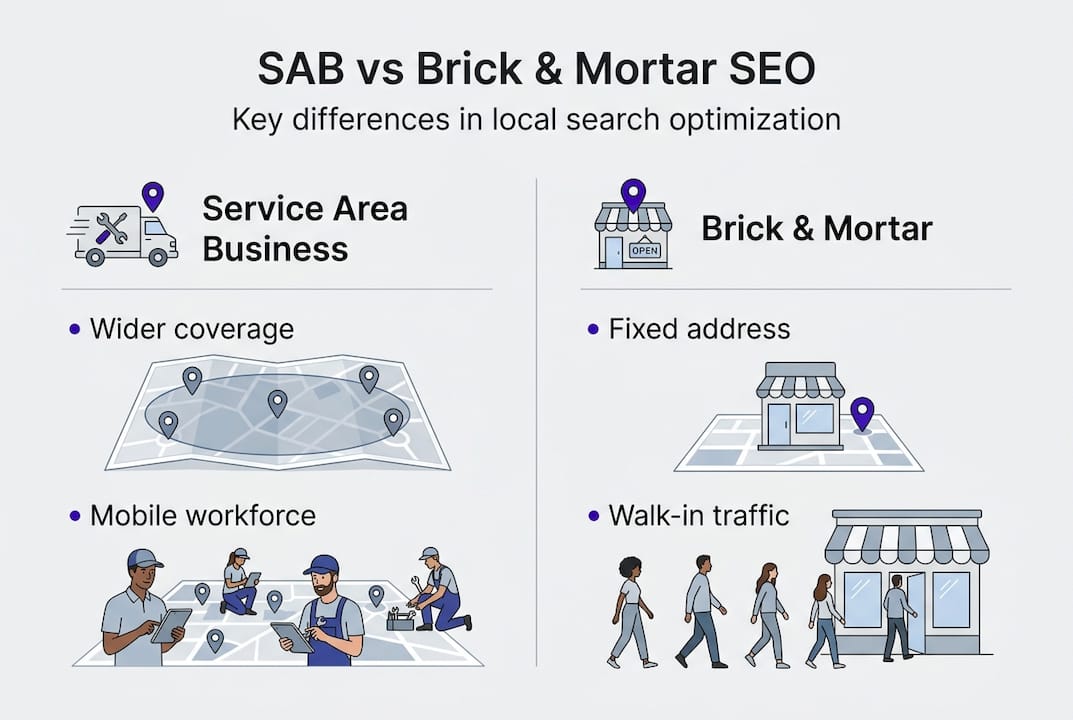
Here’s a quick comparison so you can see exactly where the differences lie:
| Factor | Brick-and-mortar SEO | Service area business SEO |
|---|---|---|
| Address visibility | Public, prominently listed | Hidden or not displayed |
| Ranking signal | Physical proximity to searcher | Service area + content depth |
| GBP setup | Storefront with photos | Service area selections, no storefront |
| Landing pages | Single location page | One page per city or neighborhood |
| Review strategy | In-person prompts at checkout | Post-service follow-up requests |
The core tools for SAB SEO success include:
- Google Business Profile with address hidden and service areas defined
- Location-specific landing pages for each city or neighborhood you serve
- NAP citations (name, address, phone) in relevant online directories
- Review generation systems tied to completed jobs
- Local backlinks from community organizations, partners, and local media
One insight that surprises many service business owners: content depth often beats physical proximity in rankings. A roofing company in a suburb that publishes detailed, city-specific pages about its services can outrank a competitor located physically closer to the searcher. Google rewards relevance and authority, not just geography. You can explore local business SEO best practices to see how this plays out across different service industries, and reviewing SEO for local service businesses gives you a broader foundation before diving into SAB-specific tactics. The SAB SEO strategies that consistently move the needle all share one thing: they treat your digital presence as your primary storefront.
Optimizing your Google Business Profile for service areas
Your Google Business Profile is the single most powerful tool in your SAB SEO toolkit. It’s often the first thing a potential customer sees before they even visit your website. Getting it right isn’t optional.
Here’s how to set it up correctly as a service area business:
- Create or claim your GBP listing at business.google.com using your legal business name.
- Select your business category carefully. Your primary category is the most important ranking signal in your profile. Choose the most specific option available (“Plumber” beats “Contractor”).
- Add secondary categories that reflect your full range of services. A law firm might list “Personal Injury Attorney” as primary and “Family Law Attorney” as secondary.
- Hide your business address. In the GBP dashboard, you can clear your address from public view. This is standard practice for SABs and does not hurt your rankings.
- Define your service areas. Google allows you to select up to 20 service areas by city, county, or ZIP code. Use all available slots strategically to cover your actual working territory.
- Add services and descriptions. List every specific service you offer with keyword-rich descriptions. Don’t just say “plumbing.” Say “emergency water heater repair” and “burst pipe service.”
- Upload photos regularly. Job site photos, team photos, and before-and-after images all signal an active, credible business.
- Post weekly updates. Google Posts keep your profile fresh and give you another place to include local keywords.
“Optimizing GBP by hiding your address and selecting up to 20 service areas is a core part of SAB methodology, and businesses that do this consistently outperform those that don’t.”
Pro Tip: When selecting your 20 service areas, don’t just pick the biggest cities. Include the specific neighborhoods, suburbs, and smaller towns where your best customers actually live. A healthcare provider in a metro area might get more conversions from a specific suburb than from the city center.
For a deeper look at how to structure your profile for maximum impact, GBP optimization for SABs walks through advanced configurations. If you want to truly master GBP optimization, there are specialized approaches that go beyond the basics. The Google Business Profile optimization services available today can accelerate results significantly compared to a DIY approach. Use service area selection tips to refine your geographic targeting once the fundamentals are locked in.
Building powerful location landing pages
After anchoring your business with a strong GBP, the next priority is dominating organic search with targeted landing pages. One page for your whole service area won’t cut it. Google wants to see that you genuinely serve each community, and a single generic page doesn’t prove that.
Every city or neighborhood you serve deserves its own dedicated page on your website. These aren’t thin, copy-paste pages with the city name swapped out. Each page needs to stand on its own as a genuine resource. Effective SAB SEO includes building location-specific landing pages with unique 500-plus word content, local keywords, and schema markup. That’s the baseline, not the ceiling.
Here’s what separates a high-performing local landing page from a weak one:
| Feature | Strong landing page | Weak landing page |
|---|---|---|
| Word count | 600+ words, unique content | Under 300 words, duplicated |
| Local keywords | City + service + neighborhood terms | Generic service terms only |
| Schema markup | LocalBusiness + Service schema | No schema |
| Social proof | Local testimonials, case studies | No reviews or generic quotes |
| Call to action | Specific, local phone number | Generic contact form only |
| Community references | Local landmarks, neighborhoods | No local context |
Key elements every location page must include:
- A unique headline that includes the city name and primary service
- Local context such as references to nearby neighborhoods, landmarks, or community events that prove you actually work there
- Service-specific content explaining what you do in that area and why local customers trust you
- Schema markup using LocalBusiness and Service types to help Google understand the page’s purpose
- A strong call to action with a local phone number and a simple form
Pro Tip: User-generated content is one of the most underused tools for location pages. Embed Google reviews that mention the specific city or neighborhood directly on that page. A testimonial from a customer in Springfield carries far more weight on your Springfield page than a generic five-star rating. This kind of authentic, local social proof signals credibility to both Google and your next potential client.
References to real community details matter more than most people expect. Mentioning a local school district, a well-known road, or a neighborhood by name tells Google you’re not just keyword stuffing. You’re a real business that operates there. Use the ranking guide for local businesses to benchmark your pages against what’s actually working in your market, and apply local SEO tips to sharpen your on-page strategy. The landing page strategy that drives the most leads always combines genuine local relevance with technical precision.
Citations, reviews, and local links: Building trust for SAB SEO
Creating findable pages is just one piece. Here’s how to build the trustworthy signals that convert searches into actual customers.
NAP citations are online mentions of your business’s name, address, and phone number across directories, review sites, and local platforms. For SABs, consistency is everything. If your business name is listed differently across directories, or your phone number has an old area code somewhere, Google gets confused and your rankings suffer. Consistent NAP citations in SAB-friendly directories, along with earning reviews and local backlinks, are SAB SEO fundamentals that you simply cannot skip.
Where to list your SAB for maximum impact:
- Google Business Profile (your most important citation)
- Yelp for home services and healthcare providers
- Houzz and Angi for home improvement businesses
- Avvo and Justia for legal professionals
- Healthgrades and Zocdoc for healthcare providers
- Facebook Business and Apple Maps
- Better Business Bureau and local Chamber of Commerce directories
Reviews are your most powerful trust signal after citations. The volume, recency, and quality of your reviews directly influence your local rankings. More importantly, they influence whether a potential customer calls you or your competitor. Build a simple post-service follow-up system: a text message or email sent within 24 hours of completing a job, with a direct link to your Google review page.
“The businesses that dominate local search in service industries aren’t always the biggest. They’re the ones with the most consistent, recent, and detailed reviews.”
Local backlinks add another layer of authority. A link from your city’s Chamber of Commerce website, a sponsorship mention on a local school’s site, or a feature in a community newspaper all tell Google that your business is genuinely embedded in the area. For home services, partnering with real estate agents or property managers can generate both referrals and links. For legal and healthcare SABs, contributing expert content to local news outlets or community blogs builds credibility fast.
Pro Tip: After completing a job, hand the customer a simple card that says “We’d love your feedback” with a QR code linking directly to your Google review page. This one tactic alone can double your review volume within 90 days.
Explore NAP citations for local SEO to audit your current citation health and fix inconsistencies before they drag down your rankings. The SAB trust signals that move the needle most are the ones you build systematically, not sporadically.
The real secret: Consistency and digital depth beat physical location
Here’s something we’ve seen play out dozens of times with service businesses: a company with no office, no storefront, and a home address they’ve hidden from Google outranks a well-established competitor with a prime downtown location. Every time. The reason isn’t luck. It’s consistent digital investment.
Many business owners waste money on commercial leases because they believe a visible address signals legitimacy. It doesn’t, not to Google and not to most modern customers. What actually signals legitimacy is a fully optimized GBP, 50 recent five-star reviews, eight city-specific landing pages, and citations that match perfectly across 40 directories.
The uncomfortable truth is that most SABs are inconsistent. They update their GBP once and forget it. They build two location pages and stop. They ask for reviews after a few jobs and then let the habit die. That inconsistency is your biggest competitor, not the business across town.
Our hard-won advice: before you sign a lease on an office you don’t operationally need, invest that money in six months of aggressive digital content, review follow-up, and citation building. The leads you generate will far outpace anything a physical address adds to your visibility. Growing local business leads through digital consistency is a strategy that compounds over time, while a physical location is a fixed cost that doesn’t.
It’s consistency and digital engagement, not your ZIP code, that ultimately wins in SAB SEO.
Boost your service area business with expert local SEO support
Ready to put these SAB SEO strategies into action for your business? Knowing the playbook is one thing. Executing it consistently while running a service business is another challenge entirely.
At City Web Company, we specialize in helping home service providers, legal professionals, and healthcare businesses build the kind of digital presence that generates steady, qualified leads without relying on a storefront. From building location-specific landing pages to managing your GBP and cleaning up citation inconsistencies, we handle the work so you can focus on serving your customers. Whether you’re just getting started or need to accelerate what’s already working, we can build a plan around your specific service area and goals. Learn how local SEO for business growth compares to traditional approaches, explore our ranking for local service businesses resources, or get started with our GBP optimization services today.
Frequently asked questions
What is considered a service area business for SEO purposes?
A service area business (SAB) is a local company that travels to serve customers at their location and does not require a public storefront for clients to visit. SABs include all businesses serving clients at their locations, from plumbers and electricians to mobile healthcare providers and attorneys who do home visits.
How long does it take for SAB SEO to improve local rankings?
Most service area businesses see meaningful ranking improvements and new leads within 3 to 6 months when they apply these strategies consistently. SAB SEO delivers results in that timeframe when citation building, GBP optimization, and content creation are all moving forward together.
Do I need a physical office to show up in Google local results?
No. Service area businesses can hide their address in Google Business Profile and still appear prominently in local search results by listing their service areas. SABs optimize GBP by hiding their address and selecting up to 20 service areas to define their geographic reach.
What’s the most important factor for SAB SEO?
Consistent NAP citations, location-specific landing pages, and a steady stream of customer reviews are the primary drivers of SAB SEO success. Consistent citations and local pages work together to signal relevance and authority to Google across every area you serve.
Recommended
These articles were popular with other readers too: