

Boost your HVAC local SEO with five key actions that enhance your visibility. Optimize your profile, collect reviews, and more for results.
SEO terminology explained: a local business owner’s guide
If you’ve ever felt overwhelmed by SEO jargon, you’re not alone. Many local business owners struggle to decode terms like backlinks, meta descriptions, and SERP. The good news? Understanding SEO terminology isn’t just for tech experts. When you grasp these key concepts, you can make smarter marketing decisions, communicate effectively with digital marketing professionals, and take control of your online visibility. This guide breaks down essential SEO terms in plain language, showing you exactly how each concept applies to growing your local service business.
Table of Contents
Table of Contents
- Key takeaways
- Understanding the basics of SEO terminology
- Exploring advanced SEO terms and their impact
- Comparing key SEO strategies for local businesses
- Applying SEO terminology to build your local marketing plan
- Boost your local business with expert SEO services
- Frequently asked questions
Key Takeaways
| Point | Details |
|---|---|
| Master SEO basics | Learning the core terms builds a foundation for smarter marketing decisions and clearer communication with digital marketing professionals. |
| Keywords drive discovery | Keywords are the exact words people type to find services like yours and should reflect what customers search for. |
| Backlinks signal trust | Backlinks act as votes of confidence and high quality links from reputable sites carry more weight than many low quality ones. |
| Local SEO matters | Optimizing for local search, including your Google Business Profile, boosts visibility for nearby customers. |
Understanding the basics of SEO terminology
Before diving into complex strategies, you need to master the fundamental vocabulary that shapes every SEO conversation. These core terms form the foundation of how search engines connect customers with your services.
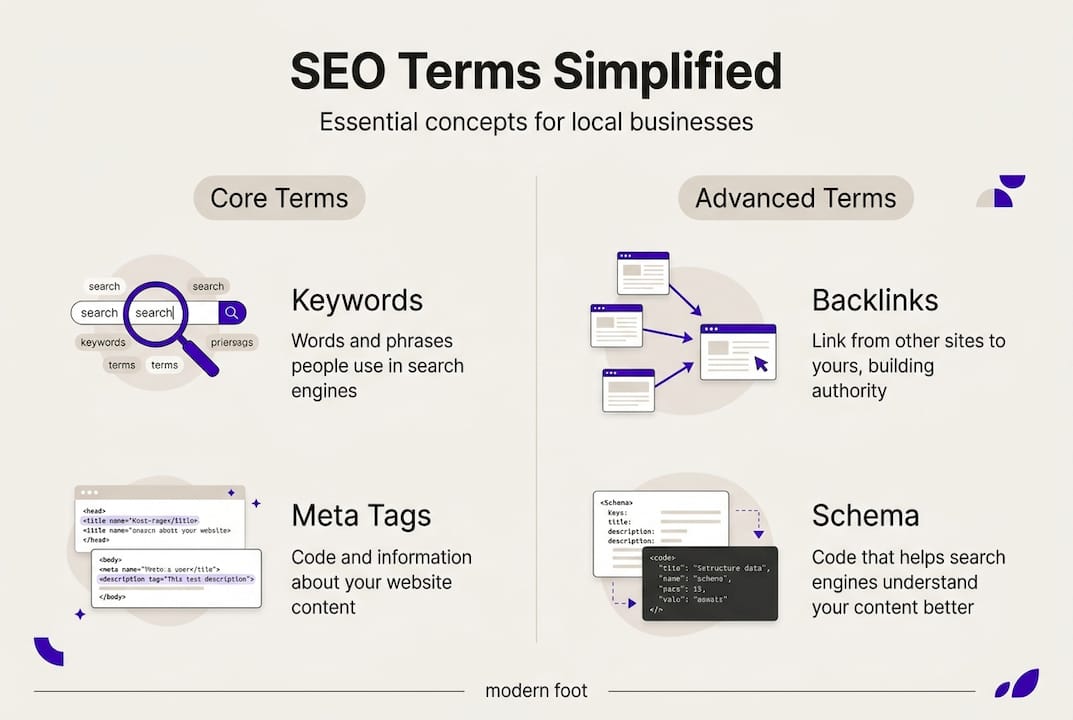
Keywords are the foundation of how people discover your business online. They’re the exact words and phrases potential customers type into Google when searching for services like yours. For a plumbing company, keywords might include “emergency plumber near me” or “water heater repair.” The right keywords bridge the gap between what you offer and what people are actively searching for.
Backlinks represent votes of confidence from other websites. When a reputable site links to your business, search engines interpret this as a signal that your content provides value. A backlink from a local chamber of commerce or industry association carries more weight than one from an unrelated blog. Quality matters far more than quantity when building your backlink profile.
Meta descriptions are the brief summaries that appear under your page title in search results. These 150-160 character snippets don’t directly affect rankings, but they significantly influence whether someone clicks through to your site. Think of them as your elevator pitch to potential customers browsing search results.
Search rankings determine where your business appears when someone searches for relevant terms. The difference between position one and position ten can mean the difference between a full schedule and an empty calendar. Rankings depend on hundreds of factors, from your website’s technical performance to the quality of your content.
Pro Tip: Focus on understanding one new SEO term each week rather than trying to master everything at once. This steady approach builds genuine knowledge without overwhelming you.
Here are the essential SEO terms every local business owner should know:
- Organic search results appear naturally based on relevance, not paid advertising
- Click-through rate (CTR) measures how often people click your listing after seeing it
- Domain authority indicates your website’s overall credibility and trustworthiness
- Alt text describes images for search engines and visually impaired users
Exploring advanced SEO terms and their impact
Once you’ve mastered the basics, these advanced concepts help you refine your strategy and compete more effectively in your local market.
Local SEO specifically targets customers in your geographic area. Unlike traditional SEO that might aim for national visibility, local SEO focuses on appearing when nearby customers search for services. This includes optimizing your Google Business Profile, managing local citations, and earning reviews from customers in your service area. For service businesses, local SEO often delivers faster, more measurable results than broader strategies.


Search intent reveals the goal behind a customer’s query. Someone searching “how to fix a leaky faucet” has informational intent, while “plumber open now” signals transactional intent. Understanding intent helps you create content that matches what people actually need at different stages of their decision-making process. When your content aligns with search intent, you’ll see higher engagement and better conversion rates.
SERP stands for Search Engine Results Page, the list of results Google displays after a search. The SERP landscape has evolved far beyond simple blue links. Today’s SERPs include featured snippets, local pack results, knowledge panels, and paid ads. Understanding SERP features helps you identify opportunities to capture more visibility beyond traditional organic listings.
Schema markup is code that helps search engines understand your content’s context. For a service business, schema can highlight your hours, services, pricing, and reviews directly in search results. While implementing schema requires some technical knowledge, the payoff comes in enhanced listings that stand out and provide more information to potential customers.
Pro Tip: Use Google’s free Search Console to see which search terms already bring visitors to your site. This data reveals opportunities you might be missing and helps prioritize your SEO efforts.
Here’s how advanced SEO terms translate into business impact:
- Local pack refers to the map results showing three businesses at the top of local searches
- Featured snippets are highlighted answers that appear above regular search results
- Mobile-first indexing means Google primarily uses your mobile site for ranking decisions
- Core Web Vitals measure your site’s loading speed, interactivity, and visual stability
| SEO Term | Definition | Impact on Local Business |
|---|---|---|
| NAP Consistency | Name, Address, Phone number matching across all online listings | Builds trust with search engines and improves local rankings |
| Citation | Any online mention of your business name and contact information | Strengthens local relevance signals and helps customers find you |
| Geo-targeting | Focusing content and ads on specific geographic locations | Reaches customers most likely to use your services |
| Long-tail Keywords | Specific, longer search phrases with lower competition | Attracts highly qualified leads ready to take action |
Comparing key SEO strategies for local businesses
Different SEO approaches serve different purposes. Understanding these distinctions helps you allocate resources effectively and choose tactics that align with your business goals.
Local SEO and traditional SEO differ fundamentally in scope and tactics. Traditional SEO aims for broad visibility across regions or even nationally, requiring extensive content creation and competitive link building. Local SEO concentrates on dominating your immediate service area through Google Business Profile optimization, local citations, and location-specific content. For most service businesses, local SEO delivers faster returns because you’re competing in a smaller, more defined market.
On-page SEO encompasses everything you control directly on your website. This includes optimizing title tags, headers, content quality, internal linking, and site speed. You have complete control over on-page factors, making them the fastest area to improve. Strong on-page SEO ensures search engines can easily understand and index your content.
Off-page SEO involves actions taken outside your website to improve rankings. Building backlinks, managing online reviews, and maintaining consistent business listings across directories all fall under off-page SEO. These factors signal to search engines that your business is legitimate, trustworthy, and valued by others. Off-page SEO typically requires more time to show results but builds long-term authority.
Technical SEO addresses your website’s infrastructure and performance. This includes site speed optimization, mobile responsiveness, secure connections (HTTPS), and proper site architecture. While less visible than content creation, technical SEO removes barriers that prevent search engines from properly crawling and indexing your site. Poor technical SEO can undermine even the best content strategy.
| Strategy Type | Best For | Time to Results | Difficulty Level |
|---|---|---|---|
| Local SEO | Service businesses targeting nearby customers | 3-6 months | Moderate |
| Traditional SEO | Businesses serving broad geographic areas | 6-12 months | High |
| On-Page SEO | Quick wins and foundational improvements | 1-3 months | Low to Moderate |
| Off-Page SEO | Building long-term authority and trust | 6-12 months | Moderate to High |
Here’s a prioritized approach for implementing SEO strategies:
- Start with on-page SEO to ensure your website foundation is solid
- Optimize your Google Business Profile for immediate local visibility
- Build consistent citations across major business directories
- Create location-specific content that addresses customer questions
- Develop a systematic approach to earning and responding to reviews
- Gradually build quality backlinks through partnerships and community involvement
Applying SEO terminology to build your local marketing plan
Knowing the terminology means nothing without practical application. Here’s how to translate your new vocabulary into actionable marketing strategies that drive real business growth.
Keyword research forms the backbone of any effective SEO plan. Start by listing the services you offer, then think about how customers describe their problems. A roofing company might target “roof leak repair” rather than just “roofing services.” Use Google’s autocomplete suggestions to discover related terms people actually search for. Focus on keywords that combine your service with location modifiers like “near me” or your city name. Document 10-15 primary keywords that represent your core services, then identify 30-50 supporting keywords that address specific customer needs.
Content optimization means strategically incorporating your target keywords throughout your website in natural, helpful ways. Your homepage should clearly state what you do and where you serve. Service pages need detailed descriptions that answer common questions while naturally including relevant keywords. Blog posts can target longer, more specific search phrases that attract customers earlier in their decision process. Every page should have a unique, descriptive title tag and meta description that encourages clicks from search results.
Google Business Profile management requires consistent attention to maintain strong local visibility. Complete every section of your profile, including business hours, services offered, and service areas. Upload high-quality photos of your work, team, and location at least monthly. Respond to every review within 24-48 hours, thanking positive reviewers and addressing concerns professionally. Post updates about promotions, seasonal services, or helpful tips to keep your profile active and engaging.
Tracking and measurement help you understand what’s working and where to focus your efforts. Set up Google Search Console to monitor which keywords bring visitors to your site. Use Google Analytics to see how visitors behave once they arrive. Track phone calls and form submissions to connect your digital marketing efforts to actual business results. Review these metrics monthly to identify trends and opportunities for improvement.
Here are practical ways to apply SEO terminology immediately:
- Audit your current website to identify missing or poorly optimized meta descriptions
- Create a spreadsheet of your top 20 keywords and track your rankings monthly
- Set up a review request system to consistently gather fresh customer feedback
- Identify three local business directories where you’re not yet listed and claim those profiles
- Write one blog post monthly targeting a specific long-tail keyword your customers search for
Boost your local business with expert SEO services
Understanding SEO terminology empowers you to make informed decisions, but implementing comprehensive strategies takes specialized expertise and consistent effort. City Web Company helps local service businesses translate SEO knowledge into measurable growth.
Our local SEO services handle everything from keyword research and content optimization to technical improvements and ongoing performance monitoring. We specialize in Google Business Profile optimization that puts your business in front of customers actively searching for your services. Whether you need help understanding the difference between local SEO and traditional approaches or want a partner to execute your entire digital marketing strategy, we deliver results that matter: more visibility, more leads, and more revenue.
Our team stays current with algorithm updates and industry changes so you can focus on running your business. We provide transparent reporting that connects SEO metrics to business outcomes, ensuring you always understand the value of your investment.
Frequently asked questions
What is the difference between SEO and local SEO?
SEO focuses on improving visibility across broad geographic areas or nationally, often requiring extensive content and competitive link building. Local SEO targets customers in your specific service area through Google Business Profile optimization, local citations, and location-based content. For service businesses serving a defined region, local SEO typically delivers faster, more cost-effective results because you’re competing in a smaller market with customers ready to take action.
How can I choose the right keywords for my local business?
Start by listing your core services, then think about the exact phrases customers use when describing their problems or needs. Research keywords that combine your services with location modifiers and question-based terms. Use Google’s autocomplete and “People also ask” sections to discover related searches. Focus on keywords with clear commercial intent rather than just high search volume, prioritizing terms that indicate someone is ready to hire a service provider.
Why is optimizing my Google Business Profile important?
Your Google Business Profile directly influences whether you appear in the local pack, the three businesses Google highlights at the top of local search results. Proper optimization improves your visibility when nearby customers search for your services, displays important information like hours and contact details, and showcases customer reviews that build trust. An optimized profile can generate phone calls and direction requests even before someone visits your website, making it one of the highest-impact SEO investments for local businesses.
How long does it take to see results from SEO efforts?
Local SEO typically shows initial improvements within three to six months, with more substantial results building over 6-12 months. Quick wins like optimizing your Google Business Profile or fixing technical issues can generate results within weeks. Building authority through content creation and backlinks requires more time but delivers compounding returns. Consistency matters more than speed, as search engines reward businesses that maintain steady optimization efforts rather than sporadic campaigns.
What’s the most important SEO factor for local service businesses?
While SEO success requires multiple factors working together, Google Business Profile optimization delivers the fastest, most visible impact for local service businesses. A complete, actively managed profile with regular posts, prompt review responses, and accurate information significantly improves your chances of appearing in local search results. Combined with a mobile-friendly website and consistent citations across business directories, Google Business Profile optimization forms the foundation of effective local SEO that drives actual customer inquiries and bookings.
Recommended
These articles were popular with other readers too: