

Use website DNI, connect call reports to Google Ads and your Google Business Profile, then tie calls to booked jobs. City Web Company can handle setup.
Why Branding Is Important for Your Business Growth
Table of Contents
Why branding is essential for your business success
Branding is the unified identity and promise your business communicates at every touchpoint, from your logo and website to how your team answers the phone. It is not a logo purchase or a color palette decision. It is the cumulative impression customers form about who you are, what you stand for, and whether you are worth trusting over every competitor in your market.
The case for investing in branding is concrete:
- Strong brands can command a price premium of up to 20% compared to weaker competitors.
- Brand consistency can increase small business revenue by 23–33%.
- 66% of consumers only purchase from brands they trust.
- Customers typically need 5–7 consistent impressions before brand recall and trust begin forming.
For small and medium-sized businesses, branding is not a luxury reserved for companies with large marketing budgets. It is the mechanism that determines whether a potential customer calls you or your competitor, whether they pay your price or push back on it, and whether they refer you to a friend or forget you existed.
Table of Contents
- How branding helps your business get recognized and stand out from competitors
- How branding builds trust and establishes business credibility
- How branding increases business value and attracts new customers
- How branding shapes employee pride and company culture
- Ensuring consistency and maintaining a strong reputation through branding
- Why investing in branding pays off over the long term
- Key Takeaways
- FAQ
How branding helps your business get recognized and stand out from competitors
Recognition does not happen after one ad or one job well done. Brand recognition is cumulative, requiring 5 to 12+ exposures across consistent touchpoints before familiarity takes hold. That means every interaction either builds toward recognition or resets the clock.
The elements that drive recognition work together, not in isolation:
- Logo and visual identity: A consistent logo, color palette, and typography make your business visually identifiable before a customer reads a single word.
- Messaging and tone: The language you use across your website, social media, and customer communications signals who you are and who you serve.
- Physical presence: A wrapped vehicle can deliver 30,000 to 70,000 daily impressions in a local market, making it one of the most cost-effective branding assets a service business can deploy.
- Online consistency: Your Google Business Profile, website design, and social media profiles should look and sound like the same company.
Differentiation is where most small businesses leave money on the table. Recognition tells customers you exist. Differentiation tells them why you are the better choice. A plumber who brands around same-day service guarantees occupies a different mental position than one who competes purely on price. A med spa that consistently communicates clinical expertise and personalized care attracts a different client than one running generic discount promotions.
Pro Tip: Before spending on ads or a new website, write a one-sentence brand position: who you serve, what you do, and what makes you different. Every visual and messaging decision flows from that sentence.
Local service businesses especially benefit from precise, trust-focused branding that targets a defined service area rather than chasing broad awareness. Narrow and consistent beats wide and scattered every time.

How branding builds trust and establishes business credibility
Trust is not built by a tagline. According to research on decision science and brand trust, trust forms through consistent experience across marketing, sales, product delivery, onboarding, and service, not through messaging alone. Every point where a customer cross-checks your business either confirms or undermines what your brand promises.
Trust is architectural. It is built layer by layer across every buyer interaction, and a single inconsistency at any stage can fracture what took months to construct. Branding is the blueprint that keeps every layer aligned.
Five trust signals that branding directly controls:
- Visual consistency: Matching colors, fonts, and imagery across all platforms signals professionalism and stability.
- Strategic differentiation: Clearly stating what you do differently removes ambiguity and reduces the customer’s perceived risk.
- Authenticity: Brands that communicate genuine values and follow through on them earn deeper loyalty than those projecting a polished image that does not match the experience.
- Social proof: Reviews, testimonials, and case studies embedded in your brand presence confirm that others have trusted you and were right to do so.
- Expertise demonstration: Content, credentials, and transparent process descriptions position your business as the knowledgeable choice.
The emotional dimension of trust matters too. Customers who feel a connection to a brand are far less likely to shop purely on price. That connection is built through consistent, authentic communication over time, not through a single campaign. Your local business branding strategy should treat every customer interaction as a trust deposit or a trust withdrawal.
How branding increases business value and attracts new customers
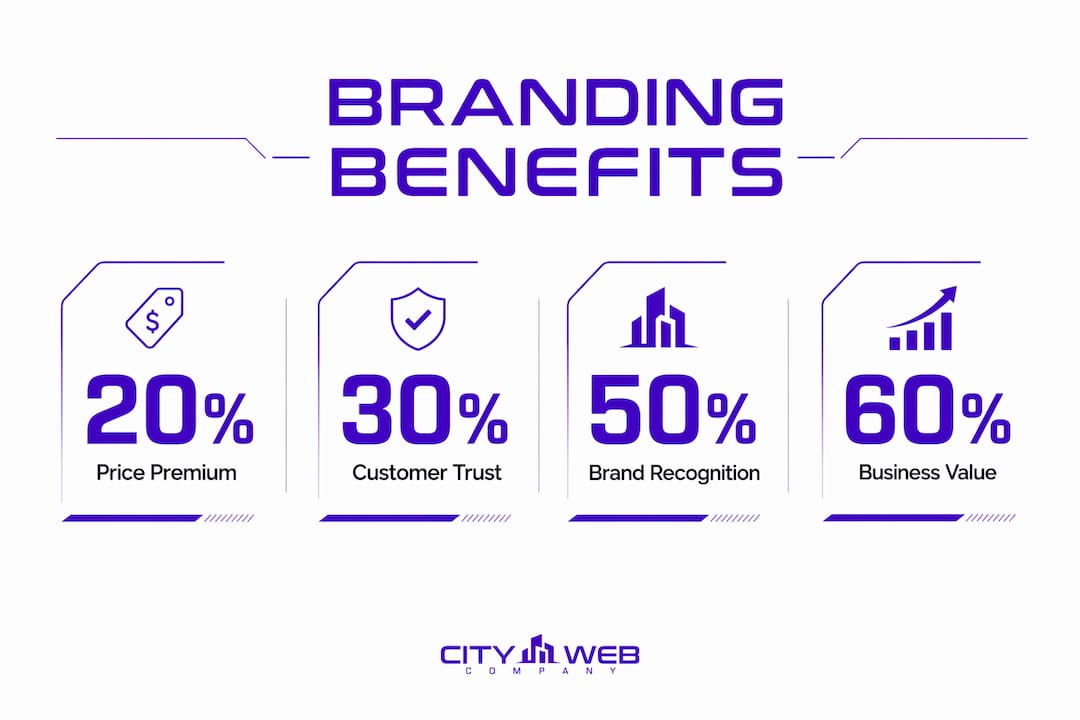
The financial case for branding is not theoretical. Businesses with strong, established brands command price premiums of up to 20% compared to weaker competitors in the same category. That premium is not about charging more arbitrarily. It reflects the perceived value customers assign to a brand they recognize and trust.
Revenue impact: Professional brand consistency can increase small business revenue by 23–33%.
Branding also makes every marketing dollar work harder. When a customer already recognizes your name and associates it with quality, your Google Ads convert at a higher rate, your social media content gets more engagement, and your sales conversations start from a position of credibility rather than skepticism. Brand equity compounds.
Concrete economic indicators of strong brand equity:
- Higher referral rates from existing customers
- Repeat business without requiring discounts or promotions
- Increased direct search volume for your business name
- Shorter sales cycles because trust is pre-established
- Lower customer acquisition costs over time
One practical note: many small businesses fall into what branding professionals call the commodity trap, purchasing a logo before defining their brand identity. The result is inconsistent branding across channels and price-based competition that erodes margins. Defining your identity first, then building visual assets around it, is what separates a brand from a business card.
The role of custom branding in local business growth is particularly clear for service companies. When your truck, your uniform, your website, and your Google profile all tell the same story, customers arrive pre-sold.

How branding shapes employee pride and company culture
A strong brand does not only face outward. Internally, it gives employees a clear sense of what the company stands for and what their work means. That clarity translates into higher morale, stronger team cohesion, and better customer interactions.
When employees understand and believe in the brand, they naturally become its ambassadors:
- They describe the company’s value confidently to friends, family, and potential customers.
- They make decisions aligned with the brand promise without needing a manager to intervene.
- They take pride in their work because it connects to something larger than a paycheck.
- They deliver more consistent customer experiences because they share a common understanding of the standard.
The connection between a strong external brand and internal organizational health is direct. Companies with clear brand identities tend to attract employees who share their values, which reduces turnover and raises the quality of customer-facing interactions. For a local HVAC company or a landscaping business, that means technicians who show up looking professional, communicate clearly, and represent the brand at every job site.
Ensuring consistency and maintaining a strong reputation through branding

Consistency is not a design preference. It is the mechanism through which branding actually works. Every time a customer encounters your brand and it looks, sounds, and feels the same as the last time, you make a deposit into their memory. Inconsistency does the opposite: it introduces doubt and forces the customer to re-evaluate whether they have the right company.
Key touchpoints that require consistent branding:
- Website: Design, tone, and messaging should match every other channel.
- Social media profiles: Profile images, bios, and post style should be immediately recognizable as the same brand.
- Vehicles and signage: Physical presence in the community reinforces digital impressions.
- Customer communications: Emails, invoices, and follow-up messages should carry the same voice and visual identity.
- Uniforms and branded merchandise: Staff appearance is a live brand impression at every job site.
The risk of inconsistency is not just aesthetic. Customers who encounter a mismatched experience, a professional website paired with an unprofessional social media presence, for example, lose confidence. That lost confidence is hard to recover. Branding is a long-term discipline, not a one-time project. The businesses that build the strongest reputations treat brand standards as operational standards, not creative guidelines.
Why investing in branding pays off over the long term
Short-term marketing tactics generate leads. Branding generates a business that does not have to fight for every lead. The compounding effect of consistent branding over years is what separates businesses that grow steadily from those that plateau or compete purely on price.
Long-term branding investment delivers outcomes that paid advertising cannot replicate on its own. Brand recognition reduces the cost of every future marketing campaign because customers already know who you are. Trust built over years means customers choose you before they even compare prices. A well-branded business also commands stronger word-of-mouth, which remains the highest-converting lead source for most local service companies.
There is also a valuation dimension. A business with a recognized brand, loyal customer base, and consistent reputation is worth more at sale than an identical business without those assets. Brand equity is a real balance-sheet consideration for owners thinking about exit strategy.
The SEO and branding connection matters here too. Branded search volume, the number of people searching specifically for your business name, is one of the strongest signals of brand equity. It grows only through consistent, long-term brand building. Businesses that invest in branding early find that their SEO performance improves alongside their reputation, because search engines reward brands that people actively seek out.
Key Takeaways
Strong branding builds the recognition, trust, and pricing power that drive sustainable revenue growth for small and medium-sized businesses.
| Point | Details |
|---|---|
| Price premium potential | Branded businesses can charge up to 20% more compared to competitors with weaker brand presence. |
| Revenue impact of consistency | Professional brand consistency can increase small business revenue by 23–33%. |
| Trust drives purchase decisions | Many consumers only buy from brands they trust, making credibility a direct revenue factor. |
| Recognition requires repetition | Customers need several consistent impressions before brand recall and trust begin forming. |
| Long-term compounding | Brand equity reduces customer acquisition costs and increases business valuation over time. |
FAQ
What is the main purpose of branding?
Branding communicates who your business is, what it stands for, and why customers should choose you over competitors. It builds the recognition and trust that drive purchase decisions and long-term loyalty.
Why is branding more important than ever for small businesses?
Consumers have more choices and more ways to research businesses than at any previous point, which means trust and recognition are harder to earn and more valuable when you have them. Businesses that invest in consistent, authentic branding stand out in crowded local markets where competitors often look identical.
How does branding affect pricing power?
Strong brands can command a price premium of up to 20% compared to weaker competitors, because customers assign higher perceived value to businesses they recognize and trust. That premium reflects brand equity, not just product or service quality.
How long does it take for branding to show results?
Brand recognition begins forming after 5–7 consistent impressions, but meaningful trust and reputation take months to years of consistent execution across all touchpoints. The long-term payoff is lower acquisition costs and stronger word-of-mouth referrals.
Recommended
These articles were popular with other readers too: