

Discover 15 effective ways to improve online visibility in 2026. Boost your SEO, social media, and ads for rapid growth!
Social media advertising for healthcare: a local guide
Social media advertising for healthcare isn’t just a nice-to-have anymore. Over 93% of the U.S. population uses social media, which means your potential patients are already scrolling, clicking, and making healthcare decisions based on what they see in their feeds. The real challenge for local healthcare marketers isn’t whether to advertise on social platforms. It’s how to reach the right patients, build genuine trust, and do it all without triggering a HIPAA violation or an FDA warning letter. This guide covers all of it.
Table of Contents
Table of Contents
- Understanding social media advertising for healthcare
- Preparing your healthcare social media advertising strategy
- Executing targeted social media campaigns to drive patient engagement
- Measuring performance and ensuring ongoing compliance in healthcare social ads
- The overlooked foundation: why compliance and education must lead your social media ads
- Elevate your healthcare marketing with specialized local SEO and digital advertising services
- Frequently asked questions
Key Takeaways
| Point | Details |
|---|---|
| Social media reach | Over 93% of Americans use social media, making it crucial for healthcare marketing strategies. |
| Compliance is essential | Healthcare ads must comply with HIPAA and FDA rules to avoid severe penalties. |
| Choose platforms wisely | Facebook and Instagram are best for patient engagement, LinkedIn for recruitment. |
| Educational content wins | Short, patient-friendly videos build trust and increase engagement. |
| Measure and optimize | Track engagement and conversion metrics to improve campaign ROI effectively. |
Understanding social media advertising for healthcare
Before you build a single campaign, you need to know where the opportunity actually lives. Healthcare social media marketing has matured significantly. Patients don’t just use social platforms to share vacation photos. They research symptoms, look up providers, read reviews, and watch videos about procedures they’re considering. That’s your audience, and they’re reachable.
Where the attention is
98% of U.S. healthcare marketers use Facebook, and social media accounts for 11.5% of total healthcare ad budgets. That number is growing every year. Facebook and Instagram dominate because of their targeting depth, ad format variety, and sheer audience size. But the way people consume content on these platforms has shifted. Passive scrolling is out. Short video, carousel posts, and interactive stories are in.
Here’s what works best for local healthcare providers on social platforms:
- Short educational videos (under 60 seconds): Explainers on common conditions, procedure walkthroughs, and “what to expect” content perform consistently well. Patients trust providers who teach before they sell.
- Instagram carousels: Step-by-step visual content works especially well for topics like pre-op preparation, medication management, or seasonal health tips.
- Patient testimonials (with written consent): These build credibility fast, but require strict compliance protocols we’ll cover in the next section.
- Community-focused content: Local health events, staff introductions, and behind-the-scenes clinic tours humanize your practice and differentiate you from large hospital networks.
Platform comparison at a glance
| Platform | Best for | Primary format | Audience strength |
|---|---|---|---|
| Patient education, appointment ads | Video, photo, carousel | Adults 35 to 65+ | |
| Brand awareness, visual health content | Reels, stories, carousels | Adults 18 to 45 | |
| Recruiting, thought leadership | Articles, posts | Healthcare professionals | |
| YouTube | Long-form education, procedure content | Video | All adult demographics |
Understanding healthcare advertising strategies at the platform level helps you allocate budget where your specific patient population actually spends time. A pediatric clinic, for example, should weight Instagram heavily because that’s where parents of young children are most active. A cardiology practice should lean into Facebook, where its older demographic dominates.
Preparing your healthcare social media advertising strategy
Getting your foundations right prevents expensive mistakes. Most compliance problems in healthcare social media don’t come from bad intentions. They come from moving too fast without documented processes. That’s a fixable problem, but only if you address it before your first campaign goes live.

Building your governance framework
Healthcare organizations must implement a social media policy to avoid regulatory penalties from HIPAA, FDA, and FTC violations. That policy needs to be a real, working document, not a PDF buried in your shared drive. Here’s how to build one that actually functions:
- Define who can post and approve content. Assign clear ownership. Every piece of paid social content should pass through at least one compliance reviewer before it publishes. For ad content making any health claims, legal review is worth the time.
- Document your patient consent process. If you plan to use patient stories, photos, or testimonials in ads, you need signed written authorization. Verbal consent is not enough. Create a HIPAA-compliant release form specific to social media advertising.
- Establish prohibited content rules. Your policy should explicitly ban sharing any protected health information (PHI), including names, appointment times, photos that identify patients, or any combination of details that could identify a specific person.
- Create a claims substantiation file. Any health claim in your ads, such as “proven to reduce recovery time” or “most effective treatment for X,” must have documented scientific evidence behind it per FDA and FTC guidelines. Keep these files organized and accessible.
- Set up a response and escalation protocol. What happens when someone comments on your ad with a personal medical question? You need a scripted, compliant response that acknowledges their concern without creating a provider-patient relationship or disclosing any health-related information publicly.
Your social media advertising workflow should map directly to these policy elements so nothing falls through the cracks when campaigns are running under deadline pressure.
Pro Tip: Run a mock compliance audit before your first campaign launches. Have someone outside your marketing team review your planned content against your HIPAA policy and FDA fair-balance requirements. Catching a problem on paper costs you nothing. Catching it after a published ad could cost you six figures.
The planning phase is also where you should define your content pillars for digital advertising for healthcare. Think about the top three to five health topics your patient population cares about most, the seasonal health events you can tie content to, and the patient journey stages you’re trying to influence. A well-structured content plan aligned with your healthcare ad strategies saves time during execution and ensures every ad serves a defined purpose.
Executing targeted social media campaigns to drive patient engagement
With your strategy foundations and compliance measures set, it’s time to build and run campaigns that actually convert. Execution is where most local healthcare providers leave money on the table, usually because they’re treating social ads like flyers rather than precision outreach tools.
Step-by-step campaign build
- Choose your primary platform based on your target patient. For most local practices, Facebook and Instagram together cover the widest patient demographic. Start there before expanding.
- Define your geographic targeting tightly. Set your audience radius to match your realistic service area. A 10 to 15 mile radius around your clinic is a reasonable starting point for most specialties. Urgent care centers can tighten that to five miles or less.
- Build lookalike audiences from your existing patient list. Meta’s advertising platform offers targeting that includes geographic, demographic, interest-based, and lookalike audience models. Upload a list of your current patients (properly anonymized) to create a lookalike audience that mirrors their characteristics. This single step can dramatically improve your ad relevance scores.
- Layer interest-based targeting. Target people who follow health-related pages, have shown interest in specific conditions you treat, or who fall into demographic groups statistically likely to need your services.
- Create ad creative that leads with education. Resist the urge to open with a promotion. “Schedule your appointment today” is weak when it’s the first thing someone sees. “Three signs your knee pain needs professional attention” earns the click first, then converts.
- Run A/B tests from day one. Test one variable at a time: headline, image, audience segment, or call to action. Don’t change multiple elements at once or you won’t know what actually moved the needle.
Comparing campaign approaches by platform
| Approach | Key limitation | ||
|---|---|---|---|
| Educational video ads | Excellent reach among 35 to 65 age group | Strong with Reels for under-45 | Requires FDA fair-balance compliance |
| Carousel health tips | Strong engagement with detailed content | Best for visual, step-by-step formats | Limit text to avoid policy flags |
| Appointment-driving CTAs | Works well in feed and Stories | Best in Stories with swipe-up links | Must avoid implied diagnosis language |
| Patient testimonials | High trust, strong conversion | Works in feed posts and Stories | Requires written patient consent |
Check out these Facebook and Instagram ads tips for platform-specific creative guidance that goes deeper on format requirements.
Pro Tip: Avoid using the word “free” in healthcare ads. On top of FDA scrutiny around misleading promotional language, the word tends to attract unqualified clicks that inflate your cost-per-result without generating real patients. Instead, use “complimentary consultation” or “no-cost initial assessment” in contexts where it’s clinically appropriate and legally reviewed.
The creative approach matters as much as the targeting. Empathetic content, content that says “we understand what you’re going through,” outperforms clinical or promotional messaging in nearly every healthcare category. A social media ads tutorial can help you build the technical side of your campaigns while you focus on getting the messaging right.
Measuring performance and ensuring ongoing compliance in healthcare social ads
Running campaigns without measurement is guessing with a budget. You need a system that tells you what’s working, what’s wasting money, and whether your campaigns are staying on the right side of regulatory requirements.
The metrics that matter in healthcare
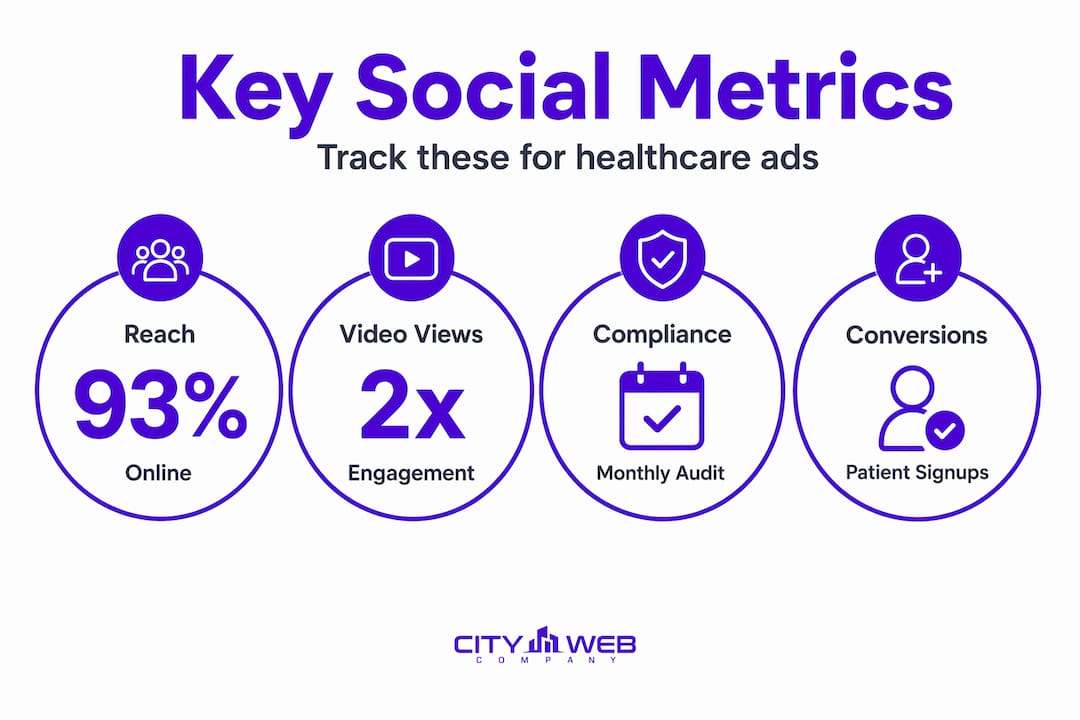

Measuring social media ROI in healthcare means tracking engagement, awareness, traffic, and conversion metrics to connect your marketing activity with real patient outcomes. That means separating your metrics into two categories.
Leading indicators tell you if your campaigns are gaining traction before appointments roll in:
- Reach and impressions (are you getting in front of enough people?)
- Video completion rate (are they watching, or bouncing at three seconds?)
- Link click-through rate (are they curious enough to learn more?)
- Post engagement rate (are they commenting, saving, and sharing?)
Lagging indicators tell you if that traction is turning into real business:
- Website appointment form completions
- Phone call conversions tracked through call tracking numbers
- New patient inquiries attributed to specific campaigns
- Cost per patient inquiry by campaign and platform
Measurement infrastructure
| Tool or method | What it tracks | Why it matters |
|---|---|---|
| UTM parameters on all ad links | Traffic source and campaign attribution | Ties website visits to specific ads |
| Facebook Pixel or Meta Conversion API | On-site conversions from social traffic | Measures appointment form completions |
| Call tracking numbers | Phone inquiries by campaign | Captures offline conversions |
| Google Analytics 4 | Full funnel patient journey | Shows multi-touch attribution |
Make sure you understand healthcare advertising compliance requirements around tracking tools, because some pixel-based tracking can inadvertently capture PHI, which creates HIPAA exposure. Use server-side conversion tracking where possible, and confirm your analytics setup has been reviewed for HIPAA compliance.
On the compliance side, build a regular audit calendar. Review all running ads monthly for claims accuracy, confirm patient consent documentation is current for any testimonial content, and document each review with dates and reviewer names. These records protect you if a regulatory complaint is ever filed. Pair your measurement efforts with your broader SEO patient growth strategy so your paid and organic efforts reinforce each other rather than working in silos. Your healthcare advertising analytics process should cover both channels together.
The overlooked foundation: why compliance and education must lead your social media ads
Here’s what most articles on this topic won’t say directly: the majority of local healthcare marketing teams approach social advertising with a consumer brand mindset. Reach, engagement, follower counts. Treat compliance as an afterthought and education as a nice-to-have. That’s exactly backwards, and it’s the reason some practices end up with warning letters, fine exposure, or patient trust problems.
The FDA’s requirements around “fair balance” aren’t just regulatory box-checking. They reflect something real about how patients make healthcare decisions. When your ad leads with benefits and buries the risks, you’re not just risking FDA scrutiny over using a “link in bio” for disclosures. You’re also undermining the trust you’re trying to build. Patients are increasingly sophisticated. They notice when a healthcare ad sounds like a late-night infomercial. They notice when the comments are turned off, when questions go unanswered, when the “testimonials” look staged.
Education-first content isn’t just safer. It’s more effective. When a local orthopedic practice posts a video that honestly explains both the benefits and recovery limitations of a specific procedure, potential patients self-qualify before they ever pick up the phone. The appointments you get from educational content tend to be better matches for your services, which means better outcomes and better reviews.
The other thing marketers underweight is the compounding cost of compliance failures. A single HIPAA breach on social media can cost a practice years of reputation repair. The fine is often the smaller problem. The news coverage, the patient trust erosion, and the internal culture shift required to recover are far more damaging. Building compliance into your social media advertising workflow from the start isn’t caution for its own sake. It’s the single highest-leverage thing you can do to protect the practice’s long-term marketing investment.
Think of education and compliance not as constraints on your creativity but as the frame that makes your creativity credible. Any local competitor can run a discount ad. Very few can produce content that genuinely helps patients understand their health while still driving qualified inquiries. That’s where durable brand differentiation actually comes from in healthcare.
Elevate your healthcare marketing with specialized local SEO and digital advertising services
If you’ve read this far, you understand that running effective social media ads in healthcare isn’t just a matter of boosting a post or duplicating what retail brands do. It takes platform knowledge, compliance discipline, and a content strategy built around patient trust.
At City Web Company, we work with local healthcare providers to build patient-focused digital marketing programs that generate real results without cutting corners on compliance. From local SEO services that increase your practice’s visibility in search to expert management of targeted social campaigns, we handle the technical and strategic work so your team can focus on patient care. Our healthcare advertising strategies are built around what actually moves patients from awareness to appointment. If you’re ready to grow your practice with campaigns that are both effective and compliant, our paid advertising guide is a great place to start, or just reach out and let’s talk about what your practice needs.
Frequently asked questions
Which social media platforms are best for healthcare advertising?
Facebook and Instagram are most effective for patient engagement and community building, while LinkedIn works better for healthcare recruitment and thought leadership campaigns targeting other professionals.
How can healthcare providers ensure compliance with HIPAA when advertising on social media?
Avoid sharing any protected health information in ads or responses, obtain written patient consent before using testimonials, and implement an approval workflow for all paid content. HIPAA violations on social media can trigger fines exceeding $2.1 million per violation category per year.
What type of content performs best in healthcare social media ads?
Short educational videos were voted the top-performing healthcare social media content type, earning 20% of responses, because they build trust before asking for any action.
How should healthcare advertisers balance promotion and education in social media ads?
Lead with patient education and empathetic framing, and ensure benefits and risks are presented with similar prominence to comply with FDA fair-balance requirements and maintain audience credibility.
Can using AI tools for social media content creation pose compliance risks for healthcare providers?
Yes. AI-generated content must go through human compliance review before publishing, and protected health information should never be entered into AI tools since most are not HIPAA-compliant.
Recommended
These articles were popular with other readers too: