

See how plumbers can turn Facebook scrollers into booked jobs with clear offers, local targeting, a 30 day test budget, fast follow up, and a path to scale.
Why SEO Matters for Clinics: Boost Patient Growth
Many clinic owners assume paid ads are the only reliable way to attract new patients online. Run the ads, get the calls, stop the ads, lose the traffic. That cycle is expensive and exhausting. What most clinics overlook is that healthcare SEO increases visibility for high-intent local searches and consistently converts those searchers into appointment inquiries, without paying for every single click. SEO works differently from advertising because its effects compound over time, meaning the effort you put in today keeps delivering results months and even years down the road.
Table of Contents
Table of Contents
- Understanding clinic SEO: What makes it different?
- The compounding power of SEO vs. paid ads for clinics
- Local search optimization: Driving appointment inquiries
- Practical steps: Getting started with clinic SEO
- Our candid take: What most clinics miss about SEO
- Ready to elevate your clinic’s online visibility?
- Frequently asked questions
Key Takeaways
| Point | Details |
|---|---|
| SEO drives ongoing patient growth | Clinics can generate steady appointment inquiries by appearing in organic local searches. |
| Local SEO is critical | Optimizing Google Business Profile and local listings boosts visibility for high-intent ‘near me’ searches. |
| Paid ads and SEO can coexist | Combining short-term PPC with long-term SEO strategies maximizes clinic reach and cost efficiency. |
| Success depends on conversion elements | Booking CTAs, review management, and NAP consistency all help turn web visitors into real patients. |
Understanding clinic SEO: What makes it different?
Generic SEO advice talks a lot about content volume and backlinks. That matters, but for clinics, the equation is more nuanced. Healthcare SEO sits at the intersection of three major forces: technical optimization, local signals, and conversion design. Neglect any one of those three, and your rankings or your appointment bookings will suffer.
Technical SEO is the foundation. Your clinic’s website needs to load fast, work perfectly on mobile devices, and be structured in a way that search engines can easily read and index. Google evaluates page speed, mobile responsiveness, secure connections (HTTPS), and structured data markup. A slow or broken site will struggle to rank no matter how great your content is.
Local signals are what make clinic SEO unique from, say, an e-commerce SEO strategy. Patients search for care close to home. They type “urgent care near me” or “family doctor in [city name]” rather than generic medical questions. So your clinic must send strong geographic signals through consistent business listings, a well-maintained Google Business Profile, and location-specific content on your website.
Conversion elements are the bridge between a site visitor and a booked appointment. Clinics often pour effort into getting traffic and then lose patients at the booking stage because the inquiry path is confusing or the phone number is buried. A clear call-to-action, a visible booking widget, and a streamlined contact form can dramatically improve how many visitors actually become patients.
What separates high-performing clinic websites from mediocre ones is how well they signal healthcare SEO expertise through E-E-A-T. E-E-A-T stands for Experience, Expertise, Authoritativeness, and Trustworthiness. Google’s algorithms, particularly for health-related content, apply heightened scrutiny because bad medical information can harm real people. Your website needs to demonstrate that real licensed professionals are behind the content and that the information is current and accurate.
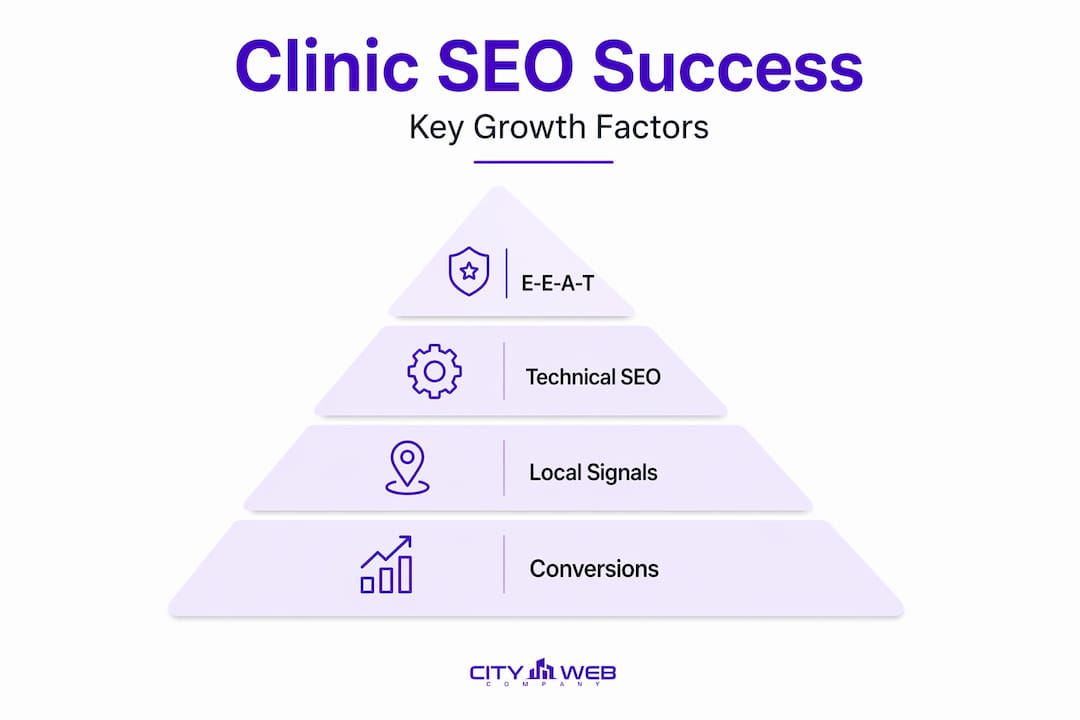
As the team at ASP Marketing explains, healthcare SEO combines technical SEO, E-E-A-T and experience signals, local signals like NAP consistency and reviews, Google Business Profile optimization, and conversion elements like booking CTAs and streamlined inquiry paths. It is far more than just writing blog posts.
Here is a quick look at the key ranking factors and how they apply to clinics:
| Ranking factor | What it means for clinics | Priority level |
|---|---|---|
| E-E-A-T signals | Licensed provider bios, accurate credentials, updated content | Very high |
| NAP consistency | Name, address, phone matching across all listings | Very high |
| Google Business Profile | Complete, active GBP with photos, hours, and reviews | Very high |
| Page speed and mobile | Fast load times and responsive design for smartphone users | High |
| On-page content | Service pages for each specialty, location-specific pages | High |
| Structured data markup | Schema for medical organizations, physicians, and FAQs | Medium |
| Inbound backlinks | Mentions from credible health directories and local sources | Medium |
Pro Tip: Before worrying about content creation, audit your NAP data across all directories. If your address or phone number appears differently across Google, Yelp, Healthgrades, and your website, you are sending mixed signals to Google and likely losing ranking ground without even realizing it.
Our SEO patient growth guide goes deeper on how clinics can build a sustainable foundation using these core factors.
The compounding power of SEO vs. paid ads for clinics
Paid advertising is like renting visibility. The moment you stop paying, your visibility disappears. SEO, on the other hand, is more like building equity. You invest effort upfront and the returns accumulate over time.


This distinction matters enormously for clinic budgets. A pay-per-click campaign for competitive keywords like “dermatologist near me” or “pediatric clinic” can cost anywhere from $5 to $40 per click depending on your market. If 100 people click and only 5 call for an appointment, you have spent a significant chunk of your marketing budget for a handful of leads. SEO, once you achieve solid rankings, delivers those same clicks without the per-click fee, which means your effective cost of patient acquisition drops substantially over time.
As Sermo’s healthcare marketing resources note, SEO targets organic clicks without paying per click once you rank, positioning it as a lower-cost acquisition channel than PPC over the long term, though ongoing effort is still needed to maintain those rankings.
Here is how the two channels compare across the metrics that matter most for clinic growth:
| Metric | SEO | Paid ads (PPC) |
|---|---|---|
| Initial cost | Moderate setup investment | High immediate spend |
| Time to results | 3 to 6 months typically | Days to weeks |
| Traffic stops when budget stops | No | Yes |
| Long-term cost per acquisition | Decreasing | Stable or rising |
| Trust perception among patients | Higher (organic results) | Lower (labeled as ads) |
| Control over targeting | Moderate | Very precise |
| Best for | Sustainable growth | Quick launches, promotions |
“The clinics that outperform their competitors online almost always have a strong SEO foundation working in the background while they run targeted paid campaigns for immediate needs. Neither strategy alone is as powerful as the two working together.”
That said, the reality for many clinics is that SEO and paid advertising are not competitors. They serve different stages of patient acquisition. Here is a practical way to think about the phased approach:
- Launch phase (months 1 to 3): Use paid ads to generate immediate appointment inquiries while your SEO foundation is being built. This bridges the gap before organic rankings kick in.
- Growth phase (months 4 to 9): As your SEO rankings begin improving, you can scale back ad spending in areas where you now rank organically, freeing up budget for other channels or specialties.
- Maturity phase (month 10 and beyond): Organic traffic carries the bulk of your new patient inquiries. Paid ads become surgical tools for launching new services, targeting specific demographics, or filling slow periods.
This phased approach is detailed further in our Google Ads healthcare guide, which covers how to balance both channels intelligently without overspending.
The SEO vs PPC insights are clear on one point: long-term compound growth from SEO consistently outpaces the returns from paid campaigns when measured over a 12-to-24-month window. That is the window that matters for clinics planning sustainable practice growth.
Local search optimization: Driving appointment inquiries
If there is one area where clinics can see the fastest impact from SEO investment, it is local search. When someone searches “family medicine clinic near me” or “walk-in clinic open now,” Google displays what is commonly called the “local pack,” a map-based set of three business listings that appear above the regular organic results. Getting into that local pack is enormously valuable because it is the first thing most patients see.
Local search optimization for driving appointment inquiries relies on three core mechanisms that clinics need to get right:
-
Google Business Profile (GBP) optimization: Your GBP listing is often the single most important local SEO asset you have. It should include complete and accurate business hours, high-quality photos of your facility and team, a full list of services, your correct address and phone number, and a steady stream of patient reviews. Posting regular updates and answering questions through your GBP also signals to Google that your listing is active and relevant.
-
NAP consistency: NAP stands for Name, Address, and Phone number. Every directory listing, social media profile, and citation of your clinic online should use exactly the same information. Even minor inconsistencies, like “Suite 200” on one listing and “Ste. 200” on another, can confuse Google’s local algorithm and dilute your ranking signals.
-
Reviews and reputation management: Patient reviews are both a ranking factor and a conversion factor. Clinics with a higher volume of recent, positive reviews rank better in local searches and are far more likely to convert a searcher into a caller. Patients trust other patients. A clinic with 120 reviews averaging 4.7 stars will consistently outperform a competitor with 20 reviews averaging 4.9 stars, simply because volume signals established credibility.
According to Sermo’s analysis, local search optimization through Google Business Profile, the Map Pack, proximity, and relevance directly maps to where patients look before booking an appointment. This is not a secondary consideration for clinics. It is often the primary driver of new patient inquiries.
Pro Tip: After each appointment, send patients a simple follow-up text or email with a direct link to your Google review page. The easier you make it for satisfied patients to leave a review, the more reviews you will collect. Even a small uptick in review volume can shift your ranking position noticeably within weeks.
Our resources on Google Business Profile SEO and the Google Profile impact on local search offer clinic owners a granular breakdown of how to optimize each element for maximum visibility.
Beyond GBP, your clinic’s website should include individual location pages if you have multiple offices, neighborhood-specific landing pages for high-value services, and structured data markup that tells Google your clinic is a medical organization with licensed providers. These technical elements, combined with an active GBP, position your clinic for the exact searches that lead to booked appointments.
Practical steps: Getting started with clinic SEO
Most clinic owners who struggle with SEO are not failing because of bad strategy. They are failing because they never built the foundation correctly in the first place. The good news is that getting started does not require an overwhelming overhaul. It requires a prioritized sequence of actions that build on each other.
Here is a proven step-by-step approach that clinics can follow to launch an effective SEO initiative:
-
Audit your current digital presence. Before adding anything new, understand what you already have. Check where your clinic appears in search results, review your Google Business Profile for completeness and accuracy, and assess your website’s page speed and mobile performance. Free tools like Google Search Console and Google PageSpeed Insights give you a starting point.
-
Fix NAP inconsistencies across all directories. Run a citation audit to identify every place your clinic appears online. Correct any discrepancies in your business name, address, or phone number. This single step often produces ranking improvements within 30 to 60 days.
-
Optimize your Google Business Profile fully. Fill in every field. Add photos. Enable messaging. Set your service categories precisely. Post updates at least twice per month. Respond to every review, both positive and negative, in a professional and timely manner.
-
Build or refresh your core service pages. Each specialty or service your clinic offers should have its own dedicated page on your website. Each page should include the service name, what patients can expect, who it is appropriate for, and a clear call-to-action for booking or calling.
-
Develop a review generation process. As mentioned in the local section, reviews are both a ranking factor and a trust signal. Build a repeatable system for asking satisfied patients to share their experience on Google.
-
Create location-specific content. If your clinic serves multiple neighborhoods or communities, create content that speaks to those specific areas. Mention local landmarks, community health concerns, and neighborhood context. This specificity tells Google your clinic is genuinely embedded in the local area.
-
Track your progress monthly. Monitor your rankings for key local terms, track the number of calls and direction requests generated from your GBP, and review your website traffic in Google Analytics. Adjust based on what the data tells you.
As Patient Edge’s research confirms, healthcare SEO increases visibility for high-intent local searches and helps convert searchers into actual appointment inquiries. That conversion piece is where many clinic SEO efforts stall. You can rank well and still fail to turn visitors into patients if your website does not make the next step obvious and easy.
Pro Tip: Do not make patients hunt for your phone number. It should appear in the header of every page, ideally as a clickable link on mobile. One extra tap between a patient and your clinic is enough to send them to a competitor.
Clinics that want a professional-level setup for their local presence should review our work on specialized Google Business Profile optimization, which outlines how a properly optimized profile functions as a secondary website that works alongside your main site.
Our candid take: What most clinics miss about SEO
After working with local service businesses across many industries, including healthcare clinics, one pattern repeats itself with remarkable consistency. Clinic owners invest in SEO, start seeing some early movement in their rankings, and then get frustrated because the phone is not ringing at the rate they expected. They blame SEO and redirect budget back to ads. But the problem is almost never the traffic. It is what happens after the patient arrives.
Most clinic SEO conversations focus on the top of the funnel: rankings, impressions, clicks. Very few conversations happen about the bottom of the funnel: the experience that turns a curious searcher into a booked patient. A clinic can rank number one for its target keywords and still underperform if the website takes six seconds to load, if the booking form asks for too much information upfront, or if there is no social proof visible above the scroll on the homepage.
The second blind spot is review management. Clinics treat reviews as a nice-to-have. In reality, a dormant review profile with outdated responses or unanswered negative reviews actively hurts conversions. Patients read reviews before calling. A bad or ignored review that sits unreplied sends a loud message about how the clinic treats concerns.
Here is the uncomfortable truth about SEO for healthcare clinics: it is slower and less predictable than paid campaigns in the short term. Strategies that promise overnight results from SEO are either overselling or cutting corners. The clinics that win long-term treat SEO as a compounding investment, not a quick fix. They combine patient-focused content with tight local signals, an active GBP, and a conversion-optimized website. Then they layer in paid ads when they need speed or want to test a new service offering.
The clinics we see get the best results from our clinic SEO outcomes work are the ones who commit to the process for at least six months before evaluating the full return. They also tend to be the ones paying the closest attention to what happens on their website after a visitor lands, not just to how they rank.
If you take one thing from our experience: do not let ranking success become a substitute for conversion success. Rankings bring patients to your door. A well-designed, trust-building website is what actually gets them to call.
Ready to elevate your clinic’s online visibility?
The strategies in this article work. But knowing what to do and executing it consistently are two very different challenges for a busy clinic team. City Web Company helps clinics move from scattered marketing efforts to a focused, results-driven SEO strategy that consistently attracts high-intent local patients.
Whether you are just starting to think about driving local leads or you want to demystify the terminology with our guide to local SEO terms, we have resources built for clinic owners at every stage. Our team specializes in SEO, Google Ads, website design, and reputation management for service-based businesses, and we bring that same precision focus to healthcare clinics. Explore our full range of digital marketing services and see how we help clinics grow with strategy, not guesswork.
Frequently asked questions
How long does it take for SEO to work for clinics?
Clinic SEO typically shows visible results within 3 to 6 months, with rankings improving and organic appointment inquiries rising steadily as the strategy matures. Combining SEO with paid ads during the early months helps bridge the gap.
Is local SEO more important than website content for clinics?
For most clinics, local SEO through Google Business Profile, NAP consistency, and reviews drives higher-impact results than content volume alone, though strong service pages and credentials on your website reinforce local rankings over time.
What’s the main reason clinics should invest in SEO instead of paid ads?
SEO delivers compounding patient growth and a lower cost per acquisition over time because organic clicks cost nothing per visit once rankings are established, unlike paid campaigns where costs continue indefinitely.
What are the most common mistakes clinics make with SEO?
Clinics most often neglect NAP consistency, skip review management, and overlook conversion optimization, all of which are critical for rankings and turning website visitors into booked patients.
Recommended
These articles were popular with other readers too: