

Pass Google Business verification with a video-first checklist. Film one continuous 30 second take, fix flagged issues, and know when to hire help.
SEO for healthcare providers: attract more patients & build trust
Having a website doesn’t mean patients will find you. The real gap most healthcare providers face isn’t a lack of content or even a bad-looking site — it’s invisibility at the exact moment a patient searches for care nearby. Map Pack presence captures roughly 33% of clicks for local queries, which means a huge share of potential patients never scroll past those top three map results. This article breaks down the SEO strategies that directly drive new patient acquisition: how local search works in healthcare, how to build the kind of credibility Google rewards, and how to stay HIPAA-compliant while doing it.
Table of Contents
Table of Contents
- Why local SEO matters most for healthcare providers
- How to build E-E-A-T and trust in healthcare SEO
- HIPAA, privacy, and safe SEO in healthcare
- Practical SEO checklist for healthcare providers
- Why most healthcare SEO advice fails providers — and what actually works
- Get expert help growing your healthcare practice online
- Frequently asked questions
Key Takeaways
| Point | Details |
|---|---|
| Local SEO is critical | Optimizing for map and local search is the number one driver of new patient visits. |
| Trustworthy content wins | Clearly sourcing medical information and listing credentials boosts both rankings and patient confidence. |
| HIPAA-compliance is mandatory | All analytics and web forms must be HIPAA-safe to avoid legal and reputational risks. |
| Action beats theory | Consistently implementing best practices, not just knowing them, leads to measurable growth. |
Why local SEO matters most for healthcare providers
Now that you know visibility is more than having a website, let’s look at the most impactful way healthcare providers gain new patients online.
Think about how patients actually search. They don’t type “best cardiologist in the United States.” They type “cardiologist near me” or “urgent care open now in [city].” This local intent means that patients are searching with a destination in mind before they’ve even picked a provider. If your practice isn’t optimized for those queries, you’re invisible to a massive segment of potential new patients.
The Google Map Pack (the block of three business listings that appears at the top of local search results with a map) dominates that search experience. Map Pack visibility captures ~33% of all clicks for local searches. That’s not a minor advantage — it’s the difference between a full appointment schedule and a half-empty one. Most of those users never scroll past the map results to traditional organic listings below.
Local SEO vs. general SEO for healthcare
Traditional organic SEO focuses on ranking web pages for specific keywords nationally or broadly. Local SEO (search engine optimization tuned for geographic intent) works differently. It prioritizes your Google Business Profile, your proximity to searchers, consistent citations across local directories, and review velocity. For most healthcare providers serving specific communities, local SEO is simply the higher-ROI (return on investment) strategy.
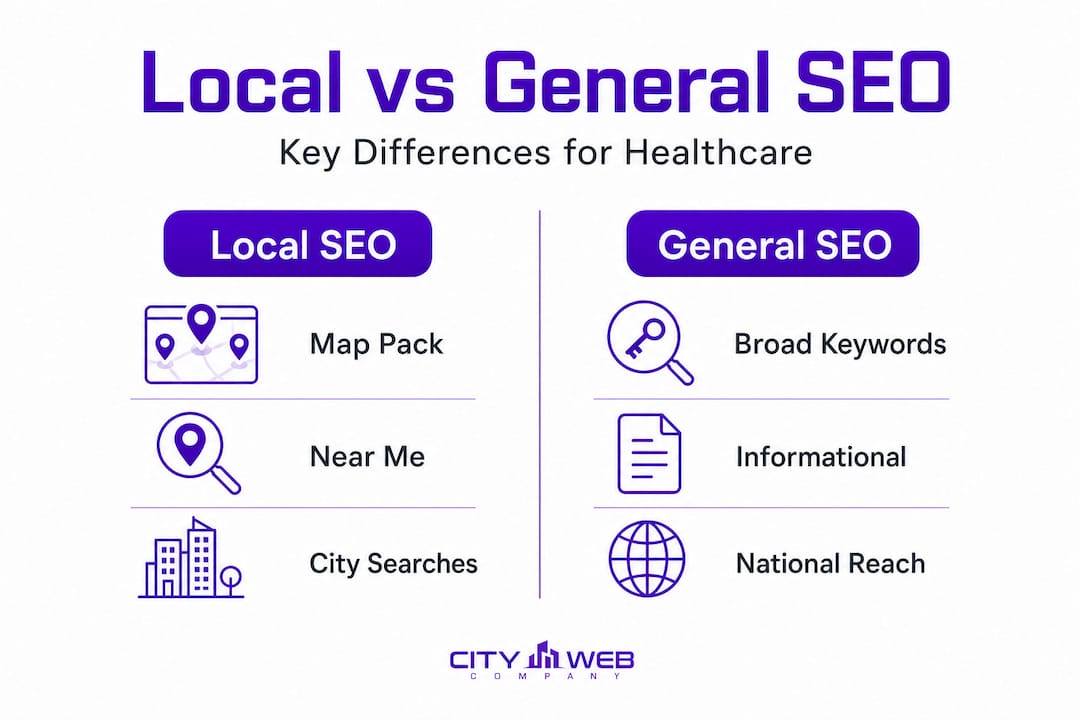
| Factor | Local SEO | General SEO |
|---|---|---|
| Search intent targeted | “Near me,” city-specific | Broad, topic-based |
| Primary visibility | Map Pack + local results | Organic page rankings |
| Speed to results | Faster (weeks to months) | Slower (months to years) |
| Patient acquisition rate | High for local practices | Lower for geographically limited care |
| Tools and tactics | Google Business Profile, local citations, reviews | Content clusters, backlinks, domain authority |
| Compliance considerations | Location data, review responses | Content accuracy, authorship |
The takeaway is clear: if you serve patients in a specific city or metro area, local SEO should get the largest share of your attention and budget. Working on SEO and patient growth together means building a strategy that stacks both approaches, but local always comes first.
What most providers miss in their Google Business Profile
Your Google Business Profile (GBP) is the single most important piece of real estate in local healthcare SEO. Most providers create it once, add their address and phone number, and forget about it. That’s leaving enormous visibility on the table.
Here are the GBP elements that move the needle and that most providers skip:
- Service listings: Google allows you to list every service you provide, from annual physicals to specialized procedures. Adding these helps your profile surface for specific searches.
- Q&A section: Patients ask questions directly on GBP. Seeding this section with your own frequently asked questions and answering them helps both SEO and patient confidence.
- Photo updates: Practices with current, high-quality photos receive significantly more profile views. Add new images monthly.
- Review responses: Responding to every review (positive and negative) signals to Google that the profile is active and managed.
- Posts: GBP allows short posts similar to social media updates. Regular posts about new services, health tips, or seasonal care needs add freshness signals.
Pro Tip: Many providers list only their primary specialty as their GBP category. Adding secondary categories (e.g., “Family practice physician” and “Internal medicine clinic”) dramatically expands the range of searches your profile can surface for. This single change often produces measurable improvements within 30 to 60 days.
Connecting your GBP strategy to broader efforts for boosting local leads creates a compound effect. Your website, your map listing, and your directory citations all reinforce each other to build local authority.
How to build E-E-A-T and trust in healthcare SEO
After understanding the impact of local search, the next step is building credibility so patients and search engines choose you.


E-E-A-T stands for Experience, Expertise, Authoritativeness, and Trustworthiness. Google introduced this framework specifically because healthcare content can directly affect people’s wellbeing. Inaccurate or misleading medical content represents a real-world risk, so Google’s quality raters use E-E-A-T to evaluate whether a page deserves to rank. Your site doesn’t just need to look professional — it needs to prove it is.
Healthcare SEO content must operationalize E-E-A-T through visible credentials, accurate sourcing, and clear authorship. That’s not a suggestion — it’s a ranking requirement for any healthcare site that wants sustainable visibility.
Trust-building elements every provider website must include
- Provider bios with credentials: Every physician, nurse practitioner, or specialist with patient-facing content should have a dedicated bio page listing their degree, board certifications, years of practice, and any specialty training.
- Visible authorship on articles and blog posts: If you publish health content, the author’s name and credentials must be visible. An anonymous “staff writer” article is an E-E-A-T red flag.
- Accurate, sourced content: Medical facts should cite reputable sources such as the CDC, NIH, or peer-reviewed publications. Unsourced claims damage trust with both users and Google’s quality systems.
- Consistent NAP (name, address, phone number): Discrepancies between your website and directory listings erode local authority.
- SSL certification: Your site must use HTTPS. Any healthcare site still running HTTP is losing both rankings and patient confidence.
- Clear privacy policy and terms: Patients need to see exactly how their data is handled before they fill out any form.
- Patient testimonials (with consent): Real reviews on your website and third-party platforms like Healthgrades add social proof and build trust signals for Google.
For practical profile optimization best practices, connecting your on-site credibility work to your Google Business Profile creates a consistent trust signal across every touchpoint a patient encounters.
Common content and credential pitfalls
| Pitfall | Why it hurts | Quick fix |
|---|---|---|
| No author byline | Fails E-E-A-T authorship signals | Add physician name and credentials to every post |
| Outdated treatment information | Signals low expertise | Conduct quarterly content audits |
| Generic stock photos only | Reduces authenticity | Add real staff and office photos |
| No references or sources | Undercuts medical accuracy | Link to CDC/NIH or peer-reviewed sources |
| Bio pages without credentials | Misses trust signals | List board certifications, degrees, affiliations |
| Missing reviews section | Reduces social proof | Actively request reviews post-appointment |
Proper displaying medical credentials on your pages isn’t just good practice for patients — it’s directly connected to how Google evaluates whether your site deserves top rankings in highly competitive healthcare markets.
“In healthcare search, trust is the currency. A page written by an unnamed author with no sourced claims will never outrank a properly attributed page from a board-certified specialist, even if the keyword targeting is identical.” — Healthcare digital marketing practitioner
This is why generic content agencies that don’t specialize in healthcare consistently underperform. Writing medically accurate, professionally attributed content takes real effort, but it’s what separates providers who dominate their local search results from those buried on page three.
HIPAA, privacy, and safe SEO in healthcare
Securing trust isn’t just about content. Protecting privacy and patient data is equally crucial when implementing SEO for healthcare.
HIPAA (the Health Insurance Portability and Accountability Act) governs how protected health information (PHI) — any data that can identify a patient linked to their health condition or care — is collected, stored, and transmitted. Most providers know HIPAA applies to their clinical operations. Many don’t realize it also applies to their digital marketing infrastructure.
HIPAA risk changes how SEO is implemented, especially around analytics, forms, call tracking, and marketing tools that might capture PHI. A standard Google Analytics setup, for example, can inadvertently log URL parameters that reveal patient health information if your site isn’t carefully configured. The consequences of a HIPAA violation tied to your marketing systems range from significant fines to reputational damage that no SEO campaign can recover from.
Essential HIPAA-safe SEO steps
-
Audit your analytics configuration. Review exactly what data your analytics platform captures. Disable data collection for pages where patients enter health information. Consider switching to a HIPAA-compliant analytics provider if your current setup can’t be sufficiently restricted.
-
Review all contact and intake forms. Any form that collects health-related information (symptoms, appointment type, referral reason) needs to be hosted on a secure, encrypted platform with a Business Associate Agreement (BAA) in place with your form provider.
-
Evaluate chat widgets. Live chat tools may capture patient messages that include sensitive health details. Ensure your chat provider offers HIPAA-compliant hosting and that a BAA is signed.
-
Configure call tracking carefully. Call tracking is valuable for measuring which SEO campaigns drive phone calls, but the recordings and transcripts may capture PHI. Use a HIPAA-compliant call tracking provider and enable automatic redaction of sensitive information.
-
Check all third-party marketing pixels. Facebook Pixel, Google Ads conversion tags, and retargeting pixels can inadvertently send patient data to ad platforms. Audit every pixel on your site and remove or configure any that fire on pages where patients enter health information.
-
Sign Business Associate Agreements. Any vendor touching patient data in your marketing stack (email platforms, CRM systems, analytics tools) needs a signed BAA before you use their service.
-
Document your compliance measures. HIPAA enforcement rewards providers who show they took reasonable steps. Keep records of your audits, BAAs, and configuration changes.
Pro Tip: Use Google Tag Manager to control exactly which pages your tracking pixels fire on. Exclude all patient portal pages, appointment confirmation pages, and any URL containing health-related parameters. This one configuration change dramatically reduces PHI exposure risk without sacrificing your marketing measurement capability.
For privacy-safe lead tracking, building compliant tracking infrastructure from the start is far less expensive than remediation after a violation. And for those also investing in paid media, understanding ads for healthcare providers and the privacy guardrails required is essential before launching any paid campaign.
“Privacy-safe measurement isn’t just a compliance checkbox — it’s a competitive differentiator. Providers who invest in clean, compliant data infrastructure make better marketing decisions and avoid the liability that sidelines less-careful competitors.” — Digital health marketing strategist
Looking at privacy-aware ad examples shows how other healthcare marketers have structured compliant campaigns that still generate measurable patient acquisition results.
Practical SEO checklist for healthcare providers
To bring all these lessons together, use this straightforward checklist to embed high-impact SEO into your daily or weekly workflow.
Healthcare SEO strategies must be operationalized through actionable, compliant steps. Having a strategy on paper doesn’t move the needle — execution does. Use this checklist for internal review or as a handoff document when working with a marketing partner.
Google Business Profile:
- Confirm all NAP information is accurate and matches your website exactly
- Add or update every service you provide in the services section
- Upload at least two new photos per month
- Respond to all new reviews within 48 hours
- Publish one GBP post per week (health tip, seasonal care reminder, or new service announcement)
- Seed the Q&A section with five or more common patient questions
Website trust and E-E-A-T:
- Every page with medical information has a named, credentialed author
- All provider bio pages include degree, certifications, and years of experience
- Medical content references at least one authoritative source (CDC, NIH, or peer-reviewed journal)
- SSL certificate is active and the site loads on HTTPS
- Privacy policy is current and accurately reflects your data practices
- Patient testimonials are present and consent has been documented
Local SEO and citations:
- Business listings are consistent across Google, Yelp, Healthgrades, Zocdoc, and major directories
- Location pages exist for each practice location with unique, locally relevant content
- Schema markup (structured data code that helps search engines understand your content) is implemented for your practice type, location, and providers
HIPAA and privacy compliance:
- Analytics platform is reviewed for PHI exposure risk
- All third-party pixels are audited and excluded from sensitive pages
- Call tracking uses a HIPAA-compliant provider with a BAA in place
- All intake forms are hosted on encrypted platforms with BAAs
Content and technical SEO:
- Title tags and meta descriptions are written for every major page
- Site loads in under three seconds on mobile
- Blog or resource section is updated at least monthly with relevant, medically accurate content
- Internal linking connects related service pages and educational content
Reviewing latest SEO best practices periodically keeps your checklist current as Google’s local ranking factors continue to evolve. This isn’t a set-it-and-forget-it checklist — treat it as a living document that gets updated as your practice and the search landscape grow.
Why most healthcare SEO advice fails providers — and what actually works
With your checklist in hand, it’s important to cut through the noise and focus only on tactics that drive ethical, measurable patient growth.
Here’s an uncomfortable truth: most SEO advice written for healthcare providers is recycled from general business marketing blogs. It sounds reasonable. It includes all the right terminology. And it consistently underperforms for medical practices. We’ve seen this pattern repeatedly working with healthcare clients.
Generic SEO playbooks tell you to “produce more content” and “build backlinks.” Neither of those moves the needle for a local OB-GYN or an urgent care clinic serving three zip codes. What actually drives patient growth in healthcare is a specific combination of local visibility, proven trust signals, and clean data practices. Not volume. Not generic authority tactics.
The providers who dominate their local search results share three characteristics. First, they treat their Google Business Profile as a living marketing asset, not a one-time setup task. Second, their websites are clearly credentialed — patients and Google can immediately identify who is providing the information and why they’re qualified. Third, their analytics and marketing infrastructure is clean, compliant, and built around actual patient acquisition metrics rather than vanity traffic numbers.
What sounds good on SEO blogs vs. what actually works for providers:
- “Publish more blog posts” vs. Publish fewer, more authoritative, credentialed posts that build real E-E-A-T
- “Get more backlinks” vs. Get listed correctly on Healthgrades, Zocdoc, and local medical directories
- “Target high-volume keywords” vs. Target high-intent, geographically specific keywords that match how patients actually search
- “Improve your domain authority” vs. Improve your Google Business Profile completeness and review velocity
- “Build a social media presence” vs. Invest in compliant, local SEO infrastructure that compounds over time
“More keywords does not equal more patients. A page stuffed with ‘best doctor’ variants and no provider credentials will lose every time to a clean, well-attributed practice page with consistent reviews and a complete local profile.”
The real impact from local SEO for healthcare providers comes from compounding small, consistent wins in the right areas — not from chasing the content volume or backlink metrics that general SEO blogs fixate on. Privacy compliance, proper credentialing, and map pack optimization are not optional nice-to-haves. They are the core of what works in this space.
One more thing worth naming: non-compliance is a growth killer. We’ve seen practices build strong organic traffic only to face a privacy incident that destroyed patient trust overnight. A single HIPAA violation discovered through sloppy analytics configuration can undo years of marketing work. Compliance isn’t just an ethical obligation — it’s a foundational business strategy.
Get expert help growing your healthcare practice online
Building compliant, high-performing healthcare SEO from scratch takes expertise most practice managers don’t have time to develop alongside running a medical business. Done right, it combines local search strategy, credentialed content production, privacy-safe tracking, and ongoing optimization — all simultaneously.
City Web Company specializes in local SEO for providers who need measurable patient growth without the compliance risk that comes from generic marketing agencies. From setting up your Google Business Profile services correctly to building a complete local search strategy, our team handles the technical and strategic work so you can focus on patient care. Explore the full range of digital marketing services built specifically for service-area businesses like yours, and schedule a consultation to see exactly where your current digital presence is leaving patients on the table.
Frequently asked questions
What is the most important ranking factor for healthcare providers in 2026?
Local SEO visibility, especially in the Google Map Pack, has the highest impact for attracting patient clicks. Map Pack presence captures ~33% of clicks for local queries, making it the single highest-priority factor for most practices.
Do healthcare websites need to show provider credentials for SEO?
Yes, credentials and medical authorship are essential for E-E-A-T, which Google uses specifically to evaluate healthcare content quality. Healthcare SEO content must operationalize E-E-A-T through credentials and accurate sourcing or rankings will suffer.
How does HIPAA affect healthcare SEO strategy?
HIPAA regulations require all digital marketing and analytics to avoid capturing or exposing patient health information. HIPAA risk changes how SEO is implemented, especially around analytics, forms, and call tracking tools.
What typical SEO tactics should healthcare providers avoid?
Avoid generic content without medical authorship and any marketing pixels or tools that risk collecting protected health information. HIPAA risk changes how SEO is implemented across every channel, including tactics that look harmless on the surface.
Can paid advertising support healthcare SEO?
Privacy-safe digital ads can effectively complement SEO by accelerating visibility for new providers or during competitive seasons, but every ad platform and tracking pixel must be audited for HIPAA compliance before launch.
Recommended
These articles were popular with other readers too: