

Pass Google Business verification with a video-first checklist. Film one continuous 30 second take, fix flagged issues, and know when to hire help.
How SEO drives patient growth for healthcare in 2026
Many healthcare marketing managers assume paid ads deliver the fastest patient growth. The data tells a different story. SEO increases organic traffic by 243% and reduces patient acquisition costs by 65% compared to paid advertising. For small to medium healthcare practices competing in crowded markets, search engine optimization provides sustainable, cost-effective patient acquisition that compounds over time. This guide walks you through proven SEO strategies tailored specifically for healthcare providers seeking measurable growth in 2026.
Table of Contents
Table of Contents
- Core SEO Strategies For Healthcare Practices In 2026
- Measuring SEO Success: Traffic Growth And Cost Efficiency Benchmarks
- Local SEO’s Critical Role For Small And Medium Healthcare Clinics
- Overcoming Healthcare SEO Challenges And Maximizing Long-Term ROI
- Boost Your Healthcare Practice’s Online Presence With Expert SEO Support
- Frequently Asked Questions About The Role Of SEO In Healthcare
Key takeaways
| Point | Details |
|---|---|
| Traffic and cost benefits | SEO dramatically increases organic traffic while lowering patient acquisition costs compared to paid ads. |
| Core strategy components | Healthcare SEO requires targeted keyword research, technical optimization, and authoritative content creation. |
| Local SEO importance | Google Business Profile optimization and local citations are critical for small practice visibility. |
| Trust and authority | E-E-A-T principles improve search rankings and patient trust in healthcare content. |
| Sustainable ROI | Integrated SEO delivers long-term patient growth with measurable return on investment. |
Core SEO strategies for healthcare practices in 2026
Healthcare practices need a multi-layered approach to compete effectively in search results. Core SEO includes keyword research targeting long-tail and local terms, on-page optimization, technical SEO, authoritative content with E-E-A-T, and local SEO tactics. Each component works together to improve your practice’s visibility when potential patients search for services.
Keyword research forms your foundation. Target long-tail phrases that match patient search intent, such as “pediatric dentist accepting new patients” or “orthopedic surgeon knee replacement.” Location modifiers dramatically increase conversion rates. A search for “cardiologist near me” signals high intent from someone ready to book an appointment. Tools like Google Keyword Planner reveal monthly search volumes and competition levels for healthcare terms in your service area.
On-page optimization ensures search engines understand your content’s relevance. Optimize title tags, meta descriptions, and header tags with target keywords. Create dedicated service pages for each treatment or specialty. Physician bio pages should highlight credentials, specialties, and patient-focused language. Internal linking between related service pages strengthens topical authority. Following SEO best practices for 2026 helps you structure content that ranks and converts.
Technical SEO addresses the behind-the-scenes elements that impact rankings. Your website must load quickly, typically under three seconds. Mobile responsiveness is non-negotiable since most healthcare searches happen on smartphones. HIPAA compliance requires secure HTTPS protocols and proper patient data handling. Structured data markup helps search engines display rich snippets like appointment booking options and patient reviews directly in search results.
Content quality separates top-ranking healthcare sites from competitors. Demonstrate Experience, Expertise, Authoritativeness, and Trustworthiness through medically reviewed articles written or vetted by licensed practitioners. Answer common patient questions thoroughly. Address treatment options, recovery timelines, and cost considerations. Video content featuring your physicians builds trust and engagement. A comprehensive local service SEO guide provides additional tactics for service-based businesses.
Pro Tip: Publish patient education content that addresses specific conditions and treatments your practice specializes in, ensuring each article is reviewed by a qualified physician to meet E-E-A-T standards and build patient trust.
- Focus keyword research on long-tail, location-specific phrases that match patient intent
- Optimize every service page with unique meta tags, headers, and physician credentials
- Implement technical SEO including fast loading speeds, mobile optimization, and HIPAA-compliant security
- Create authoritative content demonstrating medical expertise through physician-reviewed articles
- Build local SEO signals with Google Business Profile optimization and consistent NAP citations
Measuring SEO success: traffic growth and cost efficiency benchmarks
Real case studies demonstrate SEO’s measurable impact on healthcare marketing. Understanding these benchmarks helps you set realistic goals and justify SEO investment to practice leadership.
Organic traffic growth reaches 893% year-over-year with comprehensive SEO implementation. Northeast Medical Group achieved 243% traffic growth and a 65% reduction in patient acquisition costs by shifting focus from paid ads to organic search. These results compound over time as content gains authority and rankings improve. Compare this to paid advertising, which stops generating leads the moment you pause campaigns.

Patient acquisition cost varies dramatically between channels. Paid search averages $55 to $110 per click for competitive healthcare terms. Organic search delivers qualified traffic at near-zero marginal cost once your content ranks. A practice spending $5,000 monthly on Google Ads might generate 50 to 90 clicks. That same investment in SEO compounds, eventually delivering hundreds of organic visits monthly without ongoing per-click costs.
| Metric | SEO Performance | Paid Ads Performance |
|---|---|---|
| Traffic growth (YoY) | 243% to 893% | Stops when budget ends |
| Patient acquisition cost | Decreases 65% over time | $55 to $110 per click |
| Long-term sustainability | Compounds indefinitely | Requires continuous spending |
| Click-through rate | 28.5% for position 1 | 3% to 5% average |
Click-through rates favor organic results significantly. The top organic position captures 28.5% of clicks, while the second position gets 15.7%. Paid ads above organic results receive only 3% to 5% click-through rates despite higher costs. Patients trust organic results more than advertisements when researching healthcare providers.
Cost per acquisition tells the complete story. A practice investing in SEO might spend $3,000 to $6,000 monthly initially for content creation, technical optimization, and link building. Within six to twelve months, organic traffic often surpasses paid ad performance. After 18 months, the cumulative patient acquisition cost drops below paid advertising while delivering superior volume. Comparing Google Ads for healthcare marketing reveals the trade-offs between immediate visibility and sustainable growth.
Pro Tip: Track organic traffic, keyword rankings, and patient acquisition cost monthly to demonstrate SEO ROI to practice leadership, emphasizing how organic performance compounds while paid ad costs remain constant.
Local SEO’s critical role for small and medium healthcare clinics
Small healthcare practices compete primarily in local markets where proximity and convenience drive patient decisions. Local SEO strategies including Google Business Profile optimization, citations, and reviews significantly improve visibility and patient engagement.
Google Business Profile serves as your digital storefront. Claim and verify your listing immediately if you haven’t already. Complete every profile section including business hours, services offered, accepted insurance, photos of your facility, and physician bios. Regular posts about health tips, new services, or seasonal reminders keep your profile active. Respond to every patient review, both positive and negative, demonstrating your commitment to patient satisfaction.
- Claim your Google Business Profile and verify ownership through the verification process.
- Complete all profile sections with accurate business information, services, photos, and physician credentials.
- Build local citations by listing your practice on healthcare directories, insurance provider networks, and local business directories.
- Encourage satisfied patients to leave Google reviews through follow-up emails or text messages after appointments.
- Implement local schema markup on your website to help search engines understand your location, services, and specialties.
- Create location-specific content addressing health concerns common in your community or region.
Citation consistency impacts local rankings significantly. Ensure your practice name, address, and phone number appear identically across all online directories. Inconsistent information confuses search engines and potential patients. Healthcare-specific directories like Healthgrades, Vitals, and Zocdoc carry additional weight. Insurance provider directories also function as high-authority citations.
| Factor | With Google Business Profile | Without Optimization |
|---|---|---|
| Local pack visibility | Appears in top 3 local results | Rarely shows in local results |
| Patient review impact | Reviews visible in search and maps | Reviews scattered or invisible |
| Appointment booking | Direct booking links in search | Patients must visit website |
| Mobile discovery | Maps integration for directions | Harder to find and contact |
Location-based keywords drive qualified traffic. Optimize for “[specialty] in [city]” and “[treatment] near me” variations. Create neighborhood or district-specific pages if you serve a large metropolitan area. Schema markup tells search engines your exact location, service area, and specialties. This structured data helps you appear in relevant local searches.
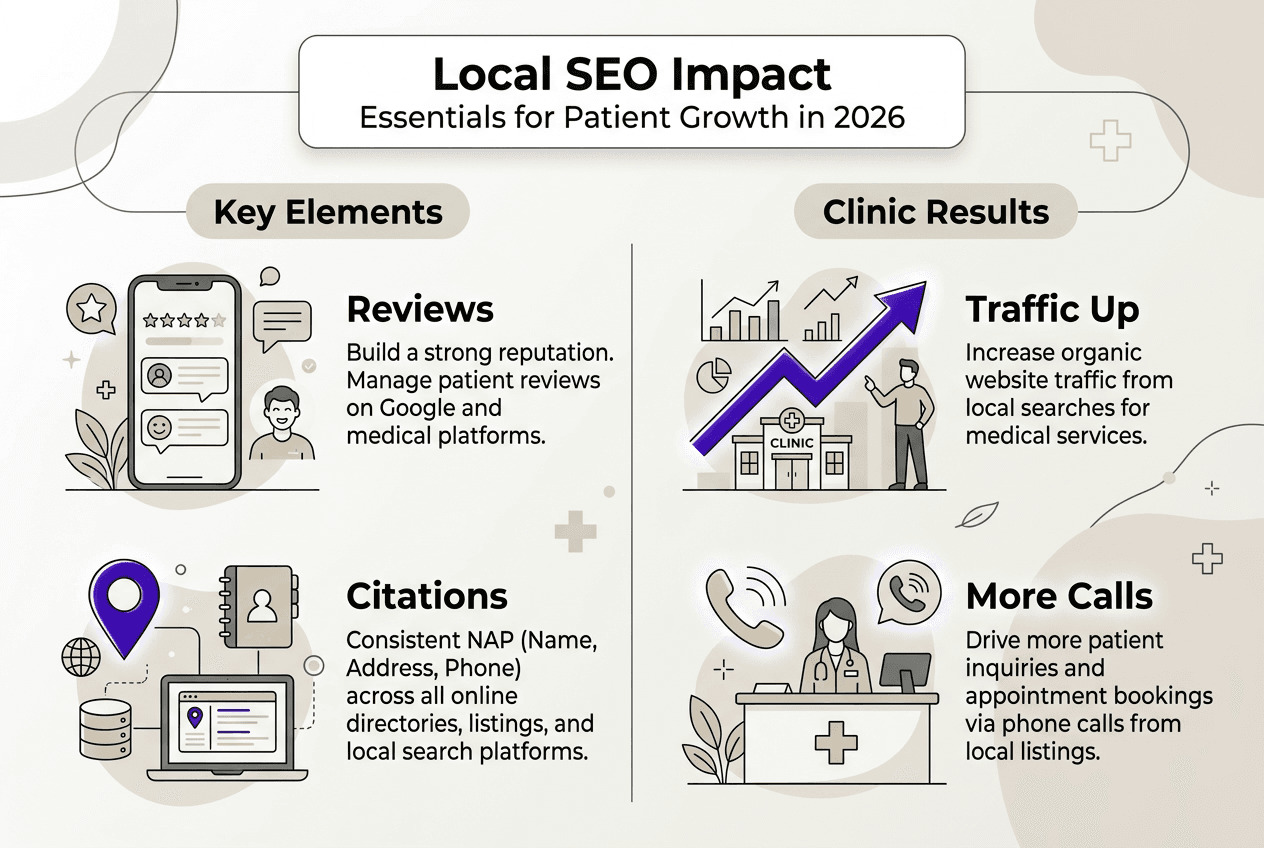

Patient reviews influence both rankings and conversion rates. Practices with 50+ positive reviews significantly outperform competitors with fewer reviews. Implement a systematic review request process. Send follow-up messages three to five days after appointments asking satisfied patients to share their experience. Make the process simple with direct links to your Google Business Profile. Our local SEO services for small businesses include review generation strategies and reputation management.
Local link building strengthens your authority. Sponsor community health events, partner with local organizations, or offer expert commentary to local news outlets. These activities generate backlinks from locally relevant websites. Host free health screenings or educational seminars that earn media coverage. Following our Google Business Profile optimization guide and local search optimization steps ensures comprehensive local visibility.
Overcoming healthcare SEO challenges and maximizing long-term ROI
Healthcare SEO presents unique obstacles that require specialized approaches. Understanding these challenges helps you develop realistic timelines and sustainable strategies.
Regulatory compliance complicates healthcare marketing. HIPAA regulations restrict how you discuss patient cases and testimonials. Medical advertising laws vary by state, limiting certain claims and requiring disclaimers. Patient privacy must remain paramount in all content. Work with legal counsel to establish content guidelines that protect your practice while still providing valuable patient education.
Competition in healthcare search intensifies annually. Major hospital systems invest heavily in SEO, dominating broad keywords. Small practices succeed by targeting hyper-local, specific long-tail keywords. A solo practitioner cannot outrank Mayo Clinic for “cardiologist,” but can dominate “pediatric cardiologist accepting Medicaid in [neighborhood].” Niche specialization and local focus provide competitive advantages.
Despite challenges like strict content regulations and fierce competition, SEO delivers one of the highest long-term ROI for healthcare marketing.
Content accuracy demands exceed other industries. Medical misinformation harms patients and damages your reputation. Every clinical claim requires citation from peer-reviewed sources. Physician review of all medical content is essential. This quality control takes time but builds the trust and authority search engines reward. Outdated content must be updated regularly as treatment protocols evolve.
Pro Tip: Establish a content review process where licensed physicians vet all medical information before publication, ensuring accuracy and building the expertise signals that improve E-E-A-T and search rankings.
Algorithm updates impact healthcare sites significantly. Google’s helpful content updates prioritize user experience and expertise. Sites with thin content, excessive advertising, or poor mobile experience lose rankings. Maintain focus on patient needs rather than search engine manipulation. Create comprehensive resources that genuinely help patients make informed healthcare decisions.
- Ensure HIPAA compliance in all patient-related content and testimonials
- Target niche, location-specific keywords where you can realistically compete
- Require physician review of all medical content to maintain accuracy and build E-E-A-T
- Update content regularly as medical guidelines and treatment protocols evolve
- Focus on patient value over search engine manipulation to survive algorithm updates
Long-term benefits justify the investment and patience SEO requires. Unlike paid advertising that stops generating leads when paused, organic rankings continue delivering patients indefinitely. Content you publish today can attract patients for years. The cumulative effect of consistent SEO work creates sustainable competitive advantages. Comparing Google Ads versus organic search for healthcare clarifies when each channel makes sense for your practice.
Timeline expectations must be realistic. Meaningful SEO results typically require six to twelve months. New websites need longer to establish authority. Competitive markets demand more time and resources. However, once achieved, top rankings become increasingly difficult for competitors to displace. Your early investment creates barriers to entry that protect market share.
Boost your healthcare practice’s online presence with expert SEO support
Implementing comprehensive healthcare SEO requires specialized expertise and consistent effort. City Web Company delivers tailored digital marketing solutions designed specifically for small and medium healthcare practices seeking measurable patient growth.

Our team understands the unique challenges healthcare providers face, from HIPAA compliance to medical content accuracy. We develop customized SEO strategies that improve local visibility, attract qualified patients, and reduce acquisition costs. Our proven approach combines technical optimization, authoritative content creation, and local search dominance to deliver sustainable results.
Whether you need help with Google Business Profile optimization, medical content development, or comprehensive digital marketing strategy, our digital marketing agency for small business provides the expertise and support your practice deserves. We specialize in local SEO services for small businesses that generate real patient growth and measurable ROI. Contact City Web Company today to discuss how we can help your healthcare practice dominate local search results and attract more patients.
Frequently asked questions about the role of SEO in healthcare
What keywords should I target for my small healthcare practice?
Focus on long-tail, location-specific keywords that match patient search intent. Target phrases like “[specialty] accepting new patients in [city]” or “[treatment] near me.” These specific terms have lower competition and higher conversion rates than broad medical keywords. Use keyword research tools to identify monthly search volumes and competition levels in your service area.
How long does it take to see SEO results in healthcare?
Most healthcare practices see meaningful traffic increases within six to twelve months of consistent SEO implementation. New websites require longer to establish authority, typically twelve to eighteen months. Competitive markets demand more time and resources. However, results compound over time, with organic traffic continuing to grow as your content gains authority and rankings improve across more keywords.
Is Google Business Profile essential for healthcare providers?
Absolutely essential for local patient acquisition. Google Business Profile determines whether your practice appears in the local pack, the three businesses shown prominently in local search results. Optimized profiles with complete information, regular posts, and positive reviews dramatically increase visibility. Most healthcare searches include location intent, making local optimization critical for small and medium practices competing in specific geographic areas.
How can I ensure my healthcare website is HIPAA compliant for SEO?
Implement secure HTTPS protocols across your entire website. Avoid using patient names, photos, or specific case details without explicit written consent. Use anonymized examples or composite patient scenarios in educational content. Work with web developers experienced in healthcare compliance to ensure contact forms, appointment booking systems, and any patient data collection meet HIPAA standards. Consult legal counsel to review your content guidelines and privacy policies.
What’s the difference between SEO and Google Ads for patient acquisition?
SEO delivers sustainable, long-term patient growth with decreasing acquisition costs over time, while Google Ads provides immediate visibility but requires continuous spending. Organic search results receive higher click-through rates and greater patient trust. SEO requires six to twelve months to show results but compounds indefinitely. Google Ads generates leads immediately but stops when you pause campaigns. Our local SEO services for healthcare help practices build sustainable patient acquisition channels that reduce reliance on paid advertising.
Recommended
These articles were popular with other readers too: