

See how plumbers can turn Facebook scrollers into booked jobs with clear offers, local targeting, a 30 day test budget, fast follow up, and a path to scale.
Legal marketing rules: Key compliance insights for firms
Legal advertising has quietly grown into a $2.5 billion industry with 32% growth since 2020, yet many service-based businesses still treat compliance as an afterthought. Whether you run a mid-sized personal injury practice or a small family law office, the rules governing how you promote your services are stricter, more specific, and more actively enforced than most business owners realize. A poorly worded Google Ad, a fake review, or an unverified “specialist” claim can trigger disciplinary action before your next client even walks through the door. This guide breaks down exactly what’s regulated, who’s watching, and how to market with confidence.
Table of Contents
Table of Contents
- What drives regulation of legal marketing?
- The core rules and who enforces them
- How legal marketing regulations work in practice
- Navigating common gray areas and compliance pain points
- Practical steps for compliant and ethical legal marketing
- Perspective: Why regulatory clarity is a competitive advantage
- Take your next step: Marketing compliance with expert support
- Frequently asked questions
Key Takeaways
| Point | Details |
|---|---|
| Regulation is about protecting trust | Legal marketing rules exist to safeguard clients and ensure the legal profession is trusted by the public. |
| Multiple regulators oversee ads | Both state bars and the FTC can enforce rules, making compliance a layered responsibility for legal marketers. |
| Digital marketing is not exempt | Online ads, reviews, and web content are regulated just like TV or print campaigns, requiring smart compliance. |
| Impressions matter as much as facts | Compliance means avoiding misleading impressions, not just literal lies, in legal marketing claims and content. |
| Competitive advantage in compliance | Viewing regulation as a framework lets your firm build trust, avoid penalties, and grow with confidence. |
What drives regulation of legal marketing?
The legal profession does not operate like a typical business sector. Attorneys hold a unique social trust. People hire lawyers during some of the most vulnerable moments of their lives: divorces, criminal charges, personal injury cases, and estate disputes. That context shapes everything about why advertising rules exist in the first place.

The core motivation behind regulation is public protection. When someone searches for a lawyer under stress, they are easy to mislead. An ad that overpromises results or cherry-picks favorable facts can steer a desperate person toward a firm that is not the right fit, or worse, one that will take their money and underdeliver. As the ABA Model Rule 7.2 clearly states, regulation protects the public and upholds the legal profession’s integrity. That is the foundation everything else is built on.
Beyond individual protection, there is the profession’s collective reputation. Attorneys are officers of the court. A perception that lawyers routinely manipulate, mislead, or hustle for clients like used car salesmen would erode trust in the entire justice system. Regulators take this seriously.
Here are the main historical and structural reasons these rules developed:
- Early abuses in advertising: Before the landmark Bates v. State Bar of Arizona case in 1977, lawyer advertising was broadly banned. Once restrictions loosened, some firms launched aggressive and misleading campaigns that prompted corrective regulation.
- The information vs. deception tension: Advertising provides genuine value when it helps people understand their options. It becomes harmful when it obscures, exaggerates, or manipulates.
- Evolving platforms: Television and billboard ads were once the primary concern. Now, digital marketing for law firms brings social media, paid search, and review platforms into the regulatory picture.
- Imbalance of power: Consumers rarely have the legal knowledge to evaluate an attorney’s claims. Regulators step in to level the playing field.
“The goal of legal advertising regulation is never to silence lawyers but to ensure that the public receives honest information so they can make informed decisions about legal representation.”
This principle separates legal marketing from most other industries. A plumber who exaggerates a bit in his ads faces different social consequences than a lawyer who does the same. The stakes for consumers, and the ethical weight on the profession, are simply higher.
The core rules and who enforces them
Understanding why rules exist is useful. Knowing exactly what those rules say and who enforces them is essential. Violations do not just come with a slap on the wrist. They can affect your license, your reputation, and your business’s future.
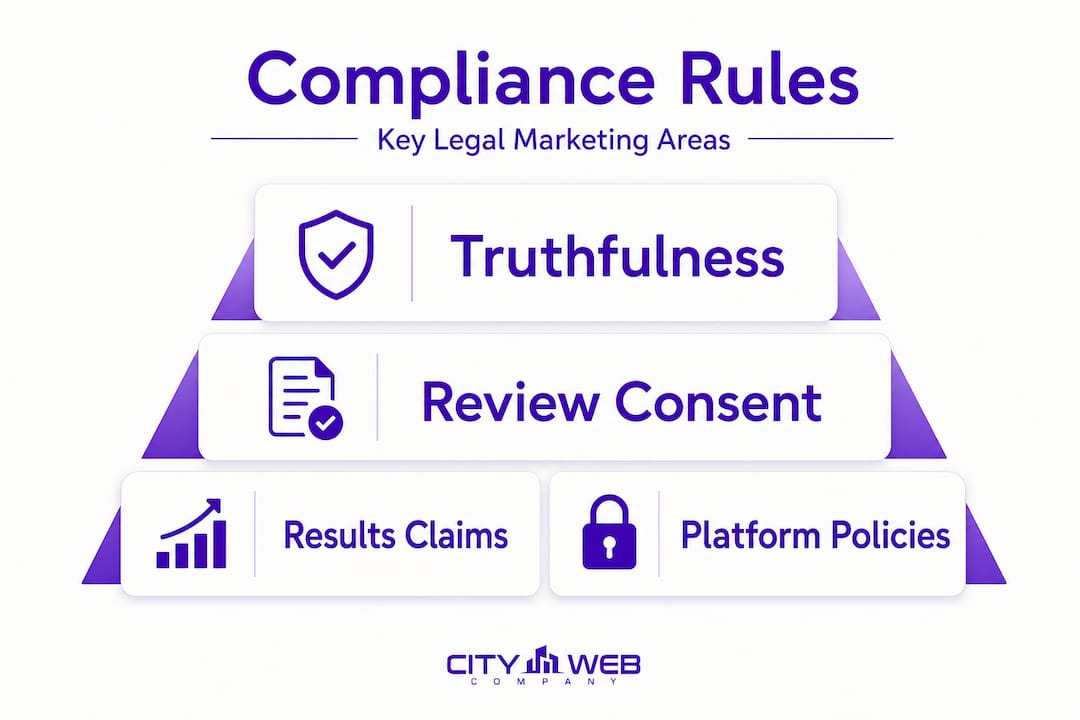

Who governs legal marketing?
Three major players oversee legal advertising in the United States:
- State bar associations: Every state has its own bar association that adopts professional conduct rules, often modeled on ABA guidelines but adapted locally. Your state bar is the primary regulator you need to worry about.
- The American Bar Association (ABA): The ABA publishes the Model Rules of Professional Conduct, which set the national standard. ABA Model Rule 7.2 restricts misleading communications and sets specific requirements for lawyer advertising, including how ads must identify the responsible attorney or firm.
- The Federal Trade Commission (FTC): The FTC has jurisdiction over consumer-facing advertising across all industries. It requires that advertising be truthful, non-deceptive, fair, and backed by evidence. This includes online reviews, testimonials, and social media posts.
Key rules at a glance
| Rule area | What it requires | Who enforces it |
|---|---|---|
| Truthfulness | No false or misleading claims in any medium | State bars, FTC |
| Identification | Ads must include attorney/firm name and contact info | State bar associations |
| Specialist claims | Must hold actual certification to claim specialty | State bar associations |
| Testimonials | Must be substantiated and disclose any compensation | FTC |
| Referral payments | No paying for referrals in most states | State bar associations |
| Review solicitation | No fake reviews or undisclosed incentives | FTC |
What these rules look like in practice
Follow this process to align your legal marketing with core compliance requirements:
- Review your state bar’s specific advertising rules before launching any campaign. ABA Model Rules are a starting point, not the final word.
- Identify a responsible attorney for every ad. Your firm’s name and contact information must appear clearly.
- Audit all testimonials and results claims for substantiation. If a client says you got them a $2 million settlement, that must be verifiable.
- Check your review strategy to ensure you are not offering incentives without proper disclosure.
- Use your legal marketing checklist as a living document, updated every time a campaign launches.
Pro Tip: Many state bars have a formal advertising review process you can use before publishing. Submitting your ad for pre-approval adds a layer of protection and gives you documented evidence of good-faith compliance.
Building an online law firm marketing strategy without first understanding these rules is like building a house without checking local zoning codes. You may get away with it for a while, but the risk is not worth it.
How legal marketing regulations work in practice
Rules on paper are one thing. What they mean for your actual campaigns, your Google Ads, your client review requests, your social media bio, is where things get real for most service-based business owners.
Digital ads are not a loophole
A common misconception is that digital advertising sits in a regulatory gray zone. It does not. Digital content and ads are treated as professional communications, subject to the same ethical rules and FTC oversight as any billboard or TV spot. A paid search ad that says “We win every case” is just as problematic online as it would be on a highway sign.
Common compliance pitfalls in digital campaigns
Here is a side-by-side look at compliant versus non-compliant approaches:
| Marketing element | Non-compliant example | Compliant alternative |
|---|---|---|
| Results claim | “We always win” | “We have a strong track record in personal injury cases” |
| Testimonial | Paid review with no disclosure | “This client was compensated for their time” |
| Specialty claim | “Expert DUI lawyer” | “Certified DUI Defense Specialist by [Certifying Body]” |
| Contact info | Ad with no firm name | Clear firm name and phone number in all ads |
| Guarantees | “Guaranteed settlement” | “We pursue maximum compensation for every client” |
Review management is a compliance issue
Your Google Business Profile and review platforms are not just marketing tools. They are regulated spaces. The FTC is explicit: you cannot generate fake reviews, pay for positive reviews without disclosure, or suppress negative reviews through tactics that deceive consumers. This catches many businesses off guard because it feels informal. It is not.
Key review compliance rules include:
- Never offer discounts, gift cards, or rewards in exchange for a review without clear disclosure
- Do not create multiple accounts or use employees to write fake client reviews
- Responding professionally to negative reviews is encouraged; deleting them deceptively is not
- Always disclose when a testimonial comes from someone with a material connection to your firm
Testimonials and results claims need substantiation
If your website says “We recovered $50 million for our clients last year,” that number needs to be accurate and verifiable. Inflated figures or cherry-picked case outcomes without proper context can mislead prospective clients about what they can realistically expect. Many state bars require disclaimers next to results claims that explain past results do not guarantee future outcomes.
Pro Tip: Before publishing a client testimonial, document the client’s consent in writing, confirm no compensation was given (or fully disclose it if it was), and verify the factual accuracy of what they said. Keep this documentation in a marketing compliance file.
Understanding the top legal marketing platforms your firm uses will help you map out where compliance review is needed. Every channel has its own nuances. The types of law firm marketing you invest in each carry distinct regulatory considerations, and a smart approach to content marketing for law firms keeps educational value front and center while staying well within ethical boundaries.
Navigating common gray areas and compliance pain points
Even business owners who genuinely want to follow the rules can stumble in the murky middle ground. These gray areas are where most compliance violations actually happen, not from bad intent but from incomplete understanding.
Not all exaggerations are equal
Regulators do not operate on a binary “true or false” framework. They evaluate the overall impression an ad creates. A statement like “The toughest lawyer in town” might read as harmless puffery. But “The most successful personal injury attorney in Texas” implies a verifiable claim about outcomes that could mislead consumers if not supported by data.
The FTC has made clear that truthful ads can still create misleading impressions if context, omissions, or framing send the wrong signal. This is sometimes called “impression policing.” Regulators ask: what would a reasonable consumer believe after seeing this ad? If the answer is something you cannot back up, you have a problem.
The First Amendment factor
Legal advertising regulation also bumps up against First Amendment protections. The case Bates v. State Bar of Arizona established that attorney advertising is protected commercial speech, meaning bar rules must balance First Amendment rights with the need to prevent deception. This is why regulators focus on deceptive or misleading content rather than banning advertising outright.
“Commercial speech protections mean legal marketers have real freedom to advertise, but that freedom has a clear boundary: the point where advertising stops informing and starts deceiving.”
Where lead payments and review incentives blur the line
Here is a numbered breakdown of the most common gray areas that trip up legal marketers:
- Paying for referrals: In most states, paying a non-attorney for client referrals violates bar rules. However, paying for legitimate lead generation services that connect you with potential clients operates in a different category. The distinction matters. Know exactly what your contract with any lead vendor says.
- Review incentives: Offering any form of reward for a review, even a small discount, without clear disclosure to both the reviewer and the audience violates FTC guidelines. The incentive does not have to be cash. Free consultations and branded gifts count too.
- Implied endorsements: If a celebrity or well-known figure appears in your ad, even tangentially, it can imply an endorsement that must meet FTC disclosure requirements.
- Case study framing: Publishing a case study that highlights a favorable outcome without noting that results vary can create an unrealistic expectation. Always include appropriate disclaimers.
- Social media boosting: Paying to amplify a client testimonial post constitutes paid advertising and must follow the same rules as any other sponsored content.
Investing in strong law firm website essentials like compliant disclaimers, proper contact information, and transparent attorney bios helps preempt many of these gray area issues before a regulator ever looks at your site.
Practical steps for compliant and ethical legal marketing
Knowing the rules matters. Having a system to follow them consistently is what separates firms that grow sustainably from those that eventually face disciplinary review. Given that ad spending and regulatory scrutiny are both rising sharply, a robust compliance process is no longer optional for serious legal marketers.
Build a compliance review process
Every piece of marketing content, ads, social posts, website pages, and email campaigns, should go through a review before it publishes. This does not have to be elaborate, but it needs to be consistent.
- Assign a compliance reviewer for each content type
- Use a checklist that covers truthfulness, required disclosures, substantiation of claims, and contact information
- Set a mandatory 24-hour hold before publishing new campaigns so review can happen
- For major campaigns, consider running your materials past a legal marketing attorney who specializes in bar compliance
Train your team
Your front-desk staff, social media manager, and any outside contractor posting on your behalf all represent your firm in the eyes of regulators. A social media post made by an intern can still trigger a bar complaint.
Training does not have to be formal. A one-page document explaining what your firm can and cannot say, reviewed quarterly, goes a long way. Cover topics like: what counts as a misleading claim, how to respond to reviews, what disclosures are required for testimonials, and who to contact internally before posting anything unusual.
Keep records of everything
Documentation is your best defense if a complaint is ever filed. Maintain organized records of:
- All published ads, including date, platform, and the version that ran
- Client consent forms for testimonials and case studies
- Review request communications (showing no incentive was offered)
- Any bar pre-approval letters for advertising materials
- Internal compliance review sign-offs for each campaign
What to do if you discover a violation
Act fast. If you identify a non-compliant ad or piece of content, remove it immediately and document when and why it was removed. If the violation is serious, proactively notifying your state bar before they receive a complaint from a third party often results in significantly lighter consequences. Show good faith at every step.
Your legal marketing checklist should include a section on violation response so your team knows the protocol without having to improvise under pressure.
Perspective: Why regulatory clarity is a competitive advantage
Most business owners, when they hear “regulations,” think about costs, restrictions, and headaches. We get it. But here is a perspective that most marketing guides will not tell you: firms that genuinely embrace compliance do not just avoid penalties. They consistently outperform competitors who treat it as a grudging checkbox.
Here is why. When a prospective client reads your ads and your reviews, they are trying to answer one fundamental question: “Can I trust this firm?” Compliance builds the trust signals that answer that question more effectively than any clever headline. A clearly identified attorney in every ad, properly disclosed testimonials, and transparent case result disclaimers all communicate professionalism and honesty. These signals work on consumers at a subconscious level. They make your marketing feel different, more credible, from the first impression.
The firms that pour money into aggressive, barely-compliant marketing often see short-term spikes in leads followed by reputational damage and regulatory disruption. We have watched it happen repeatedly. The ones that invest in ethical, transparent outreach build client relationships that generate referrals for years. That is a compounding return you will not find in any ad platform dashboard.
There is also a creative argument here. Viewing regulations as a framework rather than a barrier actually forces better marketing. When you cannot make vague promises or exaggerated claims, you have to find genuine differentiators. What does your firm actually do better than the competition? What outcomes can you honestly document? Answering those questions honestly produces marketing that is sharper, more specific, and more persuasive than generic superlatives ever were.
The myth that regulation stifles growth only holds if you see the rules as obstacles. Reframe them as standards that separate serious professionals from bad actors, and they become a tool. Your compliance becomes part of your brand story. Digital marketing for law firms that leads with honesty and transparency is not just ethically sound. It is strategically superior.
Take your next step: Marketing compliance with expert support
Building a compliant legal marketing strategy takes more than good intentions. It takes the right systems, the right partners, and a team that understands both the digital landscape and the specific rules governing your profession.

City Web Company works with legal and service-based businesses to build marketing programs that generate real leads without cutting regulatory corners. From compliant Google Ads and SEO strategies to review management guidance and website design that checks every professional conduct box, we bring structure and expertise to every campaign. Whether you need a full digital marketing for law firms strategy or want to understand digital marketing better before your next investment, our team is ready to walk you through it. Reach out for a compliance-focused strategy session and leave knowing exactly where you stand.
Frequently asked questions
Why can’t law firms advertise the same way other businesses do?
Law firms face additional ethical rules because their advertising directly impacts vulnerable consumers making high-stakes legal decisions, and ABA Model Rule 7.2 restricts certain communications to uphold the profession’s integrity and protect the public.
Are digital ads and client reviews really regulated like traditional ads?
Yes, digital ads and online reviews are held to the same standards as any other form of advertising, because digital legal marketing is subject to both professional bar ethics and federal consumer protection rules that prohibit deceptive practices regardless of the platform.
What are the penalties for violating legal marketing regulations?
Violations can lead to fines, license suspension or revocation, and formal FTC enforcement actions, with the severity depending on how seriously the breach misled consumers or damaged the profession’s integrity.
Can a law firm call itself a “specialist” in advertising?
A firm can only claim specialist status if an attorney holds formal certification from an authority approved by the state bar, because ABA Model Rule 7.2 prohibits implying specialist status without verified, properly disclosed credentials.
What is the main reason regulations focus on misleading impressions, not just wording?
Regulators recognize that even literally accurate statements can deceive through omission or framing, so they evaluate the overall impression an ad creates, because even truthful ads can mislead when context leads a reasonable consumer to a false conclusion.
Recommended
These articles were popular with other readers too: