

See how plumbers can turn Facebook scrollers into booked jobs with clear offers, local targeting, a 30 day test budget, fast follow up, and a path to scale.
Legal marketing compliance: Build trust and avoid fines
Most service business owners treat legal marketing compliance the way they treat a smoke detector: they install it, forget about it, and only pay attention when something goes wrong. But here’s what the most successful agencies and service providers understand that their competitors don’t: compliance isn’t a legal safety net you hang below your marketing strategy. It’s the foundation your entire strategy should rest on. When every claim you make is truthful, every email you send follows the rules, and every endorsement you use is properly disclosed, you build the kind of trust that converts more leads, generates more referrals, and keeps regulators off your back for good.
Table of Contents
Table of Contents
- What is legal marketing compliance?
- Key U.S. marketing compliance laws: What every service business must know
- Industry-specific regulations: How legal marketing compliance varies by sector
- Modern risk factors: Online marketing and the new enforcement landscape
- Best practices: Embedding compliance into your marketing strategy
- Legal marketing compliance: What most businesses overlook and why it matters
- How our expertise supports your compliant growth
- Frequently asked questions
Key Takeaways
| Point | Details |
|---|---|
| Compliance boosts trust | Following marketing compliance rules builds customer confidence and credibility. |
| Multiple layers of regulation | Businesses must follow federal, state, and industry-specific laws to avoid risk. |
| Digital risks are rising | Modern marketing channels like email and social media require extra attention for compliance. |
| Proactive workflows matter | Integrating legal review early and often prevents fines and grows your reputation. |
| Compliance is a growth tool | Smart legal marketing compliance is an asset—not just protection—helping your business stand out. |
What is legal marketing compliance?
Legal marketing compliance is not just a phrase for attorneys and ad lawyers. It applies to every service business that runs advertising, sends marketing emails, manages a website, or posts on social media. At its core, marketing compliance regulations ensure that all marketing activities, messages, and materials adhere to applicable U.S. laws, regulations, industry standards, and internal policies, with a specific focus on truthful, non-misleading, and substantiated claims.
Think of it this way. If your HVAC company says “guaranteed lowest prices in the state” in a Google Ad, you need to be able to prove that. If your law firm’s website says “we win 98% of our cases,” that claim must be accurate and properly contextualized. If your landscaping company sends promotional emails to a list you purchased, you may already be violating federal law. Compliance means every marketing message you put into the world can withstand scrutiny.
Here are the core principles that every service business must meet:
- Truthfulness: Every claim must be accurate and not misleading, even if technically true
- Substantiation: You must have evidence to support all objective claims before publishing them
- Clear disclosure: Fees, terms, limitations, and sponsored relationships must be disclosed
- Fair practices: You cannot exploit consumers through deceptive or manipulative tactics
- Sector-specific rules: Some industries (legal, healthcare) carry additional overlay regulations
“Legal marketing compliance is not a legal department problem. It is a marketing process problem that requires a legal solution built into every campaign.”
If your business operates in a regulated industry like law or healthcare, you also need to layer in additional professional conduct rules, which we’ll cover in a later section. For a starting point tailored to law firms, review this legal marketing checklist that outlines exactly what you need to review before launching any campaign. You can also explore how online law firm marketing intersects with these compliance demands as your practice grows.
Key U.S. marketing compliance laws: What every service business must know
Now that you understand what compliance means, let’s look at the specific legal rules that impact your marketing. The United States has several major regulatory frameworks governing advertising and marketing. Ignoring even one of them can result in government enforcement actions, private lawsuits from consumers, platform bans, and serious damage to your reputation.
The Federal Trade Commission (FTC) is the primary federal body overseeing marketing practices, and FTC Section 5 prohibits unfair or deceptive acts, requiring all ads to be truthful, non-misleading, and evidence-based. The CAN-SPAM Act governs commercial email communications, requiring senders to honor opt-out requests promptly and avoid deceptive subject lines or sender information. State-level UDAP (Unfair, Deceptive, or Abusive Practices) laws add yet another layer of risk, often giving individual consumers the right to sue businesses directly.

Here’s how the main U.S. marketing laws stack up:
| Law | Coverage area | Who it affects |
|---|---|---|
| FTC Section 5 | All advertising and marketing claims | All U.S. businesses |
| CAN-SPAM Act | Commercial email campaigns | Any business using email marketing |
| TCPA | Text message and robocall marketing | Businesses using SMS or phone marketing |
| CCPA | Consumer data privacy (California) | Businesses serving California residents |
| State UDAP laws | Deceptive/unfair marketing practices | All businesses operating in specific states |
The consequences of non-compliance are not hypothetical. Here’s what violations actually look like in practice:
- FTC enforcement actions can result in fines of up to $51,744 per violation per day for certain offenses
- CAN-SPAM violations carry penalties of up to $53,088 per email in egregious cases
- State UDAP lawsuits allow consumers to seek actual damages, plus attorney fees
- Repeated violations can lead to consent decrees, essentially federal supervision of your marketing
- Reputational damage from a compliance scandal often outlasts any fine
Pro Tip: Before launching any new marketing campaign, document your substantiation for every factual claim in the campaign. Keep those records for at least five years. If the FTC ever comes knocking, your documentation is your first line of defense.
The smartest move you can make is to review your digital marketing for law firms strategy against these frameworks at least twice a year. Regulations shift. What was acceptable last year may now carry penalties. Also bookmark the FTC’s business guidance page and check it quarterly. Pair that with the legal marketing checklist we mentioned earlier, and you have a solid self-audit system.
Industry-specific regulations: How legal marketing compliance varies by sector
Federal marketing rules are just a starting point. Service businesses must also navigate industry-specific and state-specific regulations that can be far more restrictive than anything the FTC puts out. This is where many businesses make their most costly mistakes.
For law firms specifically, ABA Model Rules 7.1 through 7.5 establish the baseline for permissible attorney advertising. Rule 7.1 prohibits false or misleading communications about a lawyer or the firm’s services. Rule 7.2 governs advertising content and the use of testimonials. Rule 7.3 limits direct solicitation of potential clients. And because every state bar association interprets and enforces these rules differently, a law firm operating in multiple states must maintain multi-jurisdiction compliance, which is far more complex than most firms realize.
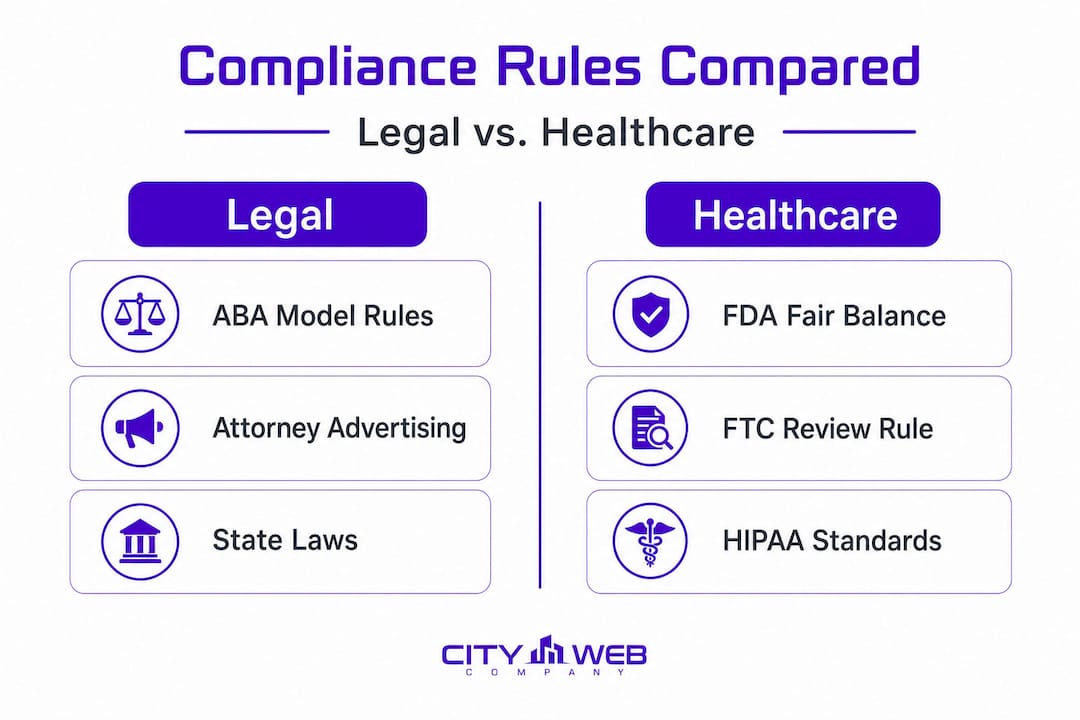

Healthcare providers face a different but equally demanding set of rules. The FDA and FTC require what’s called “fair balance” in health-related advertising, meaning that any marketing materials that mention benefits of a treatment must also clearly communicate the associated risks. Med spas, in particular, operate in a gray zone between beauty and medicine, and are subject to both state licensing board rules and FTC enforcement if their claims about results are exaggerated or unsubstantiated.
Here’s a side-by-side comparison of how compliance requirements differ across common service sectors:
| Sector | Key regulations | High-risk content areas |
|---|---|---|
| Law firms | FTC, ABA Rules 7.1-7.5, state bar rules | Outcome guarantees, misleading testimonials |
| Healthcare/med spas | FTC, FDA fair balance rules, state licensing | Treatment outcomes, before/after claims |
| HVAC, plumbing, home services | FTC, CAN-SPAM, TCPA, state UDAP | Price claims, licensing representations |
| Pest control, landscaping | FTC, state UDAP, EPA marketing rules | Product safety claims, efficacy statements |
| Moving companies | FTC, FMCSA regulations, state UDAP | Pricing representations, liability limitations |
Areas where service businesses most commonly cross the line:
- Claiming certifications or licensing they don’t hold or have let lapse
- Using before/after photos that don’t represent typical results
- Featuring testimonials from employees or close associates without disclosure
- Making price comparisons to competitors using outdated or cherry-picked data
- Sending promotional texts or emails without proper consent
One striking data point worth noting: the FTC received over 2.6 million fraud reports in a recent year, and deceptive advertising complaints represent a significant and growing portion of those filings. State attorneys general are also ramping up enforcement, and consumer lawsuits under UDAP statutes are increasing at double-digit rates in many states.
If you’re in the legal services space specifically, explore how different law firm marketing types interact with these regulations before scaling any campaign. And for a broader look at what tools are best positioned to help you market compliantly, review the top legal marketing platforms that are designed with these constraints in mind.
Modern risk factors: Online marketing and the new enforcement landscape
Beyond the laws and frameworks, it’s important to recognize how the digital landscape changes your risk profile. Social media, influencer marketing, user-generated content, and review platforms have all created new compliance hazards that simply didn’t exist 15 years ago. Regulators have noticed.
The FTC’s enforcement priorities in 2025 and 2026 have shifted significantly toward the digital space. Fake reviews, hidden fees, and influencer non-disclosure are now at the top of the agency’s enforcement list. The FTC’s 2024 Review Rule specifically enables financial penalties for businesses that create, buy, or otherwise manipulate online reviews. That means offering a discount in exchange for a positive review, or having employees post reviews under fake accounts, is no longer just an ethical problem. It’s a legal one.
The channels carrying the most digital compliance risk right now include:
- Review platforms: Incentivizing reviews, suppressing negative feedback, or posting fake reviews
- Social media advertising: Misleading claim combinations (image vs. caption contradictions), hidden sponsored labels
- Email campaigns: Deceptive subject lines, missing unsubscribe links, purchased lists
- Influencer marketing: Undisclosed paid partnerships, affiliate relationships without clear tagging
- Website landing pages: Hidden terms, impossible guarantees, misleading comparison charts
“The FTC is no longer just watching TV commercials. They’re watching Instagram stories, Google review feeds, and email inboxes. Your digital marketing is under a much brighter spotlight than most business owners realize.”
Pro Tip: Every time you partner with an influencer or brand ambassador, even a micro-influencer with just 5,000 followers, require them to include a clear, upfront disclosure in their posts using language like “#ad” or “#sponsored.” Bury it at the bottom of a caption or hide it in a hashtag storm, and both of you could be held liable.
For service businesses building a brand online, this is also where visual identity and brand credibility become tightly linked to compliance. Review these legal branding tips to understand how strong branding and honest messaging reinforce each other in a regulated environment.
Best practices: Embedding compliance into your marketing strategy
With risks evolving quickly, robust processes for compliance can both protect and grow your business. The businesses that get burned by compliance failures almost always share one trait: they treated legal review as a final-step checkbox rather than an integrated part of their marketing process. By the time the campaign is built, approved by management, and scheduled to launch, nobody wants to hear that the headline claim needs to be reworked.
The solution is to build compliance into your workflow from day one, not day 30.
Here’s how to do it right:
- Start with a compliance brief: Before any campaign kicks off, document every claim you plan to make and identify the evidence that supports each one. This brief becomes your compliance record.
- Review at the concept stage: Get legal or compliance review during the ideation phase, not after creative assets are produced. It’s far cheaper to change a concept than redesign a completed ad.
- Train your marketing team: Anyone creating content, managing email lists, or running social ads needs to understand the basics of FTC rules, CAN-SPAM requirements, and any industry-specific constraints. Annual training is the minimum. Quarterly is better.
- Audit your existing content: Run a regular audit of your website, active email sequences, social profiles, and review platforms to catch outdated claims, missing disclosures, or unsubstantiated statements.
- Document everything: Keep records of your substantiation, your legal reviews, your influencer agreements, and your opt-in consent records. If you cannot produce these when challenged, you lose.
The marketing compliance guidance from business regulatory experts is clear: integrating legal review into your marketing workflows early protects you from fines, preserves your reputation, and actually improves campaign quality because you catch weak or unsubstantiated claims before they go public.
Automation can play a major role here. Modern platforms designed for content approval workflows can route every piece of marketing content through the right reviewers before it publishes. Explore how marketing automation tools can help you standardize and scale this process without creating bottlenecks that slow down your campaigns.
Legal marketing compliance: What most businesses overlook and why it matters
Here’s the uncomfortable truth most marketing consultants won’t tell you: the majority of compliance failures in service business marketing are not legal failures. They’re process failures.
Law firms and home service companies don’t typically get hit with FTC enforcement because a lawyer on staff made a deliberate decision to deceive. They get hit because a marketing coordinator wrote a headline that sounded great, a manager approved it quickly under deadline pressure, and nobody in the room asked the simple question: “Can we actually prove this claim?”
Compliance fails when it lives in a legal silo, disconnected from marketing, sales, and operations. The businesses that do this well, the ones that build real differentiation in crowded markets, treat compliance as a marketing discipline. They ask the same questions about every campaign: Is this honest? Can we prove it? Would our best customer feel deceived if they read this after hiring us?
That mindset shift is where the real opportunity lives. Consumers in 2026 are more skeptical than ever. Review fraud, AI-generated content, and a flood of unsubstantiated health and financial claims have made people deeply distrustful of marketing in general. When your business shows up with clear, honest, well-documented claims, you immediately stand out. Transparency, not clever copywriting, is your biggest competitive differentiator right now.
We’ve worked with service businesses that turned their compliance process into a marketing asset. One firm began explicitly noting on their website that all testimonials featured are from real clients, not incentivized, and that all outcome references reflect documented averages, not exceptional cases. Conversion rates improved. Not because the claims were more dramatic, but because they were more believable.
Compliance also protects the customer relationship long-term. When your marketing sets accurate expectations and your service delivers on those expectations, you generate referrals naturally. When your marketing overpromises and your service underdelivers, you generate chargebacks, negative reviews, and UDAP complaints.
For service businesses looking to build lasting brand equity alongside legal protection, the overlap of content marketing and compliance is one of the most underused strategies in the market today. Educational content that demonstrates expertise without making unsubstantiated promises builds trust at scale without creating compliance risk.
How our expertise supports your compliant growth
Marketing compliance shouldn’t slow your growth. It should accelerate it by giving your customers a reason to trust you faster.
At City Web Company, we build digital marketing strategies that are both results-driven and compliance-aware. Whether you’re running digital marketing for local leads, managing a law firm’s online presence, or scaling a home service company into new markets, our team understands how to craft campaigns that convert without cutting corners. Our services are designed to integrate substantiated claims, proper disclosures, and industry-specific requirements directly into your website content, paid ads, and email strategy. Explore our full range of digital marketing services to see how we align strategy with compliance, or get started with a tailored approach through our digital marketing for law firms program built for regulated industries.
Frequently asked questions
What happens if I ignore legal marketing compliance?
You risk fines, lawsuits from consumers or regulators, and serious damage to your reputation and search visibility. State UDAP laws add an additional layer of liability by allowing private consumers to sue directly, not just government agencies.
Does compliance only apply to law firms, or all service businesses?
Every service business must comply with baseline FTC and CAN-SPAM requirements, but law firms face extra restrictions under ABA Model Rules 7.1 through 7.5 and state bar ethics guidelines that govern advertising content, testimonials, and client solicitation.
How can I make sure my emails are compliant?
Use truthful subject lines, include a clear unsubscribe mechanism, and never obscure sender information to meet CAN-SPAM standards. Review your email list sources regularly to ensure all contacts gave proper consent.
Are fake reviews and undisclosed influencer content illegal?
Yes, both are now clearly in the FTC’s enforcement crosshairs. The FTC’s 2024 Review Rule enables direct financial penalties for businesses that generate, purchase, or manipulate online reviews, and undisclosed paid partnerships violate the FTC’s endorsement guidelines.
Can marketing automation help with compliance?
Absolutely. Automation tools can streamline approval workflows, create documentation trails, and flag content for legal review before it publishes. Using automation to reduce manual errors in compliance-heavy processes is one of the most practical investments a growing service business can make.
Recommended
These articles were popular with other readers too: