

Pass Google Business verification with a video-first checklist. Film one continuous 30 second take, fix flagged issues, and know when to hire help.
Law firm website essentials: attract more clients online
Most law firms treat their website like a digital business card, but that approach costs them dozens of potential clients every month. Your website is not just a place to list your practice areas and phone number. It is a 24/7 client acquisition engine that must actively persuade visitors to contact you. This guide reveals the critical strategies that separate high-performing law firm websites from those that simply exist online, covering design principles, SEO tactics, content marketing, and conversion optimization that drive measurable results.
Table of Contents
Table of Contents
- Key takeaways
- Why law firm websites must go beyond aesthetics
- Core website essentials for law firms: design, content, and usability
- SEO and local search strategies for law firm website success
- Leveraging content marketing and client engagement on your law firm website
- Enhance your law firm’s online presence with expert digital marketing
- FAQ
Key Takeaways
| Point | Details |
|---|---|
| Prominent contact information | Put the phone number in the header with a click to call on mobile to increase consultations. |
| Trust signals matter | Testimonials, credentials, case results, and clear explanations of your process should appear prominently on the site to overcome client skepticism. |
| Client focused content | Content should explain processes in plain language and address common concerns instead of heavy legal jargon. |
| Clear site purpose | Each page must have a clear purpose and a next step to guide visitors toward contacting you. |
| SEO and local presence | Search engine optimization and local search presence should drive relevant traffic to your firm. |
Why law firm websites must go beyond aesthetics
Many attorneys invest thousands in sleek website designs only to wonder why their phone stays quiet. The harsh reality is that visual polish alone never converted a single client. Your website must strategically address the specific anxieties and questions potential clients bring when searching for legal representation. A visitor landing on your site is typically stressed, confused about legal processes, and comparing multiple firms simultaneously. They need immediate reassurance that you understand their situation and can solve their problem.
Trust signals become your most powerful conversion tools in this context. Digital marketing strategies for law firms dramatically increase client trust and contact rates when implemented correctly. Client testimonials, professional credentials, case results, and clear explanations of your process all work together to overcome the natural skepticism people feel when hiring an attorney. These elements must appear prominently throughout your site, not buried on a separate testimonials page.
User experience design guides visitors toward action rather than leaving them to wander aimlessly. Every page should have a clear purpose and next step. Your homepage should immediately clarify what you do, who you serve, and why visitors should choose you. Practice area pages must answer common questions while making it effortless to schedule a consultation. Contact forms should request only essential information, because every additional field reduces completion rates.
Pro Tip: Place your phone number in the header of every page with click-to-call functionality for mobile users. This single change can increase consultation requests by 15-20% because it eliminates the friction of searching for contact information when someone is ready to reach out.
The most effective law firm websites follow a strategic hierarchy:
- Immediate clarity about your specialization and service area
- Prominent trust signals visible above the fold
- Simple navigation that matches how clients think about their problems
- Multiple conversion opportunities throughout the visitor journey
- Content that educates rather than intimidates
This approach transforms your website from a passive information repository into an active client acquisition system that works continuously to grow your practice.
Core website essentials for law firms: design, content, and usability
Your website design must communicate professionalism within three seconds or visitors leave. Consistent branding across all pages, including colors, fonts, and imagery, builds recognition and signals attention to detail. Avoid generic stock photos of gavels and law books. Instead, use authentic photos of your team and office that humanize your practice. Potential clients want to see the actual attorneys they might work with, not staged corporate imagery.

Content strategy should obsessively focus on client needs rather than showcasing your legal knowledge. Write practice area pages that explain processes in plain language, address common concerns, and outline what clients can expect when working with you. Replace legal jargon with conversational explanations. For example, instead of discussing “tort liability in premises cases,” explain “how property owners can be held responsible when someone gets injured on their property.” This client-focused approach from legal firm branding experts makes your expertise accessible.
Navigation architecture should mirror how clients think about their problems, not how attorneys categorize legal services. Someone facing a DUI charge searches for “DUI lawyer” not “criminal defense attorney.” Your menu structure must use the language your target clients actually use. Keep main navigation to five to seven items maximum. Every additional menu option increases cognitive load and reduces the likelihood visitors find what they need.
Calls to action require strategic placement and persuasive copy. Generic phrases like “Contact Us” convert poorly compared to specific, benefit-driven alternatives like “Schedule Your Free Case Evaluation” or “Get Answers to Your Questions Now.” Place calls to action at natural decision points: after explaining a practice area, following client testimonials, and at the end of blog posts. Multiple opportunities to convert increase overall consultation requests without feeling pushy.
| Website element | Standard benchmark | Best practice target |
|---|---|---|
| Page load time | Under 3 seconds | Under 2 seconds |
| Mobile traffic percentage | 60-70% of visitors | Optimized for 100% |
| Bounce rate | 40-60% | Under 40% |
| Pages per session | 2-3 pages | 4+ pages |
| Average session duration | 1-2 minutes | 3+ minutes |
Mobile responsiveness and fast loading are non-negotiable performance standards that reduce bounce rates significantly. Google prioritizes mobile-friendly sites in search rankings, and over 60% of legal searches now happen on smartphones. Your site must automatically adapt to any screen size, with touch-friendly buttons and readable text that requires no zooming. Page speed affects both user experience and SEO, so compress images, minimize code, and use reliable hosting.
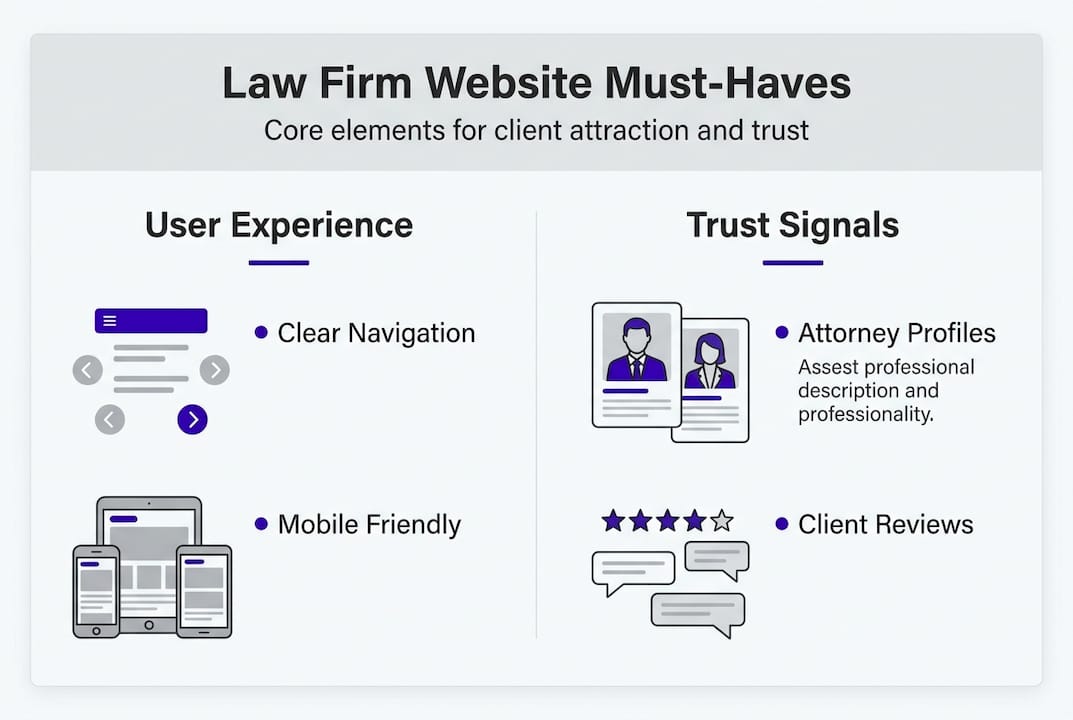

Pro Tip: Test your website on actual mobile devices, not just desktop browser simulators. Real-world testing reveals usability issues that simulators miss, like buttons too small to tap accurately or forms that trigger awkward keyboard layouts.
Accessibility features benefit all users while expanding your potential client base. Use sufficient color contrast for text readability, provide alt text for images, ensure keyboard navigation works throughout your site, and structure content with proper heading hierarchy. These improvements help visitors with disabilities while also improving your SEO performance and overall user experience.
SEO and local search strategies for law firm website success
Local SEO differs fundamentally from traditional SEO because it prioritizes geographic relevance over pure authority. When someone searches “personal injury lawyer near me” or “divorce attorney in Chicago,” Google displays results based primarily on proximity, relevance, and prominence within that specific location. Your optimization strategy must therefore emphasize local signals rather than competing for national rankings that bring unqualified traffic from outside your service area.
On-page SEO elements form the foundation of search visibility. Every practice area page needs a unique, descriptive title tag that includes your target keyword and location. Meta descriptions should compellingly summarize the page content in 150-160 characters to improve click-through rates from search results. Use header tags (H1, H2, H3) to structure content logically, incorporating relevant keywords naturally. Create dedicated location pages for each city or region you serve, with unique content explaining your services in that specific area.
| Local SEO tactic | Traditional SEO tactic | Primary benefit for law firms |
|---|---|---|
| Google Business Profile optimization | National directory listings | Appears in local map pack for nearby searches |
| Location-specific landing pages | Broad topic authority pages | Captures clients in your service area |
| Local citation building | General backlink acquisition | Reinforces geographic relevance signals |
| Client reviews on Google | Social media engagement | Builds trust and improves local rankings |
Google Business Profile optimization represents the single highest-impact local SEO tactic for law firms. Local SEO strategies dramatically increase leads for firms serving specific communities. Claim and verify your profile, then optimize every section completely. Choose the most specific business categories available, add high-quality photos of your office and team, post regular updates, and most importantly, actively solicit and respond to client reviews. Firms with 50+ positive Google reviews consistently outrank competitors with fewer reviews, even when other SEO factors favor the competition.
Off-page SEO for law firms centers on building authoritative backlinks from relevant sources. Local news coverage, bar association memberships, legal directories, and community involvement all create valuable link opportunities. Guest posting on legal blogs, participating in local business organizations, and sponsoring community events generate both links and local awareness. Quality matters far more than quantity, so pursue links from respected sources rather than spamming low-quality directories.
Tracking SEO performance requires monitoring specific metrics that correlate with client acquisition:
- Organic search traffic volume and trends over time
- Rankings for your target keywords in your service area
- Google Business Profile views, clicks, and direction requests
- Conversion rate from organic traffic to consultation requests
- Phone calls and form submissions attributed to search traffic
Use Google Analytics and Google Search Console to track these metrics monthly. Significant ranking improvements typically take three to six months, so evaluate performance on quarterly cycles rather than week to week. Understanding why legal firms need SEO helps set realistic expectations for timeline and results.
Pro Tip: Create separate tracking phone numbers for different marketing channels so you can definitively attribute consultation calls to your website versus other sources. This data proves SEO ROI and helps optimize your marketing budget allocation.
Local SEO services drive more qualified traffic than broad national campaigns because they connect you with people actively searching for legal help in your area. Someone searching “estate planning attorney Boston” has immediate intent and geographic relevance, making them far more likely to convert than someone researching general estate planning information.
Leveraging content marketing and client engagement on your law firm website
Content marketing establishes your expertise while addressing the specific questions potential clients ask before hiring an attorney. Publishing regular blog articles on topics relevant to your practice areas improves search rankings, provides shareable resources, and demonstrates your knowledge. Focus on answering the “how,” “why,” and “what happens if” questions clients commonly ask during consultations. Each article should target a specific search query and provide genuinely useful information rather than thinly veiled sales pitches.
FAQ pages serve multiple strategic purposes simultaneously. They improve SEO by targeting question-based searches, reduce repetitive inquiries by answering common questions proactively, and help visitors self-qualify whether they need your services. Structure FAQs with clear questions as headings and concise answers in plain language. Cover topics like fee structures, case timelines, what to bring to initial consultations, and how your process works. Regular content updates improve search rankings and keep clients informed about legal developments affecting them.
Case studies and client testimonials build trust more effectively than any claims you make about yourself. Detailed case studies that explain the client’s situation, your approach, and the outcome demonstrate your problem-solving abilities. Always obtain proper consent and avoid disclosing confidential information. Video testimonials carry even more weight than written ones because they feel more authentic and harder to fabricate. Feature testimonials prominently on your homepage and relevant practice area pages.
Client interaction opportunities transform passive website visitors into engaged prospects. Enable blog comments to foster discussion, though moderate them to prevent spam. Offer downloadable resources like checklists or guides in exchange for email addresses, building your marketing list. Implement live chat or chatbots to answer simple questions immediately when visitors browse your site after hours. Each interaction point creates another opportunity to demonstrate your responsiveness and expertise.
Content topics should align strategically with both user questions and SEO keywords. Research what people actually search for using tools like Google’s autocomplete suggestions, “People Also Ask” boxes, and keyword research platforms. Create content that matches search intent rather than just keyword volume. For example, someone searching “how long does a divorce take” wants process information, not a sales pitch for your services. Answer their question thoroughly, then offer a consultation as a natural next step.
Effective content marketing follows these principles:
- Address real client concerns with practical, actionable information
- Write in conversational language that non-lawyers easily understand
- Update evergreen content annually to maintain accuracy and freshness
- Promote your best content through email newsletters and social media
- Link internally between related articles to keep visitors engaged longer
Various lead generation approaches work together synergistically when your content strategy supports your overall marketing goals. Blog posts attract initial traffic, downloadable resources capture contact information, email nurture sequences build relationships, and strategic calls to action convert readers into consultations.
Enhance your law firm’s online presence with expert digital marketing
Implementing these website essentials requires both technical expertise and strategic marketing knowledge that most law firms lack in-house. City Web Company specializes in digital marketing for law firms, combining website optimization, local SEO, content strategy, and conversion rate optimization into cohesive campaigns that generate measurable results. Their team understands the unique challenges legal practices face in competitive markets and develops tailored solutions that attract qualified clients rather than just increasing traffic numbers.
Whether you need a complete website redesign, ongoing SEO management, or strategic content development, their comprehensive digital marketing services address every aspect of your online presence. They work exclusively with service-based businesses like law firms, bringing specialized knowledge of what actually drives client acquisition in your industry. Stop wondering why your website underperforms and get started with City Web Company to transform your online presence into a consistent source of new client opportunities.
FAQ
What are the must-have features of a successful law firm website?
Successful law firm websites prioritize clear contact information with multiple ways to reach you, mobile-responsive design that works flawlessly on all devices, and client-focused content that addresses visitor concerns in plain language. Trust signals like client testimonials, professional credentials, and case results must appear prominently throughout the site. Strategic calls to action guide visitors toward scheduling consultations at natural decision points, and fast loading speeds keep visitors engaged rather than bouncing to competitor sites.
How can SEO improve my law firm’s online client leads?
SEO improves search engine rankings, making your firm appear prominently when potential clients search for legal services in your area. Local SEO strategies specifically target geographic searches like “divorce lawyer near me,” connecting you with high-intent prospects actively seeking representation. Optimized websites attract qualified traffic from people who already need your services, converting at much higher rates than cold outreach or generic advertising.
Why is mobile responsiveness critical for law firm websites?
Mobile responsiveness ensures your website functions properly on smartphones and tablets, which now account for over 60% of legal searches. Google prioritizes mobile-friendly sites in search rankings, so poor mobile performance directly reduces your visibility. Visitors who struggle with tiny text, broken layouts, or difficult navigation on mobile devices immediately leave to find competitor sites that work better, costing you potential clients every single day.
What content types best engage potential law clients online?
FAQ pages answering common legal questions, blog posts explaining relevant legal topics in accessible language, and detailed client testimonials all establish authority while addressing visitor concerns. Case studies demonstrating your problem-solving approach and successful outcomes build confidence in your abilities. Video content explaining legal processes or introducing your team creates stronger connections than text alone, and downloadable resources like checklists or guides provide value while capturing contact information for follow-up.
Recommended
These articles were popular with other readers too: