

Pass Google Business verification with a video-first checklist. Film one continuous 30 second take, fix flagged issues, and know when to hire help.
Agency Tested Google Ads Launch for Pest Control: Start with LSAs
Yes, Google Ads works for pest control, and it usually works fast. The evidence: 76% of people who run a local search visit a related business within 24 hours, which is exactly the kind of urgency pest problems create. Your first move should be verifying eligibility for Local Services Ads, and if that’s not available in your area yet, launch one tightly scoped Search campaign built around emergency keywords with a dedicated landing page. Do that before touching anything else.
TL;DR:
- Local Services Ads should be your initial focus because they offer better ROI and trust signals through the Google Guarantee badge, especially in competitive markets.
- Split your campaigns based on urgency with separate landing pages and tailored ad copy for emergency versus planned service searches to improve conversion rates.
- Set your initial budget based on your market size and stick to it for at least 30 days to allow Google’s algorithm to optimize effectively.
- Use precise geo-targeting by ZIP codes and schedule ads only during staffed hours to maximize lead quality and reduce wasted spend.
- Achieve measurable ROI by implementing detailed conversion tracking for calls, forms, and booked jobs, then analyze and adjust weekly based on cost per lead and profit data.
Table of Contents
Table of Contents
- 30 to 90 Day Launch Checklist for Pest Control Google Ads
- Which Google Ad Type Should Pest Control Companies Use First?
- Building a Campaign Structure That Doesn’t Waste Money
- What Should You Budget for Pest Control Google Ads?
- Ad Copy, Extensions, and Landing Pages That Convert Clicks Into Jobs
- Tracking Setup That Actually Proves ROI
- Mistakes That Quietly Drain Pest Control Ad Budgets
- Do You Need an Agency, or Can You Run This Yourself?
- Connecting Google Ads Leads to Your CRM and Follow-Up Process
- Compliance Rules Pest Control Advertisers Need to Follow
- City Web Company’s Perspective on Running These Campaigns
- How City Web Company Can Help You Launch or Fix a Pest Control Campaign
- Sources
- FAQ
30 to 90 Day Launch Checklist for Pest Control Google Ads
Many pest control owners spend the first month adjusting settings that have limited impact early on. The sequence below fixes that. Follow it in order, because each step depends on the one before it.
- Check Local Services Ads eligibility and apply for Google Guarantee. LSAs put your business at the very top of results with a green checkmark, and the Google Guarantee badge signals licensing and insurance verification that pest control customers actively look for.
- Build two Search campaigns, not one. Split emergency intent (“wasp nest removal today,” “ants in kitchen exterminator”) from planned or preventive intent (“quarterly pest control plan,” “termite inspection cost”).
- Build service-specific landing pages before you spend a dollar on clicks. Each page needs a phone number that’s clickable on mobile and a call-tracking number, not your main office line.
- Set your starting budget based on your market size and hold it steady for 30 days. Resist the urge to raise or lower bids daily. Google’s algorithm needs a stable signal to learn from.
- Load a negative keyword list on day one. Terms like “jobs,” “DIY,” “how to,” and “free” waste clicks fast in this industry.
- Set ad scheduling to match your actual staffing. If nobody answers calls after 6 PM, don’t pay for clicks at 9 PM.
- Turn on conversion tracking before the campaign goes live, not after. Retroactive tracking data is nearly worthless for optimization.
Get through this list and you’ll have a real read on cost per lead within four to six weeks, not guesswork.
Which Google Ad Type Should Pest Control Companies Use First?
Start with Local Services Ads. They’re pay-per-lead instead of pay-per-click, which means you’re not paying for window shoppers, and the Google Guarantee badge does trust-building work that no amount of ad copy can replicate. For a lot of local pest companies, LSAs deliver the best first-dollar return of any paid channel available.
Search campaigns come second, once your account has some structure. Search gives you full control over keywords, match types, ad copy, and bidding, which matters once you’re trying to scale past what LSAs alone can deliver. The tradeoff is that Search demands more setup work and ongoing management to avoid burning budget on the wrong queries.
Performance Max is the one to leave alone at first. It’s an automated campaign type that blends Search, Display, YouTube, and Discover placements into one black box, and it generally underperforms for local service businesses early because it needs high conversion volumes to learn before it optimizes well. Turn it on with thin conversion data and you’re funding Google’s algorithm’s education, not your lead pipeline.
Here’s how the three stack up in practice:
- Local Services Ads: pay-per-lead pricing, built-in trust badge, minimal creative work, best used from day one.
- Search campaigns: full keyword and bid control, best for scaling once you have clean tracking and a few months of data.
- Performance Max: broad automated reach, but opaque placement reporting makes it a poor fit until your account has volume and history.
The winning combination for most pest control companies is LSAs running alongside a lean, well-built Search account. LSAs catch the leads who want to call someone right now. Search catches the ones doing a bit more comparison shopping first. Adding Local Services Ads to a Search foundation tends to produce more total leads than either channel run alone, because they’re capturing different points in the buying decision.
Building a Campaign Structure That Doesn’t Waste Money
A messy account is the single biggest reason pest control companies think Google Ads “doesn’t work.” It’s not the platform. It’s the structure.
Split budget by urgency, not by service type alone
Emergency campaigns chase same-day searches: active infestations, wasp nests, sightings that scare people into calling immediately. Preventive campaigns chase planned purchases: quarterly service contracts, termite inspections before a home sale, seasonal treatments booked in advance.
These two intents convert differently and deserve different ad copy, different landing pages, and different bid strategies. An emergency searcher wants “same day service” in the headline. A preventive searcher wants “licensed and insured” and a price range.
Group keywords into service buckets
Inside each campaign, build ad groups around specific pest types rather than lumping everything into one generic “pest control” group. A workable starter structure looks like this:
- Bed bugs
- Termites
- Ants
- Rodents (mice and rats)
- Wasps and stinging insects
- General inspections
- Commercial pest control
Each bucket gets its own keywords, its own ad copy, and ideally its own landing page. Someone searching “bed bug exterminator” wants to see bed bug specific language and pricing, not a generic homepage that mentions six other services first.
Match type discipline from day one
Start new ad groups on phrase match rather than broad match. Broad match can pull in searches Google’s algorithm considers “related,” which for pest control often means completely unrelated queries about bug identification, pest control jobs, or DIY forums. Phrase match keeps you closer to actual buying intent while still catching reasonable variations.
Build your negative keyword list before launch, not after you’ve burned through a week of budget. Starter negatives for this industry typically include: “jobs,” “career,” “salary,” “how to kill,” “DIY,” “home remedy,” “free,” “training,” and “certification.” Add city names outside your service area as negatives too if you’re running geo-targeted campaigns in a specific ZIP cluster.
Geo-targeting and scheduling
Target by ZIP code cluster rather than a blanket radius around your office, especially if your service area has gaps or if you’re deliberately avoiding certain towns due to drive time or past collection issues. Pull performance reports by ZIP monthly and cut the ones that never convert.
Ad scheduling should mirror when your phones are actually staffed. If your dispatcher works 7 AM to 7 PM, don’t run full budget overnight when a missed call means a lost lead to a competitor who does answer.
What Should You Budget for Pest Control Google Ads?
Budget scales with market size, and pest type changes your cost per click significantly. General pest searches typically run $10 to $35 per click, while termite and bed bug terms often run $25 to $60 or more, because those jobs carry higher ticket values and more competition bids up the price accordingly.
Pro Tip: Calculate your break-even cost per lead before you set a daily budget, not after. Take your average job value, multiply by your typical close rate, and that number tells you the maximum you can afford to pay per lead and still turn a profit.
Anything above that number is losing money on that lead source; anything comfortably below it is worth scaling.
Local Services Ads leads for pest control commonly run $25 to $100 per lead, depending on how competitive your metro area is and how many other pest companies are bidding for the same LSA slots.
Is $500 a month enough? It’s enough to learn something in a small market, but it’s tight anywhere with real competition. At $500 you’re often testing rather than scaling, especially once you factor in higher CPCs for termite and bed bug terms. Is $20 a day good? That’s $600 a month, which sits at the low end of what most small markets need to generate a steady stream of leads rather than an occasional trickle.
The signal to scale spend is simple: once your cost per booked job sits comfortably below your break-even number for two to three consecutive months, add budget in 20% increments and watch whether cost per lead holds steady or climbs.
Ad Copy, Extensions, and Landing Pages That Convert Clicks Into Jobs
Pest control searches carry more urgency than almost any other home service category, and ads written to reduce friction with same-day availability, clear pricing signals, and trust badges convert noticeably better than generic service ads.
Headline and description formulas that work
Lead with urgency and availability: “Same-Day Pest Control – Call Now” or “Emergency Wasp Removal – Available Today.” Follow with credentials: “Licensed, Insured, 24/7 Emergency Service.” Close with a guarantee or risk reducer: “Free Inspection – No Contract Required.”
For preventive campaigns, shift the emphasis toward planning language: “Quarterly Pest Plans From $XX/Month” performs better than urgency copy, because the searcher isn’t in crisis mode. They’re comparison shopping.
Extensions worth enabling
- Call extensions, scheduled to only show during staffed hours, so a click doesn’t route to voicemail.
- Location extensions, which build local trust and show proximity.
- Sitelink extensions pointing to individual service pages: termite, bed bugs, rodents, commercial.
- Structured snippets listing the specific pests you treat.
- Promotion extensions for any current offers, like a discounted first treatment.
Landing page non-negotiables
A landing page built for one service converts better than a homepage trying to serve every visitor. Every pest control landing page built for paid traffic needs a click-to-call button above the fold, a short form (name, phone, ZIP, pest type, nothing more), visible licensing and insurance information, and a clear next step after form submission, whether that’s an automated confirmation text or an immediate callback promise.
Test one variable at a time: headline urgency language, form length, or the placement of trust badges relative to the call button. Small changes to a landing page’s above-the-fold layout routinely move conversion rates more than any bid adjustment does.
Tracking Setup That Actually Proves ROI
You can’t optimize what you can’t measure, and pest control accounts fail on this more than any other point. Set up separate conversion actions for phone calls, form submissions, and booked appointments. Treating all three as one generic “conversion” hides which parts of your funnel are actually working.
Google’s own documentation on conversion tracking recommends configuring distinct conversion actions for calls, forms, and offline bookings, and importing offline conversion data back into Ads whenever you can. That last part matters more than most owners realize: if your CRM knows a lead became a paid job, feed that back into Google Ads so the algorithm learns to find more leads like your best customers, not just your most clickable ones.
Call tracking closes the loop between an ad click and an actual booked job. Assign a unique tracking number to your Google Ads traffic, log the source in your CRM, and you’ll finally know which keyword, ad group, or campaign is producing real revenue rather than just phone activity.
Once you have a reasonable volume of conversion data, usually a few dozen conversions per month at minimum, you can start using Google Ads Experiments to test bid strategies or ad copy changes in a controlled split rather than guessing. Switching to conversion-based automated bidding before you have that volume tends to backfire, because the algorithm has too little data to optimize against.
Check these numbers weekly at minimum, daily if you’re actively managing bids:
- Impressions and click-through rate, to catch ad relevance problems early.
- Conversion rate by campaign and ad group, to spot which landing pages are underperforming.
- Cost per lead, tracked separately for calls versus form fills.
- Cost per booked job, the number that actually tells you if the campaign is profitable.
Mistakes That Quietly Drain Pest Control Ad Budgets
Audits of underperforming pest control accounts routinely find that a handful of repeat mistakes drain 20% to 40% of total spend. Here’s what to check first if your cost per lead looks too high.
- Overbroad match types with no negative list. Broad match without negatives pulls in searches for pest control jobs, DIY remedies, and completely unrelated queries. Fix it by tightening to phrase match and building out negatives immediately.
- Sending every click to the homepage. A homepage forces visitors to hunt for the service they searched for, and every extra click loses a percentage of them. Fix it by building one landing page per service bucket.
- Ignoring staffing when scheduling ads. Paying for clicks when nobody’s answering the phone is money spent on missed opportunities that go straight to a competitor. Fix it by aligning ad schedules to your actual call center or dispatcher hours.
- Turning on Performance Max before you have tracking or volume. PMax needs clean conversion data to optimize, and without it the campaign spends broadly with little accountability. Fix it by pausing PMax until Search and LSA campaigns have several months of solid conversion history.
Most of these fixes cost nothing to implement. They just require someone to actually look at the account rather than letting it run on autopilot.
Do You Need an Agency, or Can You Run This Yourself?
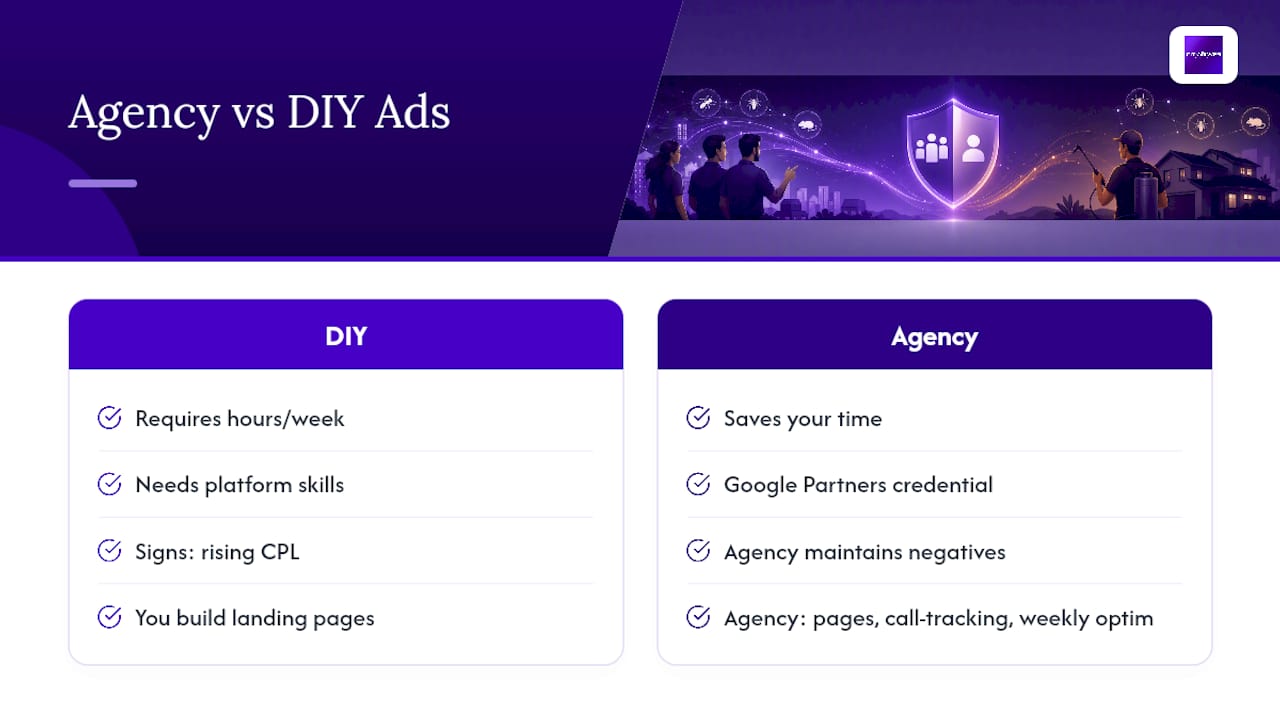
Running your own Google Ads account makes sense if you have a few hours a week to dedicate to it and a budget large enough to tolerate a learning curve without it sinking your business. If you’re managing technicians, answering phones, and running dispatch yourself, finding that time consistently gets hard fast.
Signs it’s time to bring in help: your cost per lead keeps climbing despite tweaks, you haven’t touched your negative keyword list in months, or you simply don’t have anyone checking the account weekly. A Google Partners credential is one signal worth checking when evaluating a paid-search partner, since it reflects a baseline of platform certification and account management experience.
A solid agency engagement for pest control typically includes landing page builds specific to your top services, weekly bid and keyword optimizations, ongoing negative keyword maintenance, full call-tracking integration tied to your CRM, and a reporting cadence you can actually understand without a marketing degree.
Pricing models vary. Flat monthly management fees are common and predictable. Percentage-of-spend models scale with your budget but can feel misaligned once your spend gets large. A fair benchmark for either model includes transparent reporting on exactly what you’re paying in media spend versus management fees, with no hidden markup on the ad platform itself.
Connecting Google Ads Leads to Your CRM and Follow-Up Process
A lead that isn’t followed up on within minutes is a lead you probably paid for and lost anyway. Pest control customers calling from a Google Ads click are frequently comparing three or four companies in the same afternoon, and the first one to answer often wins the job.
Route every call and form submission directly into your CRM with the source tagged clearly: LSA, Search Emergency, Search Preventive, or whichever campaign generated it. That tagging is what lets you calculate real cost per booked job later, not just cost per lead.
Set up automated follow-up for anyone who fills out a form but doesn’t answer a callback right away: a text within five minutes, a second call attempt within the hour, and an email with your licensing information and a booking link if you still haven’t connected by end of day. For preventive plan leads specifically, a nurture sequence over one to two weeks converts a meaningful share of “just researching” visitors who weren’t ready to book the day they clicked.
The CRM data also feeds back into your ad account. Once you know which keywords and campaigns produce customers who actually pay for recurring service plans, not just one-off treatments, you can shift budget toward those higher lifetime value sources instead of optimizing purely for cheapest cost per lead.
Compliance Rules Pest Control Advertisers Need to Follow
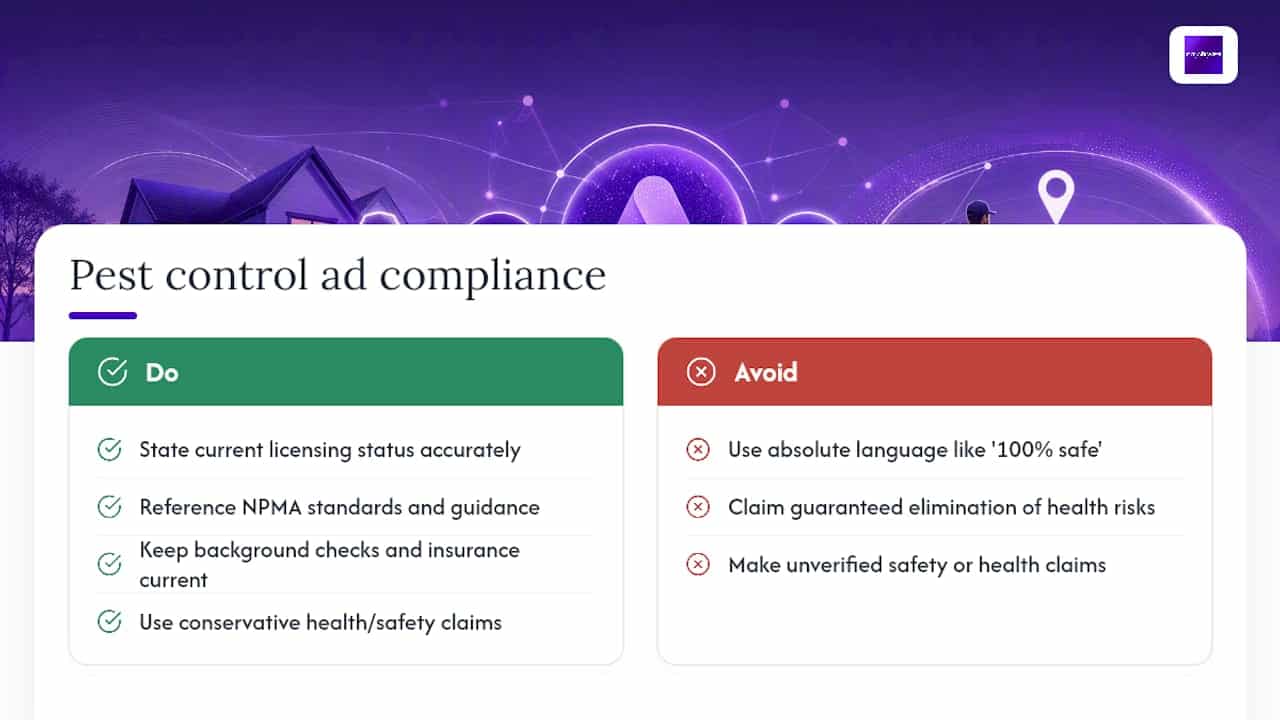
Pest control ads fall under scrutiny that generic home service ads don’t face, largely because the industry involves chemical treatments and public health claims. Google’s advertising policies restrict certain pesticide-related claims, and ads that imply guaranteed elimination of health risks or make unverified safety claims risk disapproval or account review.
State licensing matters here too. Most states require pest control operators to hold a specific license, and referencing licensing status in ad copy or on landing pages should reflect your actual current status, not a general claim of being “certified” without specifics. The NPMA is a useful reference point for understanding industry standards around licensing, safety communication, and consumer trust signals that regulators and customers both look for.
Avoid absolute language in ad copy: words like “guaranteed elimination,” “100% safe,” or “kills all pests instantly” invite both policy trouble and customer disappointment when reality doesn’t match the promise. Google Guarantee eligibility for Local Services Ads also requires passing a background check and insurance verification, so keep that documentation current if you want to maintain that badge, since lapses can pull your listing without much warning.
Stay conservative with health and safety claims specifically. A treatment that reduces pest activity is a defensible claim. A treatment that eliminates all health risk from a pest infestation is not, and policy reviewers tend to flag that kind of language quickly.

City Web Company’s Perspective on Running These Campaigns
The pest control accounts that perform best share one trait: someone is actually paying attention to them every week, not just at setup. Structure alone doesn’t keep a campaign profitable. Ongoing pruning of search terms, adjusting bids as seasonality shifts, and catching a landing page that’s quietly underperforming, that’s where the real cost-per-lead gains happen.
City Web Company measures the first 90 days by a specific milestone: enough conversion volume to trust the data, then a clear read on cost per booked job by campaign. That’s the number that matters, not clicks or impressions.
Owners chasing the cheapest cost per click often end up with the most expensive cost per job, because cheap clicks rarely come from the searchers ready to book same day.
— Matt
How City Web Company Can Help You Launch or Fix a Pest Control Campaign
Google Ads for pest control companies can be managed as a hands-on alternative to managing it alone between service calls and staffing headaches. If you’ve read this far and realized your account needs a landing page rebuild, a cleaner negative keyword list, or call tracking that actually ties back to booked jobs, that’s exactly the gap City Web Company closes.

A quick-start engagement typically covers Google Ads account setup or audit, service-specific landing page builds, local profile optimization to support local presence, and call-tracking integration so every lead source is measurable from day one. Effective management includes frequent optimization rather than leaving campaigns on autopilot, and reporting that focuses on cost per booked job instead of only vanity metrics. For a fuller picture of how these pieces fit together for pest control specifically, City Web Company’s pest control marketing services walk through the approach in more detail.
If you’d rather have someone else own the weekly grind of bid adjustments, negative list maintenance, and landing page testing, get started with City Web Company and find out what a properly structured account could generate for your business.
Sources
The figures and recommendations in this guide draw on Google’s own advertiser documentation along with industry benchmarking sources focused specifically on pest control paid search. For conversion tracking setup, Google Ads Help documents the exact steps for configuring call, form, and offline conversion actions. For testing bid strategies and ad variations once you have volume, Google Ads Experiments explains the controlled testing tools available inside the platform.
For cost benchmarking specific to this industry, Sprout Sage Solutions’ breakdown of pest control ad costs and Adwave’s comparison of pest control advertising channels both informed the budget ranges and CPC figures used throughout. PCT Online’s reporting on common Google Ads mistakes shaped the mistakes and quick-fixes section. For industry credibility standards and licensing context, the National Pest Management Association remains a solid reference point.
- Pest Control Advertising: 7 Channels Compared (2026)
- Google Ads for Pest Control Cost: est. $50–$150 Per Lead
- Google Ads Mistakes That Cost PCOs Thousands
- Ads experiments — Google Ads
- Set up conversion tracking — Google Ads Help
FAQ
What Is the Best Advertising Channel for Pest Control Services?
Local Services Ads combined with a well-structured Search campaign typically outperforms other channels for pest control, because both target people actively searching for help right now rather than passively scrolling.
Is $500 a Month Enough for Google Ads?
It’s enough to start testing in a small market, but it’s tight almost anywhere with real competition, especially given that termite and bed bug keywords alone can run $25 to $60 or more per click.
Is $20 a Day Good for Google Ads?
Twenty dollars a day works out to about $600 a month, which sits at the low end of a workable budget for a small market and is unlikely to produce consistent volume in a competitive metro area.
Do Google Ads Work for Contractors and Home Service Businesses?
Yes, particularly for service categories with urgent search intent like pest control, plumbing, and HVAC repair, where a large share of local searchers convert to a visit or call within 24 hours.
How Long Before I Know if My Campaign Is Working?
Give a new campaign 30 days before making major changes, and plan on 60 to 90 days before you have enough conversion data to judge true cost per booked job with confidence.
Recommended
These articles were popular with other readers too: