
Pass Google Business verification with a video-first checklist. Film one continuous 30 second take, fix flagged issues, and know when to hire help.
Winning at Google Ads Is Not About Clicks, It’s About What Happens Next
If your Google Ads campaigns are failing, it is almost certainly not because of your keywords or ad copy. The real problem, the one that quietly drains your budget, is the jarring disconnect between the promise your ad makes and the experience your landing page delivers. This is the gap where ad spend evaporates.
Table of Contents
The Real Reason Your Google Ads Budget Is Evaporating
Many business owners treat Google Ads like a vending machine. You put money in, a click comes out, and you hope a lead follows. When that does not happen, the first instinct is to blame the ad itself. You have likely watched your budget drain away with little to show for it but confusing analytics reports.
This begins a frustrating cycle. You tweak ad copy, adjust bids, and may even pause campaigns altogether, convinced that Google Ads does not work for your business. The ad, however, is rarely the problem.
The issue is almost always what happens after the click. A potential customer, searching for exactly what you offer, clicks your ad and lands on a page that is confusing, generic, or unrelated to their search. This is the hidden flaw in most paid ad strategies.
The Broken Pathway to Conversion
That broken pathway is the primary cause of wasted ad spend. You are paying for every single one of those clicks. When the page they land on does not meet their expectations, they leave immediately. That click you just paid for is now a sunk cost with zero return.
The core problem is a fundamental mismatch between what a user expects after they click your ad and what they actually find on your website. This disconnect is more than a minor inconvenience; it is a direct drain on your revenue.
I see this scenario play out constantly with local service businesses. A homeowner searches for "emergency plumber near me," clicks an ad promising 24/7 service, and is sent to a generic homepage with no clear phone number or contact form. They are not going to hunt for information. They just hit the back button and click on your competitor’s ad instead.
Beyond Clicks to Actual Revenue
High click-through rates are a vanity metric if they do not lead to booked jobs. That disconnect between your ad and landing page is directly harming your campaign’s profitability. Of course, keeping spending in check is crucial, and a great place to start is understanding Google Ads pricing to see where your money is going.
This reframes the entire challenge. Optimizing your landing pages for Google Ads is not a technical chore you can ignore. It is the single most important action you can take to turn expensive traffic into profitable customers.
It is here, at the intersection of the ad's promise and the landing page's delivery, that campaigns are won or lost. Focusing on this connection is the first step toward building a system that does not just generate clicks, but consistently produces qualified leads and real growth for your business.
Matching Your Landing Page To Your Customer's Search Intent
Effective strategy begins by understanding your customer's mindset the moment they type into Google. Someone searching for 'emergency AC repair near me' is in a completely different state of mind than someone browsing 'best bathroom remodel ideas'. One needs help now. The other is gathering information.
Your landing page must be a direct, immediate answer to their specific search. Not a generic, catch-all page from your main website. This is where most campaigns bleed money. They drive high-intent, urgent traffic to a page built for casual browsers, creating a frustrating experience that guarantees a lost lead.
The entire goal is to create a seamless transition from their search to your solution. For a local service business, that means thinking in terms of two things: urgency and information.
Aligning Your Page With Searcher Psychology
High-urgency searches demand a page built for speed and immediate action. Put yourself in the shoes of a homeowner with a burst pipe. Their click on an ad for a "24/7 plumber" should land them on a page where a click-to-call button is the first and most obvious thing they see. Below it should be a simple form with just two fields to request service.
Conversely, a research-focused search like "kitchen renovation costs" requires a different approach. This user is not ready to hire anyone. Sending them to a "Get a Free Quote Now!" page is premature and will likely cause them to leave.
A smarter approach is to provide what they are looking for: information. A page that offers a detailed project gallery, a downloadable cost guide, or a video of client testimonials will build trust and capture their information for future follow-up.
This comes down to the Rule of One: one clear message, for one specific audience, with one primary goal. When this is wrong, it becomes expensive. Misalignment between your ad and your landing page harms your Quality Score, which directly increases your ad costs and reduces your visibility.
This flowchart shows how quickly ad spend is wasted when a page does not match the click's intent.
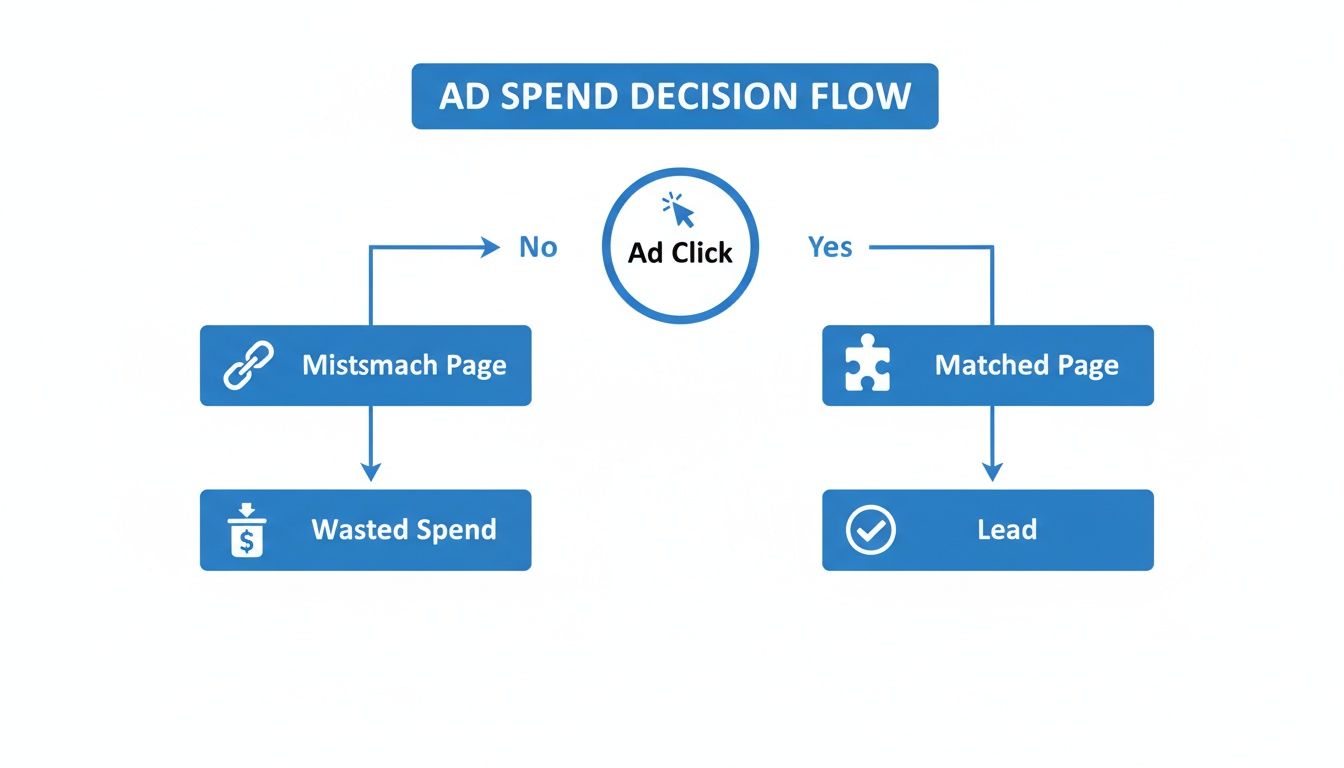
As you can see, every ad click presents a choice. A mismatched page leads directly to wasted ad spend. A perfectly matched page leads to a conversion. Your page's relevance is the deciding factor.
The Financial Impact of Relevance
Getting this connection right has a significant financial impact. The data tells a clear story. On average, Google Ads generate a 200% return on investment, an ROI powered by landing pages that convert around 4.6% of clicks across industries. You can see the full research on Google Ads benchmarks from Strataigize to understand why a seamless user journey is non-negotiable for a positive return on ad spend.
When your ad and landing page speak the same language, you are not just selling a service. You are providing an immediate solution and building trust from the very first click.
This shift in perspective is what separates campaigns that burn cash from those that build businesses.
Stop thinking of your landing page as just another page on your website. It is a purpose-built, focused answer to a specific customer’s problem. Getting this right is the first and most critical step toward building a profitable ad account.
Anatomy Of A High-Converting Local Service Landing Page
Many business owners invest in slick web design, believing a "professional" look is what generates leads. The reality is that a high-converting landing page for a Google Ads campaign is about one thing: getting a qualified lead, fast. It is a tool, not a work of art.
The point is to turn that expensive ad click into a paying customer. There is a simple, repeatable blueprint for this, built on clarity and a frictionless path to action. This is what separates pages that generate leads from those that just burn your budget.

The Critical "Above The Fold" Elements
Everything a visitor sees without scrolling is "above the fold." On a mobile phone, where most local searches happen, that is not much space. You have about three seconds to prove they are in the right place.
Your page must instantly answer three questions for them:
- What do you do? (e.g., Emergency Plumbing)
- Where do you do it? (e.g., Serving the Dallas-Fort Worth Area)
- How do I contact you? (A large, tappable phone number and a simple form)
A headline like "HVAC Services" is a waste of space. A benefit-focused headline like "Your Comfort Restored Today" connects directly with their problem. Pair that with a "Same-Day Service Guarantee" and a click-to-call phone number, and you have captured their attention.
Building Trust And Reducing Friction
Once you have passed the initial three-second test, the rest of the page is about building trust and making it incredibly easy for them to take the next step. Forget generic stock photos and vague promises. Your visitors are intelligent and can spot a fake.
A landing page is not a brochure for your business. It is a purpose-built tool designed to solve a specific problem for a specific visitor who arrived from a specific ad.
The best trust signals are tangible and local. It is all about providing concrete proof that you are a real, reliable expert in their area.
The most effective trust-building elements are simple but powerful:
- Local Testimonials: Real quotes or short video clips from happy customers in the neighborhoods you serve.
- Industry Certifications: Logos from the BBB, HomeAdvisor, or relevant trade groups that show you are a vetted professional.
- Real Project Photos: A before-and-after gallery of recent jobs you completed in their town.
- Faces of Your Company: A picture of your actual team, not smiling models in hard hats.
Each element has a job: reduce their risk and build their confidence in choosing you. A roofer showing a portfolio of new roofs in the visitor’s own zip code is infinitely more persuasive than a generic list of services. This is a deliberate path that guides the user from the promise in your ad, through the proof, and straight to your contact form.
Optimizing Your Forms and Calls to Action for More Leads
The single most important real estate on your landing page is the call to action and the form that follows. This is the final step, where a potential customer decides to either become a qualified lead or abandon your page.
This is where your entire investment in landing pages google ads pays for itself or goes to waste.
Too many businesses use passive, generic button text like "Submit" or "Send." This language feels like a chore. For a customer with an urgent problem, your call to action needs to be a solution, not a task.
Making the Final Step Effortless
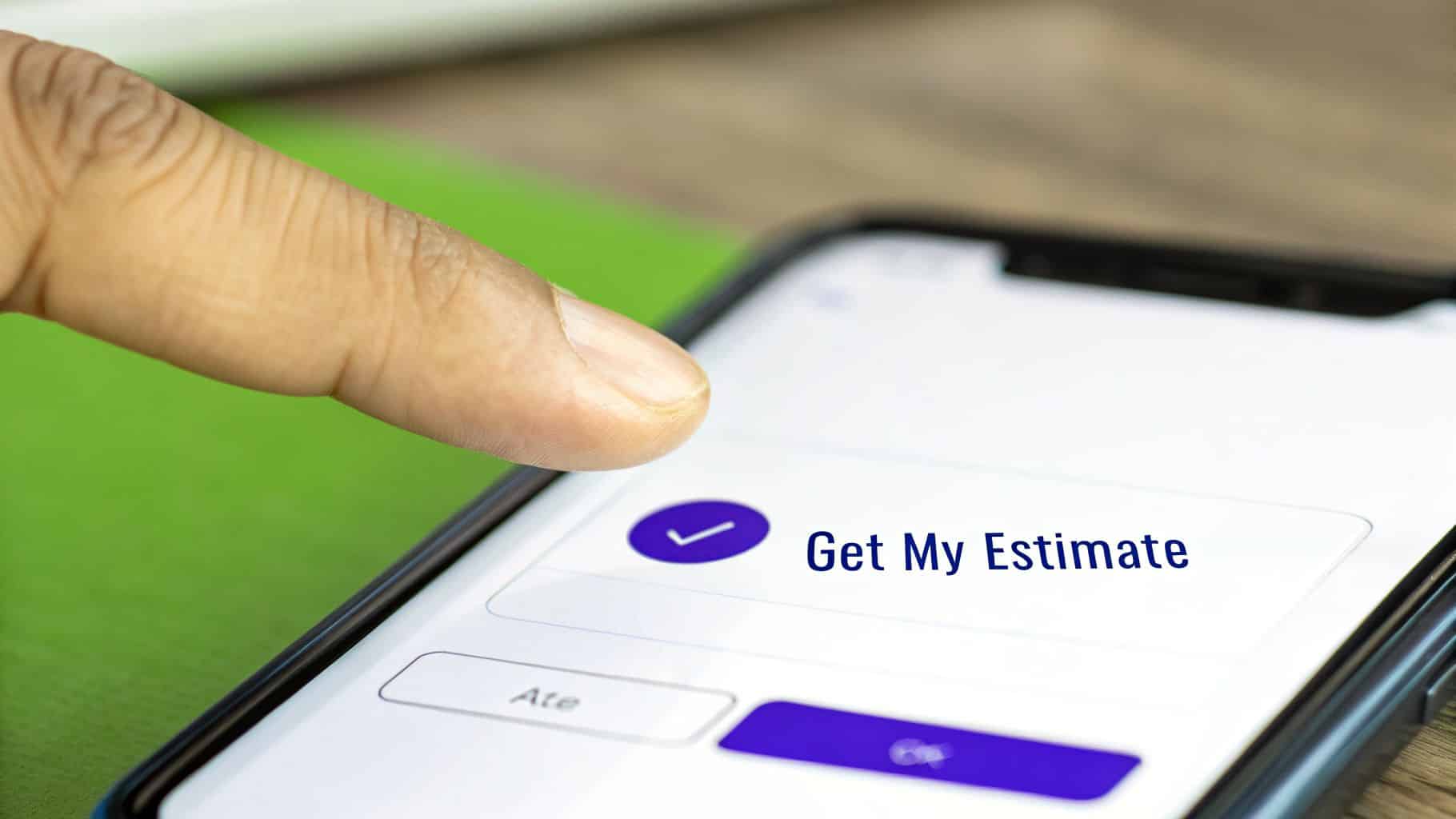
Using action-oriented language is essential. If you are a roofer, a button that says "Get My Free Roofing Estimate" is specific, valuable, and directly answers what the user came for. It feels like a gain for them, not a demand from you.
The same logic applies to your lead capture form. The number of fields you ask for is directly tied to your conversion rate. The more you ask, the fewer leads you will get. A long, intimidating form is a major point of friction, especially for someone on a mobile device needing immediate help.
Balancing Information With Conversion
For a local service business, you need just enough information to qualify and contact the lead. Nothing more.
Here is what is essential:
- Name: Necessary for a personal follow-up.
- Phone Number: Critical for urgent service requests.
- Email Address: Useful for sending estimates and non-urgent communication.
- Zip Code: Helps you instantly confirm they are in your service area.
Anything beyond this, like asking for a detailed project description right away, just creates hesitation. If you need more detail, a multi-step form is a better strategy. The first step captures only the core contact info. Subsequent steps can then gather more detail once the user is already committed.
Your goal is not to gather every piece of data upfront. It is to make starting the conversation so easy that the visitor does not think twice. The initial contact is the win.
Data from service industries confirms this. Google Ads landing pages in this sector see an average conversion rate of 6.5%. While many pages struggle with high bounce rates, simply using a single, clear call to action can boost conversions to 13.5%. This proves that simplifying that final click is one of the most powerful moves you can make. You can discover more insights about Google Ads conversion rates that highlight this very point.
Finally, make your CTA button impossible to miss, especially on mobile. A "sticky" click-to-call button that stays fixed at the bottom of the screen as a user scrolls ensures help is always just a tap away. This is how you turn a simple page into a lead generation machine.
Measuring Performance To Drive Continuous Growth
Getting your dedicated landing page live is a major first step, but it is not the last one. A common mistake business owners make is treating their landing page as a "set it and forget it" project.
Real growth comes from constantly measuring and refining its performance with real-world data.
You cannot improve what you do not measure. Without clear tracking, you are making budget decisions based on feelings instead of facts. Tools like the Google Ads Conversion Tag and Google Analytics Goals move you from guesswork to data-driven profit.
Stop Guessing, Start Tracking
Setting up conversion tracking is less technical than it sounds. It means placing a small bit of code on your "thank you" page, the page a user sees after they fill out your form or click your call button.
This tag is a game-changer. It tells Google which specific ads, keywords, and landing page variations are actually generating leads, not just worthless clicks.
Once it is active, you gain immediate clarity. You can see with certainty which headline is driving phone calls and which ad group is bringing in form fills. This data is the foundation of profitable advertising. It lets you stop wasting money on what is not working and double down on what is.
The Power of A/B Testing
With tracking in place, you can begin the real work: continuous improvement through A/B testing. This is a simple process of testing one version of your page against another to see which one converts more visitors into customers.
Optimization is not a one-time task; it is an ongoing process of refinement. Every small test provides an insight that compounds over time, steadily increasing your return on ad spend.
For example, an electrical contractor could test two different headlines for their Google Ads traffic:
- Version A: "Licensed & Insured Electricians" (This focuses on building trust)
- Version B: "Same-Day Electrical Service Available" (This focuses on speed and urgency)
By sending traffic to both pages, you let customer actions tell you what they really value. You might discover that your audience values speed far more than credentials, an insight that could reshape your entire marketing message.
The data shows a massive opportunity here. While landing pages driven by Google Ads see average conversion rates around 9.7%, a shocking 17% of marketers A/B test them. This is a mistake, especially when personalized CTAs can outperform standard ones by an incredible 202%. You can explore more statistics about landing page optimization to see just how critical this process is.
This data-first approach removes the guesswork. It empowers you to make strategic decisions that directly increase your lead volume while lowering your cost per acquisition. This is the clarity a true partner provides, turning your ad spend from an expense into a predictable engine for growth.
Frequently Asked Questions About Google Ads Landing Pages
Even with a sound strategy, a few questions often arise when building landing pages for Google Ads. We hear these from business owners, so here are direct answers.
How Long Does My Landing Page Need To Be?
There is no magic number. Your landing page needs to be exactly long enough to convince a visitor to act, and not one word longer.
For an urgent need, like a plumber responding to a burst pipe, keep it short. A clear phone number and a simple form are all that is needed. For a high-consideration service like a full kitchen remodel, a longer page is necessary to build trust with project galleries, testimonials, and a detailed process breakdown.
Why Are My Google Ads Disapproved For "Malicious Content"?
This is a common and frustrating problem. It often happens when your landing page is on a shared platform, like a free plan from HubSpot or Wix.
If another user on that same shared server gets flagged for suspicious activity, Google can blacklist the entire domain, taking your perfectly clean page down with it. The only surefire fix is to host your landing page on your own custom domain (e.g., yourbusiness.com/offer). This isolates you from others' mistakes and gives you full control.
How Much Should I Spend On Google Ads To See Results?
This is the wrong question to ask. The answer depends on your industry, your city, and your competition. Instead of focusing on a daily budget, you need to focus on your Cost Per Acquisition (CPA).
Determine what a new customer is worth to your business. Once you know that number, you can work backward to determine what you can afford to pay for a single qualified lead.
The real measure of success is not what you spend each day; it is whether you are profitable. Beyond just watching clicks, it is critical to know how to calculate Return on Ad Spend (ROAS) to ensure every dollar you invest is making you money.
Should I Send Ad Traffic To My Homepage?
Almost never. Sending targeted ad traffic to a generic homepage is one of the fastest ways to burn through your ad budget.
Your homepage is built for everyone: existing customers, potential employees, and casual browsers. It is a general directory. A landing page is a specialized tool built for one specific audience with one specific goal: conversion. A mismatch between your ad and your page causes confusion, and confused visitors always leave.
Getting these details right is what separates a frustrating ad campaign from a predictable engine for growth. If you are tired of guesswork and ready to implement a data-driven strategy for your landing pages, the team at City Web Company has the expertise to bring you clarity.
These articles were popular with other readers too: