
Unlock the power of social media advertising for healthcare. Discover how to attract the right patients and build trust in your marketing campaigns.
Demystifying Search Engine Algorithms: Boost Local Leads
TL;DR:
- Search engine ranking for local businesses depends on a three-stage process: crawling, indexing, and ranking. Focus on technical health, local signals, and credibility elements like E-E-A-T to improve visibility. Personalization and timely reviews also significantly influence local search results.
You run a tight operation, your reviews are solid, and your crew shows up on time every single time. Yet somehow, a competitor down the street keeps appearing above you on Google. It feels unfair, and honestly, it is a little maddening. The real issue usually has nothing to do with service quality. It has everything to do with how search engines “see” and sort websites. Search engines use sophisticated, multi-stage processes to decide who earns the top spots, and most local service business owners have never been shown how that process actually works. This guide breaks down the algorithm pipeline in plain language, explains which signals matter most, and gives you a clear roadmap to turn that knowledge into more calls, more bookings, and more revenue.
Table of Contents
Table of Contents
- How search engines work: The three-stage algorithm pipeline
- Ranking signals decoded: What really influences your search position
- Why E-E-A-T and YMYL matter for local businesses
- Personalization, ranking cascades, and local search: What small businesses must know
- What most algorithm explanations miss: Intent, speed, and simple wins
- How to turn algorithm know-how into more local leads
- Frequently asked questions
Key Takeaways
| Point | Details |
|---|---|
| Search is multi-stage | Understanding crawling, indexing, and ranking empowers smarter optimization for local businesses. |
| E-E-A-T builds trust | Author bios, client testimonials, and visible expertise boost both rankings and customer confidence. |
| Local and personalized results | Location, device, and business listings influence who sees your service in search. |
| Bing and Google differ | Target intent and authority for Google, but use exact-match and social posting for Bing to maximize reach. |
| Focus on applied action | Consistent updates, reviews, and business profile optimizations yield measurable leads and visibility improvements. |
How search engines work: The three-stage algorithm pipeline
Most business owners think getting their website “listed” online means they will start showing up on page one. That is one of the most common and costly misconceptions in local marketing. Getting indexed is just the starting line, not the finish line. To understand why, you need to know how search engines actually process your site.
Search engine algorithms follow a three-stage process: crawling (discovering pages via links), indexing (storing and analyzing content), and ranking (evaluating relevance and quality to order results). Every major search engine, including Google and Bing, runs on this same core pipeline. The tools and models powering each stage have grown dramatically more sophisticated, but the three stages themselves have not changed.
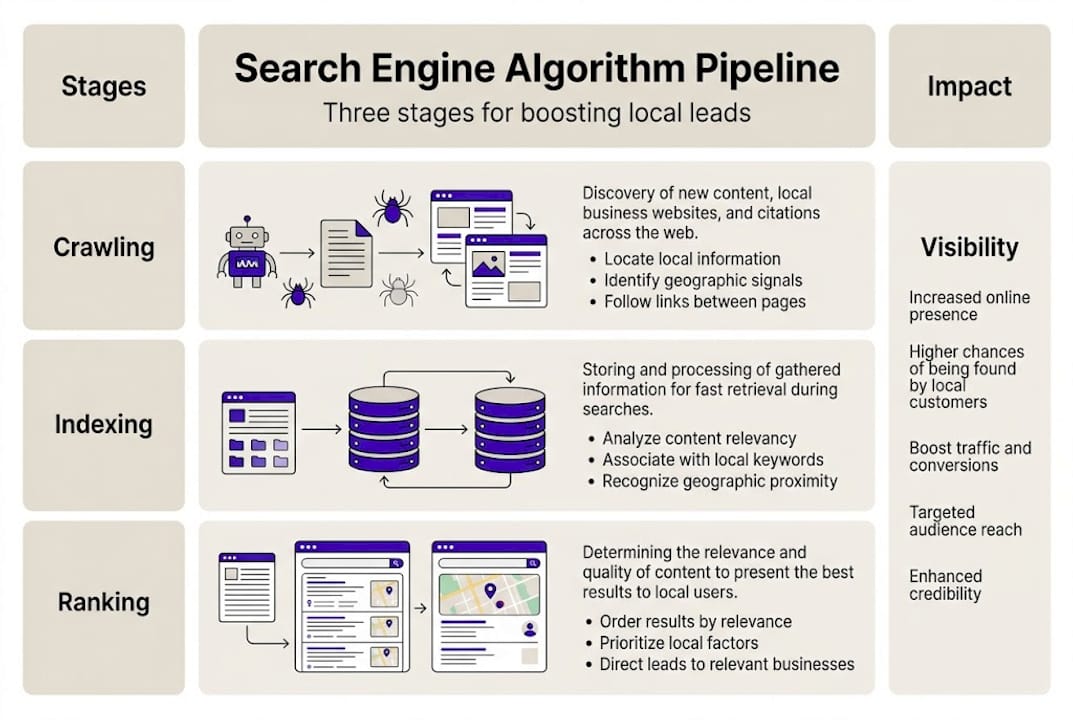
| Stage | What happens | Local business impact |
|---|---|---|
| Crawling | Search engine bots follow links to find your pages | Poor site structure or broken links block discovery |
| Indexing | Content is stored, analyzed, and categorized | Thin or duplicate content leads to weak indexing |
| Ranking | Pages are scored and ordered for each query | Missing local signals push you below competitors |
Here is a simple way to think about it. Crawling is like a mail carrier walking your neighborhood looking for addresses. Indexing is when the post office records every address and what kind of mail goes there. Ranking is when the post office decides whose mail gets delivered first based on urgency and relevance. If your “address” is hard to find or your “mail” is unclear, you get deprioritized every time.
Understanding how Google’s official search overview describes this process helps clarify why technical site health matters as much as great content. You can have the best service descriptions in your city, but if crawlers cannot reach your pages, none of that content will ever rank.
Here is what commonly blocks each stage for local service businesses:
- Crawling blockers: Slow page load times, broken internal links, no XML sitemap, pages blocked by robots.txt accidentally
- Indexing blockers: Duplicate content across service pages, thin pages with fewer than 300 words, no structured data markup
- Ranking blockers: Missing local keywords, no Google Business Profile, few or no inbound links from local sources, poor mobile experience
Practicing local SEO best practices from the start saves you from fixing foundational problems later. Most local service sites we audit have at least two of these blockers active at the same time, which compounds the visibility problem significantly. Fix the pipeline first, then focus on signals.
With the groundwork set, let’s go deeper into what signals the algorithms use, especially those every business owner can control.
Ranking signals decoded: What really influences your search position
Google uses over 100 signals including relevance (keyword matching and intent via NLP models like BERT and MUM), E-E-A-T (Experience, Expertise, Authoritativeness, Trustworthiness), PageRank (link quality and quantity), Core Web Vitals (user experience), and content helpfulness. That sounds overwhelming, but the good news is you do not need to master all 100. You need to focus on the signals that move the needle for local service businesses.


| Signal type | Google priority | Bing priority |
|---|---|---|
| Keyword relevance | Semantic intent via NLP | Exact-match keywords |
| E-E-A-T | Very high, especially for YMYL | Moderate |
| Backlink quality | High (PageRank model) | Moderate |
| Social signals | Low direct impact | Higher direct impact |
| Core Web Vitals | Confirmed ranking factor | Less emphasized |
| Local signals | Google Business Profile critical | Bing Places important |
The contrast between Google and Bing is worth understanding. Google wants to know what the user means, not just what they typed. Bing still rewards exact-match keyword usage more directly. For a plumber in Phoenix, this means your Google pages should answer questions naturally and demonstrate expertise, while your Bing-facing content can lean into specific phrases like “emergency plumber Phoenix AZ.”
Core Web Vitals measure how fast your pages load, how stable the layout is, and how quickly the page responds to user input. These are SEO benchmarks that directly affect whether Google considers your site a good experience. A slow site is a silent lead killer.
Here are five actionable improvements that move the needle for local service visibility:
- Add location-specific service pages (one page per city or neighborhood you serve)
- Earn backlinks from local directories, chambers of commerce, and industry associations
- Improve page speed by compressing images and enabling browser caching
- Write content that answers real customer questions, not just keyword-stuffed descriptions
- Keep your NAP (Name, Address, Phone) consistent across every online listing
Building search optimization for local leads around these five pillars gives you a measurable foundation. Pair that with a solid Local SEO for services strategy and you are addressing both the technical and content sides of the algorithm.
Pro Tip: For Google, demonstrate authority and helpfulness through detailed service pages and customer testimonials. For Bing, target exact keywords in your page titles and meta descriptions. Both engines reward consistency, but they reward different things first.
Now that you know the signals, the next step is to understand which signals count most for local service businesses, especially when critical advice is involved.
Why E-E-A-T and YMYL matter for local businesses
E-E-A-T stands for Experience, Expertise, Authoritativeness, and Trustworthiness. YMYL stands for “Your Money or Your Life.” These two frameworks shape how Google evaluates content quality, and they apply directly to many local service businesses, more than most owners realize.
YMYL topics like health, finance, and services require higher E-E-A-T standards because they impact users’ well-being. Local service businesses may qualify if they advise on critical decisions. Think about it this way: a homeowner searching for a mold remediation company or an electrical repair service is making a decision that affects their family’s safety. Google treats those searches with extra scrutiny.
Which service businesses fall into YMYL territory? More than you might expect:
- Home services: HVAC, electrical, plumbing, mold remediation, disaster restoration
- Health adjacent: Med spas, pest control (chemical exposure concerns), water damage cleanup
- Financial impact: Moving companies, roofing contractors, any service with major cost implications
If your business falls into any of these categories, Google’s quality raters are evaluating your site against higher trust standards. That means a generic, thin website with no author information and no visible credentials will struggle to rank, even if your technical SEO is solid.
Here is how to build the credibility signals Google is looking for:
- Add an “About Us” page with real owner photos and professional background
- Include staff bios or technician credentials on service pages
- Display licenses, certifications, and insurance information prominently
- Collect and showcase detailed customer testimonials (not just star ratings)
- Use schema markup to help search engines identify your business entity
- Link to your business from trusted local sources like the Better Business Bureau
The E-E-A-T documentation from Google makes clear that trust is built through transparency, not tricks. Implementing service-based SEO strategies that incorporate these credibility elements gives your site a structural advantage over competitors who skip them.
Pro Tip: Use original customer data, before-and-after project photos, and a visible owner profile to meet E-E-A-T standards. These signals are hard to fake and easy for Google’s quality systems to recognize as genuine.
A well-executed ranking guide for service businesses will always include E-E-A-T as a core pillar, not an afterthought. Businesses that treat trust-building as a marketing strategy rather than a compliance checkbox tend to see the biggest long-term ranking gains.
Building trust is only half the battle. Now let’s see how search engines personalize results for your local customers and what ranking cascades mean for small business visibility.
Personalization, ranking cascades, and local search: What small businesses must know
Search engines do not show everyone the same results. The page a homeowner in Austin sees when they search “AC repair near me” is different from what someone in Denver sees for the same query. That is personalization at work, and it is powered by a layered system called a ranking cascade.
Ranking uses multi-stage cascades: sparse retrieval (BM25), dense neural (RankBrain-like models), GBDT pre-rank, and neural re-rank, all personalized by location and device. Think of it like a tournament. Thousands of pages enter the first round, and only the most relevant advance through each stage until a final ranked list emerges for that specific user at that specific moment.
Personalization factors that shape local results include:
- Device type: Mobile searches trigger different layouts and often favor businesses with fast mobile sites
- User location: GPS and IP data mean your service area boundaries matter enormously
- Search history: Repeat searchers may see results influenced by their past clicks and behavior
- Google Business Profile completeness: A fully optimized profile is a primary local ranking signal
- Review recency and volume: Fresh reviews signal an active, trustworthy business to the algorithm
“Bing CTR directly affects ranking faster than Google; Google relies more on intent and E-E-A-T.” This distinction matters for how quickly you can expect to see results from your optimization efforts.
For Google, the multi-stage ranking evidence shows that intent alignment and authority signals take time to build. For Bing, a spike in click-through rate from a well-crafted title and description can move your ranking within weeks. Both are worth pursuing, but with different timelines in mind.
The practical implications for your business are straightforward. Claim and fully complete your Google Business Profile with accurate service area tags, business hours, and photo updates. Make sure your website loads in under three seconds on mobile. Respond to every review, positive or negative, because that activity signals to the algorithm that your business is engaged and current.
Using local SEO tips specifically designed for service businesses helps you align with these personalization signals systematically. Pair that with service area SEO strategies to make sure your coverage areas are clearly communicated to both search engines and potential customers.
With all these moving parts, what does it look like in practice for a local service business? Let’s connect the algorithm details to real customer acquisition.
What most algorithm explanations miss: Intent, speed, and simple wins
Here is something most SEO guides will not tell you: obsessing over every individual ranking signal is usually a distraction. The businesses we see win consistently in local search are not the ones tracking 100 metrics. They are the ones who understand what their customers are actually trying to accomplish and then make it ridiculously easy to find that answer.
Google prioritizes semantic intent and E-E-A-T over exact keywords, while Bing favors exact-match and social signals, and both evolve with machine learning. That evolution means the algorithm is getting better at detecting genuine helpfulness versus keyword manipulation. Businesses that create content for real customers rather than for bots are the ones who hold their rankings through algorithm updates.
Speed of adaptation matters more than perfection. Local service businesses that add new service pages when they expand, update their Google Business Profile after every project, and consistently collect reviews tend to outperform larger competitors who set their SEO once and forget it. The local SEO benefits compound over time when you treat your online presence as a living asset rather than a one-time project.
Bing is underrated as a feedback tool. Because Bing’s ranking responds to click-through rate changes faster than Google, testing new page titles and descriptions on Bing can give you early signals about what messaging resonates before you see the same effect on Google.
Pro Tip: Every quarter, audit what your top three local competitors rank for and compare it to what your actual customers search. The gap between those two lists is your content opportunity.
How to turn algorithm know-how into more local leads
Understanding the algorithm is powerful, but applying it consistently while running a service business is a different challenge entirely. Most business owners simply do not have the bandwidth to monitor ranking cascades, update service area pages, and manage review responses on top of everything else.
That is exactly where City Web Company steps in. Our team specializes in translating algorithm knowledge into real ranking results for local service businesses. From building out your expert ranking guide strategy to managing your local SEO services end to end, we handle the technical and creative work so you can focus on your customers. We also offer specialized Google Business Profile optimization to make sure your most visible local asset is working as hard as possible. If you are ready to stop guessing and start growing, let’s talk.
Frequently asked questions
How does Google decide which local business to show first?
Google ranks local businesses using over 100 signals including relevance, distance, E-E-A-T, reviews, and content quality. The business that best satisfies all of those signals for a specific user query earns the top position.
What’s the fastest way for a service business to improve search rankings?
Optimize your Google Business Profile, gather credible reviews, and update your website with clear service information and genuinely helpful content. Google’s guidance consistently points to E-E-A-T signals like author bios, case studies, and client testimonials as high-impact credibility builders.
Is it necessary to optimize for Bing as well as Google?
Yes. Bing delivers diversified leads and responds to CTR changes faster than Google, making it a useful testing ground and a real source of additional traffic from a different user demographic.
What is YMYL and why should I care as a local service provider?
YMYL (Your Money or Your Life) applies to businesses whose services impact critical decisions, and Google holds those sites to higher trust and content standards. If you offer home, health-adjacent, or high-cost services, your site needs stronger credibility signals to compete.
Recommended
- Search Optimization: Growing Leads for Local Service Businesses
- Local SEO for Service Businesses: Boosting Leads Fast
- What Is Service-Based SEO? 78% Local Leads Boost in 2026
- Local Search Engine Optimization: A Step-by-Step Guide to Get Found – City Web Company | Digital Marketing Agency
- SEOContentGenerator | Easygarage · L’outil préféré des loueurs
These articles were popular with other readers too: