

Pass Google Business verification with a video-first checklist. Film one continuous 30 second take, fix flagged issues, and know when to hire help.
Content optimization guide: boost local visibility fast
Your HVAC company does great work, your reviews are solid, and your technicians show up on time. But when a homeowner three miles away searches “AC repair near me,” a larger company with a mediocre reputation keeps getting the call. That scenario plays out every day for thousands of local service businesses across the country, and the root cause is almost always the same: weak content strategy. You do not need a massive marketing budget to fix this. What you need is a clear, repeatable process for content optimization that makes Google and your future customers recognize you as the obvious local choice.
Table of Contents
Table of Contents
- What you need to get started with content optimization
- Step-by-step: Building your local content foundation
- On-page essentials: Optimizing titles, meta tags, and schema
- Consistency, publishing strategy, and growth signals
- How to assess, measure, and improve your content results
- What most local businesses get wrong about content optimization
- Grow your business with expert content optimization support
- Frequently asked questions
Key Takeaways
| Point | Details |
|---|---|
| Go beyond generic pages | Creating unique, locally relevant pages dramatically boosts both search rankings and customer trust. |
| Optimize every detail | Titles, meta descriptions, and schema must focus on local intent to get found and clicked. |
| Consistency is key | Regularly publishing fresh content signals authority and builds lasting local engagement. |
| Measure for true results | Using the right tools helps verify what drives calls and leads so you can double down on what works. |
What you need to get started with content optimization
Now that we understand the value of content optimization, let’s go over exactly what you need before getting started.
The single most important requirement is a genuine willingness to update your existing website pages and commit to adding new content on a regular basis. No tool or trick replaces that. If your site has not been touched in two years, search engines treat it like a store with the lights off. Consistent, relevant updates send a signal that your business is active, trustworthy, and worth recommending to searchers.
Before you write a single word, gather these core assets:
Essential assets to collect:
- A complete list of every service you offer, written out in plain language your customers actually use
- Geographic details for each service area, including specific neighborhoods, zip codes, and any local landmarks that residents recognize
- At least five to ten customer testimonials, ideally tied to specific locations and service outcomes
- Current, high-quality photos of your team, your work, and your service vehicles with your branding visible
- Any before-and-after images, project case studies, or certifications relevant to your trade
Must-have tools to set up:
- Access to your website’s content management system (CMS), whether that is WordPress, Wix, Squarespace, or a custom platform
- A claimed and fully filled-out Google Business Profile (GBP)
- Google Search Console and Google Analytics, both connected to your site
As the Content Marketing for Local SEO Guide explains, you should create dedicated location-specific landing pages with unique content highlighting in-demand services, neighborhoods, landmarks, testimonials, and case studies from that area, rather than relying on generic “areas served” pages. Generic pages simply do not convert.
Here is a quick comparison of how preparedness affects your starting point:
| Asset | Why it matters | Where to use it |
|---|---|---|
| Location-specific testimonials | Builds neighborhood trust instantly | Landing pages, GBP posts |
| High-quality photos | Improves time-on-page and credibility | Service and location pages |
| Service descriptions | Fuels keyword-rich, useful content | Every page |
| GBP access | Enables local search visibility | GBP posts and Q&A |
| Analytics access | Reveals what is and is not working | Ongoing strategy |
Building location-specific landing pages from the start is far more effective than retrofitting a generic site later. And if you are unsure whether your current site layout supports conversions, take a look at what a high-converting local website actually includes.
Pro Tip: Ask your happiest customers to mention the neighborhood or city in their review. “They fixed our furnace in Riverside Heights in less than two hours” is worth ten times more than a generic five-star rating.
Step-by-step: Building your local content foundation
With your resources gathered, here are the exact steps to put your content optimization into action for local results.
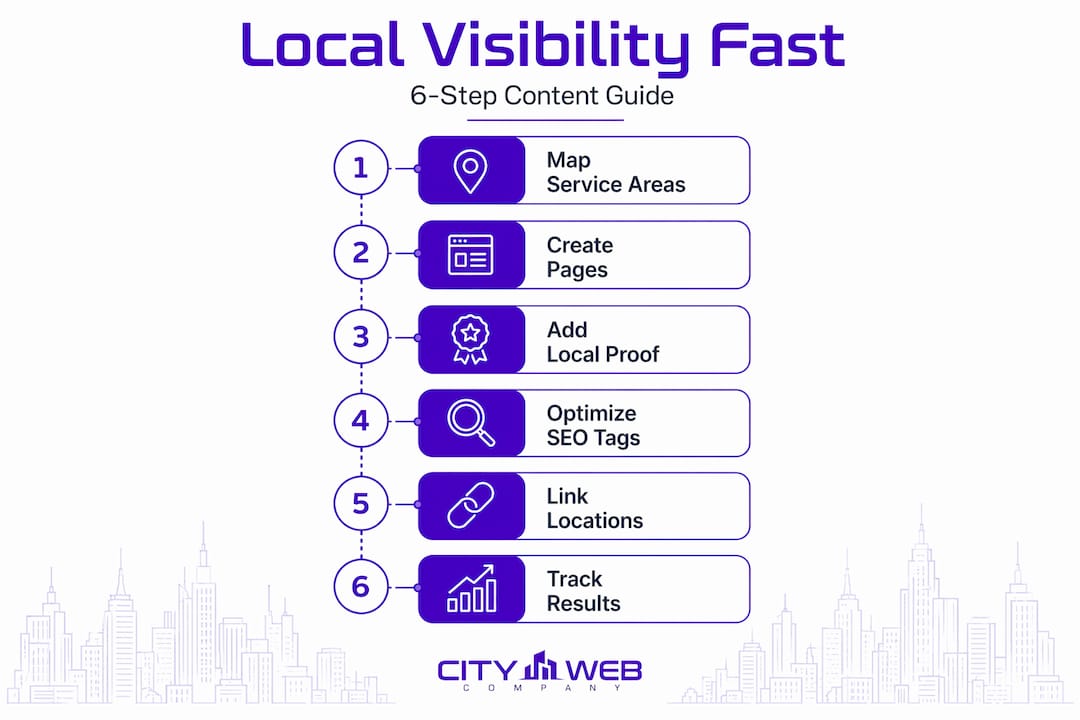
Step 1: Map your service areas in detail.
List every city, suburb, and neighborhood where you actively serve customers. Do not just name the town. Go deeper: what are the common problems residents there face? Do older neighborhoods have aging plumbing? Do newer developments have specific HVAC brands you regularly service? Those specifics are gold.
Step 2: Assign a dedicated page to each major service area.
Each location deserves its own page, not a paragraph buried on a generic contact page. A roofing company serving five towns should have five unique location pages, each written as if the author lived there and knew the community.
Step 3: Write page content that reflects actual local knowledge.
Mention the neighborhoods you have worked in, reference local landmarks near a recent project, and cite the specific services customers in that area call about most. This is not fluff. It signals geographic relevance to both search engines and the humans reading the page.

Step 4: Add social proof tied to each location.
A testimonial from a customer in Elmwood Park placed on your Elmwood Park service page is dramatically more persuasive than a generic review shown site-wide. Specificity drives trust.
Step 5: Connect pages to your GBP.
Link your location pages in your Google Business Profile description and posts. This cross-connection strengthens relevance signals and makes it easier for Google to understand your service geography. Connect your Google Business Profile directly to your strongest pages to reinforce that geographic authority.
Step 6: Internally link between location pages and service pages.
A page about mold remediation in your main city should link to your suburb pages and vice versa. This creates a web of relevance that search engines reward.
Here is how a generic “areas served” page compares to a properly built local landing page, and why the difference matters so much:
| Feature | Generic areas served page | Custom local landing page |
|---|---|---|
| Content | City name and maybe a paragraph | 500+ words with local specifics |
| Testimonials | None or generic | Location-matched customer reviews |
| Photos | Stock images | Real project photos from that area |
| Keywords | Minimal, vague | Service + city + neighborhood terms |
| Conversion rate | Very low | Significantly higher |
| Search ranking potential | Weak | Strong |
The gap between these two approaches is not minor. Building unique local pages is one of the highest-return activities a local service business can invest time into.
Pro Tip: Use the name of a well-known local park, school, or street intersection on your location pages. Residents recognize those references immediately, which builds an instant sense of familiarity and trust.
Thin, copied content across location pages is one of the fastest ways to destroy both your search rankings and your credibility with potential customers. Google can recognize near-duplicate pages, and visitors can tell when a page was written about nowhere in particular. Do not let a shortcut cost you the lead.
On-page essentials: Optimizing titles, meta tags, and schema
With pages laid out, let’s dig into the technical content tweaks that make your business stand out in search results.
On-page optimization refers to the specific text signals embedded in your page code that tell search engines exactly what the page is about and who it serves. These are not optional extras. They are the foundation.
Title tags are the clickable blue text that appears in search results. They are one of the strongest signals you send to Google. According to proven on-page SEO mechanics, your title tag should include your target service and location, and stay under 60 characters to avoid being cut off in search results. A good example: “Furnace Repair in Naperville | Fast Local HVAC.” That is clear, local, and action-oriented.
Meta descriptions appear below the title in search results. They do not directly affect rankings, but they dramatically affect whether someone clicks. Keep them between 150 and 160 characters, include your location, name the service, and end with a call to action. “Need fast furnace repair in Naperville? Our licensed HVAC team is available today. Call for a free estimate.” That kind of copy converts browsers into callers. If you want to write better meta descriptions that actually earn clicks, the specifics matter more than most business owners realize.
H1 tags are the main visible headline on each page. It should address the specific problem a customer in that area is trying to solve, not just announce your company name. “Affordable Water Heater Repair for Naperville Homeowners” is far more compelling than “Our Plumbing Services.”
Schema markup is structured data added to your page code. It tells search engines things that plain text cannot always communicate clearly. For local service businesses, three types matter most:
- LocalBusiness schema: Communicates your business name, address, phone number, and hours in a format Google can read and display directly in search
- Service schema: Identifies the specific services you offer so they can appear as rich results in searches
- Review schema: Allows your star ratings to appear visually in search listings, which dramatically increases click-through rates
A strong digital marketing strategy connects these on-page elements into a cohesive system rather than treating each one as a separate task.
Pro Tip: Create a simple template document with placeholders for title tag, meta description, H1, and schema fields. Fill it in before you write the page content. Consistent formatting across twenty pages saves hours and prevents the kind of small errors that quietly hurt your rankings.

Consistency, publishing strategy, and growth signals
Now that the technicals are dialed in, sustain growth by keeping your content and local presence fresh and credible.
Publishing content once and walking away is one of the most common mistakes local service businesses make. A single round of location pages is a strong foundation, but search engines reward ongoing activity. Fresh content tells Google that your site is alive, your business is operating, and new information is worth indexing.
Consistent publishing of 2-4 posts per month is the minimum to build topical authority, with weekly updates being ideal for competitive markets. Integrating your website blog with your Google Business Profile posts multiplies the freshness signals you send.
Here is a practical sequence for creating that synergy:
- Choose a topic tied to a specific service or location. “What to do when your pipes freeze in Old Town” is better than “Winter plumbing tips.”
- Write the full blog post on your website. Aim for at least 600-800 words with location-specific details, real advice, and a clear call to action.
- Create a GBP post summarizing the article. Include a link back to the full post on your website. This drives traffic and signals content freshness to Google.
- Share the GBP post link with one or two satisfied customers. Ask if it resonates. Their engagement (clicking, viewing photos) contributes to your local presence signals.
- Add the topic to your editorial calendar. Track what you published, when, and what results it generated over 60 to 90 days.
For ongoing content ideas, the two most effective formats for local service businesses are case studies and FAQ pages. A case study about a mold remediation job in a specific neighborhood, complete with photos and the customer’s outcome, is deeply persuasive and highly searchable. An FAQ page answering the questions your customers actually ask (“How long does a water heater installation take?” or “Do you offer same-day service in Brookfield?”) targets long-tail search queries that most competitors ignore.
Explore more publishing tips and apply them to your Google Business Profile optimization for the strongest combined effect.
Pro Tip: Set a recurring calendar reminder every two weeks labeled “Content check.” Use it to publish or update one piece of content and one GBP post. That single habit, maintained consistently, will outperform most competitors who publish in bursts and then go quiet for months.
How to assess, measure, and improve your content results
Finally, let’s make sure your efforts are actually moving the needle and refine your approach for even better results.
Publishing content without measuring results is like running a job site without tracking whether the work is done. You need concrete data to know what is earning leads and what needs to be reworked.
The three primary tools for local content measurement are Google Analytics, Google Search Console, and your Google Business Profile insights. Each answers different questions. Analytics tells you what visitors do on your site. Search Console tells you what searches bring them there. GBP insights tell you how customers find and interact with your profile.
Here are the key content KPIs (key performance indicators) to track monthly:
| KPI | What it measures | Where to find it |
|---|---|---|
| Page views per location page | Traffic volume by area | Google Analytics |
| Click-through rate (CTR) | How often searchers click your listing | Google Search Console |
| Calls from page | Direct conversions via phone | GBP Insights / Call tracking |
| Form submissions | Lead volume from page | Google Analytics / CRM |
| GBP interactions | Profile views, clicks, directions | GBP Insights |
| Avg. time on page | Engagement quality | Google Analytics |
A strong CTR with low time-on-page suggests your title and meta description are compelling, but the page itself is not delivering. High page views with zero form submissions suggest a conversion issue: maybe the call to action is buried or the page lacks trust signals. These data points give you specific problems to solve, not just general underperformance to worry about.
Use these questions to guide on-page improvements during your review:
- Does the page include the city or neighborhood name in the title, H1, and at least once in the first paragraph?
- Is there a real testimonial from a customer in that area?
- Does the page have a visible, specific call to action above the fold?
- Are there local photos, not stock images?
- Does the page answer the top three questions a customer in this area would have?
- Is the page linked from your GBP and from related pages on your website?
When you identify a page that performs well, do not just celebrate. Study it. What does it have that the underperformers lack? Then replicate those elements across your weakest pages. Your best content is a template, not a lucky accident.
What most local businesses get wrong about content optimization
Most local service companies approach content with a “more is better” mindset. They add a blog, fill it with short generic articles stuffed with keywords, and wait for the phone to ring. It does not work, and after a few months, they conclude that content marketing is a waste of time. That conclusion is wrong. The strategy was the problem, not the channel.
The businesses that consistently win in local search share a different approach. They focus on making every page unmistakably local. Not just adding a city name to a generic template, but writing content that reflects genuine knowledge of the community. When a homeowner in a specific suburb reads your service page and sees a reference to a road they drive every day or a neighborhood challenge that directly applies to their house, trust forms almost instantly. That is the kind of content that generates calls.
Duplicate content across location pages is one of the most damaging mistakes we see. If you serve eight cities and your eight location pages are nearly identical except for the city name, Google treats them as low-quality and will not rank any of them well. Worse, visitors who land on those pages can sense the copy-paste approach and immediately question your local expertise.
The fix is not necessarily longer pages. It is more specific pages. A conversion-focused website structure treats each location as a unique audience with unique concerns, not just a variable to swap into a template.
The other mistake we see constantly is ignoring visual authenticity. Photos of your actual team, your actual trucks, and your actual work in recognizable local settings outperform any stock photo library. Customers are sophisticated enough to tell the difference, and when they see real photos, the credibility gap between you and a larger competitor closes fast.
Here is the hard truth: the extra hour it takes to write a genuinely local, people-centered page is the best investment you can make in your digital presence. One excellent, specific, authentic page will consistently outperform ten generic ones. Invest in quality, tie every piece of content to a real person in a real neighborhood, and let that authenticity be your competitive edge.
Grow your business with expert content optimization support
If you’re ready to move faster and further with your content, here’s how City Web Company can help.
Building a content optimization strategy from scratch takes time, and the details matter enormously. City Web Company works specifically with local service businesses to build and manage content strategies that generate real leads, not just traffic.
Whether you are trying to understand the difference between local SEO vs. traditional SEO or need a complete search engine ranking guide built around your specific trade, our team brings deep experience with the industries you operate in. From HVAC companies to disaster restoration firms, we know what local customers search for and how to make sure your business appears when they do. If you are curious about how digital marketing explained through a local lens looks in practice, reach out for a free consultation and let’s talk through what is actually holding your visibility back.
Frequently asked questions
What makes content optimization critical for local service businesses?
It helps your business appear where local customers are actively searching and builds trust through relevant, specific information that generic competitors cannot replicate. Location-specific pages with real testimonials and neighborhood detail consistently outperform broad, generic content.
How many new articles or posts should a service business publish per month?
Aim for at least 2-4 new pieces of content monthly, with weekly updates being ideal for staying competitive in high-demand local markets and building topical authority over time.
What should every local landing page include?
Each page needs unique service descriptions, references to local neighborhoods, area-specific testimonials, and real photos from that community. Dedicated location pages with those elements convert far better than any generic template.
What are the ideal length limits for title tags and meta descriptions?
Keep title tags under 60 characters and meta descriptions between 150 and 160 characters to ensure your listings display correctly and completely in search results.
Recommended
These articles were popular with other readers too: