

Use website DNI, connect call reports to Google Ads and your Google Business Profile, then tie calls to booked jobs. City Web Company can handle setup.
Why Optimize for Local Search: A Guide for Local Businesses
Local search optimization is the deliberate effort to improve your online presence so your business appears prominently when nearby customers search for what you offer. The top 3 Google Local Pack results capture 44% of all clicks for local-intent searches. That single statistic explains why ranking in those top spots is the most direct path to qualified foot traffic and phone calls. Google ranks local businesses on three core factors: relevance, distance, and prominence. Businesses that understand and act on all three consistently outperform those that ignore even one. This guide explains why optimize for local search is the right question to ask, and gives you a clear path to act on the answer.
Table of Contents
What are the benefits of optimizing for local search?
Local search optimization delivers advantages that paid advertising simply cannot replicate over time. The benefits are concrete, measurable, and compound the longer you invest in them.
Visibility where buyers are already looking
When someone searches “plumber near me” or “HVAC repair in [city],” they are ready to hire. Local SEO targets high-intent users within a service radius typically ranging from 5 to 25 miles, filtering out people who would never realistically become your customers. That filtering effect means every visitor who finds you through local search is already a qualified lead.
Appearing in the Google Local Pack, Google Maps, and the top organic results gives your business three separate chances to capture that click. Businesses that show up in all three positions dominate their local market in a way that no single paid ad can match.
Higher ROI than paid advertising
Local SEO consistently delivers 2–5x higher ROI than paid ads by generating sustainable, qualified leads at a lower cost per acquisition. Paid ads stop the moment your budget runs out. Local SEO rankings, once earned, keep sending traffic without a recurring spend attached to each click.

This cost advantage compounds over time. A business that builds strong local rankings in year one continues to benefit in year two and three, while a business relying entirely on paid ads resets its visibility every billing cycle.
Real-world foot traffic and conversions
The benefits of local search extend well beyond the screen. Customers who find a business through local search convert at significantly higher rates than those who arrive through generic organic traffic, because their search intent is tied to a specific location and an immediate need.
- Increased visibility in Google Maps and the Local Pack drives direction requests and calls.
- Higher conversion rates result from reaching customers at the exact moment of purchase intent.
- Foot traffic increases directly when your business appears for “near me” searches.
- Unqualified traffic decreases because local SEO filters by geography automatically.
- Long-term compounding growth means rankings built today keep delivering next year.
Pro Tip: Track Google Business Profile insights monthly. Direction requests and phone calls from your profile are direct indicators of how well your local presence converts searchers into customers.
How does Google determine local search rankings?
Google uses three ranking factors for local search: relevance, distance, and prominence. Understanding each one tells you exactly where to focus your effort.
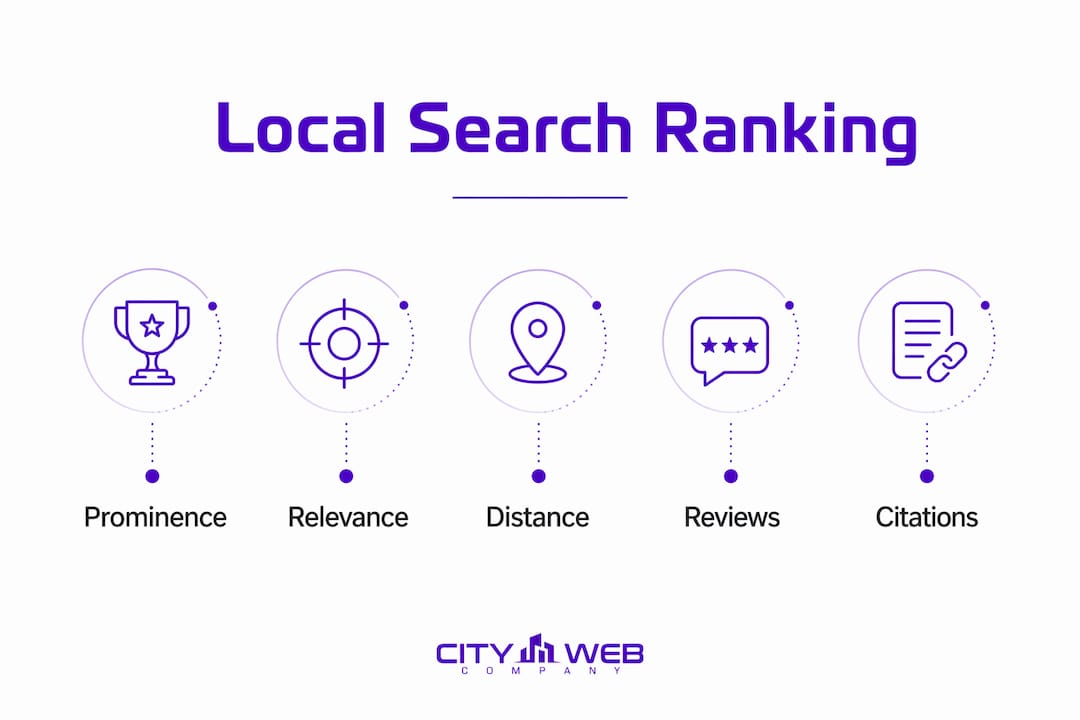

Relevance measures how well your business matches what the searcher is looking for. A roofing company that lists itself accurately as a roofing contractor, not a general contractor, will rank for roofing searches and skip irrelevant ones. Accurate Google Business Profile categories are the primary lever for relevance.
Distance measures how close your business is to the searcher or the location they specified. You cannot move your physical location, but you can make sure Google knows exactly where you are through consistent address data across every directory.
Prominence measures how well-known and trusted your business is online. Review volume, review quality, local backlinks, and branded search volume all feed into prominence. This is the factor where sustained effort pays off most visibly.
Why Google Business Profile accuracy matters
Businesses with fully optimized Google Business Profiles, accurate categories, and consistent citations rank higher and appear in the Local Pack more often. An incomplete profile signals to Google that the business may not be active or trustworthy. A complete profile with photos, hours, services, and a precise primary category signals the opposite.
Review signals carry significant weight. Businesses with 50+ reviews and 4.0+ star ratings dominate local search results. That threshold is not arbitrary. It reflects the volume of social proof Google needs to confidently rank a business above competitors with fewer or lower-quality reviews.
The growing role of AI in local search
AI-powered local packs appear on roughly 22% of tracked queries, and AI overviews appear on 57–80% of local searches. That shift elevates the importance of structured data, schema markup, and conversational content. Businesses that only optimize for traditional keyword placement will lose ground to those that also structure their content for AI-generated answers.
Local backlinks from community organizations, local media outlets, and partner businesses significantly improve local SEO authority. These links tell Google that your business is recognized and trusted within its geographic community, which directly boosts prominence.
Pro Tip: Add LocalBusiness schema markup to your website’s homepage and contact page. This structured data helps AI-powered search features pull accurate information about your business directly from your site.
What practical steps should local business owners take?
Knowing why local search matters is only half the equation. The steps below translate that knowledge into ranking improvements.
-
Claim and complete your Google Business Profile. Select a narrow, accurate primary category. Selecting a narrow and accurate primary category prevents unqualified leads and boosts ranking for relevant searches. Add secondary categories only where they genuinely apply. Fill in every available field: hours, services, photos, and a keyword-rich business description.
-
Build consistent NAP citations. NAP stands for Name, Address, and Phone number. List your business on Google, Yelp, Bing Places, Apple Maps, and industry-specific directories. Every listing must use identical formatting for your business name, address, and phone number. Even small variations, like “St.” versus “Street,” create trust issues with Google’s algorithm.
-
Earn and manage Google reviews. Ask every satisfied customer for a review. Use a short, direct request: “Would you mind leaving us a Google review? It helps local customers find us.” Respond to every review, positive or negative, using location-specific language. Mentioning your city and service in responses adds a local relevance signal that many businesses overlook.
-
Create localized website content. Build dedicated location-specific pages for each city or neighborhood you serve. Each page should include the service name, city name, and relevant local details. Generic service pages with no geographic context rank poorly for local searches.
-
Earn local backlinks. Sponsor a local event, partner with a complementary business, or pitch a story to a local news outlet. Each link from a locally recognized website adds to your prominence score. Low-quality directory submissions do not carry the same weight and can dilute your link profile.
-
Use Google Posts regularly. Google Posts appear directly on your Business Profile and signal that your listing is active. Post about promotions, events, or seasonal services at least twice a month. An active profile ranks better than a stagnant one.
-
Increase Google Maps engagement. Google Maps direction requests and branded search volume are engagement signals that help distinguish top Local Pack rankings. Encourage customers to search for your business by name and request directions through Google Maps. These behavioral signals tell Google that real people are actively choosing your business.
-
Optimize for voice and AI search. Write FAQ content on your website using natural, conversational questions and answers. Add schema markup for your business type, services, and location. Voice searches tend to be longer and more question-based than typed searches, so content that mirrors how people speak performs better in voice results.
What common mistakes do local businesses make with local SEO?
Most local businesses make the same handful of errors. Each one is avoidable once you know what to look for.
“The biggest local SEO mistake is not a technical failure. It is inconsistency. Businesses that list their address one way on Google and a different way on Yelp send conflicting signals that erode trust with both Google and potential customers.”
Choosing the wrong Google Business Profile category
Selecting a broad or inaccurate primary category is one of the most common and costly errors. A pest control company that lists itself under “Home Services” instead of “Pest Control Service” will rank for far fewer relevant searches. The primary category is the single most influential field in your Google Business Profile. Get it wrong and every other optimization effort works against a flawed foundation.
Ignoring NAP consistency
Inconsistent or incorrect NAP information across directories negatively impacts credibility and local SEO rankings. Many businesses update their address or phone number on their website but forget to update every directory listing. A mismatch between your Google profile and your Yelp listing creates a trust gap that Google penalizes.
Neglecting reviews
Businesses that collect 10 reviews and then stop actively requesting more fall behind competitors who treat review generation as an ongoing process. Review recency matters as much as volume. A business with 100 reviews, all from three years ago, looks less active than one with 40 reviews from the past six months.
- Ignoring negative reviews signals poor customer service to both Google and prospective customers.
- Failing to respond to reviews misses a chance to add location and service keywords naturally.
- Asking for reviews only once, rather than building a repeatable process, leads to stagnation.
Skipping localized on-site content
A website with no city names, no neighborhood references, and no location-specific service pages gives Google nothing to match against local searches. Generic content ranks generically. Local content ranks locally. The importance of local SEO on your own website is just as significant as your off-site signals.
Relying on low-quality directories
Submitting your business to hundreds of low-authority directories in a single week does not build prominence. It creates citation noise. Focus on a smaller number of high-quality, relevant directories and keep them accurate. Quality always outweighs quantity in citation building.
Leaving your Google Business Profile inactive
A profile with no new photos, no posts, and no recent reviews looks abandoned. Google’s algorithm favors active profiles because they reflect businesses that are actually open and serving customers. Set a calendar reminder to update your profile at least twice a month.
Key Takeaways
Local search optimization is the highest-ROI investment a local business can make because it targets buyers who are already nearby, already searching, and already ready to act.
| Point | Details |
|---|---|
| Local Pack dominance | The top 3 Local Pack results capture 44% of clicks, making those positions the most valuable in local search. |
| Three ranking factors | Google ranks local businesses on relevance, distance, and prominence. All three require active management. |
| Reviews drive rankings | Businesses with 50+ reviews and a 4.0+ star rating consistently outrank competitors with fewer or lower-quality reviews. |
| NAP consistency is non-negotiable | Inconsistent Name, Address, and Phone data across directories erodes trust and lowers rankings. |
| Local SEO beats paid ads long-term | Local SEO delivers 2–5x higher ROI than paid advertising by generating sustainable leads without per-click costs. |
Why I think most local businesses are leaving their best leads on the table
After working with local service businesses across dozens of markets, the pattern is clear. Most owners understand that local search matters. Very few treat it as a system rather than a one-time task.
The businesses that win in local search are not the ones with the biggest budgets. They are the ones that show up consistently. They update their Google Business Profile every two weeks. They respond to every review within 24 hours. They build one or two good local backlinks per quarter instead of chasing hundreds of low-quality ones.
The rise of AI in local search has raised the stakes, but it has not changed the fundamentals. AI overviews on 57–80% of local searches pull from the same signals Google has always valued: accurate information, genuine reviews, and a website that clearly communicates what you do and where you do it.
The compounding effect is real and it is underappreciated. A business that builds its local presence steadily over 18 months does not just rank better. It becomes the default choice in its market. Customers recognize the name. They search for it directly. That branded search volume then feeds back into prominence, which improves rankings further.
The businesses I see struggle most are those that treat local SEO as a checkbox. They claim their Google profile, collect a few reviews, and then move on. Six months later, a competitor who stayed consistent has passed them in the rankings. Local search is not a project you finish. It is a practice you maintain.
— Matt
How City Web Company helps local businesses rank and grow
City Web Company specializes in local SEO services for small businesses that need real results, not just rankings reports. The team handles Google Business Profile optimization, citation management, review strategy, local link building, and localized website content, all built around the three factors Google uses to rank local businesses.
City Web Company has helped hundreds of local service businesses across the United States increase their visibility in the Local Pack and convert that visibility into leads. Whether you run an HVAC company, a landscaping business, or a med spa, the path to more local customers starts with a stronger local presence. Explore the digital marketing guide for local business growth to see how a full-service approach turns local search into your most reliable lead source.
FAQ
Why optimize for local search instead of just running ads?
Local SEO generates sustainable leads without a per-click cost, delivering 2–5x higher ROI than paid ads over time. Ads stop working the moment your budget runs out; local rankings keep driving traffic.
How long does it take to see results from local SEO?
Most local businesses see measurable ranking improvements within 3–6 months of consistent optimization. Competitive markets may take longer, but the compounding effect accelerates results over time.
What is the most important factor in local search rankings?
Google weighs relevance, distance, and prominence equally, but prominence is the factor most businesses underinvest in. Building reviews, local backlinks, and an active Google Business Profile drives prominence faster than any other tactic.
How do I improve my local SEO without a big budget?
Focus on the free fundamentals: complete your Google Business Profile, ask every customer for a review, and build one or two local backlinks per quarter through community partnerships or local media. These steps cost time, not money, and they deliver lasting results.
Does my website affect my local search rankings?
Yes. A website with localized content, accurate NAP data, and LocalBusiness schema markup sends strong on-site signals that support your Google Business Profile rankings. Businesses with no location-specific pages on their website consistently rank below those that have them.
Recommended
These articles were popular with other readers too: