

See how plumbers can turn Facebook scrollers into booked jobs with clear offers, local targeting, a 30 day test budget, fast follow up, and a path to scale.
Streaming TV Ads Explained for Small Business Owners
Streaming TV ads are full-screen video commercials delivered over the internet to connected devices like smart TVs, streaming sticks, and mobile apps, inserted dynamically and targeted to specific households. Amazon Advertising describes them as personalized, digital video ads that reach viewers wherever they stream content.
- Where they run: Smart TVs, Roku devices, Fire TV, gaming consoles, and streaming apps on platforms like Prime Video, Hulu, and Pluto TV
- How they are targeted: By geography, demographics, household behavior, and deterministic device IDs, not just broad age brackets like linear TV
- Why SMBs should care: Lower minimums and self-serve buying options have made this channel accessible to local businesses, not just national brands
Table of Contents
Table of Contents
- What Are Streaming TV Ads? Definitions and Key Terms
- How Streaming TV Ads Are Delivered
- Where Do Streaming TV Ads Appear?
- What Ad Formats and Creative Specs Do You Need?
- How Targeting, Measurement, and Attribution Work
- How to Buy Streaming TV Ads and What They Cost
- Pros and Cons of Streaming TV Ads for Advertisers
- Who Uses Streaming TV Ads? SMB Use Cases
- Step-by-Step Starter Plan to Run a Streaming TV Ad Test
- How City Web Company Runs Streaming TV Campaigns for Local Businesses
- Key Takeaways
- Why Streaming TV Is Worth Testing Before You Are Ready
- City Web Company Handles Streaming TV Campaigns for Local Businesses
- Useful Sources
- FAQ
What Are Streaming TV Ads? Definitions and Key Terms
Streaming TV ads go by several names in the industry. Knowing the vocabulary helps you ask better questions when talking to a vendor or agency.
- CTV (Connected TV): Any television set connected to the internet, whether through a built-in smart TV platform or an external device like a Roku stick or Amazon Fire TV
- OTT (Over-the-Top): Content delivered over the internet, bypassing traditional cable or satellite; the delivery method that makes streaming TV ads possible
- AVOD (Ad-Supported Video on Demand): Streaming services that offer free or lower-cost content in exchange for showing ads, such as Peacock’s free tier or Tubi
- FAST (Free Ad-Supported Streaming TV): Linear-style channels delivered over the internet with ad breaks, like Pluto TV or The Roku Channel
- DSP (Demand-Side Platform): Software advertisers use to buy ad inventory programmatically across multiple publishers
- SSP (Supply-Side Platform): Software publishers use to sell their ad inventory to DSPs
- SSAI (Server-Side Ad Insertion): Ads stitched into the video stream on the server before delivery; viewers receive one seamless stream
- CSAI (Client-Side Ad Insertion): The viewer’s device fetches and plays the ad separately from the content
How streaming TV compares to other channels:
- Linear TV: Broad demographic targeting, fixed broadcast schedule, no household-level personalization, high minimum spend
- Streaming TV: Household and device targeting, on-demand and live inventory, programmatic buying, flexible budgets
- Online short-form video (YouTube, social): Skippable, often mobile-first, lower CPMs, shorter attention windows, less TV-like viewing context
How Streaming TV Ads Are Delivered
The mechanics behind streaming ad delivery matter because they affect playback quality, ad blocking, measurement accuracy, and what creative formats you can run.
SSAI vs. CSAI: the core difference
With Server-Side Ad Insertion, the ad is stitched into the video manifest on the server before it reaches the viewer’s device. The player receives one continuous stream, so the transition between content and ad is broadcast-quality with no buffering gap. Because the ad is part of the stream itself, client-side ad blockers cannot detect or strip it. Premium publishers like Prime Video and Hulu use SSAI for exactly this reason.
CSAI works differently. The device pauses the content, calls an ad server, fetches the ad, plays it, then resumes the content. That sequence introduces latency, potential quality mismatches between the ad and the content, and vulnerability to ad blockers. CSAI does, however, support richer interactive formats because the ad runs inside the app’s own player environment.
| Feature | SSAI | CSAI |
|---|---|---|
| Ad insertion point | Server, before delivery | Client device, at playback |
| Playback quality | Broadcast-quality, seamless | Can buffer; bitrate mismatch possible |
| Ad blocker resistance | High | Low |
| Interactive ad support | Limited | Strong |
| Best use case | Premium CTV, live sports, FAST channels | App-based interactive or shoppable ads |
| Measurement complexity | Requires server-side tracking | Standard client-side pixels work |
The programmatic ad-tech chain
When a viewer starts a show, a lot happens before the first ad plays. The auction and decisioning process completes in under 100 milliseconds. Here is the sequence:
- The publisher’s ad server detects an available ad slot
- The SSP sends a bid request to connected DSPs
- DSPs evaluate the impression against advertiser targeting criteria and submit bids
- The winning bid is returned to the SSP and ad server
- The ad creative is retrieved from a CDN (Content Delivery Network)
- SSAI stitches the ad into the stream (or CSAI calls it to the device)
- Measurement vendors fire impression and completion pixels
Pro Tip: Ask any vendor whether their inventory uses SSAI or CSAI before you commit budget. SSAI inventory tends to deliver cleaner impression counts and better completion rates, which matters more than a slightly lower CPM on CSAI placements.
Where Do Streaming TV Ads Appear?
Streaming TV ads reach viewers across a wide range of devices and content environments. Understanding the landscape helps you estimate reach and choose the right context for your message.
Device types:
- Smart TVs (Samsung, LG, Vizio with built-in streaming platforms)
- Streaming sticks and boxes (Amazon Fire TV, Roku, Apple TV, Chromecast)
- Gaming consoles (PlayStation, Xbox)
- Mobile phones and tablets running streaming apps
- Desktop browsers on streaming sites
Major publishers and platforms:
- Amazon Advertising / Prime Video: Reaches Prime subscribers with non-skippable ads in premium content; also includes Fire TV placements across third-party apps. Amazon’s SSAI implementation via AWS MediaTailor powers both live and VOD monetization at scale.
- Roku: The Roku Channel and third-party apps on the Roku platform; one of the largest CTV footprints in the U.S.
- Hulu: A major AVOD player with a large ad-supported subscriber base and strong targeting data
- Pluto TV: A leading FAST channel with linear-style programming and broad reach
- Twitch: Live streaming with display and video ad placements, particularly strong for gaming and younger audiences
Statista’s CTV advertising data tracks over 100 million CTV households in the United States, a reach figure that rivals broadcast television. For a local HVAC company or med spa, that scale means you can carve out a precise geographic slice of that audience rather than paying for the whole country.
Premium content contexts, like live sports or exclusive original series, typically deliver higher completion rates and stronger brand safety compared to run-of-network programmatic inventory. The tradeoff is cost: premium placements require a different buying strategy than open-auction buys.


What Ad Formats and Creative Specs Do You Need?
Streaming TV ads support several formats, and the one you choose affects both your creative requirements and your budget.
Common formats:
- Pre-roll: Plays before the content starts; high attention, often non-skippable on premium inventory
- Mid-roll: Inserted during the content, similar to a traditional TV commercial break; strong completion rates
- Post-roll: Plays after the content ends; lower attention but also lower CPM
- Bumper ads: Short, non-skippable spots (typically 6 seconds) used for brand recall
- Pause ads: Static or animated overlays that appear when a viewer pauses playback
- Companion and shoppable units: Interactive overlays or second-screen prompts that let viewers click through or add items to a cart
Creative checklist for a standard 15- or 30-second CTV spot:
- Video file: MP4 or MOV, H.264 codec
- Resolution: 1920×1080 (16:9 aspect ratio)
- File size: typically under 500MB per platform spec
- Audio: stereo, normalized to broadcast loudness standards (usually -24 LKFS)
- Closed captions: required on many platforms; viewers often watch with sound off
- Brand message in the first 5 seconds: TV-screen storytelling rewards a visual hook before the verbal pitch
Pro Tip: If you already have a 30-second TV spot or a well-produced social video, you can often repurpose it for CTV with minor edits. Add captions, check the audio levels, and confirm the aspect ratio. A clean existing asset beats a rushed new production.
How Targeting, Measurement, and Attribution Work
One of the strongest arguments for streaming TV over linear TV is the targeting precision. You are not buying a time slot and hoping the right people are watching.
Targeting options available to SMBs:
- Geography: ZIP code, DMA (Designated Market Area), city, or radius targeting
- Demographics: Age, gender, household income
- Behavioral and contextual: Purchase intent signals, content category, viewing history
- Household-level targeting: Matching device IDs to household profiles using deterministic data (verified logins) or probabilistic data (modeled from device signals)
- Retargeting: Reaching viewers who have visited your website or engaged with your brand on other channels
Deterministic targeting uses confirmed identity signals, like a logged-in Amazon or Hulu account, and is more accurate. Probabilistic targeting models identity from device and behavioral signals and covers a broader but less precise audience.
Key metrics and when to use them:
| Metric | What it means | When to use it |
|---|---|---|
| Impressions | Total number of times your ad was served | Reach planning and pacing |
| CPM (Cost Per Mille) | CPM | Comparing inventory cost efficiency |
| Completion rate | Percentage of viewers who watched the full ad | Creative quality and inventory quality check |
| Reach | Unique households or devices exposed | Brand awareness campaigns |
| Frequency | Average number of times a household saw your ad | Managing overexposure |
| View-through conversion | Action taken after seeing the ad, without clicking | Attribution for brand-awareness goals |

Pro Tip: For a first SMB test, set completion rate as your primary KPI, not conversions. A completion rate above 85% on non-skippable inventory tells you the creative is working and the targeting is on. Chase conversions in month two once you know the ad is actually being watched.
How to Buy Streaming TV Ads and What They Cost
Buying streaming TV ads is not as complicated as it sounds, but the path you choose affects your minimum spend, targeting options, and how much control you have.
Buying options:
- Programmatic open auction: Buy impressions in real time through a DSP; lowest minimums, broadest reach, variable quality
- Private marketplace (PMP): A curated deal between a publisher and a buyer, accessed programmatically; better inventory quality than open auction
- Direct buy: Negotiate directly with a publisher like Hulu or Roku for guaranteed placements; higher minimums, premium context
- Self-serve platforms: Tools like MNTN let advertisers set up and manage CTV campaigns without a managed service; accessible for SMBs with modest budgets
What does it cost? CPMs vary significantly by format, publisher, and targeting depth. Industry cost guides show that open-auction programmatic inventory can run at lower CPMs while premium placements, like live sports or branded series on major AVOD platforms, command higher CPMs. The spread is wide, so always ask vendors for CPM estimates specific to your targeting criteria.
SMB test budget checklist:
- Set a minimum test budget you can sustain for 4–6 weeks without cutting the campaign short
- Confirm your creative is production-ready before you spend a dollar on media
- Choose one geographic target (your primary service area) and one audience segment
- Select one buying path: self-serve programmatic or a managed platform like MNTN
- Agree on a reporting cadence before launch (weekly is standard for a pilot)
- Define success metrics upfront: completion rate, reach, and one downstream action (calls, site visits)
Before you buy, have these ready:
- Final video file in the correct spec for your chosen platform
- A landing page that matches the ad’s offer or message
- UTM parameters or pixel tracking set up on your website
- A clear geographic boundary for your campaign
Pros and Cons of Streaming TV Ads for Advertisers
Streaming TV advertising has real advantages over both linear TV and standard digital video, but it also comes with tradeoffs worth knowing before you commit budget.
Pros:
- Household-level targeting precision that linear TV cannot match
- Full-screen, non-skippable formats with high completion rates on premium inventory
- Flexible budgets and self-serve options that work for SMBs
- Benefits of CTV advertising include the ability to shift budgets from linear TV while keeping TV-quality creative impact
- Measurable impressions, reach, and frequency, unlike traditional broadcast buys
Cons:
- Audience fragmentation across dozens of publishers makes unified measurement harder
- Creative production costs can be significant if you do not have existing video assets
- Measurement and attribution are still maturing; view-through conversions are harder to tie to revenue than a Google Ads click
- Inventory quality varies widely; open-auction buys can include low-quality placements
- Frequency capping across platforms is imperfect, so viewers can see the same ad too many times
Pro Tip: Cap your frequency at 3–5 impressions per household per week on any single platform. Without a cap, you will burn budget on the same households and irritate the viewers you are trying to win over.
Who Uses Streaming TV Ads? SMB Use Cases
Streaming TV is not just for national brands. Local service businesses are finding real use for it, particularly for awareness campaigns in a defined geographic area.
Industry-specific scenarios:
- Home services (HVAC, plumbing, pest control): Run a 15-second pre-roll ad targeting homeowners in your service ZIP codes during spring or fall seasonal peaks. Goal: brand recall so they call you first when the AC breaks.
- Med spas and cosmetic clinics: Target women 30–55 in a 20-mile radius watching lifestyle and wellness content. Goal: drive appointment bookings for a new treatment launch.
- Legal (personal injury, family law): Run mid-roll ads on news and documentary content targeting adults 25–54 in your metro. Goal: top-of-mind awareness before a need arises.
- Restaurants and retail: Use FAST channel placements to reach local viewers with a time-sensitive offer. Goal: foot traffic during a slow period.
- Moving companies and disaster restoration: Target new movers or homeowners in specific ZIP codes. Goal: reach people at exactly the moment they need your service.
Streaming TV works best for brand awareness and consideration goals. If you need immediate, trackable leads at low cost per acquisition, paid search advertising is usually a faster path. Streaming TV and search work well together: streaming builds the brand awareness that makes your search ads more effective.
Step-by-Step Starter Plan to Run a Streaming TV Ad Test
A first campaign does not need to be complicated. Follow this sequence and you will have a valid test running within three to four weeks.
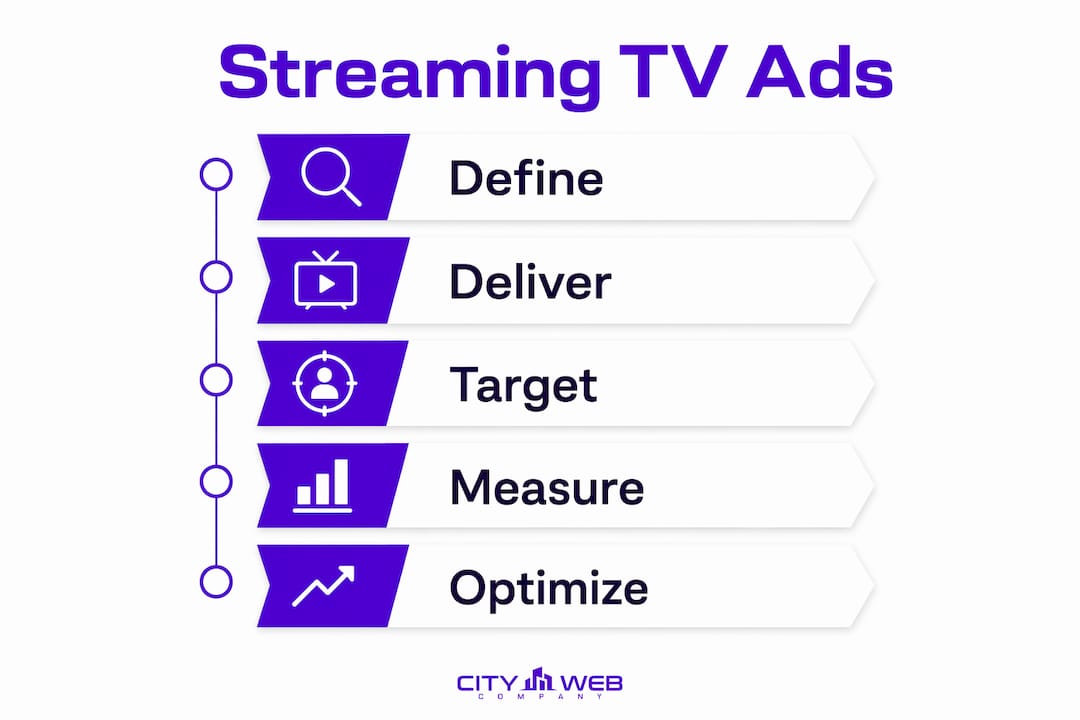
- Define your goal. Pick one: brand awareness (reach and frequency) or a measurable action (site visits, calls). Do not try to optimize for both in a pilot.
- Set your budget. Decide on a total spend you can commit for 4–6 weeks. Spreading too little over too long a period produces inconclusive data.
- Prepare your creative. A 15- or 30-second video in 1920×1080, with captions and a clear call to action in the first 5 seconds. If you have an existing spot, adapt it.
- Choose your targeting. Start with geography (your service area) plus one demographic or behavioral segment. Keep it simple.
- Select your buying path. Self-serve platforms like MNTN are a practical starting point for SMBs. Managed buys through an agency give you more support but require a higher minimum.
- Set up tracking. Install your pixel or configure UTM parameters before the campaign goes live. You cannot optimize what you cannot measure.
- Launch and set a reporting cadence. Review performance weekly. Check completion rate, reach, frequency, and any downstream actions.
- Run for at least 4 weeks. Shorter flights do not generate enough data to draw conclusions.
- Evaluate and iterate. After the test period, compare completion rate and downstream metrics against your baseline. Adjust targeting or creative before scaling.
Suggested timeline:
- Week 1: Goal setting, budget confirmation, creative prep
- Week 2: Platform setup, targeting configuration, tracking verification
- Week 3: Campaign launch, first weekly review
- Weeks 4–6: Active flight, weekly optimization
- Week 7: Post-campaign analysis and decision on next steps
Pro Tip: If you want to test two creatives, run them simultaneously with equal budget split and identical targeting. Do not change the targeting between the two; only the creative should differ. That is the only way to know which video is actually performing better.
How City Web Company Runs Streaming TV Campaigns for Local Businesses
City Web Company follows a structured workflow for every streaming TV campaign, from the first discovery call to post-campaign reporting. Here is what that looks like in practice.
Agency workflow:
- Discovery: Identify business goals, service area, target audience, and existing creative assets
- Creative review or production: Audit existing video assets for CTV specs; coordinate production if needed
- Targeting build: Configure geography, demographics, and behavioral segments in the DSP
- Trafficking: Upload creative, set frequency caps, configure tracking pixels and UTM parameters
- QA: Verify ad delivery, impression pacing, and tracking before full budget release
- Weekly reporting: Deliver performance summaries covering impressions, completion rate, reach, frequency, and downstream actions
- Optimization: Adjust targeting, creative rotation, or inventory mix based on weekly data
Sample campaign timeline and budget bands:
| Phase | Timeline | Sample Budget Band |
|---|---|---|
| Discovery and creative prep | Week 1–2 | Included in management fee |
| Campaign setup and trafficking | Week 2–3 | Included in management fee |
| Pilot flight (awareness test) | Weeks 3–8 | $1,500–$3,000 media spend |
| Analysis and optimization | Week 9 | Included in management fee |
| Scaled campaign (if pilot succeeds) | Month 3+ | $3,000+ media spend/month |
Questions to ask before hiring an agency for streaming TV:
- Do you use SSAI or CSAI inventory, and how do you verify impression quality?
- What DSPs or platforms do you use, and can I see the publisher list?
- How do you handle frequency capping across publishers?
- What does your reporting include, and how often will I receive it?
- What is the minimum media spend for a pilot, and what is included in the management fee?
City Web Company’s streaming TV advertising services are built specifically for local service businesses. You can also review client case studies to see how the agency has applied these campaigns for businesses in home services, healthcare, and other local verticals.
Key Takeaways
Streaming TV ads give local businesses TV-quality reach with digital targeting precision, and the barrier to entry is lower than most SMBs expect.
| Point | Details |
|---|---|
| Core definition | Streaming TV ads are full-screen video commercials delivered over the internet to connected devices, targeted at the household level. |
| SSAI vs. CSAI | SSAI delivers broadcast-quality, ad-blocker-resistant playback; CSAI supports richer interactivity but is more vulnerable to blocking. |
| SMB buying path | Self-serve platforms and programmatic open-auction buys offer the lowest minimums and are the practical starting point for local businesses. |
| First KPI to track | Completion rate above 85% on non-skippable inventory signals that creative and targeting are working before you optimize for conversions. |
| City Web Company | City Web Company manages streaming TV pilots for local service businesses, from creative review through weekly reporting and optimization. |
Why Streaming TV Is Worth Testing Before You Are Ready
Most local businesses wait too long to test streaming TV. They assume it is expensive, complicated, or only for brands with national budgets. That assumption is outdated.
The real barrier is not cost. Self-serve platforms and programmatic buying have brought minimums down to a range that a plumbing company or med spa can justify as a test. The actual barrier is creative. Most SMBs either do not have a video asset or assume the one they have is not good enough for TV. In practice, a clean 15-second spot with captions and a clear offer performs well on CTV, and if you already have a produced social video, you are closer than you think.
The other thing most guides understate is the pairing effect. Streaming TV builds brand awareness in your service area. When someone who saw your ad later searches for your service on Google, they are more likely to click your result because they recognize the name. That lift in branded search performance is real, even if it does not show up directly in your streaming TV attribution report. Running streaming TV alongside paid search is a more complete strategy than either channel alone.
Start with a 4–6 week pilot, a single geographic target, and one creative. Measure completion rate first. Scale what works.
City Web Company Handles Streaming TV Campaigns for Local Businesses
Local service businesses that want TV-quality reach without a broadcast budget have a practical option. City Web Company manages streaming TV advertising end to end for SMBs, from creative review and targeting setup through weekly reporting and campaign optimization.

The agency works with home services companies, med spas, legal practices, and other local businesses to build pilots that start at realistic budget levels and scale based on results. You do not need a national ad budget or an in-house media team. You need a clear goal, a service area, and a video asset.
Ready to find out whether streaming TV fits your marketing mix? Request a consultation and City Web Company will walk you through a pilot plan built around your business, your market, and your budget.
Useful Sources
- Amazon Advertising: Streaming TV Ads: Amazon’s advertiser-facing overview of streaming TV ad formats, targeting, and placement options on Prime Video and Fire TV.
- Dolby OptiView: What Is Streaming TV Advertising?: A technical explainer covering how streaming TV advertising works, including delivery methods and industry context.
- Adtelligent: What Is Video SSAI?: A detailed breakdown of Server-Side Ad Insertion, how it differs from CSAI, and why publishers prefer it for premium inventory.
- MNTN: Streaming TV Advertising Complete Guide: A platform-level guide covering buying options, formats, and campaign strategy for advertisers new to CTV.
- Strategus: How Much Does It Cost to Advertise on Streaming Services?: Industry cost benchmarks and CPM ranges for different streaming TV placements and formats.
- AppsFlyer: What Every Marketer Needs to Know About Streaming Ads: A marketer-focused overview of streaming ad formats, measurement, and strategy considerations.
FAQ
What are streaming TV ads?
Streaming TV ads are full-screen video commercials delivered over the internet to connected devices like smart TVs, streaming sticks, and mobile apps. They are targeted at the household or device level and inserted dynamically into content on platforms like Prime Video, Hulu, and Roku.
How much do streaming TV ads cost?
Costs vary by format, publisher, and targeting depth. Programmatic open-auction inventory runs at lower CPMs, while premium placements on major AVOD platforms command higher rates. A realistic SMB pilot typically requires a media spend in the $1,500–$3,000 range for a 4–6 week test.
Why do streaming services have ads now?
Streaming platforms added ad-supported tiers to grow their subscriber base at lower price points and to generate revenue from viewers who prefer not to pay full subscription prices. AVOD and FAST models let platforms offer free or discounted access while monetizing through advertising.
Can viewers turn off streaming ads?
On most platforms, ads on free or ad-supported tiers cannot be skipped or disabled without upgrading to a paid, ad-free subscription. Some platforms, like Twitch, give streamers limited controls over ad density, but viewers generally cannot opt out of ads on AVOD inventory.
Are streaming TV ads effective for small businesses?
Yes, particularly for local brand awareness. The combination of household-level geographic targeting and full-screen, non-skippable formats gives small businesses TV-quality exposure in their specific service area. Pairing streaming TV with paid search typically produces stronger results than either channel alone.
Recommended
These articles were popular with other readers too: