
Pass Google Business verification with a video-first checklist. Film one continuous 30 second take, fix flagged issues, and know when to hire help.
Prove TikTok Ads Work for Local Businesses in 7 Steps
Yes, TikTok ads work for local business, but only if you treat the platform as a testing ground, not a billboard. Run one In-Feed or Spark Ads campaign inside a tight local radius, attach the TikTok Pixel before launch, and invest a moderate budget behind a test period of one to two weeks. That single move tells you more than any amount of theorizing.
TL;DR:
- Running one short-term, localized TikTok ad campaign with proper tracking and a moderate budget can provide valuable insights into audience response.
- In-Feed ads are ideal for promoting time-sensitive offers and driving traffic, while Spark Ads are best for amplifying engagement on existing popular posts.
- Tight geo-targeting combined with limited layering prevents data dilution, and minimum budgets of $20 per ad group and $50 per campaign are essential for sufficient data collection.
- Authentic, on-location footage with clear calls-to-action outperforms polished videos, and using neighborhood-specific signals builds trust for local audiences.
- Testing multiple creative variants over seven to 14 days helps identify effective messaging before scaling or considering managed advertising services.
Table of Contents
Table of Contents
- Which TikTok Ad Formats Work Best For Local Goals?
- Targeting and Budgets for Local Campaigns
- Creative That Converts Local Customers
- 7-Step Quick Setup Checklist to Launch a Local TikTok Ad Test
- Measure, Attribute, and Prove Local Impact
- City Web Company Perspective: Agency-Tested Tactics and Case-Study Evidence
- Get Help Launching and Scaling Your TikTok Local Campaigns
- Sources
- FAQ
Which TikTok Ad Formats Work Best For Local Goals?
Not every ad format fits every local goal, and picking the wrong one wastes budget you can’t get back. TikTok’s own advertiser platform serves over 1 billion monthly users, so the audience size is never the bottleneck for a local shop. The bottleneck is matching format to outcome.
In-Feed ads work best for time-sensitive offers and driving traffic to a booking page or menu. They show up in the main scroll feed, feel native, and cost less per view than most other formats. A pizza shop running a “$5 off before 8pm” promo is a textbook example of In-Feed use.
Spark Ads amplify a real organic post that’s already earning likes and comments, which preserves the social proof instead of starting from zero. This matters more than owners expect, since running Spark Ads on posts with existing engagement builds trust faster than a fresh, unproven video.
Lead generation ads fit appointment-driven services like dental offices, salons, or HVAC companies where the goal is a filled-out form, not a click. TikTok’s native lead gen forms keep the whole funnel inside the app, which raises completion rates versus sending someone to an external landing page.
Store Visits is available in some markets and estimates foot traffic directly. Where it isn’t offered, use proxies instead:
- Directions-click tracking through your Google Business Profile
- Coupon code redemptions tied to the ad
- Call tracking numbers unique to the campaign
Local businesses using small-business TikTok playbooks consistently favor In-Feed and Spark Ads because both formats let native, authentic footage do the selling.
Targeting and Budgets for Local Campaigns
TikTok’s targeting tools let you narrow by city, county, or Designated Market Area (DMA), and in some markets by ZIP code radius, according to TikTok’s own local advertising guide. A mobile detailing service that will drive 20 minutes should use a radius setting. A single-location coffee shop should stick to a tight city or ZIP boundary, since anyone outside a 10 minute walk or drive is unlikely to convert.
Layering matters just as much as radius. Add one demographic filter (age range) and one interest category on top of geography, then stop. Stack three or four layers and TikTok’s algorithm can’t find enough matching users to exit the learning phase.
Pro Tip: Don’t set daily budgets so low that TikTok can’t collect enough impressions to optimize. Underfunded campaigns often look like failed campaigns when they’re really just starved of data.
Budget minimums are non-negotiable, not suggestions. Practical benchmarks to plan around:
- Ad-group level minimum around $20 per day, campaign level around $50 per day, per current small-business TikTok guidance.
- A full monthly test in the $300 to $500 range gives the algorithm enough signal, based on independent local-business TikTok reporting.
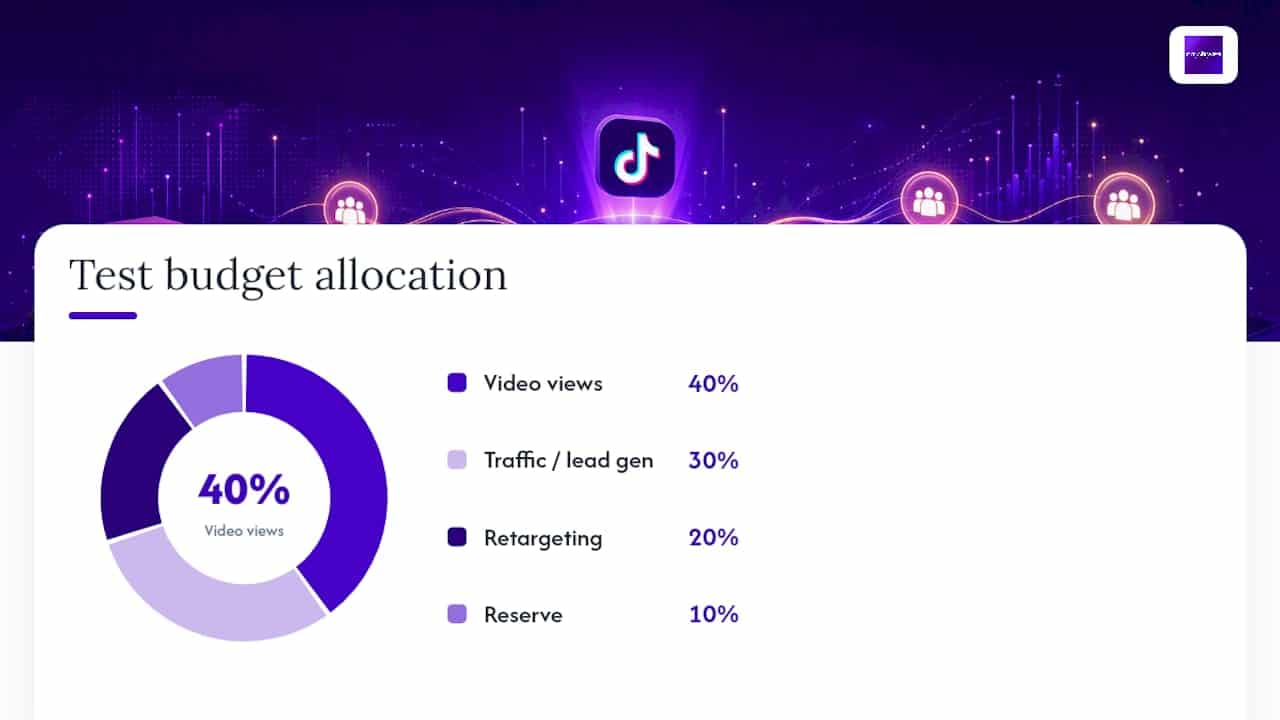
- Split that budget roughly 40% video views (build the retargeting pool), 30% traffic or lead gen, 20% retargeting warm viewers, 10% held in reserve for a winning variant.
A test budget under $300 for a full month rarely clears the learning phase before you run out of runway, which is the single most common reason local test campaigns get judged a failure when they were actually just underfunded.
Creative That Converts Local Customers
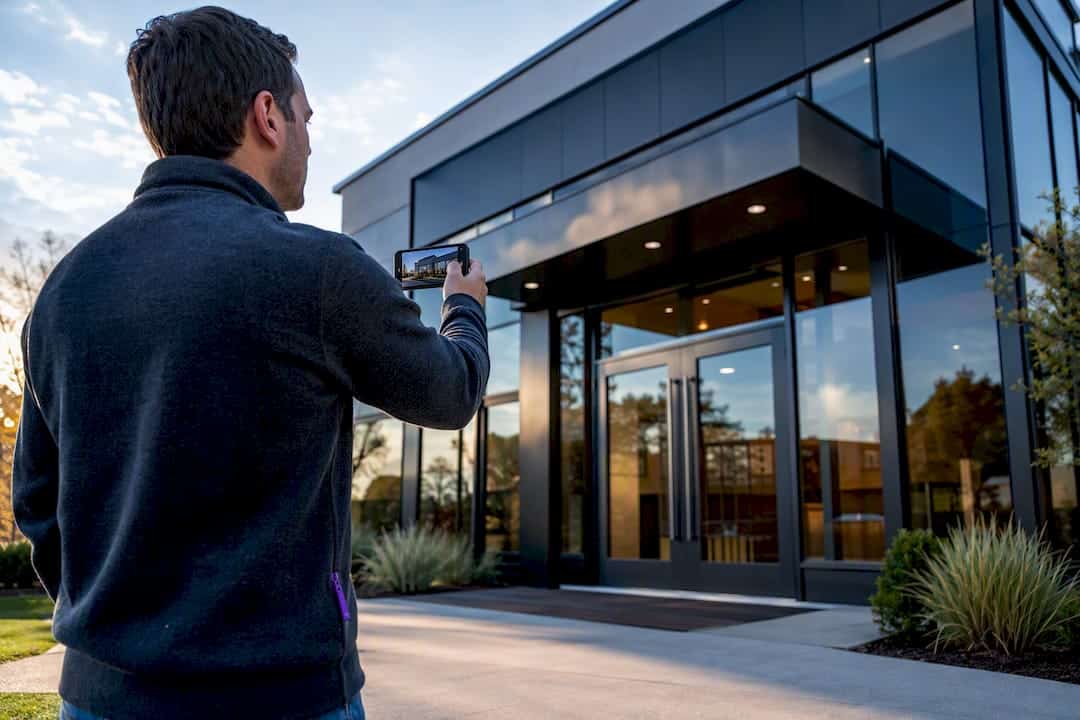
Native, on-location footage shot on a phone consistently beats polished studio production for neighborhood audiences. Multiple local TikTok playbooks confirm authentic footage outperforms studio-quality ads, and the reason is simple: TikTok users scroll past anything that looks like a commercial.
Three creative rules apply across nearly every local vertical:
- Hook within the first 2 seconds. A shot of your storefront sign, your parking lot, or a satisfied customer walking out works better than a logo animation.
- Show the actual place and the actual result. A landscaper should film the yard before and after, not a stock photo of a lawn.
- End with one clear CTA. “Tap to book” or “Show this video for 10% off” beats a vague “Visit us today.”
Two 10 to 15 second templates to build from immediately:
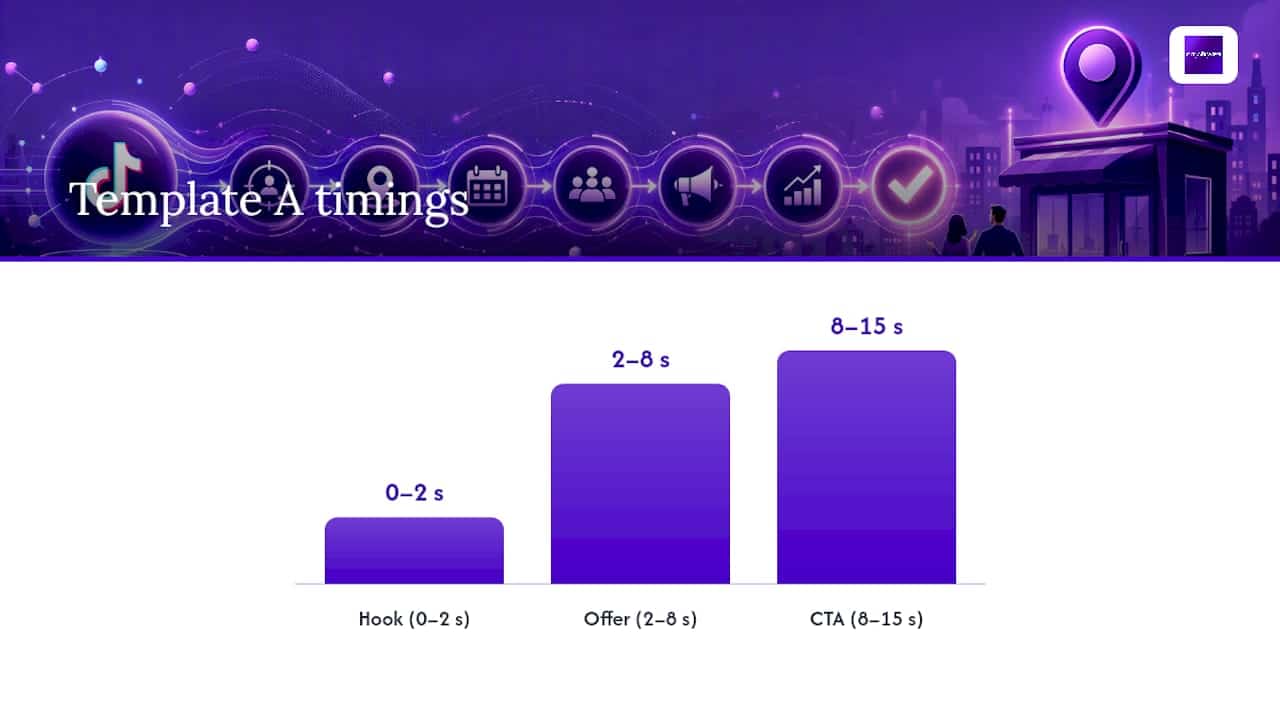
Template A (offer-led): 0 to 2 seconds, show the product or storefront. 2 to 8 seconds, state the offer and deadline. 8 to 15 seconds, CTA with location name spoken on camera.
Template B (proof-led): 0 to 2 seconds, customer reaction shot. 2 to 10 seconds, quick testimonial or before/after. 10 to 15 seconds, CTA plus address or neighborhood name.
Local proof tokens like an address sign, a staff member’s name tag, or a visible parking area do more trust-building than any graphic overlay. Verified Business badges and Local Feed placement add another layer of legitimacy, since neighborhood-specific signals reduce the “will this actually be near me” hesitation that keeps viewers from tapping through.

To produce multiple neighborhood variants fast, reuse the same script and swap only the spoken location name and the on-screen address graphic. A script-generation tool built for short-form hooks can speed up that first draft when you’re producing several versions in one sitting. For more format context, City Web Company’s breakdown of TikTok for local business covers how these tactics fit into a wider local marketing plan.
7-Step Quick Setup Checklist to Launch a Local TikTok Ad Test
- Pick one local outcome. Booking, phone call, store visit, or lead form. Not all four.
- Match format to that outcome. Lead gen for appointments, In-Feed or Spark for traffic and offers.
- Set tight geo-targeting. City, DMA, or radius, sized to how far a customer will realistically travel.
- Build 2 to 3 creative variants. One offer-led, one proof-led, one neighborhood-specific version.
- Install tracking before you spend a dollar. TikTok Pixel and Events API for online actions, plus UTM parameters and either a coupon code or a dedicated call-tracking number for offline proxies.
- Run for 7 to 14 days minimum. That window matches TikTok’s typical learning-phase duration and gives enough data to judge results fairly.
- Set scale or kill criteria upfront. Decide your cost-per-lead or cost-per-booking threshold before launch, not after you see the numbers.
Writing these numbers down before launch matters more than most owners realize. Anchoring every decision to one outcome keeps a campaign from drifting into vanity metrics like views and likes that don’t pay the rent.
Measure, Attribute, and Prove Local Impact
Online conversions get tracked through the TikTok Pixel, the Events API, and UTM-tagged links on every ad. Offline impact, which is where most local business value actually lands, needs proxies:
- Coupon code redemptions at checkout or the counter
- Unique call-tracking numbers per campaign
- Booking confirmations tied to a specific ad source
- Directions-click counts from your Google Business Profile
A compact dashboard keeps you from drowning in TikTok’s native reporting. Track these seven numbers weekly:
| Metric | What it tells you |
|---|---|
| Spend | Whether you’re pacing toward your test budget |
| Impressions | Whether the algorithm is finding your audience |
| CTR | Whether the creative is stopping the scroll |
| Cost per local action | Whether the funnel converts efficiently |
| Bookings or calls | Whether interest turns into revenue intent |
| Coupon redemptions | Offline proof of in-store impact |
| Revenue | The number that actually justifies the spend |
Run the test for the full 7 to 14 day window before judging it. A campaign with a rising CTR and falling cost per local action by day 10 is a signal to scale; one that’s flat or declining by day 7 is a signal to pause and rework the creative, not the budget.
City Web Company Perspective: Agency-Tested Tactics and Case-Study Evidence
Most local businesses lose money on TikTok not because the platform doesn’t work, but because staff and booking systems aren’t ready for the leads it generates. Sync your offer, your booking calendar, and whoever answers the phone before you launch, not after the first lead comes in. A short 7 day creative sprint, testing two or three variants back to back, usually surfaces a winner faster than one polished ad left running for a month.
…
DIY testing makes sense for the first $300 to $500 spend, when you’re just proving the channel matters. Once a winning creative emerges and you’re ready to scale spend across multiple locations or ad accounts, that’s the point to consider a managed provider. An agency audit worth paying for should review your pixel setup, your geo-targeting logic, your creative variance, and your offline tracking chain, in that order.
— Matt
Get Help Launching and Scaling Your TikTok Local Campaigns
Consider using an agency alternative to guessing your way through TikTok Ads Manager alone. Such providers offer setup including campaign structure, pixel installation, geo-targeting, and native creative, built and monitored by experts who run these tests regularly across multiple local industries.

The initial engagement starts with an audit of your current setup (or a clean build if you’re starting from zero), a test plan matched to one clear local outcome, and a realistic timeline for when you’ll see signal. What you bring to that first conversation: your booking or lead capture process, your current ad spend history if any, and two or three ideas for offers you’re willing to test. Explore City Web Company’s TikTok advertising services to see how a managed test compares to running it solo, or start with a broader look at local lead generation tactics if TikTok is one piece of a bigger paid media plan. Ready to see what a test looks like for your business? Get started here.
Sources
- TikTok for Business | Marketing & Advertising on TikTok
- TikTok for Local Business (2026): Local Feed, SEO & Foot Traffic
- TikTok Local Playbook for Store Visits & Sales
- How Small Businesses Can Leverage TikTok to Generate More Sales
FAQ
How Much Do TikTok Ads Typically Cost?
Local businesses can start a valid test for $300 to $500 total, with campaign-level minimums around $50 per day and ad-group minimums around $20 per day.
How Can I Make $1,000 a Month on TikTok?
That question usually applies to creators earning through TikTok’s Creator Fund or brand deals, not to businesses running paid ads, which are a spend, not an income source; local businesses should instead measure return through bookings, calls, and revenue generated per ad dollar spent.
How Much Is 1,000 Views on TikTok Ads?
Cost per view varies by targeting tightness and creative quality, and TikTok doesn’t publish a fixed rate, so the most reliable way to know your number is running a small test campaign and checking your own account’s reporting.
Can I Use TikTok to Promote My Local Business?
Yes. TikTok’s advertising platform includes local targeting by city, county, or DMA, plus formats like In-Feed, Spark Ads, and lead generation built specifically for driving nearby customers to book, call, or visit.
Should I Run TikTok Ads Myself or Hire an Agency?
DIY testing works fine for the first $300 to $500 spend to prove the channel; once a winning creative emerges and you want to scale across locations or ad accounts, a managed provider like City Web Company can audit your setup and take over execution.
Recommended
These articles were popular with other readers too: