

Pass Google Business verification with a video-first checklist. Film one continuous 30 second take, fix flagged issues, and know when to hire help.
Technical SEO for local businesses: visibility & growth
TL;DR:
- Technical SEO ensures search engines can crawl, read, and rank your website effectively.
- Core elements like site speed, mobile usability, and schema markup have the biggest local impact.
- Regularly auditing with free tools helps fix issues that silently hinder search visibility.
You can publish the best content in your industry, run Google Ads every week, and still watch competitors outrank you on every search. That frustrating gap often comes down to one thing most local service businesses overlook: technical SEO. Technical SEO is the process of optimizing a website’s infrastructure to enable search engines to efficiently crawl, render, index, and rank its content. Without this foundation, even great content struggles to surface in local results. This guide breaks down what technical SEO actually means for a plumber, dentist, or HVAC company, which elements matter most, and the practical steps you can take right now to stop leaving leads on the table.
Table of Contents
Table of Contents
- What is technical SEO? Unpacking the essentials
- Key technical SEO elements that impact local search
- How technical SEO gets implemented: Tools and auditing basics
- Best practices and quick wins for local business owners
- Why skipping technical SEO is the most common growth bottleneck
- Take your local SEO to the next level
- Frequently asked questions
Key Takeaways
| Point | Details |
|---|---|
| Technical SEO drives visibility | Optimizing the structure of your website allows local customers to find you more easily in search results. |
| Core elements matter most | Site speed, crawlability, indexing, and mobile readiness are the foundational tasks that local business owners should prioritize. |
| Easy tools reveal hidden problems | Free tools like Google Search Console and PageSpeed Insights help you quickly spot and fix SEO blockers. |
| Quick wins are possible | Many critical technical SEO fixes can be done without coding or hiring expensive specialists. |
What is technical SEO? Unpacking the essentials
Most business owners hear “SEO” and think about blog posts, keywords, and Google Business Profile updates. That’s on-page SEO and content SEO. Technical SEO is a different layer entirely. It’s about how your website is built and how well search engines can access, read, and understand it.
Think of it this way: your content is the message, and technical SEO is the postal system that delivers it. If the delivery system is broken, the message never arrives, no matter how well it’s written.
Technical SEO optimizes your website’s infrastructure so search engines can efficiently crawl, render, index, and rank your pages. For a local roofing company or a physical therapy clinic, this directly determines whether Google can find your service pages and show them to nearby customers.
Here are the core pillars of technical SEO every local business should know:
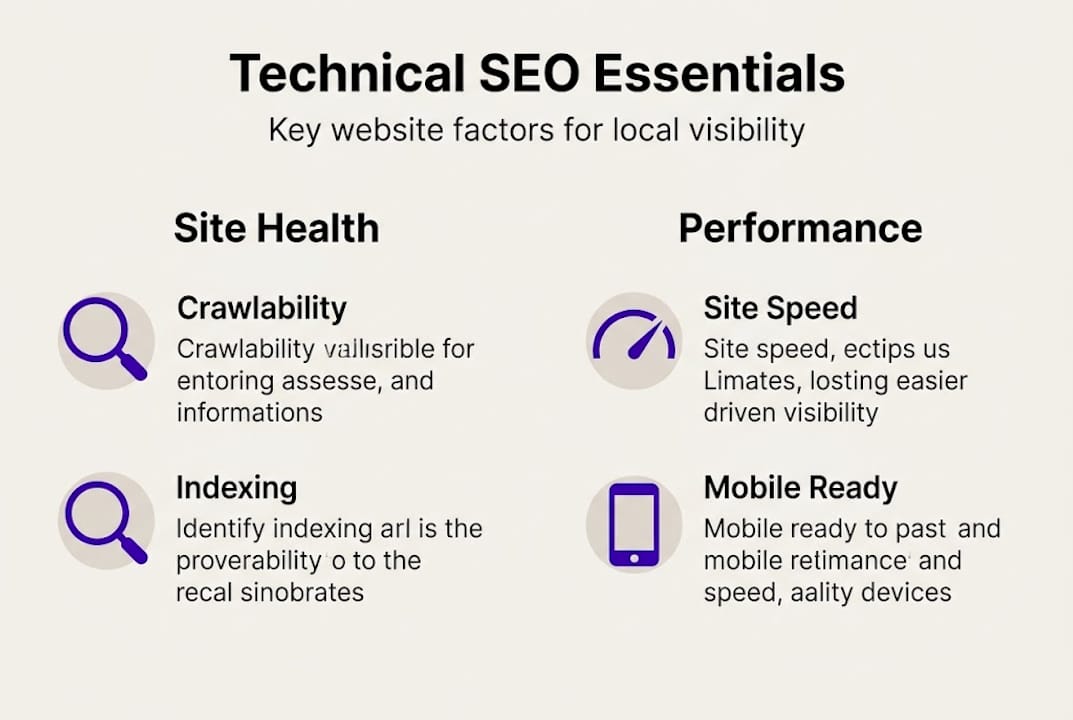
- Crawlability: Can Googlebot access your pages? A misconfigured robots.txt file can accidentally block your most important service pages from being discovered.
- Rendering: Can Google read your content after the page loads? Sites that rely heavily on JavaScript can appear blank to search engines if not set up correctly.
- Indexing: Are your pages actually included in Google’s index? Accidental “noindex” tags or duplicate content issues can quietly remove pages from search results.
- Site speed: Slow pages frustrate users and get penalized in rankings. A one-second delay in load time can significantly reduce conversions.
- Structured data: This is code you add to your site to help Google understand what your business does, where you’re located, and what services you offer.
- Site architecture: How your pages link to each other affects how Google distributes ranking authority across your site.
“Before you invest another dollar in content or advertising, make sure Google can actually find and read your website. Technical SEO is the foundation everything else is built on.”
Building search engine friendly websites means addressing all of these pillars, not just one or two. Many local businesses focus on content while unknowingly running a site that Google can barely crawl. A solid local business website optimization strategy always starts with the technical layer.
The practical consequences are real. A home services company with a misconfigured sitemap may never get its new service area pages indexed. A healthcare practice with a slow mobile site loses patients who bounce before the page even loads. These aren’t hypothetical problems. They happen every day to businesses that are otherwise doing everything right.
Key technical SEO elements that impact local search
Not all technical SEO factors carry equal weight for local businesses. Some have an outsized impact on whether you show up in the local pack, get phone calls, or rank above a competitor two miles away. Let’s look at what matters most and what fixing each one actually looks like.
Core technical SEO elements include crawlability, rendering, indexing, site speed, Core Web Vitals, structured data, and site architecture. For local businesses, site speed and structured data tend to deliver the most immediate, measurable impact.
| Technical element | Common problem | What fixing it does |
|---|---|---|
| Site speed | Pages load in 5+ seconds | More calls from users who stay on site |
| Mobile usability | Buttons too small, text too tiny | Higher rankings in mobile local results |
| Structured data | No schema markup | Richer Google listings with reviews, hours |
| Crawlability | Robots.txt blocking service pages | Google can index and rank those pages |
| SSL certificate | HTTP instead of HTTPS | Trust signals for users and Google |
| Canonical tags | Duplicate service pages | Ranking authority focused on one page |
Site speed deserves special attention. Google’s Core Web Vitals measure real-world performance. The key targets are an LCP (Largest Contentful Paint) of 2.5 seconds or less and an INP (Interaction to Next Paint) of 200 milliseconds or less. These aren’t just technical benchmarks. They reflect whether a real person on a phone can load your page and book an appointment without frustration. Understanding site speed and Google rankings is essential because slow sites consistently lose ground in local search results.


Structured data, often called schema markup, is another high-impact element. Adding LocalBusiness schema to your site tells Google your business name, address, phone number, hours, and service area in a format it can read without guessing. This directly supports local pack visibility.
Mobile optimization is non-negotiable. More than half of all local searches happen on mobile devices. If your site isn’t built for small screens, you’re losing a large portion of potential customers before they even read a word. Investing in mobile search optimization is one of the highest-return technical improvements a local business can make.
Pro Tip: Start your Core Web Vitals review with Google’s PageSpeed Insights tool. It gives you a score for both mobile and desktop, flags specific issues, and tells you exactly what to fix. Focus on mobile first since that’s where most of your local customers are searching.
The businesses that dominate local search aren’t always the ones with the most content. They’re the ones whose sites load fast, work perfectly on phones, and give Google clear signals about who they are and where they serve.
How technical SEO gets implemented: Tools and auditing basics
You don’t need to be a developer to start improving your technical SEO. The right tools do most of the heavy lifting, and many of them are free. The key is knowing which tools to use and what to look for when you run your first audit.
Prioritize audits with GSC, Semrush Site Audit, and PageSpeed Insights to unblock indexing issues before pouring more budget into content or ads. These three tools cover the most critical ground for local service businesses.
| Tool | Best for | Cost |
|---|---|---|
| Google Search Console | Indexing issues, crawl errors, search performance | Free |
| Semrush Site Audit | Full technical audit, broken links, site health score | Paid (free tier available) |
| Google PageSpeed Insights | Core Web Vitals, speed, mobile performance | Free |
| Screaming Frog | Deep crawl analysis, redirect chains, duplicate content | Free up to 500 URLs |
Here’s a straightforward process for running your first technical audit:
- Set up Google Search Console. Verify your website and submit your XML sitemap. This gives Google a map of your pages and lets you see any crawl errors or indexing problems.
- Check your coverage report. In GSC, look at the “Pages” section. Any pages marked as “excluded” or “not indexed” need attention, especially your core service and location pages.
- Run a PageSpeed Insights test. Enter your homepage and your most important service page. Review the mobile score first. Anything below 50 is a red flag.
- Run a Semrush Site Audit. This tool scans your entire site and produces a health score along with a prioritized list of issues to fix, from broken links to missing meta tags.
- Review your robots.txt file. Type your domain followed by /robots.txt into your browser. Make sure you’re not accidentally blocking important pages.
- Check for HTTPS. Your site should load with a padlock icon in the browser. If it doesn’t, your hosting or SSL certificate needs attention.
Exploring the best SEO tools available in 2026 can help you find options suited to your budget and skill level. For businesses in trades and home services, there are also SEO tools for home services that are specifically designed for your industry context.
The most important mindset shift here is treating technical SEO as a prerequisite, not an afterthought. Fixing crawl errors and speed issues first means every piece of content you publish afterward actually gets seen.
Best practices and quick wins for local business owners
You don’t need a six-month project to start seeing results from technical SEO. Several high-impact improvements take less than an hour to check and can make a real difference in how your site performs in local search.
Technical SEO covers basic yet often overlooked tasks like optimizing internal links and site structure, and these are exactly the kinds of things most local businesses skip. Here’s what to check right now:
- Submit your XML sitemap to Google Search Console if you haven’t already. This tells Google which pages exist and should be indexed.
- Test your mobile usability using Google’s Mobile-Friendly Test tool. Look for tap targets that are too close together or text that’s too small to read.
- Run a speed test on your homepage and your top service page using PageSpeed Insights. Note your mobile score and the top three recommendations.
- Check for broken internal links. Broken links waste crawl budget and frustrate users. Screaming Frog or Semrush can find these quickly.
- Add basic LocalBusiness schema to your homepage and contact page. Many WordPress plugins like Yoast or RankMath make this straightforward without any coding.
- Verify your SSL certificate is active and that all pages redirect from HTTP to HTTPS.
The biggest mistakes local businesses make are surprisingly common. Blocking service pages in robots.txt, running on slow shared hosting, skipping SSL, and ignoring schema markup are all fixable problems that silently cost rankings every day.
Learning what Google wants from your website comes down to a few consistent signals: fast load times, clear structure, mobile readiness, and accurate business information. None of these require advanced technical skills to address at a basic level.
Pro Tip: Set a quarterly calendar reminder to run a quick technical SEO check. Search engine algorithms update frequently, and a site that passed every test six months ago might have new issues today, especially after adding new pages, changing plugins, or switching hosting providers.
A step-by-step local website optimization approach works best here. Fix the most critical issues first, such as indexing blocks and site speed, then work through secondary items like schema and internal linking. Small, consistent improvements add up fast.
The quick-win mindset matters. You don’t need to solve every technical SEO issue at once. Even fixing one crawl error or improving your mobile load time by two seconds can move the needle on local rankings.
Why skipping technical SEO is the most common growth bottleneck
We’ve worked with local businesses across home services, healthcare, and legal industries, and the pattern is almost always the same. A business invests in blog content, pays for Google Ads, and wonders why the phone isn’t ringing more. Then we look under the hood and find service pages that Google hasn’t indexed in months, a mobile load time of eight seconds, and zero structured data.
The content was fine. The ads were targeted correctly. But the technical foundation was broken, and it was silently canceling out every other marketing effort.
Conventional wisdom in digital marketing pushes content first. Publish more, rank more. But that logic only works when Google can actually access and understand your site. Technical SEO is the amplifier. It’s what turns a decent content strategy into real local visibility.
The uncomfortable truth is that most local businesses don’t find out they have technical SEO problems until they’re already losing ground to a competitor. Crawl errors don’t send you an alert. A misconfigured canonical tag doesn’t show up in your ad dashboard. These issues sit quietly in the background while your budget keeps running.
Building competitive local SEO strategies always starts with a clean technical foundation. Fix the infrastructure first, and everything else you invest in, content, ads, reviews, starts working harder.
Take your local SEO to the next level
Understanding technical SEO is one thing. Implementing it correctly across a live website while running a business is another challenge entirely. That’s where City Web Company comes in.
We specialize in helping local service businesses build the technical foundation that makes every other marketing effort more effective. Whether you’re trying to understand local SEO vs traditional SEO or need a clear local service SEO ranking guide to follow, we have the resources and expertise to move you forward. We also help businesses maximize their Google Business Profile optimization to capture more local pack visibility. If you’re ready to stop guessing and start ranking, let’s talk about what a technical SEO audit can reveal for your business.
Frequently asked questions
How do I know if my local business website has technical SEO issues?
You can use tools like Google Search Console or Semrush Site Audit to identify common problems such as crawl errors, slow load times, or missing sitemaps. Most issues are flagged automatically with clear descriptions of what needs to be fixed.
What technical SEO factor has the biggest impact on local rankings?
Site speed and mobile readiness are crucial, as Google prioritizes fast, mobile-friendly sites in local results. Meeting Core Web Vitals targets like LCP under 2.5 seconds gives your local pages a measurable ranking advantage.
Do I need to code to fix technical SEO problems?
Most fixes don’t require coding. Many technical SEO improvements can be made using website settings, plugins, or tools that flag issues with clear instructions and guided steps. Platforms like WordPress make many fixes accessible to non-technical users.
How often should I check my website’s technical SEO?
A quarterly technical SEO check is recommended, or whenever you add new features to your website. Since website infrastructure changes with updates and new content, regular checks ensure your visibility and performance stay on track.
Recommended
These articles were popular with other readers too: