
See how plumbers can turn Facebook scrollers into booked jobs with clear offers, local targeting, a 30 day test budget, fast follow up, and a path to scale.
The Role of Branding for Home Services: Owner’s Playbook
Branding turns your intangible work into a perceivable, trustable product that increases conversion rates, referral velocity, and pricing power. That is the short version. The longer version is what this playbook covers.
Three things happen when a home service business brands consistently:
- Homeowners recognize your truck before they remember your name, and that recognition shortens the decision to call you instead of searching Google from scratch. Contractor Magazine frames this as “owning the mind of the customer.”
- Your brand acts as a pre-purchase quality cue. Because homeowners cannot inspect your work before they hire you, a consistent visual identity across your website, reviews, and vehicles reduces their perceived risk enough to move them off the fence.
- Staff alignment follows. When your team wears the same uniform, drives wrapped trucks, and follows the same communication scripts, operations tighten alongside your reputation.
One caveat worth stating early: marketing alone cannot substitute for poor service quality. Branding amplifies what is already there. If the work is inconsistent, a sharp logo makes the disappointment more memorable, not less.
Table of Contents
Table of Contents
- Why the role of branding for home services hits differently than other industries
- What a home services brand actually includes (it goes well beyond a logo)
- How branding drives leads, conversion rates, and pricing
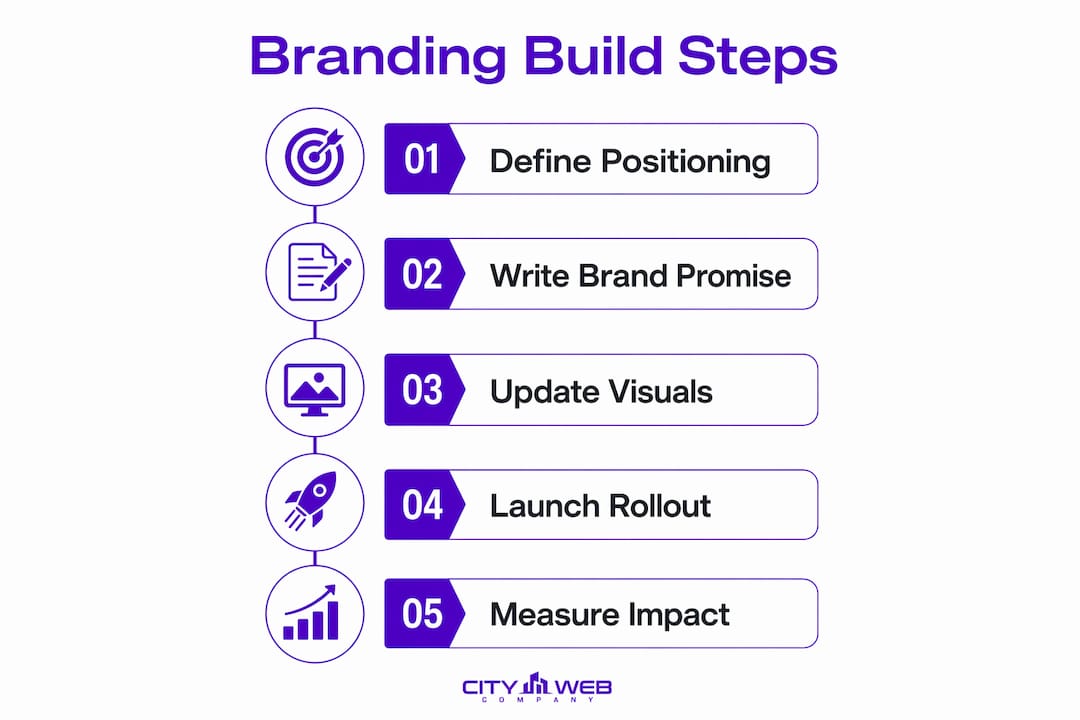
- How to build or refresh your brand in 30, 60, 90 days and beyond
- Common branding mistakes home service companies make and how to fix them
- How to measure whether your branding is actually working
- What a real home services branding project looks like: a City Web Company example
- How to run a competitor brand analysis for your home services market
- Key Takeaways
- A straight take on what branding actually requires from you
- How City Web Company helps home service brands grow
- Recommended further reading
- FAQ
Why the role of branding for home services hits differently than other industries
Home services carry a specific trust problem that most other industries do not. A homeowner is letting a stranger into their house, often during a stressful situation, to fix something they cannot evaluate themselves. That is a high-stakes, low-information purchase.

Service-branding research confirms that brands function as information cues, helping consumers evaluate quality before a purchase they cannot inspect. In home services, those cues are everything: the truck wrap, the technician’s shirt, the Google Business Profile photo, the review response. Each one either closes the trust gap or widens it.
Branding also accelerates unaided recall. When a pipe bursts at 11 PM, a homeowner does not browse comparison sites. They call the name they already know. A clear brand identity means your number gets dialed instead of a competitor’s.
The internal effects compound the external ones. Branding functions as a culture tool that improves hiring and retention when employees identify with a mission. A technician who wears a uniform they are proud of represents the company differently than one who shows up in a faded t-shirt. That difference shows up in customer reviews.
Pro Tip: Before spending on vehicle wraps or a new logo, write a one-sentence brand promise your technicians can memorize. “We show up on time, fix it right the first time, and leave your home cleaner than we found it” is more powerful than any color palette.
What a home services brand actually includes (it goes well beyond a logo)
Most owners think branding means a logo and maybe a color scheme. The real inventory is longer, and every item on it either builds trust or erodes it.
Primary brand elements:
- Brand promise / service guarantee: The specific, stated commitment you make to every customer. “Same-day service or the call is free” is a brand promise. It sets expectations and gives customers a reason to choose you over a cheaper option.
- Name and tagline: Memorable, pronounceable, and ideally descriptive of your service area or specialty.
- Visual identity: Logo, color palette, and typography used consistently across every surface.
- Vehicle and uniform system: Wrapped trucks and logoed uniforms are your most visible mobile billboard. Contractor Magazine specifically calls out consistent visual identity across trucks and uniforms as a core driver of unaided recall.
- Website UX: Your site is the first place most prospects verify you are real. A brand-aligned site with clear service pages, photos of your actual team, and visible reviews converts browsers into callers.
- Review and testimonial system: Reviews are social proof that your brand promise is real. They belong on your website, your Google Business Profile, and your social pages.
- Customer communications: Dispatch texts, appointment confirmations, invoices, and follow-up emails should all carry your brand voice and visual identity.
- Technician behavior standards: How your team greets customers, explains work, and handles complaints is part of the brand. Shopify’s service branding guidance recommends leaning into personal branding when a named owner or lead technician provides continuity.
Where to apply brand assets:
| Touchpoint | Primary Role | Quick Example |
|---|---|---|
| Vehicle wrap | Trust + recall | Homeowner sees your truck on their street before they need you |
| Uniform / badge | Trust + professionalism | Tech introduces himself by name with a logoed shirt |
| Website landing page | Conversion | Clear headline, service area, reviews above the fold |
| Google Business Profile | Discovery + trust | Consistent photos, hours, and review responses |
| Social media profiles | Differentiation | Before/after photos with branded overlays |
| Dispatch / confirmation texts | Retention | Branded message with tech name and ETA |
| Invoice / receipt | Referral trigger | Thank-you note with a review request link |
| Job site signage | Local recall | Yard sign during and after a project |
The role of custom branding in local business growth extends to branded merchandise too: hats, pens, and notepads left with customers keep your name in front of them long after the job is done.
How branding drives leads, conversion rates, and pricing
Recognition lowers friction. When a homeowner already knows your name from a neighbor’s yard sign or a truck they passed on the highway, your Google ad gets a higher click-through rate because it confirms something familiar. That is not a soft benefit; it is a measurable difference in cost per lead.
Guarantees reduce price sensitivity. A clearly stated service guarantee shifts the conversation from “how much?” to “when can you come?” Homeowners will pay more for certainty, especially for high-stakes work like electrical, HVAC, or water damage restoration.
Consistent experience increases referrals. A customer who had a great experience with your branded technician, received a follow-up text, and got a thank-you card is far more likely to mention you by name to a neighbor than one who had a fine but forgettable interaction. Referrals from branded businesses tend to arrive pre-sold, which compresses your sales cycle.
Concrete outcomes to track:
- Higher click-through rates on branded paid search ads versus generic ads
- Improved contact-to-booking conversion when your website, reviews, and GBP photos are consistent
- Higher average order value when a service guarantee is prominently displayed
- Faster referral velocity when post-job follow-up is systematized
- Better lead quality, meaning fewer price-only shoppers, when your brand signals premium service
For a practical look at how these outcomes connect to a full home services marketing blueprint, the mechanics of lead generation and branding work together, not in parallel.
How to build or refresh your brand in 30, 60, 90 days and beyond
A staged rollout that aligns operational changes with outward signals reduces customer confusion and protects your existing referral flows during a rebrand. Here is a realistic timeline.
Phased brand build timeline
| Timeframe | Priority Tasks | Budget Range |
|---|---|---|
| Days 1-30 | Define positioning, write brand promise, audit GBP and website | $0 |
| Days 30-60 | Update logo/colors, order uniforms, refresh GBP photos | $500-$2,000 |
| Days 60-90 | Launch review collection process, update social profiles, align dispatch comms | $0-$1,000 |
| Months 4-6 | Vehicle wrap(s), website redesign or refresh, paid ad creative alignment | $2,000-$5,000 |
| Months 7-12 | Staff training on brand standards, community engagement, advertising integration | $1,000-$5,000/yr |
Budget ranges are approximate and vary by market and vendor. A single vehicle wrap typically runs $1,500-$3,500 depending on vehicle size and design complexity.
Step-by-step quick-start plan
- Write your positioning statement. One sentence: who you serve, what you do, and why you are different. This becomes the filter for every brand decision.
- Audit your Google Business Profile. Consistent name, address, phone number, current photos, and a response to every review. This is the highest-ROI touchpoint for a constrained budget. GBP optimization directly affects how often you appear in local map searches.
- Standardize your visual identity. Pick two colors and one font. Apply them to your email signature, invoices, and social profiles before you spend on anything physical.
- Order branded uniforms. Logoed shirts and hats for every technician. This is the single most visible daily brand touchpoint and one of the lowest-cost moves available.
- Set up a review request process. A text sent within two hours of job completion asking for a Google review. Automate it if possible.
- Refresh your website’s above-the-fold content. Your headline should state your service area, your specialty, and your guarantee. Add a photo of your actual team.
- Wrap at least one vehicle. Even a partial wrap on your most-used truck multiplies brand impressions daily.
- Train your team on the brand promise. Every technician should be able to say what your company stands for in one sentence.
- Align your paid ads with your brand visuals. Use the same colors, fonts, and guarantee language in Google Ads and social ads that you use on your website.
Pro Tip: When budgets are tight, prioritize touchpoints that influence first contact: your Google Business Profile, your website landing page, and your technician’s appearance at the job. Those three cover the moments when a prospect decides whether to book or bail.
Common branding mistakes home service companies make and how to fix them
Inconsistent visuals across touchpoints. Your truck is red, your website is blue, and your uniforms have a logo from three years ago. Customers notice the mismatch even if they cannot articulate it. PMMag practitioners note that a mismatch between internal improvements and outward branding confuses customers and dampens trust. Fix: create a one-page brand style guide with your hex codes, logo files, and font names, then share it with every vendor.
Incomplete on-job branding. A technician arrives in a branded truck but wears a personal hoodie. The trust signal breaks at the moment of highest impact. Fix: make branded uniforms non-negotiable, not optional, and keep spares in the truck.
Treating branding as cosmetic only. A new logo does not fix a 3.2-star Google rating or a dispatch process that leaves customers waiting without updates. Fix: pair every outward brand investment with an operational improvement. New website? Also launch a review request process. New truck wrap? Also train the tech who drives it.
Ignoring review management. Reviews are the most visible part of your brand for anyone who searches your name. An unanswered one-star review signals that you do not care. Fix: respond to every review within 48 hours, positive or negative, using your brand voice.
Overcomplicating the logo or vehicle wrap. A wrap with six colors, three phone numbers, and a paragraph of services is unreadable at 40 mph. Fix: one dominant color, one logo, one phone number, one tagline. Legibility at speed is the only design brief that matters for vehicles.
Before: A plumbing company had four different logo versions across their website, trucks, and invoices, and no review response process. After: a single logo file distributed to all vendors, a weekly review response routine, and a 0.4-star rating improvement over six months.
How to measure whether your branding is actually working
The goal is a simple measurement framework you can run without a data team.
Primary KPIs to track:
- Branded search volume: How often people search your company name directly in Google. Rising branded search means growing awareness. Track this in Google Search Console.
- Contact-to-booking conversion rate: Of every call or form submission, what percentage becomes a booked job? Branding improvements typically show up here first.
- Average order value (AOV): Track cohorts of customers acquired before and after a brand change and compare their AOV. This is a more reliable signal of brand-led pricing power than trying to isolate brand lift from ad spend alone.
- Referral rate: What percentage of new customers mention a referral source? Ask on every intake call.
- Review volume and sentiment: Total reviews and average star rating, tracked monthly. Consistency builds memory; memory builds trust, and reviews are the most public record of whether that trust is warranted.
- Lead quality: Are you getting more price-only shoppers or more customers who ask about your guarantee? Brand strength shifts this ratio.
Simple ROI framing: If your current contact-to-booking rate is 40% and a brand refresh moves it to 50%, and you receive 100 contacts per month at an average job value of $400, that 10-point improvement generates $4,000 in additional monthly revenue. That math pays for a vehicle wrap in under a month.
Reporting cadence:
- Weekly: check lead volume and review notifications
- Monthly: review conversion rate, AOV, and new review count
- Quarterly: pull branded search volume from Google Search Console and compare referral rate
Tools that work for this without a data team: Google Search Console for branded search, your CRM or booking software for conversion and AOV, and Google Business Profile Insights for local discovery trends. An SEO checklist for home services covers the technical side of branded search visibility in more detail.
What a real home services branding project looks like: a City Web Company example
A regional HVAC company came to City Web Company with a recognizable problem: solid technicians, inconsistent brand. Their Google Business Profile had outdated photos, three different logo versions appeared across their trucks and website, and they had no process for collecting reviews after jobs.
City Web Company’s work covered four areas over a 90-day engagement:
- Visual identity consolidation: One logo file, two brand colors, and a typography standard distributed to their vehicle wrap vendor, uniform supplier, and web developer.
- GBP optimization: Updated photos, corrected service categories, and a response template for reviews.
- Review collection system: An automated post-job text sent within two hours of completion, linked directly to their Google review page.
- Website refresh: Above-the-fold content updated to include their service guarantee, a photo of the actual owner, and their service area.
City Web Company serves home services, HVAC, plumbing, pest control, landscaping, disaster restoration, and other local service businesses. Services include local SEO, Google Business Profile optimization, branded website design, paid advertising, social media management, and custom promotional products.
How to run a competitor brand analysis for your home services market
A competitor brand analysis tells you where the gaps are in your local market and which brand positions are already taken.
Step 1: List your top five local competitors. Search your primary service keyword plus your city (e.g., “HVAC repair Denver”) and note the top organic and map results.
Step 2: Audit their visual identity. Screenshot their website, Google Business Profile, and any visible truck or uniform photos. Note their dominant colors, logo style, and tagline if they have one. You are looking for patterns and gaps.
Step 3: Read their reviews. Not just the star rating. Read the text of their most recent 20 reviews and note what customers praise and what they complain about. Those complaints are your brand opportunity.
Step 4: Check their brand consistency. Does their website match their GBP photos? Do their social profiles use the same logo? Inconsistency in a competitor is a gap you can fill by being the one who looks put-together.
Step 5: Map the positions. After auditing five competitors, you will usually find that one or two own “fastest response,” one owns “lowest price,” and most own nothing memorable. The open positions, “most trustworthy,” “best warranty,” “family-owned and local,” are where your brand can plant a flag.
Step 6: Identify your differentiator. Based on the gap map, choose one position your operations can actually deliver on. Do not claim “fastest” if you cannot staff for it. Authenticity in brand messaging is what makes a differentiator stick long-term.
Step 7: Revisit quarterly. Competitors rebrand, new entrants arrive, and review sentiment shifts. A quarterly 30-minute audit keeps your positioning current.
Key Takeaways
Branding for home services is an operational growth multiplier: consistent visuals, a clear service promise, and a managed review presence convert more contacts, justify higher prices, and generate referrals without additional ad spend.
| Point | Details |
|---|---|
| Branding reduces perceived risk | Consistent trucks, uniforms, and reviews give homeowners quality cues before they hire you. |
| Consistency drives recall and revenue | An improvement in contact-to-booking rate on monthly contacts at average order value adds notable additional revenue per month. |
| Measure what matters | Track branded search volume, contact-to-booking rate, AOV, and referral rate monthly using Google Search Console and your CRM. |
| Fix mistakes before scaling | Inconsistent visuals and unmanaged reviews undermine every dollar spent on advertising. |
| City Web Company delivers this end-to-end | From GBP optimization and branded websites to vehicle creative and review systems, City Web Company handles the full brand alignment for home service businesses. |
A straight take on what branding actually requires from you
Most home service owners underestimate one thing: branding is a management decision before it is a marketing decision. You can hire an agency to design a logo, build a website, and wrap your trucks. But if your technicians do not know what the brand stands for, or if your dispatch process contradicts the promise on your website, the investment leaks.
The businesses that see the clearest results from brand work are the ones that treat it as an operational standard, not a one-time project. They write down their brand promise, train their team on it, and hold the line when a technician wants to skip the logoed shirt on a hot day. That consistency, applied over months, is what brand consistency research identifies as the long-term driver of recognition and reliable customer selection.
When evaluating an agency for branding work, ask for before-and-after examples from home service clients specifically. Ask what they track and how often they report it. An agency that cannot show you a conversion rate or a review volume trend from a past client is selling aesthetics, not outcomes.
How City Web Company helps home service brands grow
Home service owners who want to implement this playbook without doing it alone have a direct path forward with City Web Company. The agency handles the full stack of brand-aligned digital marketing: local SEO and GBP optimization, branded website design, Google Ads management, social media advertising, review management, and custom promotional products including uniforms and branded merchandise.

What a first consult looks like: City Web Company starts with a brand and digital audit covering your GBP, website, review profile, and competitor positioning. You leave with a prioritized list of the highest-ROI moves for your specific market, not a generic checklist. For home service businesses ready to stop competing on price and start winning on trust, the home services marketing services page is the right starting point. You can also review the full range of services at City Web Company’s services page or request a consult directly.
Recommended further reading
- A Conceptual View of Branding for Services (Business Perspectives): The academic foundation for understanding why brands reduce perceived risk in service purchases. Worth reading if you want the theory behind the tactics.
- Branding 101 for the Home Services Contractor (Contractor Magazine): Practical, industry-specific guidance on recall, labor attraction, and visual consistency. The most directly applicable resource for contractors.
- Branding That Works as Hard as Your Crew (Plumbing and Mechanical Magazine): Practitioner-focused piece on consistency and internal brand alignment. Read this for the operational perspective.
- 6 Service Branding Strategies for Small Business Owners (Shopify): Covers authority-building tactics and personal branding for service businesses. Useful for owners who want to attach their own name and face to the brand.
- How Home Services Companies Can Stand Out in a Crowded Market (Brandcraft): Good overview of differentiation strategies specific to the home services competitive environment.
FAQ
What is the role of branding in service marketing?
Branding in service marketing acts as a pre-purchase quality signal, giving customers a way to evaluate a provider before they can inspect the work. For home services specifically, consistent branding across trucks, uniforms, and digital touchpoints reduces perceived risk and shortens the decision to hire.
What are the 5 C’s of branding?
Definitions of the “5 C’s of branding” vary by source and no single canonical framework dominates the industry. A common version covers clarity, consistency, content, connection, and credibility. For home service businesses, consistency and credibility tend to deliver the most measurable near-term impact.
How much does it cost to brand a home service business?
A basic brand foundation, covering a logo, uniforms, GBP update, and website refresh, typically runs $1,000-$5,000 depending on your market and vendors. A full rollout including vehicle wraps and paid advertising creative can cost several thousand dollars more over the first year.
How long does it take to see results from branding?
Quick wins like improved GBP photos and a review collection process can show measurable results within 30-60 days. Broader recognition and pricing power from consistent branding typically build over 6-12 months of sustained application.
Can a small home service company compete on branding against larger chains?
Yes, and local branding is often an advantage. A named owner, a community presence, and a personal service guarantee are things a national chain cannot replicate. Homeowners frequently prefer a local brand they recognize over a corporate one they do not trust.
Recommended
These articles were popular with other readers too: