

Pass Google Business verification with a video-first checklist. Film one continuous 30 second take, fix flagged issues, and know when to hire help.
Boost Your Business with Digital Marketing for Home Services
Most home service marketing problems do not start with bad effort. They start with disconnected effort.
A contractor hires one company for SEO, boosts a few Facebook posts, runs Google Ads during peak season, asks the office manager to collect reviews when there is time, and hopes the phone keeps ringing. Leads may come in, but the pattern is unstable. One month looks strong. The next month feels expensive. No one can clearly say which channel produced booked jobs, which leads were junk, or why costs keep climbing.
That is where digital marketing for home services usually breaks down. Not at the tactic level, but at the system level.
Owners feel the symptoms in practical terms. Wasted ad spend. Missed calls. Poor visibility in the map pack. A website that gets traffic but does not convert. Reports full of clicks and impressions that never explain revenue. The frustration is valid because most marketing stacks were assembled piece by piece, not engineered to work together.
The businesses that grow more predictably build something different. They treat local SEO, Google Business Profile, paid search, reviews, social campaigns, and tracking as one connected operating system. That shift changes everything. Costs become easier to manage. Visibility becomes more durable. Decisions become less emotional because the data ties back to booked work.
Table of Contents
Beyond Random Acts of Marketing
A lot of home service companies are not under-marketed. They are under-structured.
The common assumption is simple. If leads are inconsistent, add another tactic. Run another ad set. Hire another vendor. Post more often. Send another mailer. The activity increases, but the underlying problem stays the same.
That is why so many owners feel like they are paying for motion instead of progress.
Why disconnected tactics create expensive confusion
A local service business usually depends on a few core moments. Someone searches. Someone compares options. Someone decides who feels trustworthy enough to call.
If your channels do not support that journey together, each tactic works harder than it should. Your website has to overcome weak reviews. Your ads have to compensate for poor local visibility. Your social content tries to build familiarity without a clear path to booking.
The result is not just inefficiency. It is delayed learning.
A disconnected setup usually creates these problems:
- No shared performance view. SEO, PPC, and social reports live in separate dashboards, so no one sees the full path from search to booked job.
- Weak conversion flow. Ads send traffic to generic pages, or the Google Business Profile points to a homepage that does not match the service searched.
- Budget drift. Spend stays in channels that look busy instead of channels that produce appointments.
- Trust gaps. Reviews, service pages, licensing details, and response expectations are inconsistent across platforms.
For owners trying to make sense of modern online local business marketing, that distinction matters. The issue is rarely whether SEO or ads “work.” The issue is whether the business built a structure that lets those channels reinforce each other.
A home service business grows faster when marketing behaves like a connected service pipeline, not a pile of unrelated tasks.
What a growth system looks like
A strong system does not start with “what channel should we add next?” It starts with “what happens from the first search to the booked job, and where does that path break?”
That framing changes the order of operations.
First, the business needs a conversion-ready foundation. Then it needs visibility where urgent intent happens. Then it needs brand presence for future demand. Finally, it needs tracking that shows what produced revenue.
This is what separates a busy marketing account from a reliable lead engine.
Your Digital Storefront and Local Visibility
Before advertising can perform well, your online presence has to remove friction.
In home services, people rarely browse for fun. They are looking for a solution, often on a phone, and often with limited patience. 78% of local searches on mobile devices lead to a purchase within 24 hours according to Invoca’s home services marketing statistics. That is not casual traffic. It is decision-stage traffic.
If your website is slow, unclear, or generic, the visitor does not “consider your brand.” They call someone else.
Your website is not a brochure
A home service website has one job. Turn local intent into action.
That means the homepage matters, but service-specific pages matter more. Someone searching for drain cleaning, AC repair, roof leak repair, or electrical troubleshooting should not land on a vague all-services page and do the sorting themselves.
The strongest local sites usually have:
- Service pages with clear intent match. Each major service gets its own page with plain language, service area relevance, and a direct booking path.
- Immediate contact options. Tap-to-call buttons, short forms, and visible hours reduce hesitation.
- Proof near decision points. Reviews, certifications, service guarantees, and real team photos should sit near calls to action.
- Mobile-first layout. Buttons need to be easy to use on a phone. Text needs to be scannable. Load times need to feel instant.
- Location relevance. Service area pages help search engines and customers understand where you operate.
A beautiful site can still fail if it hides the next step.
For a deeper look at page structure, calls to action, and trust placement, this breakdown of a high-converting local website is useful because it focuses on what moves visitors to call or submit a form.
What owners often get wrong on the site itself
The most common mistake is building for appearance instead of urgency.
A remodeler may have more room for inspiration content. An emergency plumber, electrician, or HVAC company does not. The buyer is not asking whether your site feels modern. They are asking whether you look credible, available, and easy to reach.
That is why these fixes tend to matter more than cosmetic redesigns:
Replace generic headlines
“Welcome to our website” says nothing. “Fast AC repair in [service area]” gives the visitor confidence that they found the right place.Shorten forms
When someone needs a technician, a long questionnaire creates friction. Ask for what the office needs to respond.Match the ad to the page
If a Google Ads campaign targets water heater repair, the click should not land on a general plumbing page.
Your Google Business Profile does a different job
Your website is the storefront. Your Google Business Profile is the roadside sign that gets people to walk in.
For many home service searches, the profile appears before a user ever reaches your site. That makes profile quality a direct factor in lead flow, not a side task.
A strong profile includes:
- Accurate service categories
- Consistent business information
- Service area clarity
- Fresh photos
- Review activity
- Clear business description
- Relevant updates when appropriate
Reviews deserve special attention. They are not just social proof. They shape whether the searcher trusts you enough to click or call.
If your website answers “Can you do the job?”, your Google Business Profile answers “Can I trust you enough to contact you right now?”
The handoff between website and profile
These two assets need to reinforce each other.
When the profile promises emergency availability but the site buries the phone number, confidence drops. When the site lists one service area and the profile suggests another, trust weakens. When reviews describe one specialty but the service pages emphasize something else, conversion suffers.
The best results usually come from simple alignment. Same positioning. Same core services. Same local relevance. Same promise about how quickly and professionally the business responds.
This alignment is what makes the rest of your marketing worth funding.
Attracting Urgent Demand with Search Engine Dominance
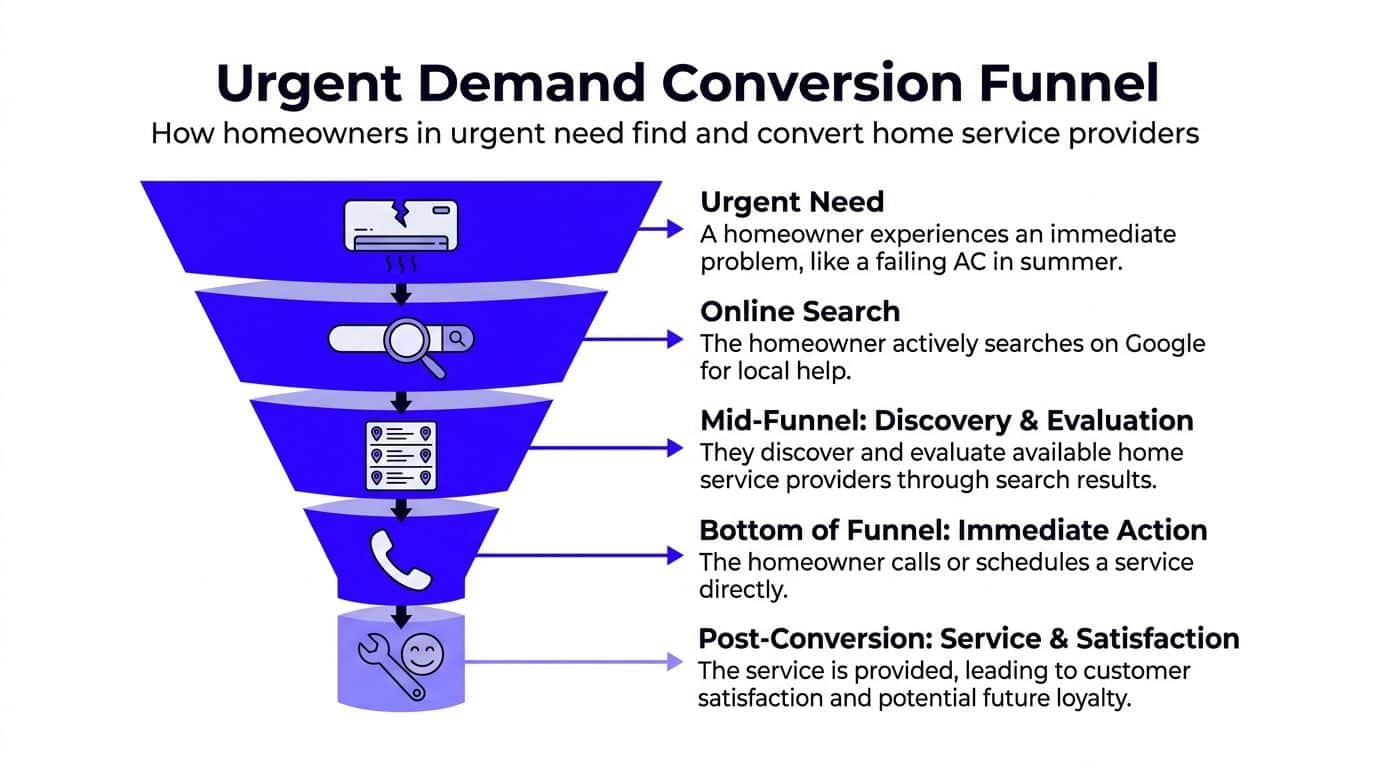
At 9:17 p.m., a homeowner finds water spreading across the floor from a failed supply line. They are not researching brands. They are scanning the search results for one company that looks legitimate, answers fast, and can get a technician out tonight.
That is the job of search in home services. It captures demand at the moment the problem becomes expensive or unsafe to ignore.
Local SEO builds durable coverage for urgent service queries
Urgent demand still has patterns. People search by service, city, neighborhood, and problem type. They use terms like emergency plumber, AC repair near me, drain backup, no heat, electrician open now. If your site has no page that clearly matches those searches, Google has little reason to rank you for them.
Local SEO solves that over time. The work is usually operational, not glamorous. Build service-area pages that reflect real coverage. Strengthen internal links so authority flows to revenue-driving pages. Add local schema. Keep business information consistent across the web. Support those pages with reviews that mention the actual services you want to sell.
Hughes Media explains this well in its home services digital marketing guide. The article notes how mobile and voice-driven local searches shape discovery for home service companies. Hughes Media also highlights how Google Local Services Ads can increase trust because the Google Guarantee badge reduces perceived risk during a high-stress decision.
For contractors covering several towns, page structure matters as much as keyword choice. One generic services page rarely competes well across an entire region. A tighter local architecture usually performs better, which is why this guide to local SEO for contractors is useful for understanding how service areas, intent, and page coverage fit together.
Google Ads buys speed, but only if the account is disciplined
SEO compounds. Emergencies do not wait for compounding.
Paid search fills that gap. It lets a company appear immediately for high-intent searches while organic visibility matures, and it gives owners a way to push harder on profitable services during weather spikes, staffing openings, or seasonal swings.
The trade-off is cost. In home services, wasted clicks get expensive fast. Broad match terms, loose geo settings, weak negative keyword lists, and generic landing pages can turn a healthy budget into a pile of low-quality calls. I have seen accounts generate plenty of leads on paper while producing very few jobs the field team wanted.
Strong Google Ads programs usually share three traits:
- They focus on urgent, high-intent search terms, not broad research traffic
- They match each ad group to a specific landing page and offer
- They restrict spend by service area, hours, and job type, so the office is not paying for calls it cannot book profitably
That is the difference between buying leads and buying bookable work.
LSAs influence the decision before your website ever gets a chance
Local Services Ads sit in a different part of the buying process. They do not just create visibility. They reduce hesitation.
For a homeowner dealing with a failed water heater or a tripped panel, trust often matters more than brand storytelling. Reviews, verification, service category fit, and fast response time can push the decision in minutes. That is why LSAs often work well for call-driven service lines where the customer wants reassurance first and details second.
They still need management. Wrong job categories attract bad leads. Loose service area settings waste budget. Slow call handling hurts ranking and booking rate. Disputed leads need review. An LSA account is only as good as the dispatch and phone process behind it.
Search dominance comes from the full stack working together
Owners often ask which matters more: SEO, Google Ads, or LSAs.
The answer depends on the gap you are trying to close, but predictable growth usually comes from using all three with clear roles.
| Channel | Main role | Best use case |
|---|---|---|
| Local SEO | Durable visibility | Recurring demand across target service areas |
| Google Ads | Immediate coverage | Priority services, new market pushes, seasonal spikes |
| LSAs | Trust-driven conversion | Call-heavy services where verification improves close rate |
Marketing for home services becomes more strategic here. SEO lowers dependence on paid traffic over time. Google Ads protects lead flow while organic rankings build. LSAs improve conversion for urgent searches where trust is the main barrier. Together, they create wider coverage and usually lower blended acquisition cost than any one channel can on its own.
The system still breaks if response speed is poor. Expensive search traffic gets wasted every day after the click, not before it. For teams working on that handoff, automating emergency booking for plumbers and electricians is a useful look at how faster intake can turn more search demand into scheduled jobs.
Search performs best when visibility, trust, and response time are built as one system. If one part fails, customer acquisition gets more expensive.
Building Your Brand and Generating Future Demand
The owner who relies only on search usually feels this at some point. Leads are fine when demand is high, then the phone softens, ad costs rise, and every month starts to depend on who needs help right now.
Search captures active demand. Brand marketing shapes who gets chosen later, often before the homeowner has a problem. For home service companies, that matters because many high-value jobs are not purchased in a single session of comparison shopping. People notice trucks in the neighborhood, see your team on social, hear your name more than once, and store that impression until the need becomes urgent.
That is how future demand gets built.
Social media supports recall and trust
Owners often expect Facebook and Instagram to produce the same kind of lead flow as Google. That expectation creates bad decisions, because these channels do a different job.
Social works best as a visibility layer that keeps the business familiar between service cycles. It gives homeowners repeated proof that your company is active, local, and credible. It also strengthens retargeting, so people who already visited your site or recognized your name see you again before they search.
The content itself does not need heavy production. In many markets, simple and specific outperforms polished and generic because it feels true.
Useful examples include:
- Before-and-after job photos with a short explanation of what was fixed
- Short technician videos answering common homeowner questions in plain language
- Seasonal reminders tied to weather, maintenance windows, or local service patterns
- Geo-targeted campaigns built around neighborhoods, ZIP codes, or service clusters
Used this way, social is not a vanity play. It increases recognition, supports later conversion, and makes branded search more likely.
Streaming TV can raise demand before search starts
Streaming TV deserves more attention from regional home service companies than it usually gets.
It combines the visual authority of television with the targeting and measurement standards of digital media. That makes it useful for contractors who want broader local awareness without paying for untargeted mass-market reach. It is especially effective when the business already has solid search coverage, because the TV impression increases the odds that a homeowner clicks your name later instead of treating every provider as interchangeable.
CallRail examines that overlap in its digital marketing for home services article, noting that the connection between streaming TV, local SEO, and PPC is still underused. The same article references City Web Company’s experience with multi-location contractors and points to stronger lead quality from streaming TV than traditional Facebook in some campaigns.
The practical takeaway is straightforward. Do not swap out search for streaming TV. Use streaming TV to create familiarity earlier, so search converts more efficiently later.
Brand channels lower friction across the whole system
A homeowner sees a short HVAC ad on Hulu during a local weather swing. Later, they notice the same company in a neighborhood Facebook campaign about tune-ups. A week after that, their system starts struggling, and they search Google. Your listing appears, the reviews look credible, and the click feels safe.
Many dashboards would credit only the final search.
That misses the true chain of influence. Social and streaming TV often affect branded searches, click-through rate, trust, and close rate long before the lead form or phone call. That is the system view. Search harvests demand more efficiently when earlier channels have already reduced uncertainty.
This is also where wasted spend gets exposed. If brand campaigns run in isolation, the business may generate awareness in one place and lose the customer somewhere else because the search result looks weak, the reviews are thin, or the landing page does not match the promise from the ad.
What breaks brand investment
Brand channels fail when marketing gets ahead of operations.
Common problems include:
- Promoting offers the office cannot support
- Running awareness campaigns in areas outside the actual service radius
- Using polished creative without local proof, such as real jobs, real technicians, or real reviews
- Sending interested homeowners into weak search results, outdated pages, or inconsistent messaging
Brand building works when every impression makes the next step easier. The goal is not visibility for its own sake. The goal is a connected system where familiarity raises response rates, strengthens search performance, and lowers the cost of winning the job.
Connecting the System with Tracking and Analytics
An owner approves SEO, Google Ads, LSAs, and a retargeting campaign. Leads come in. The phones ring. The reports look busy. Then the month ends, revenue is uneven, and no one can say which dollars produced booked jobs.
That problem is common in home services because marketing data usually lives in separate places. Ad platforms report clicks. Call tracking reports call volume. The CRM shows some job outcomes if the team updates it consistently. Each tool reports activity, but the owner still lacks a clean answer to a basic question: which channels are producing profitable work?
Connected tracking fixes that.
Separate reports produce bad budget decisions
A disconnected setup can look organized. Google Ads has one dashboard. SEO rankings sit in another. Meta reports engagement. Call recordings live somewhere else. The CRM may contain lead notes, but not reliable source data. Teams end up comparing partial reports and calling it attribution.
Scorpion has noted that stronger agencies use integrated platforms so SEO, PPC, and social data can be evaluated together, as explained in its home services marketing data blueprint. The practical advantage is speed. When lead source, booking status, and revenue sit in the same reporting flow, a company can adjust budgets based on outcomes instead of waiting on month-end guesswork.
That changes the quality of every decision.
What to track
Lead volume alone is too shallow. The useful question is which campaigns produced qualified calls and forms that turned into booked jobs at an acceptable acquisition cost.
For a home service business, that usually means connecting:
- Call tracking so each major source ties back to inbound phone activity
- Form tracking so website inquiries can be attributed to the campaign, keyword group, or landing page
- CRM status updates so leads move from inquiry to booked job to closed revenue
- Channel tagging across SEO, PPC, LSAs, social, and streaming TV
- Landing page attribution so conversion performance can be reviewed by service and by geography
If one of those pieces is missing, reporting starts to drift. You may know where a lead came from, but not whether it booked. Or you may know the job value, but not which campaign created the opportunity.
The metric shift that improves allocation
Many home service companies still optimize around lead count because it is easy to see and easy to report. That shortcut creates expensive blind spots.
A broad campaign can generate cheap leads that never schedule. Another channel may produce fewer inquiries but far more booked jobs in the right zip codes. If reporting stops at the lead stage, the business often increases spend on the wrong source.
A better scorecard looks like this:
| Layer | What it tells you | Why it matters |
|---|---|---|
| Lead source | Where the inquiry came from | Prevents blind channel spending |
| Booked job | Whether the lead became scheduled work | Removes vanity metrics from budget decisions |
| Revenue quality | Which sources drive profitable jobs and repeat business | Improves long-term allocation |
The cheapest lead is often not the best customer.
What optimization looks like with connected data
Once attribution is tied to booked work, channel management gets sharper. If paid search generates high-cost calls for one city but strong booked jobs in another, spend can shift by geography. If LSAs perform well for plumbing but poorly for HVAC, coverage can tighten around the stronger trade. If social retargeting lifts branded search conversion later in the funnel, that support role becomes visible instead of being ignored.
This is the difference between managing channels one by one and managing a system. Each channel affects the next. Good tracking exposes those relationships, which is how acquisition cost comes down over time.
Tools help, but process decides whether the data stays usable. The CRM needs clean stages. The office staff needs a consistent habit for marking calls as booked, unqualified, or lost. Marketing teams need access to downstream outcomes, not just front-end traffic numbers. City Web Company offers a local business CRM within its broader marketing stack, which matters here because CRM visibility can connect lead source data to follow-up and booked-job status instead of leaving those records split across separate systems.
What usually breaks the tracking layer
Three problems show up repeatedly:
No one owns data hygiene
If call outcomes and lead statuses are not updated, attribution degrades within weeks.Reporting stays stuck at marketing activity
Rankings, clicks, and impressions matter, but booked jobs, close rates, and revenue quality should carry more weight.Each channel is managed in isolation
Separate vendors often defend their own numbers instead of helping the owner evaluate the full path to revenue.
When tracking is connected, the conversation gets simpler. The business can stop asking which report looks best and start asking which investments are producing profitable work, where follow-up is breaking, and what should change this week.
How to Budget and Prioritize Your Marketing Spend
Most owners do not need a bigger marketing budget first. They need a clearer allocation model.
A budget becomes productive when it reflects business stage, service mix, and time horizon. If all spending goes to short-term lead capture, the company remains dependent on constant ad pressure. If everything goes into long-term SEO while the calendar is light, the business waits too long for traction.
The right budget usually balances three jobs. Foundation. Demand capture. Brand reinforcement.
Start with the business stage, not the channel list
An emerging business usually needs credibility and local discoverability first. A growth-stage company needs stronger lead flow and tighter channel coordination. A market leader often needs broader market coverage, better attribution, and additional brand channels.
That means the same tactic can be smart for one company and premature for another.
Here is a practical planning model.
Sample Monthly Digital Marketing Budgets for Home Services
| Marketing Channel | Emerging Business ($2,500/mo) | Growth Business ($6,000/mo) | Market Leader ($12,000+/mo) |
|---|---|---|---|
| Website improvements and landing pages | Moderate priority | Ongoing optimization | Continuous testing and expansion |
| Local SEO and Google Business Profile | Core investment | Core investment | Core investment across locations |
| Google Ads and Local Services Ads | Limited, tightly targeted | Strong demand capture layer | Expanded coverage by service line |
| Reviews and reputation workflow | High priority | High priority | High priority with process automation |
| Social media and retargeting | Light support | Moderate support | Integrated support across campaigns |
| Streaming TV advertising | Usually deferred | Test selectively by market | Strong option for regional brand lift |
| Tracking and CRM integration | Basic setup required | Advanced attribution needed | Full cross-channel visibility essential |
What to fund first
If the business is still building its local footprint, start with the assets every future campaign depends on:
- A conversion-ready website
- A complete Google Business Profile
- Local SEO for core services and service areas
- Reliable review collection
- Basic tracking for calls and forms
If those pieces are weak, paid media becomes more expensive than it needs to be.
Once the foundation is stable, paid search usually becomes the next priority because it captures active demand. Social and streaming TV make more sense when the business can handle follow-up well and wants to shape future demand instead of only reacting to it.
Think in layers, not one-off expenses
The easiest budgeting mistake is forcing every dollar to prove itself in the same time frame.
SEO and service pages usually behave like assets. Paid search behaves like controlled access to immediate demand. Brand channels help future conversion rates, branded search, and recall. Tracking supports all of it by showing what should expand and what should be cut.
That layered view helps owners avoid two extremes. Underinvesting in long-term visibility, or overinvesting in channels they cannot yet measure properly.
A realistic budget should buy both leads today and lower acquisition cost over time.
One practical rule
If a channel cannot be tracked to meaningful business outcomes, keep the spend conservative until the measurement improves.
That does not mean every channel must prove itself instantly. It means every serious investment should fit into a clear system with a purpose, a path to conversion, and a way to judge performance.
That approach keeps budgeting strategic instead of reactive.
Moving from Tactics to a Strategic Growth Partnership
Home service companies do not need more noise. They need a cleaner operating model for growth.
When the website converts, the Google Business Profile supports local trust, search campaigns capture urgent demand, brand channels create future demand, and tracking ties everything back to booked jobs, the business stops guessing. Marketing becomes easier to manage because each part has a defined role.
That is the fundamental shift.
Most frustration in digital marketing for home services comes from trying to evaluate isolated tactics without seeing the full system. A campaign looks weak when the landing page is weak. SEO looks slow when reviews are sparse. Social looks ineffective when no retargeting or branded search strategy exists. Paid search looks overpriced when the office misses calls or follows up inconsistently.
Owners usually feel those problems as waste. What is missing is structure.
A strategic approach fixes that by connecting cause and effect. Better local visibility improves lead quality. Better pages improve conversion rates. Better tracking improves budget decisions. Better brand recall raises the odds that a homeowner chooses you instead of another listing.
That kind of growth is not built by adding random marketing services one by one. It is built by aligning the entire path from first impression to scheduled work.
If your business is ready to move from scattered tactics to a connected growth system, City Web Company can help map the gaps, align the channels, and build a marketing structure that is easier to measure and manage. The right partner should give you clarity, not more confusion.
These articles were popular with other readers too: