

Use website DNI, connect call reports to Google Ads and your Google Business Profile, then tie calls to booked jobs. City Web Company can handle setup.
How to Create Promotional Swag for Small Businesses
The fastest way to create promotional swag that actually works: pick one anchor item tied to a specific moment, set a tiered budget, lock in your production method, and track one KPI from day one. That sequence keeps you from ordering 500 generic pens nobody wants.
Here is the short version you can act on right now:
- Define the moment first (trade show, customer welcome kit, employee milestone, order insert)
- Pick one anchor product that reflects your brand quality
- Set a budget tier: entry (a few dollars per unit), mid (moderate investment), or premium (higher investment)
- Choose a production path: print-on-demand for small runs, bulk screen print or embroidery for volume
- Track one KPI: redemption rate, social shares, or sales lift from a promo code
Pro Tip: Start planning at least six to eight weeks before your deadline. Design approvals, production, kitting, and shipping each eat time, and rushing any one of them usually means paying a premium or accepting lower quality.
If you want the whole program handled for you, City Web Company’s promotional products services cover design through fulfillment.
Table of Contents
Key Takeaways
Promotional swag works when it is goal-led, tied to a specific moment, and measured against at least one trackable KPI from the first send.
| Point | Details |
|---|---|
| Start with the moment | Define the customer or employee moment first; item selection follows from that, not the other way around. |
| Use tiered budgets | Entry ($3–$8), mid ($10–$25), and premium ($30+) tiers each serve different objectives and audiences. |
| Anchor product rule | Build every kit around one high-perceived-value anchor item; fill with two to four lower-cost complements. |
| Measure one KPI | Track redemption rate, social shares, or sales lift per campaign; one clear metric beats five vague ones. |
| City Web Company | City Web Company handles design, sourcing, kitting, and fulfillment for local service businesses that want a managed swag program. |
Table of Contents
- How Do You Define Goals and Set a Budget for Promotional Swag?
- What Are the Best Promotional Swag Items for Your Goal?
- What Design Rules Make Swag Look Intentional, Not Cheap?
- Which Production Method Should You Use for Your Swag?
- How Do You Pick a Vendor Without Getting Burned?
- How Should Small Businesses Handle Swag Fulfillment and Inventory?
- Where and How Should You Distribute Swag for Maximum Impact?
- Sample Budget Tiers and a Simple ROI Model
- How City Web Company Runs Promotional Swag Programs
- What City Web Company Sees Succeed Most Often
- City Web Company Handles the Hard Parts of Swag Campaigns
- Sources
- FAQ
How Do You Define Goals and Set a Budget for Promotional Swag?
Swag without a goal is just stuff. Before you pick a product, decide what you want it to do. According to Shopify’s branding merchandise guide, the most effective programs start by establishing goals and a budget before touching product selection.
The five most common objectives for small businesses:
- Brand awareness: Get your name in front of new audiences at events or through referrals
- Lead generation: Attach swag to a form fill, demo request, or QR code scan
- Employee recognition: Reinforce culture and reduce turnover with milestone gifts
- Sales incentives: Reward repeat purchases or upsells with a tangible thank-you
- Event follow-up: Keep your brand visible after a trade show or community event
Each objective maps to a different distribution channel. Brand awareness swag goes wide and cheap. Employee recognition goes narrow and premium. Lead-gen swag needs a trackable CTA attached to it, whether that is a QR code, a promo code, or a dedicated landing page.
Budget tiers and what to expect
| Tier | Per-Unit Cost | Best For | Expected Quality |
|---|---|---|---|
| Entry | a few dollars per unit | Mass giveaways, trade shows, order inserts | Functional; tote bags, pens, stickers |
| Mid | moderate investment | Client gifts, event kits, onboarding | Noticeable quality; drinkware, apparel |
| Premium | higher investment | VIP clients, executive gifts, retention | High-perceived value; tech, leather goods |

KPIs to track from the start: social engagement (tags, shares), redemption rate on promo codes, sales lift in the 30 days after distribution, repeat purchase rate, and customer lifetime value uplift in cohorts that received swag versus those that did not.
What Are the Best Promotional Swag Items for Your Goal?
Item selection is where most small businesses go wrong. They pick what they like rather than what their customer will actually use. Swagify’s branded promotional items guide makes the point clearly: practical, well-made items get kept and deliver better marketing value than novelty items that end up in a drawer.
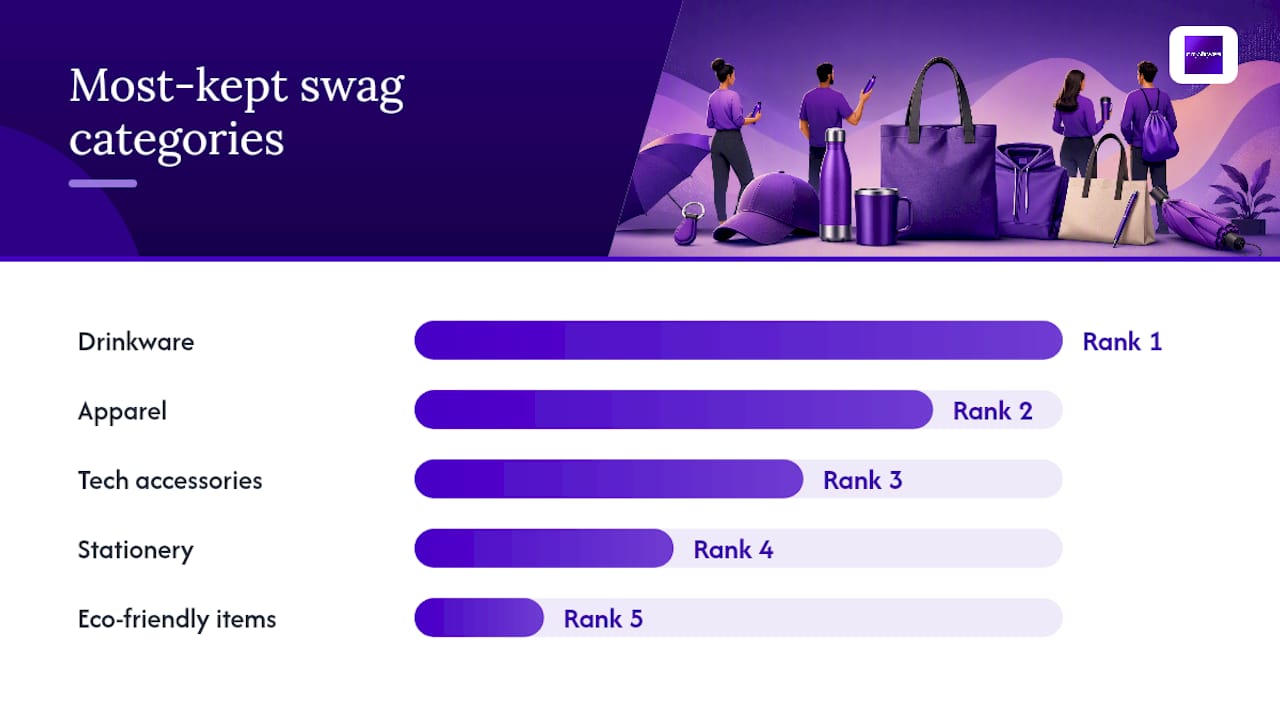
Here are the top categories, ranked by how often recipients keep them:
- Drinkware (tumblers, mugs, water bottles): Used daily, high perceived value, logo stays visible for years
- Apparel (t-shirts, hats, quarter-zips): Walking billboards when the fit and quality are right; cheap versions get donated
- Tech accessories (phone stands, charging cables, power banks): High utility, kept long-term, works well for premium tiers
- Stationery (notebooks, pens, sticky notes): Low cost, high volume, best for trade shows and entry-tier budgets
- Eco-friendly items (reusable bags, bamboo products, seed packets): Strong signal for sustainability-focused brands; growing preference among younger audiences
- Stickers and patches: Extremely low cost, high shareability, especially effective for younger demographics and brand advocates
Items that tend to get tossed: cheap plastic keychains, low-quality stress balls, and anything that does not connect to the recipient’s daily routine.
Pro Tip: When building a kit, choose one anchor product that sets the perceived value of the whole package, then fill around it with two to four lower-cost complementary items. A $40 tumbler paired with a $4 notebook and a $3 sticker feels like a $60 kit. A $4 notebook paired with a $3 pen feels like exactly what it cost.
Per Flywheel Brands’ kit-building guide, limiting kit size to three to five items and investing in packaging quality dramatically improves the unboxing experience and perceived brand value.
What Design Rules Make Swag Look Intentional, Not Cheap?
Good swag design is mostly restraint. The brands that get it right use less logo, more negative space, and better color discipline than the brands that plaster their name across every surface.
Four rules that separate premium-looking swag from generic giveaways:
- Keep it simple: One logo or wordmark, one placement, one color story. Adding a tagline, a website URL, and a phone number to a hat brim is how you make something look like a billboard, not a brand.
- Place the logo for normal use: On a mug, that means the front face when held. On a shirt, left chest or center chest, not both. Think about how the item looks when someone is actually using it.
- Respect negative space: A logo that breathes looks more expensive than one that fills every inch of available surface.
- Color contrast matters: Your logo needs to read clearly against the item color. A dark navy logo on a dark charcoal bag disappears. Test contrast before approving.
File spec checklist before you send to production
- Export your logo as a vector file (AI, EPS, or SVG), not a JPEG or PNG
- Convert all fonts to outlines so the printer does not need your typeface installed
- Set color mode to CMYK for print, Pantone for exact color matching
- Include bleed (typically 0.125 inches) and keep critical elements inside the safe area
- Request a digital proof before approving any production run
- For embroidery, request a stitch-out sample before full production
Canva’s merchandise maker lets you generate mockups and prototypes quickly, which is useful for visualizing placement and catching errors before they become expensive production mistakes.
Pro Tip: Tone-on-tone embroidery (matching thread color to fabric color) reads as premium even at mid-tier price points. A navy logo embroidered on a navy hat looks intentional. The same logo screen-printed in white on a cheap cotton tee looks like a giveaway.
Your branding strategy should drive every design decision here. If your brand uses a specific Pantone color, enforce it on every item, not just the ones where it is easy.
Which Production Method Should You Use for Your Swag?
Production choice comes down to four variables: how many units you need, how much time you have, what quality level you are targeting, and whether sustainability is a brand priority.
Print-on-demand works for small runs (under 50 units) and zero-inventory situations. You pay more per unit, but you carry no stock. Good for testing new items or fulfilling one-off gifts. Lead time is typically five to ten business days.
Bulk screen printing or embroidery is the standard for apparel and most hard goods at volume. Minimum order quantities (MOQs) usually start at 24–48 pieces. Per-unit cost drops sharply at 100+ units. Lead time runs two to four weeks domestically.
Private-label manufacturing is for businesses that want fully custom products with their own specifications, materials, and packaging. MOQs are high (often 500+), lead times stretch to eight to sixteen weeks, and overseas production adds complexity. Reserved for established programs with predictable volume.
Local print shops offer faster turnaround, easier communication, and the ability to see samples in person. Per-unit costs are higher than offshore bulk, but you avoid shipping surprises and can often get rush orders done in days.
Full-service agencies handle sourcing, design, kitting, and fulfillment under one roof. The per-unit cost is higher, but the operational load on your team drops to near zero.
Sustainability is worth building into your material selection early. Recycled polyester, organic cotton, bamboo, and FSC-certified paper products carry a higher per-unit cost but signal brand values that resonate with a growing share of customers. Industry experts consistently note that eco-friendly materials are no longer a niche preference; they are becoming a baseline expectation for many audiences.
How Do You Pick a Vendor Without Getting Burned?
Most swag horror stories trace back to a vendor chosen on price alone. A vendor RFP checklist prevents the most common failures.
Questions to ask every vendor before placing an order:
- What is your minimum order quantity for this item?
- What is your standard production lead time, and what is your rush lead time?
- Do you provide a physical sample before full production?
- What is your policy if colors do not match the approved proof?
- Do you offer fulfillment and kitting, or production only?
- What file formats do you accept, and do you have an art team for setup?
- What are your return and reorder policies?
Red flags that should stop you from placing an order:
- No physical sample available before production
- Vague lead times (“ships when ready” or “usually two to three weeks”)
- No digital proof step in the workflow
- Unclear shipping origin (domestic vs. overseas affects lead time and quality control)
- No references or verifiable past work
- Hidden setup fees that appear only at checkout
Pro Tip: Always ask for an itemized quote that separates product cost, setup/art fees, shipping, and any per-item fulfillment charges. Vendors who bundle everything into a single per-unit price make it impossible to compare quotes accurately or spot where costs are inflated.
The City Web Company troubleshooting guide for custom promotional products covers the most common ordering mistakes and how to avoid them.
How Should Small Businesses Handle Swag Fulfillment and Inventory?
Fulfillment is where most small-business swag programs quietly fall apart. You order 200 shirts, they arrive, and now they live in a closet until someone remembers to send them. That is not a program; it is a pile.
4imprint’s corporate swag store guide identifies inventory management and self-serve storefronts as the two critical elements that separate reliable programs from ad hoc purchasing. The same principle applies at small-business scale.
Fulfillment options by business size:
- In-house storage: Works for very small volumes (under 100 units). Requires a dedicated person to pack and ship. Breaks down fast when volume grows.
- Third-party fulfillment (3PL): You ship inventory to a warehouse; they pick, pack, and ship per order. Per-order fees apply, but you get professional packing and real tracking.
- Dropship/print-on-demand: No inventory held. Orders trigger production and direct shipment. Higher per-unit cost, zero storage risk.
- On-demand swag storefront: Employees or clients order from a branded portal; items are produced and shipped on demand. Best for employee recognition programs and distributed teams.
Inventory best practices
| Practice | Why It Matters |
|---|---|
| Single source of truth | One spreadsheet or platform tracks all SKUs, quantities, and reorder points |
| Reorder triggers | Set a minimum stock level that automatically prompts a reorder before you run out |
| Safety stock | Keep a buffer of your highest-velocity items to cover production delays |
| Kitting QC checklist | Verify item count, print quality, and packaging condition before every batch ships |
Swag frames this as a five-pillar system: sourcing, storage, distribution, storefronts, and analytics. Most programs fail because one pillar is weak, usually storage or analytics.
When your monthly order volume consistently exceeds 30–50 shipments, the manual approach stops making sense. That is the point to move to a managed storefront or a 3PL partner.
Where and How Should You Distribute Swag for Maximum Impact?
Distribution is the multiplier. The same $15 tumbler sent at the right moment to the right person generates more goodwill than a $50 item dropped into a generic mass mailing.
Channel playbook:
- Trade shows and events: High-volume, entry-tier items work here. Attach a QR code to a landing page so you can track how many event attendees convert later.
- Order inserts: A sticker or card tucked into a shipped order costs almost nothing and drives social shares when the item is interesting enough to photograph.
- Onboarding kits: New employee or new client welcome kits set the tone for the relationship. This is where premium swag earns its cost.
- Loyalty and referral programs: Swag as a reward for a fifth purchase or a referral converts better than a discount because it is tangible and shareable.
- PR and influencer sends: A curated kit sent to a local influencer or media contact can generate earned coverage worth multiples of the product cost.
Tracking methods that actually work:
- Unique QR codes per distribution channel (event vs. mailer vs. influencer)
- Promo codes tied to specific swag sends, tracked in your POS or e-commerce platform
- Dedicated landing pages with UTM parameters for each campaign
- Social listening for brand tags and mentions in the 30 days after a send
Swag that encourages social sharing has a built-in amplification effect. Unboxing moments, especially for well-packaged kits, generate organic content that extends your reach without additional spend. Measuring advertising effectiveness follows the same attribution logic: tie every spend to a trackable outcome before you commit the budget.
Sample Budget Tiers and a Simple ROI Model
Here is a concrete budget example for a mid-tier swag campaign targeting 100 recipients:
Simple ROI formula:
- Track revenue from recipients who used a promo code or scanned a QR code in the 60 days after receiving the kit
- Subtract the total campaign cost from that tracked revenue
- Divide by total campaign cost and multiply by 100 for ROI percentage
Untracked brand lift and repeat purchase behavior add to that number over time.
Short-term ROI is harder to prove for awareness-focused campaigns. Set realistic expectations: a trade show giveaway will not show a clean revenue number in 30 days. An onboarding kit tied to a client retention metric will. Match your measurement approach to your objective, and use tools like ROI tracking for paid campaigns as a model for attribution logic.
How City Web Company Runs Promotional Swag Programs
City Web Company approaches swag programs the same way it approaches digital campaigns: define the moment, build the system, measure the result.
The operational checklist used for client programs:
- Define the two or three moments in the customer or employee journey where swag adds the most value (onboarding, milestone, event)
- Curate a tight catalog of five to eight approved items rather than an open-ended catalog that creates decision paralysis
- Set up a branded storefront or order portal so approved items can be ordered without going through a manual approval chain each time
- Centralize inventory with a single tracking system and defined reorder triggers
- Automate sends where possible (triggered by a CRM milestone, a purchase, or a date)
- Measure one primary KPI per campaign and review it at 30 and 60 days
When City Web Company integrated a branded welcome kit into a local home services client’s onboarding process, the client reported stronger early engagement from new customers and a measurable uptick in five-star review requests completed within the first 30 days of service. The kit included a premium anchor item, a referral card with a QR code, and a handwritten note card, all sourced, kitted, and shipped through a centralized fulfillment workflow.
Pro Tip: Keep your catalog small on purpose. A catalog of five well-chosen items that you reorder predictably costs less per unit, ships faster, and looks more intentional than a catalog of 40 items you order in quantities of 12. Predictable volume is how you negotiate better pricing.
What City Web Company Sees Succeed Most Often
Most small businesses overthink the product and underthink the moment. The swag itself matters less than when it arrives and what it asks the recipient to do next.
The programs that consistently perform well share three traits. First, they have a curated catalog, usually five items or fewer, chosen because they fit the brand and the recipient’s daily life. Second, they attach swag to a specific moment in the customer journey rather than distributing it randomly. Third, they measure one KPI and use it to decide whether to repeat, adjust, or cut the program.
The most common mistake is treating swag as a one-time event purchase rather than a repeatable system. Buying 200 shirts for a trade show and then doing nothing with the remaining 150 is not a program. It is an expensive experiment with no feedback loop.
The second most common mistake is choosing items based on what the business owner likes rather than what the recipient will actually use. A $30 branded wine glass is a great gift for a wine-drinking audience and a useless one for everyone else.
Swag works when it is specific, timely, and tied to a next step. A tumbler with a QR code that leads to a referral landing page is a marketing asset. The same tumbler with just a logo is a nice gift. Both have value, but only one compounds.
City Web Company Handles the Hard Parts of Swag Campaigns
Running a swag program well takes more operational lift than most small businesses expect. Sourcing, design approvals, kitting, fulfillment, and tracking each require time and vendor relationships that take months to build.
City Web Company’s promotional products services cover the full workflow: product sourcing from vetted suppliers, logo and design support, kit assembly, fulfillment coordination, and storefront setup for businesses that want a self-serve ordering system. For local service businesses already running digital campaigns, adding a swag program through the same agency means your physical and digital brand assets stay consistent without managing two separate vendor relationships.
The practical difference: instead of spending three to four weeks sourcing vendors, requesting samples, and managing production timelines yourself, you describe the moment and the audience, and City Web Company builds the program around it. Ready to get started? Request a quote or consultation and have a working swag program in your hands faster than the DIY route typically allows.
Sources
These references provide deeper reading on the topics covered in this guide:
- Branding Merchandise: How To Create Fun Branded Merch (2025) – Shopify
- How to Set Up a Corporate Swag Store | 4imprint Articles
- Swag
- How to Build a Branded Swag Kit from Scratch: A Step-by-Step Guide | News | Flywheel Brands
- Canva merchandise maker content pages
FAQ
What items sell best in a swag store?
Drinkware (tumblers and water bottles), apparel (hats and t-shirts), and tech accessories (charging cables and phone stands) consistently rank as the highest-retention swag items because recipients use them daily. Practical items that fit into a recipient’s routine get kept; novelty items typically do not.
What are some cool swag ideas for small businesses?
Premium tumblers with a QR code referral card, branded notebooks paired with a quality pen, and eco-friendly tote bags with a bold logo are all strong choices. The best ideas connect to a specific moment, like a new client welcome kit or a trade show giveaway, rather than being distributed without context.
What are the trending swag items in 2026?
Insulated drinkware, sustainable and eco-friendly products (bamboo goods, recycled materials), and tech accessories like wireless chargers and phone stands have been among the most requested categories. Brands with sustainability values are increasingly choosing FSC-certified paper goods and organic cotton apparel over conventional alternatives.
How much should a small business budget for promotional swag?
Entry-tier campaigns run $3–$8 per unit and work well for mass giveaways; mid-tier runs $10–$25 per unit for client gifts and onboarding kits; premium items at $30 or more are best reserved for VIP clients or employee recognition. A mid-tier kit campaign for a moderate group size typically includes costs such as design, kitting, and shipping, adding up to a few thousand dollars.
How do you measure the ROI of a swag campaign?
Attach a unique promo code or QR code to every swag send, track revenue from recipients who use it within 60 days, subtract total campaign cost, and divide by campaign cost for your ROI percentage. One trackable KPI per campaign, whether redemption rate, social shares, or sales lift, gives you the data to decide whether to scale or adjust the program.
Recommended
These articles were popular with other readers too: