
Use website DNI, connect call reports to Google Ads and your Google Business Profile, then tie calls to booked jobs. City Web Company can handle setup.
Definition of Branding Strategy: Unlock Business Growth
Most local businesses do not have a marketing problem first. They have a coordination problem.
They run Google Ads, post on social media, tweak their website, maybe invest in Local SEO, and still feel like the whole thing is expensive, inconsistent, and hard to trust. Leads come in, but many are poor fits. Traffic increases, but sales stay uneven. The business looks active, yet it does not feel clear.
That gap is where the definition of branding strategy matters.
A branding strategy is not decoration. It is not your logo, your colors, or a clever slogan. It is the operating system behind how your business is understood, remembered, and chosen. When that operating system is missing, every tactic works harder than it should. When it is clear, SEO, paid ads, websites, reviews, and sales conversations start reinforcing each other instead of competing with each other.
Table of Contents
Why Your Marketing Feels Disconnected and Expensive
A lot of advice tells business owners to just add more tactics.
Run more ads. Post more often. Launch another campaign. Refresh the website. Try a new platform.
That advice sounds practical, but it often worsens the underlying problem. If your marketing feels scattered, the issue is usually not effort. The issue is that each channel is saying something slightly different, attracting slightly different people, and measuring success in isolation.

Tactics can work and still waste money
A Google Ads campaign can generate clicks.
A website can look modern.
A social page can stay active.
None of that guarantees the business is building trust with the right buyers. If one message says “lowest price,” another says “premium service,” and your reviews talk mostly about speed, the market gets mixed signals. Mixed signals create hesitation. Hesitation lowers conversion quality.
That is why owners often say things like:
- “We are getting leads, but they are shopping us hard.”
- “Our traffic is up, but our close rate is not.”
- “Every marketing vendor wants to sell a different fix.”
Those are not random frustrations. They are signs that the business lacks a clear strategic center.
Attribution can show activity, not clarity
Part of the confusion comes from measurement.
You can look at dashboards all day and still miss the structural problem. A report might show which channel assisted a conversion, but that does not automatically explain why the buyer trusted you, why they chose a competitor, or why lead quality swings from month to month.
If you want a useful primer on that reporting gap, what is attribution in marketing is worth reviewing. It helps separate channel credit from the bigger question of market perception.
A campaign can be technically efficient and still be strategically weak. That is why “working” marketing can still feel disappointing.
The missing layer under the spend
When business owners feel like marketing is a revolving expense, they usually assume the problem sits in execution.
Sometimes it does. More often, execution is reacting to a deeper issue. The business has not clearly decided what it wants to be known for, who it serves best, what promise it is making, and how that promise should show up everywhere.
Without that foundation, each tactic becomes a stand-alone decision.
With it, each tactic becomes a multiplier.
What Is a Branding Strategy Really
The simplest practical definition is this.
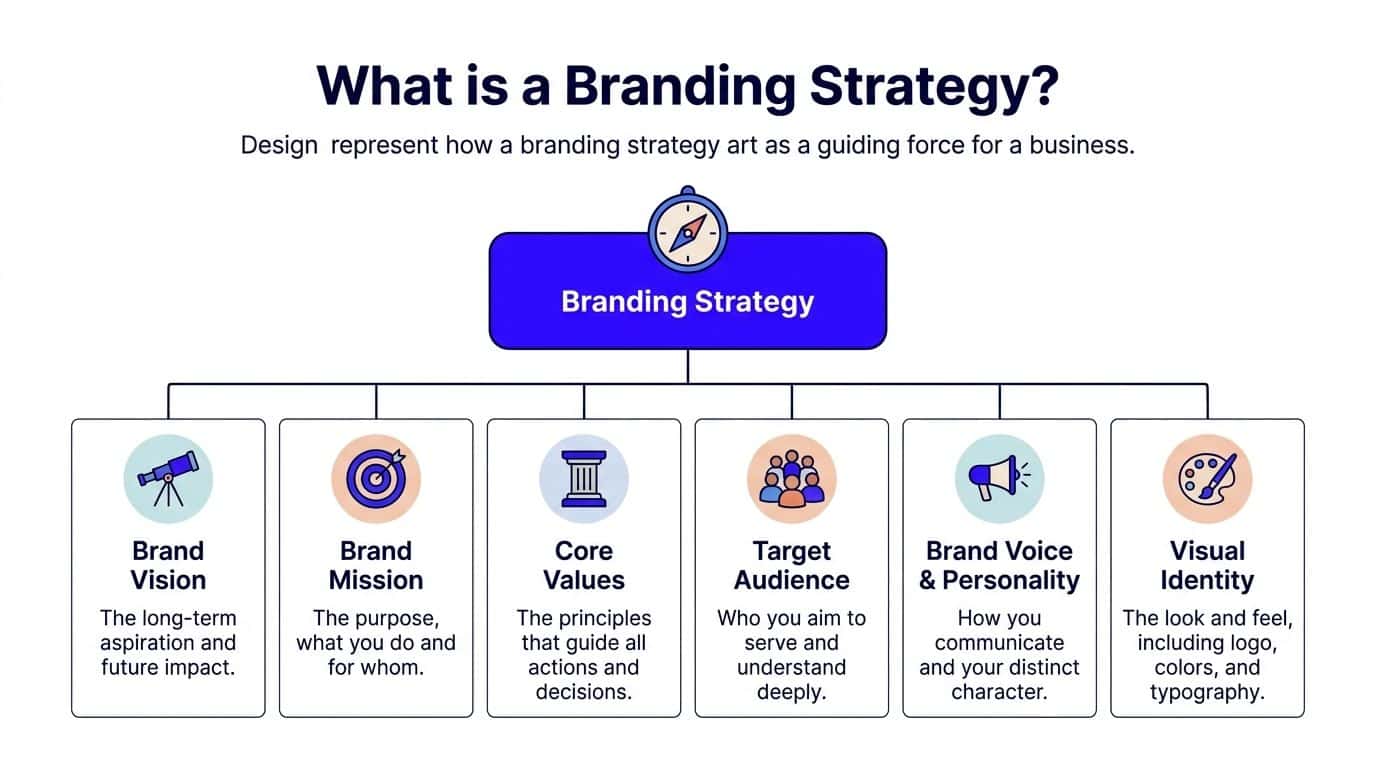
A branding strategy is the long-term plan that shapes how customers perceive your business and why they should prefer it over other options. It defines your identity, market position, promises, and communication across touchpoints. It is what makes the business coherent.
That matters financially, not just creatively. According to Bynder’s branding strategy overview, companies with a strong branding strategy outperform competitors by 20% in revenue growth and achieve 3.7 times higher customer engagement rates. The same source notes that Procter & Gamble formalized brand management in 1950, and increased market share by 15% within five years by focusing on positioning and messaging.
Think blueprint, not paint
Most owners think branding means visual polish.
That is like confusing house paint with the architectural plan. Paint matters, but paint does not tell you where the walls go, how people move through the space, or whether the structure supports the way the house needs to function.
Branding strategy is the blueprint.
Your logo, colors, typography, and website visuals are the visible layer. Your SEO pages, Google Ads campaigns, review responses, truck wraps, and sales scripts are the lived layer. The strategy is what makes those parts align.
What it includes in plain business terms
A brand strategy answers questions like these:
- What do we want to be known for in this market?
- Who are we best suited to serve and who are we not built for?
- Why should someone trust us quickly when comparing local options?
- What promise should every touchpoint reinforce?
- How should the business sound and behave online and offline?
That is why the definition of branding strategy is much broader than design. It gives direction to operations, marketing, sales, hiring, and customer experience.
What changes when it is clear
Take a local HVAC company.
Without strategy, the website says “quality service,” the ads push financing, the technicians emphasize speed, and the reviews mention friendliness. None of those things are bad. They just do not add up to a sharp market position.
With strategy, that same company may decide it wants to own “dependable home comfort with clear communication for busy families.” Once that is decided, the site copy, Google Business Profile updates, ad headlines, appointment reminders, and technician training all support the same promise.
Branding strategy does not make marketing louder. It makes marketing more consistent, easier to trust, and easier to remember.
That is why businesses with clear strategy often feel easier to choose, even when competitors offer similar services.
Branding Strategy vs Marketing Tactics A Critical Distinction
Local businesses often blur three different things together.
They say “we need branding” when they mean a logo refresh. They say “we need marketing” when they mean lead generation. They say “our brand is weak” when the core issue is inconsistent positioning.
The distinction matters because each one solves a different problem.
One business, three different layers
Use a local emergency plumbing company as the example.
| Layer | What it does | Practical example |
|---|---|---|
| Branding strategy | Defines who you are, who you serve, and why people should choose you | “We are the reliable 24/7 responder for homeowners who want fast help and calm communication during urgent issues.” |
| Marketing tactics | Deliver that message through channels and campaigns | Google Ads for urgent plumbing terms, Local SEO service pages, review requests, call tracking, van signage, streaming TV spots |
| Brand identity | Gives the business a recognizable visual and verbal look | Logo, colors, typography, uniforms, truck design, tone of voice |
If those three layers are not connected, the business feels fragmented.
What strategy decides
Strategy comes first because it narrows decisions.
It tells you whether you are competing on speed, trust, specialization, convenience, premium experience, or something else. It also tells you who should feel like your best-fit customer.
That is why strategy is the “who” and “why.”
A plumbing company with a serious after-hours reputation will write very different homepage copy than a budget-first plumbing company. It will answer phones differently. It may even organize service pages and Google Ads campaigns differently because urgency and reassurance matter more than discount language.
What tactics do after that
Tactics are the delivery vehicles.
They put your strategy into the market through search, paid media, website structure, email automation, reviews, local listings, and social content. Good tactics amplify a good strategy. They cannot invent one.
This is why so many businesses keep changing agencies or channels without fixing the underlying issue. The ad account gets blamed, but the ad account is often carrying unclear positioning.
A deeper look at that sequence is covered in this City Web Company article on branding or advertising what your business needs first.
What identity can and cannot do
Brand identity helps recognition.
It can make a business feel modern, established, friendly, upscale, technical, or approachable. That matters. But identity alone does not create preference if the underlying promise is vague.
A cleaner logo on a confused business is still a confused business.
That is why rebrands disappoint owners when the work only touches visuals. They expected better leads, stronger trust, and easier sales conversations. Instead, they got new files for the sign shop.
If your branding effort starts and ends with design, you improved appearance. You did not necessarily improve strategy.
The test that exposes the gap
A simple test helps.
If your team can answer these questions consistently, your strategy is probably stronger than you think:
- Who is our best-fit customer
- What problem do we solve better than nearby competitors
- What proof supports that claim
- What tone should a prospect experience from first click to final invoice
If those answers vary by employee, vendor, or channel, the business is still operating tactically.
The Core Components of Your Brand Strategy
A strong brand strategy is not a mood board. It is a working framework.
In practice, that framework usually lives in a document your team can use. According to Ignyte’s brand strategy guide, a brand strategy is a data-driven framework outlined in a formal document that specifies brand architecture, personality, and messaging. The same source notes that precise research into customer segmentation and competitive analysis directly causes 20-30% higher brand awareness and loyalty.
That is why strategy needs structure.

Purpose
Purpose is your business reason for existing beyond “we offer this service.”
That does not mean writing something lofty for a wall plaque. It means identifying the outcome you want customers to associate with your company.
An HVAC company might define its purpose around making homes feel dependable and stress-free for families who do not want surprise breakdowns. A dental office might frame its purpose around helping anxious patients feel comfortable enough to get consistent care.
Purpose matters because it keeps the business from sounding generic. It also helps owners make decisions that fit the kind of company they are trying to build.
When purpose is missing, marketing usually defaults to interchangeable claims like trusted, quality, affordable, experienced. Every competitor says the same thing.
Positioning
Positioning is where strategy gets sharp.
It answers this: what specific place should your business hold in the customer’s mind?
Not the best in every way. Not the cheapest, fastest, friendliest, and most premium at the same time. A business has to choose what it wants to be known for.
Here is what effective positioning tends to sound like for local businesses:
- Emergency service provider: fast, calm, available, reliable
- Premium contractor: detail-driven, transparent, design-oriented
- Family dental practice: patient, approachable, trust-building
- Med spa: modern, professional, confidence-focused
Weak positioning tries to please everyone. Strong positioning filters.
That filtering improves lead quality because your messaging starts attracting people who value what you do well.
Positioning is a trade-off. If everyone feels like your audience, no one clearly feels chosen.
Messaging
Messaging turns strategy into language people can understand quickly.
This includes your headline structure, service descriptions, value proposition, review request wording, email follow-ups, sales scripts, and even how your front desk answers the phone.
For a roofing company, messaging built around “precision insurance restoration with organized communication” will sound very different from messaging built around “fast storm response for urgent roof damage.”
Both may be valid. Only one should lead.
Good messaging usually does three jobs at once:
- Names the problem clearly
- Signals the kind of customer you serve best
- Reinforces the promise behind the service
Many businesses drift at this point. Their website says one thing, their Google Ads say another, and their sales team improvises the rest. Strategy closes that gap by giving everyone shared language.
Visual identity
Visual identity is the visible expression of the strategy.
It includes your logo, color system, typography, photography style, vehicle graphics, uniforms, signage, and layout choices on the site. It should support your position, not distract from it.
A law firm, a pediatric dentist, and a garage door company should not all look polished in the same way. Their visual systems should communicate different levels of warmth, urgency, professionalism, or technical confidence based on the audience they serve.
This is also where owners often overspend emotionally and underspend strategically. They get stuck on logo revisions while neglecting the message the brand needs to carry.
Motion can help in the right contexts too. If you are exploring digital assets for video intros, website headers, or social content, this guide to animated logos is useful. The caution is simple. Animation should support recognition, not replace clarity.
A related issue is consistency across channels. If your business sounds polished on the website and chaotic on social media, trust erodes. That challenge is explored well in this piece on your brand everywhere keeping one voice across every social platform.
Customer experience
The strategy becomes real in the customer experience.
Customer experience includes the speed of your callback, how estimates are explained, whether technicians arrive in a consistent presentation, how problems are handled, how invoices are written, and how follow-up happens after the job.
A local brand is not built by marketing alone. It is built when operations repeatedly prove the promise marketing made.
For example, a chiropractor positioning around calm, personalized care cannot run patients through a rushed intake process and still expect the brand to feel coherent. A remodeling firm claiming premium communication cannot send vague project updates and still maintain trust.
The businesses that win locally usually align these five parts. Purpose guides decisions. Positioning narrows the promise. Messaging states it clearly. Visual identity reinforces it. Customer experience proves it.
Branding Strategy Examples for Local Businesses
Theory gets easier once you watch it play out in a real market.
Below are two practical scenarios. Neither depends on flashy campaigns. Both work because the business makes clear decisions and then carries those decisions through every touchpoint.
The high-trust electrician
A local electrical company serves higher-income neighborhoods with older homes, remodel work, panel upgrades, and smart home installs.
The owner could market the company as “full-service electrical experts.” Most competitors already do. That language is broad, safe, and forgettable.
Instead, the business chooses a tighter strategy. It wants to be known as the electrician for homeowners who value clean work, modern solutions, and clear communication.
That choice shapes everything.
The website photography shows organized crews, labeled workspaces, and finished installations that look intentional. Service pages emphasize safety, planning, and homeowner education. Google Ads focus on upgrade-related searches instead of just emergency terms. Estimate emails explain scope clearly instead of relying on short price quotes.
Even offline, the strategy holds. The vans look refined rather than loud. Technicians wear clean uniforms and walk customers through what they are doing in plain language. Review requests prompt homeowners to mention professionalism, clarity, and respect for the home.
The result is not just more leads. It is better-fit leads.
People calling this company are less likely to expect the cheapest bid because the business has already signaled a different kind of value.
The community-focused landscaping company
Now take a landscaping company in a competitive suburban market.
Most firms show before-and-after yard photos, list mowing and maintenance services, and run seasonal promotions. Nothing is wrong with that. The problem is sameness.
This company decides to position itself around neighborhood pride, reliability, and long-term relationships for busy homeowners. It does not want to be seen as a commodity crew. It wants to feel like the dependable local team that helps homeowners keep the property looking cared for all season.
That strategy changes the tone.
The homepage speaks to homeowners who are tired of chasing vendors and dealing with inconsistent schedules. The social content features familiar neighborhoods, seasonal care advice, and practical updates rather than generic inspiration posts. Streaming TV creative focuses on family routines, curb appeal, and the confidence that the yard will be handled without follow-up calls.
The crews reinforce the same idea. They communicate arrival windows, leave properties orderly, and flag small issues before the homeowner notices them. Invoices are easy to understand. Follow-up messages sound neighborly, not corporate.
What both examples have in common
These businesses are very different, but the operating pattern is the same.
They do not start with channels. They start with a market position and let that position guide execution.
Here is what that looks like in practice:
- Website copy reflects the chosen promise, not generic service language
- Ad targeting matches the buyer mindset, not just raw search volume
- Visual design supports the audience expectation, whether premium, warm, technical, or reassuring
- Team behavior confirms the brand, so trust does not collapse after the click
What usually fails instead
The opposite pattern is common.
A business says it wants premium clients but runs discount-heavy ads. Or it wants loyal long-term customers but communicates only during promotions. Or it claims local trust while outsourcing the customer experience to scripts that sound interchangeable.
That mismatch is why branding strategy matters. It turns preference from an accident into a system.
The strongest local brands do not look coordinated by chance. Someone made decisions early, then protected those decisions across every touchpoint.
Building and Measuring Your Own Branding Strategy
A branding strategy becomes useful when it is documented, applied, and measured.
Without documentation, it lives in the owner’s head. Without execution, it stays theoretical. Without measurement, it gets dismissed as subjective.

Build it in four working steps
The first step is research.
Look at your current customers, best jobs, review themes, sales objections, and competitor positioning. Do not just ask who buys from you. Ask who closes fastest, stays loyal longest, and causes the fewest operational headaches.
The second step is definition.
Write down your purpose, position, audience, value proposition, voice, and customer promise. Keep it plain enough that a dispatcher, office manager, salesperson, and web designer could all apply it the same way.
Third comes documentation.
This should become a usable internal reference, not a vague slide deck. It can include homepage messaging priorities, service page rules, review request language, visual standards, response tone, and examples of what your brand sounds like when it is working well.
Fourth is execution.
Apply the strategy across the website, Local SEO pages, ad copy, Google Business Profile posts, intake scripts, estimates, emails, and follow-up sequences. Consistency is where strategy starts producing business value.
Measure what the strategy changes
Many owners assume branding cannot be measured. That is not accurate.
According to Qualtrics on brand strategy, data-driven strategies yield 18% higher customer retention. The same source notes that success is measured with brand equity metrics like unaided recall with a greater than 30% benchmark and Net Promoter Score above 50. It also states that for service businesses like plumbers, positioning as “reliable 24/7 responders” via Local SEO can cause a 22% lead generation boost when messaging aligns with customer pain points.
For a local business, the practical tracking list often looks like this:
- Lead quality: Are you getting fewer price-only inquiries and more buyers who fit your service model?
- Sales friction: Are prospects requiring less explanation because the website and ads pre-frame your value?
- Review language: Do customers repeat the same strengths you intended to own?
- Retention and referrals: Are more customers coming back or recommending you without needing heavy incentives?
- Brand search behavior: Are more people searching your business by name after seeing you in multiple channels?
Use simple scorecards, not vanity dashboards
A small business does not need an oversized brand analytics stack.
It needs a regular review rhythm. Monthly or quarterly is usually enough to spot patterns in lead quality, close rate, review themes, and customer feedback.
A simple internal scorecard can track:
| Metric | What to watch |
|---|---|
| Lead fit | Whether inquiries match your ideal customer profile |
| Review themes | Repeated phrases that reveal what customers notice |
| Close rate quality | Whether better-positioned leads convert with less price resistance |
| NPS or satisfaction trends | Whether experience is reinforcing the promise |
If the market consistently describes your business the way you intended, your strategy is taking hold. If not, the gap is usually in execution or in the original positioning.
Frequently Asked Questions About Branding Strategy
Is branding strategy only for large companies
No.
Local service businesses often need it more because they compete in crowded markets where services look similar on paper. A clear strategy helps a smaller business stop blending in and stop relying only on price or constant ad spend.
Is a branding strategy the same as a logo package
No. A logo package is one output.
Brand strategy decides what the business should mean to customers, what promise it should reinforce, and how every touchpoint should support that position. Design supports that work, but it does not replace it.
Can a small business build one without a huge budget
Yes.
The first version does not need to be elaborate. It needs to be clear. A small business can start by documenting audience, positioning, message priorities, and customer experience standards in a practical internal guide.
The mistake is not starting small. The mistake is staying vague.
How often should a business review its strategy
Review it when the market changes, when services expand, when lead quality drops, or when growth creates inconsistency across locations or teams.
A strategy should stay stable enough to build recognition, but not so rigid that it ignores real shifts in customer behavior or competitive pressure.
What are signs our current strategy is weak
A few patterns show up repeatedly:
- Your leads are inconsistent
- Different team members describe the business differently
- Your ads generate activity but not trust
- Customers compliment things you never intended to emphasize
- Your website, reviews, and sales process feel like different companies
Does branding strategy help SEO and paid ads
Yes, because it improves the message those channels carry.
SEO can increase visibility, and ads can create demand quickly, but both perform better when the underlying promise is clear. Better positioning often improves click quality, landing page relevance, and conversion confidence.
What should be written down first
Start with these:
- Who your best-fit customer is
- What you want to be known for
- Why that claim is credible
- How the brand should sound
- What experience must happen after the lead comes in
That alone creates more alignment than most local businesses currently have.
If your marketing feels active but not connected, the missing piece may not be another campaign. It may be the strategy underneath all of them. City Web Company helps local businesses build growth systems where brand clarity, SEO, paid media, and conversion strategy work together. If you want a calmer, more effective approach to visibility and lead generation, start with a conversation about what your business should be known for before you spend more trying to promote it.
These articles were popular with other readers too: