

See how plumbers can turn Facebook scrollers into booked jobs with clear offers, local targeting, a 30 day test budget, fast follow up, and a path to scale.
How to Create Legal Ads That Comply and Convert
Creating legal ads means drafting notices that are truthful, clearly structured, and compliant with U.S. federal standards, particularly the FTC’s truth-in-advertising requirements. Get it right and your ad serves its legal function without dispute. Get it wrong and you face rejection, fines, or liability that far outweighs any short-term gain.
Every compliant legal ad shares the same core components:
- Involved parties: Full legal names and addresses of all parties named in the notice
- Date: The publication date and any legally required response deadlines
- Legal authority or signature: The issuing authority, attorney name, or responsible party
- Purpose statement: A plain-language explanation of why the notice exists
- Required actions: Specific steps the reader must take, with deadlines
- Contact information: Where parties can direct questions or responses
- Disclaimers: Any state-mandated language, such as “past results do not guarantee future outcomes” for attorney ads
Accuracy is non-negotiable. Misleading consumers, even with technically true statements, violates federal standards and exposes you to legal liability. City Web Company works with businesses in regulated sectors every day, and the pattern is consistent: ads that fail do so because of missing information, not bad creative.
Table of Contents
What goes into a legal ad or notice?
Legal ads fall into two categories. The first is attorney or business advertising, which promotes services and must comply with FTC rules and, for lawyers, American Bar Association Model Rules. The second is court-mandated public notices, such as probate notifications, foreclosure announcements, and class action alerts, which must appear in state-approved publications and follow statutory formatting requirements.
Both types share a required structure. Here is what every compliant legal ad needs:
- Party identification: Full legal names and current addresses, not trade names or abbreviations
- Publication date and deadline: The exact date the notice runs and any response window required by statute
- Issuing authority: The court, agency, or attorney responsible for the notice, including bar number where required
- Purpose of the notice: One or two sentences stating what the notice concerns, written in plain language
- Required action or participation: What the reader must do, by when, and how, with no ambiguity
- Contact details: Phone number, mailing address, or both, depending on the jurisdiction
- Mandatory disclaimers: State-specific language your jurisdiction requires, placed prominently near the relevant claim
Pro Tip: Before publishing, check your state bar’s advertising handbook. The Florida Bar, for example, publishes a detailed handbook updated as recently as august 2023 that includes sample ads and filing cover sheets for every ad format, from print to targeted social media.
For attorney ads specifically, ABA Rule 7.1 prohibits false or misleading statements, Rule 7.2 permits advertising through written, recorded, or electronic media provided the responsible attorney is identified, and Rule 7.3 restricts live solicitation of prospective clients. Every state adds its own layer on top of these baseline rules.


How should you write a legal ad?
Plain language wins every time. Clear, direct language and a professional tone improve both readability and legal authority, and they help ads meet the standards regulators actually enforce.
Follow these writing principles:
- Lead with the most critical information. State the purpose and required action in the first two sentences. Readers and regulators should not have to search for what the notice is about.
- Use short sentences. Each sentence should carry one idea. Long, clause-heavy sentences bury key facts and create ambiguity that can be challenged.
- Avoid legal jargon. Words like “hereinafter,” “aforementioned,” and “pursuant to” add length without adding clarity. Use the plain equivalent.
- Be specific about deadlines. “Respond within 30 days” is weaker than “Respond by March 15, 2026.” Exact dates prevent disputes about when the clock started.
- Never exaggerate. Superlatives like “best” or “guaranteed” require objective proof. Puffery (“best burger in town”) is generally acceptable because consumers read it as opinion, but any claim that can be measured must be true and supported.
- Match your ad to its landing page. For digital legal ads, the page your ad links to must reflect exactly what the ad promises. Mismatched messaging is a major flag for regulators and kills conversion rates.
The FTC’s standard is that the overall impression of an ad must not mislead, even if every individual statement is technically accurate. Leaving out material information that affects how a reader understands your notice is treated the same as making a false statement.
What compliance mistakes cause legal ads to get rejected?
Most ad rejections trace back to information failures, not creative problems. Missing disclaimers and prohibited terminology are the most common culprits, and both are entirely avoidable with a structured pre-flight process.

FTC and federal standards
The FTC requires that advertising claims be truthful, evidence-based, and non-deceptive. Any objective claim about your product or service quality must be backed by factual evidence. Unsupported claims or omitted material information violate advertising law regardless of intent.
Platform-specific rules
Digital platforms add another layer. Ad platforms use AI text scanners that analyze all text in ads, including text embedded in images and video captions, rejecting ads with disallowed words or unsupported claims before a human reviewer ever sees them. Meta flags ads that reference personal attributes like financial status or health conditions. Google is aggressive about income promises and unrealistic outcome language. Knowing each platform’s specific trigger words before you write saves days of revision cycles.
Common errors to avoid:
- Missing or buried disclaimers (place them near the claim, not in fine print at the bottom)
- Absolute language: “guaranteed,” “always,” “never,” and “best” without supporting evidence
- Mismatched ad copy and landing page content
- Targeting a protected class in a way that violates fair lending or housing rules
- Using outdated compliance guidelines (regulations change; a rulebook from 2021 may already be a violation)
- Improper version control, publishing an old non-compliant draft instead of the approved final
Building a compliance-first workflow
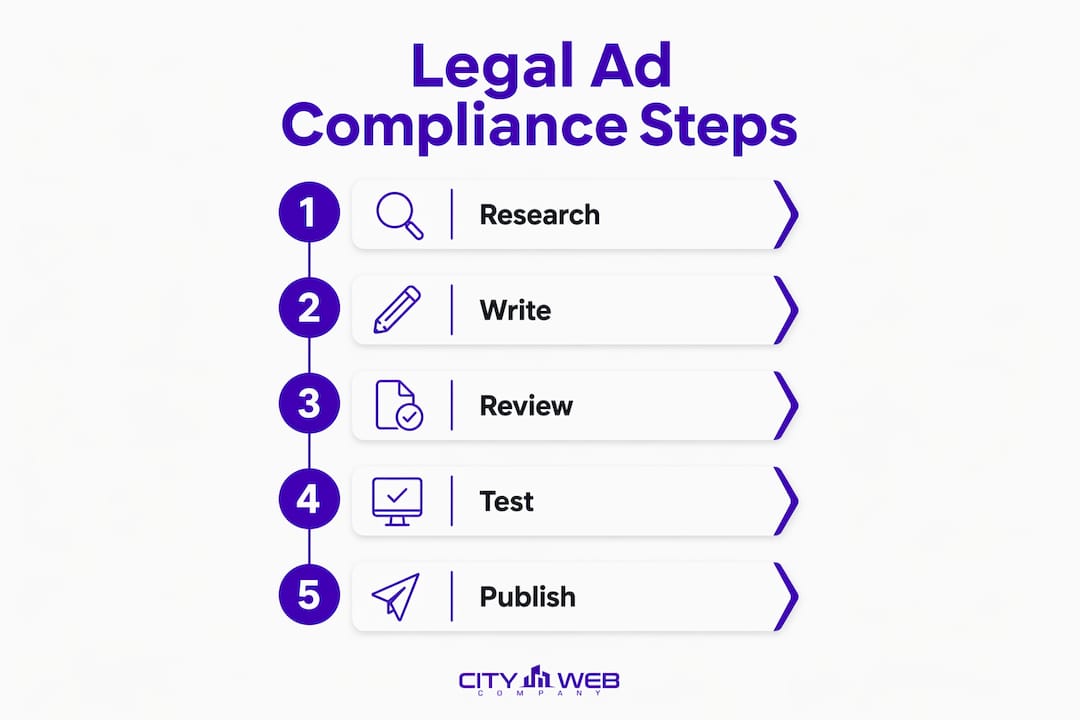
A compliant ad creative workflow integrates legal review at the start of the process, not the end. Compliance should be baked into the creative brief, not bolted on after the ad is polished. A standardized brief forces the strategist to answer upfront: Which disclaimers are required? What claims are being made? What is the target audience?
Before any ad goes live, run a pre-flight check with a fresh set of eyes. That reviewer should confirm five things: all numbers and dates are accurate, disclosures are legible and placed per platform rules, the ad matches the destination page, all links work, and targeting does not inadvertently reach a protected group.
Pro Tip: Treat compliance as part of your brand voice, not a hurdle. Brand compliance integrated into creative from day one means fewer revisions, cleaner ad accounts, and lower long-term costs. Teams that view compliance as a competitive advantage consistently outperform those that treat it as a final checkpoint.
Strict file naming conventions also matter more than most people realize. Using a naming system like V3_LEGAL_APPROVED_FINAL and digital asset management practices prevents the nightmare scenario of accidentally publishing an outdated, non-compliant version. Lock the file once it is approved.
If you want a structured starting point, City Web Company’s legal marketing checklist walks through the compliance steps that regulated businesses use before launching any ad campaign.
Key Takeaways
A legal ad that complies with FTC standards, names all parties clearly, and includes required disclaimers near each claim is far less likely to be rejected or create liability than one assembled without a structured review process.
| Point | Details |
|---|---|
| Lead with the answer | State the purpose and required action in the first two sentences of every legal notice. |
| Include all required components | Every legal ad needs party names, dates, issuing authority, purpose, required actions, and contact information. |
| Back every objective claim | Unsupported claims violate FTC standards; puffery is acceptable only when no objective measurement applies. |
| Run a pre-flight check | A fresh reviewer should confirm accuracy, disclosures, landing page match, working links, and targeting before launch. |
| Integrate compliance early | Build compliance requirements into the creative brief, not the final review, to reduce rejections and revision cycles. |
FAQ
Are ads legally binding contracts?
Advertisements are generally invitations to negotiate, not binding offers, unless they contain specific terms that meet the legal criteria for an offer. A binding agreement requires a definite offer, acceptance, and consideration.
What is the best way to send a legal notice?
The required method depends on the type of notice and your jurisdiction. Court-mandated public notices typically must run in a state-approved newspaper of general circulation for a specified number of weeks. Direct legal notices to individuals are usually sent by certified mail to create a documented delivery record.
How much does it cost to publish a legal notice in a newspaper?
Costs vary widely by publication, market size, and notice length. Rates are set by individual newspapers and are not publicly standardized at the federal level. Contact the legal notices department of your target publication directly for a current rate card.
How do lawyers advertise their services legally?
Lawyers may advertise through written, recorded, or electronic media under ABA Rule 7.2, provided the responsible attorney is identified in every communication. All claims must be truthful, disclaimers must be included where state rules require them, and live solicitation of prospective clients for personal gain is restricted under Rule 7.3. For a deeper look at digital marketing for law firms, City Web Company covers the channel-by-channel approach that keeps attorney advertising compliant and effective.
What happens if a legal ad is non-compliant?
A non-compliant ad can be rejected by the publication or platform, trigger regulatory review, result in fines, or expose the issuing party to legal liability. For attorney ads, state bar violations can lead to disciplinary action. Fixing the underlying information failure, usually a missing disclaimer or unsupported claim, resolves most rejections before they escalate.
Recommended
These articles were popular with other readers too: