

Pass Google Business verification with a video-first checklist. Film one continuous 30 second take, fix flagged issues, and know when to hire help.
Essential steps to successfully rebrand your law firm
TL;DR:
- A law firm’s rebrand can reposition its image, attract clients, and differentiate in competitive markets.
- Proper preparation, including market research and legal checks, is essential before executing a rebrand.
- Strategic marketing and internal communication are crucial for measuring success and sustaining momentum.
A law firm that built its reputation on personal injury cases a decade ago may now find itself struggling to attract corporate clients, top associates, or even the attention of its own community. The logo looks dated. The website feels like a relic. Competitors with sharper messaging are winning the cases you should be winning. This is not a crisis. It is a signal. A well-executed rebrand can reposition your firm, sharpen client perception, and open doors that stale branding quietly closes. This guide walks you through every stage of the process, from recognizing the need to measuring real results.
Table of Contents
Table of Contents
- Assessing the need for a rebrand
- Preparing for your law firm’s rebranding journey
- Executing the rebranding process: step-by-step
- Launching and measuring your new brand
- A reality check on law firm rebranding: what most guides miss
- Accelerate your rebrand with expert marketing support
- Frequently asked questions
Key Takeaways
| Point | Details |
|---|---|
| Assess rebrand necessity | Evaluate both internal and external signals before starting your law firm’s rebranding. |
| Prepare thoroughly | Clear objectives, stakeholder buy-in, and early IP/legal review ensure a smooth rebrand. |
| Follow proven steps | A strategic, step-by-step process maximizes your rebrand’s effectiveness and brand equity. |
| Measure post-launch results | Track website traffic, client feedback, and leads to gauge your rebrand’s true business impact. |
Assessing the need for a rebrand
Not every firm that feels stuck actually needs a rebrand. Sometimes a targeted marketing push or a website refresh does the job. But there are specific triggers that point clearly toward a deeper brand overhaul, and recognizing them early saves time and money.
The most common triggers include mergers and acquisitions, a significant shift in practice areas, leadership transitions, or a market that has simply evolved past your current positioning. If your firm recently merged with another, two distinct brand identities now compete for client loyalty. If you have moved from general practice into a specialized niche like healthcare law or construction litigation, your old brand may be sending the wrong message entirely.
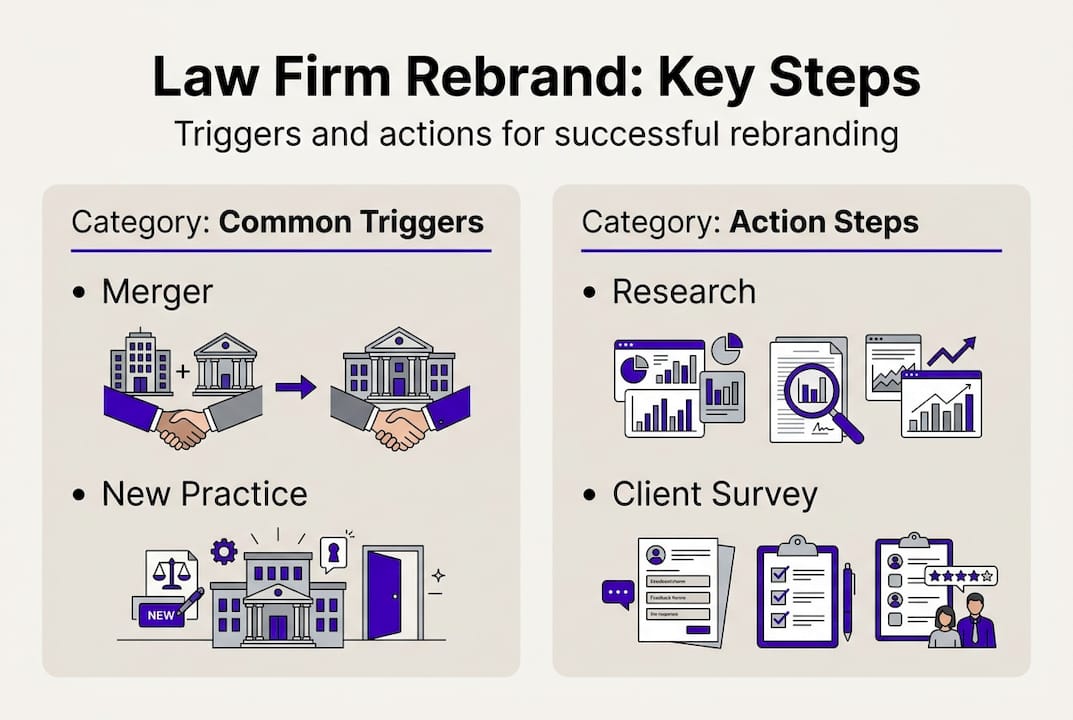
Internal feedback matters just as much as external signals. When your own attorneys struggle to describe what makes your firm different, that is a brand alignment problem. When client surveys reveal confusion about your services or values, that is a cue worth taking seriously. Rebranding signals growth and can attract top talent, which means the stakes extend beyond client perception into recruiting and retention.
Here are the clearest signs it is time to act:
| Sign | What it indicates |
|---|---|
| Outdated visual identity | Clients perceive the firm as behind the times |
| Inconsistent messaging across platforms | Confusion about what the firm actually does |
| Declining website traffic or inquiries | Brand is not resonating with target audience |
| Staff cannot articulate the firm’s value | Internal misalignment with brand purpose |
| New competitors outperforming you visually | Market positioning has weakened |
“AmLaw firms increasingly use rebranding not just to refresh their look, but as a deliberate growth strategy to signal capability, attract lateral hires, and differentiate in crowded markets.”
If three or more of those signs apply to your firm right now, a rebrand is not optional. It is overdue. Reviewing solid branding tips for law firms can help you frame the scope before you commit resources.
Preparing for your law firm’s rebranding journey
Once you have confirmed the need, preparation is where most firms either set themselves up for success or quietly plant the seeds of failure. A rebrand without clear goals is just expensive redesign.
Start by defining what you want the new brand to accomplish. Are you trying to attract a different type of client? Signal a shift into a more lucrative practice area? Differentiate from firms that look and sound exactly like you? Your goals will shape every decision that follows, from color palette to website copy to how you announce the change.
Next, conduct genuine market and client research. Survey current clients about how they perceive your firm. Interview prospects who chose a competitor. Analyze what your top three competitors communicate about themselves. This research is not optional background work. It is the foundation of a brand that actually connects.
Assemble a rebranding committee that includes senior leadership, your marketing lead, and critically, legal or intellectual property counsel. Many firms skip the legal piece and pay for it later. Early IP involvement ensures trademark protection and prevents you from launching a new name or logo that infringes on an existing mark.
Here is a pre-rebrand checklist to work through before any creative work begins:
- Audit all existing brand materials, including your website, social profiles, signage, and print collateral
- Conduct a domain availability search for any potential new firm name or tagline
- Run a trademark search through the USPTO database
- Complete stakeholder interviews with partners, associates, and key clients
- Document your firm’s core values and the client experience you want to deliver
- Review your current website essentials to identify what carries forward and what gets replaced
Pro Tip: Engage your IP counsel before you fall in love with a new name. Trademark conflicts discovered after design work is complete cost significantly more to resolve than those caught at the research stage.
Executing the rebranding process: step-by-step
With your goals defined and your groundwork laid, execution becomes a matter of following a structured sequence. Rebranding involves strategy, design, legal review, and rollout, and skipping any of those phases creates gaps that show up at the worst possible moment.
- Develop your brand vision and messaging framework. Define your firm’s positioning statement, core differentiators, and tone of voice. This document guides every creative decision.
- Design the visual identity. Work with a professional designer or agency to create your logo, color system, typography, and brand guidelines. A logo change alone is not a rebrand. A holistic rebrand updates how your firm looks, sounds, and feels across every touchpoint.
- Complete legal clearance. Before finalizing any name, logo, or tagline, confirm trademark clearance and secure relevant domains and social handles.
- Build or redesign your digital assets. Your website is the centerpiece. Update it first, then move to social profiles, email signatures, and online directories. Solid website optimization ensures your new brand performs in search, not just in appearance.
- Update print and physical assets. Stationery, signage, business cards, and office materials all need to reflect the new identity.
- Execute internal and external communication. Announce the rebrand to staff before clients. Then roll out to clients, referral partners, and the public.
Here is a quick comparison to help you decide how to resource the project:
| Factor | DIY rebrand | Agency-led rebrand |
|---|---|---|
| Cost | Lower upfront | Higher upfront, better ROI |
| Time | Longer, often stalls | Structured timeline |
| Risk | Higher for errors | Managed with expertise |
| Results | Inconsistent | Cohesive and measurable |
Pro Tip: Consistency is the most underrated part of a rebrand. Every platform, from your Google Business Profile to your conference room signage, should reflect the same identity. Inconsistency signals disorganization to potential clients. Explore digital marketing for law firms to understand how to maintain that consistency online.
Launching and measuring your new brand
A rebrand that launches quietly is a rebrand that underperforms. The launch moment is a marketing opportunity, and firms that treat it as one see measurably better results.
Start with an internal rollout before anything goes public. Brief your entire team on what changed, why it changed, and what the new brand stands for. Staff who understand and believe in the brand become its most credible ambassadors. Those who feel blindsided become its loudest critics.


For the external reveal, coordinate across channels simultaneously. Update your website, social media profiles, Google Business Profile, and any directory listings on the same day. Issue a press release to local legal publications. Send a personal email to your top clients explaining the change and what it means for them. Firms track website engagement and new client inquiries as the primary post-launch metrics, and you should too.
Stat to watch: Law firms that execute a coordinated digital rebrand report up to a 40% increase in website session duration within the first 90 days, reflecting stronger audience alignment with the new messaging.
Here is what to track after launch:
- Website traffic volume and source breakdown
- Average time on page and bounce rate
- New client inquiry volume and quality
- Search engine rankings for target practice area keywords
- Social media engagement rates
- Client and prospect feedback gathered through surveys or follow-up calls
Set a 30, 60, and 90-day review cadence. If certain metrics are not moving, adjust the messaging or distribution strategy before assuming the brand itself is the problem. A strong online marketing plan paired with a solid marketing checklist keeps your post-launch momentum from fading.
Gathering client feedback post-launch is not just a nice-to-have. It tells you whether the brand is landing the way you intended or whether there is a gap between your intention and your audience’s experience.
A reality check on law firm rebranding: what most guides miss
Most rebranding guides treat the process like a design project with a legal checklist attached. That framing misses the harder truth. Rebranding’s impact goes beyond visuals; it affects firm culture and long-term strategy in ways that catch leadership off guard.
The biggest obstacle we see is not budget or design. It is internal resistance. Senior partners who built their careers under the old brand often feel that changing it diminishes their legacy. That resistance does not go away on its own. Leadership needs to frame the rebrand as an evolution, not an erasure, and bring skeptics into the process early enough to feel ownership over the outcome.
Cultural alignment is the piece most firms skip entirely. A new logo on a firm that still operates with a 1990s client service mentality is just a costume. The brand has to reflect how you actually work, not just how you want to appear. Invest in content marketing that demonstrates your values through real work and real results, not just polished taglines.
Finally, momentum after launch is fragile. The first 90 days matter enormously. Firms that treat the launch as the finish line lose the gains they worked hard to create.
Accelerate your rebrand with expert marketing support
A rebrand is one of the highest-leverage investments a law firm can make, but only when it is executed with precision and followed by consistent, strategic marketing. Moving from a new logo to measurable market results requires more than good design.

At City Web Company, we specialize in helping law firms translate brand transformations into real business growth through digital marketing for law firms that covers SEO, paid advertising, website design, and more. Whether you are at the planning stage or ready to launch, our team can build the marketing infrastructure your new brand deserves. Explore our full range of digital marketing services and find out how we help law firms grow.
Frequently asked questions
What should a law firm avoid when rebranding?
Law firms should avoid skipping trademark checks and rolling out inconsistent messaging across platforms. Early legal and IP involvement prevents costly conflicts that surface after launch.
How long does a successful law firm rebrand typically take?
Most law firm rebrands take between 3 and 9 months when done properly, accounting for strategy, design, legal review steps, and client communication. Rushing the timeline is one of the most common causes of a rebrand that underdelivers.
Should our law firm work with a marketing agency for rebranding?
Partnering with a marketing agency gives you access to specialized expertise and a structured process that reduces risk. Agency-led rebrands consistently produce more cohesive results than in-house efforts attempted without dedicated resources.
How will rebranding affect our current clients?
When communicated proactively and clearly, a rebrand strengthens client trust by signaling growth and intentionality. Effective rollout ensures existing clients feel informed rather than surprised by the change.
Recommended
These articles were popular with other readers too: