

Pass Google Business verification with a video-first checklist. Film one continuous 30 second take, fix flagged issues, and know when to hire help.
Content marketing for local business growth: 3x more leads
TL;DR:
- Content marketing generates more leads at a lower cost than traditional paid ads.
- Consistent, localized content builds long-term authority and search visibility for local businesses.
- A scalable content system with tracking improves ROI and reduces dependency on ads over time.
Most local service businesses pour money into paid ads every month, only to watch leads dry up the moment the budget runs out. Here’s what that cycle costs you: content marketing generates 3x more leads at 62% lower cost than traditional methods. Yet the majority of home service, legal, and healthcare businesses still treat content as an afterthought. This guide breaks down exactly how content marketing works for local service industries, which content types deliver the strongest ROI, and how to build a system that keeps generating leads long after you publish.
Table of Contents
Table of Contents
- What is content marketing and why does it matter?
- Content marketing vs. traditional and paid advertising
- Best types of content for local service businesses
- Building a consistent and scalable content system
- What most local businesses overlook about content marketing
- Amplify your results with expert digital marketing help
- Frequently asked questions
Key Takeaways
| Point | Details |
|---|---|
| More leads, less cost | Content marketing generates more leads than ads and costs significantly less for local service businesses. |
| Sustainable long-term ROI | Unlike paid ads, quality content works year-round and delivers compounding results over time. |
| Best-performing content types | Localized blog posts, FAQs, and case studies deliver the greatest results for service industries. |
| Consistency and tracking | A regular content system and simple analytics are essential for success and improvement. |
What is content marketing and why does it matter?
Content marketing is the practice of creating useful, educational material that helps your ideal customer solve a problem or answer a question. Instead of interrupting someone with a sales pitch, you show up when they’re already searching for help. That’s a fundamentally different relationship with your audience.
For local service businesses, this means writing blog posts that answer the questions your clients ask every day. It means creating videos that explain your process, sending email newsletters that keep past clients engaged, and publishing social posts that showcase your expertise. None of this screams “buy now.” All of it builds trust.
Here are the primary channels that work best for local service businesses:
- Blog posts and articles: Answer common questions, explain services, and rank in local search results.
- Email newsletters: Stay top of mind with past clients and warm leads.
- Short videos: Show your process, introduce your team, or explain a common problem.
- Social media posts: Reinforce your expertise and humanize your brand.
- FAQ pages: Capture searchers who are close to making a decision.
The numbers behind content marketing for lead generation are hard to ignore. Blogging businesses get 13x more leads and ROI averages $3 to $7.65 per $1 spent. For a plumbing company or a family law practice, that kind of return changes what’s possible with a modest marketing budget.
Statistic spotlight: Service businesses that publish consistent content see a 200% to 400% increase in qualified leads over 12 months compared to businesses relying solely on paid ads.
Pro Tip: Local guides and FAQ pages are two of the fastest ways to build trust with nearby searchers. A post titled “What to expect from a roof inspection in [your city]” targets exactly the right person at exactly the right moment.
Exploring proven content marketing strategies before you start publishing saves you from wasting time on content that doesn’t convert. The goal isn’t to publish more. It’s to publish what your local audience is already searching for.
Content marketing vs. traditional and paid advertising
Paid ads work. Nobody is saying they don’t. But they work only while you’re paying for them. The moment your Google Ads budget hits zero, your phone stops ringing. Content marketing operates on a completely different model.
A well-written blog post or FAQ page can rank in search results for years. It keeps generating traffic, inquiries, and calls without any additional spend. That’s compounding value, and it’s something paid ads simply can’t offer.
“Hyperlocal content costs 73% less annually than local service ads for the same number of leads.”
Here’s a side-by-side look at how these approaches compare:
| Factor | Content marketing | Paid advertising |
|---|---|---|
| Upfront cost | Low to moderate | High and ongoing |
| Lead cost over time | Decreases as content compounds | Stays flat or increases |
| Visibility after budget stops | Remains active | Disappears immediately |
| Trust building | High (educational value) | Low (perceived as sales) |
| Timeline to results | 3 to 6 months | Immediate |
| Long-term ROI | Very high | Moderate |
The case for blog content marketing becomes even stronger when you look at local service industries specifically. A single post answering “How much does it cost to hire a personal injury attorney in [city]?” can bring in qualified leads for three to five years. No ad campaign delivers that kind of shelf life.
That said, the smartest approach isn’t either/or. Many businesses use paid ads for immediate traction while building their content library in parallel. Over time, the content takes over more of the lead load and the ad spend can shrink.
Key advantages content marketing holds over paid channels:
- Builds organic search rankings that ads can’t buy
- Creates shareable assets that generate referral traffic
- Positions your business as the local authority in your field
- Reduces dependency on ad platforms and their rising costs
If you’re unsure where content fits within your broader strategy, understanding small business marketing help can clarify how to balance both approaches effectively. And for legal practices specifically, content marketing for law firms follows a distinct set of rules worth knowing before you start.
Best types of content for local service businesses
Not all content performs equally. For legal, healthcare, and home service businesses, certain formats consistently outperform others. The key is matching content type to the way your customers actually search and decide.
Here’s a breakdown of the highest-impact content types and what you can realistically expect from each:
| Content type | Best for | Expected ROI | Lead impact |
|---|---|---|---|
| Localized blog posts | All service industries | 3:1 to 5:1 | 200% to 400% increase |
| FAQ pages | Legal, healthcare | High | Strong conversion lift |
| Case studies | Home services, legal | Moderate to high | Trust and close rate |
| How-to guides | Home services | Moderate | Top-of-funnel volume |
| Video testimonials | All industries | High | Social proof conversion |
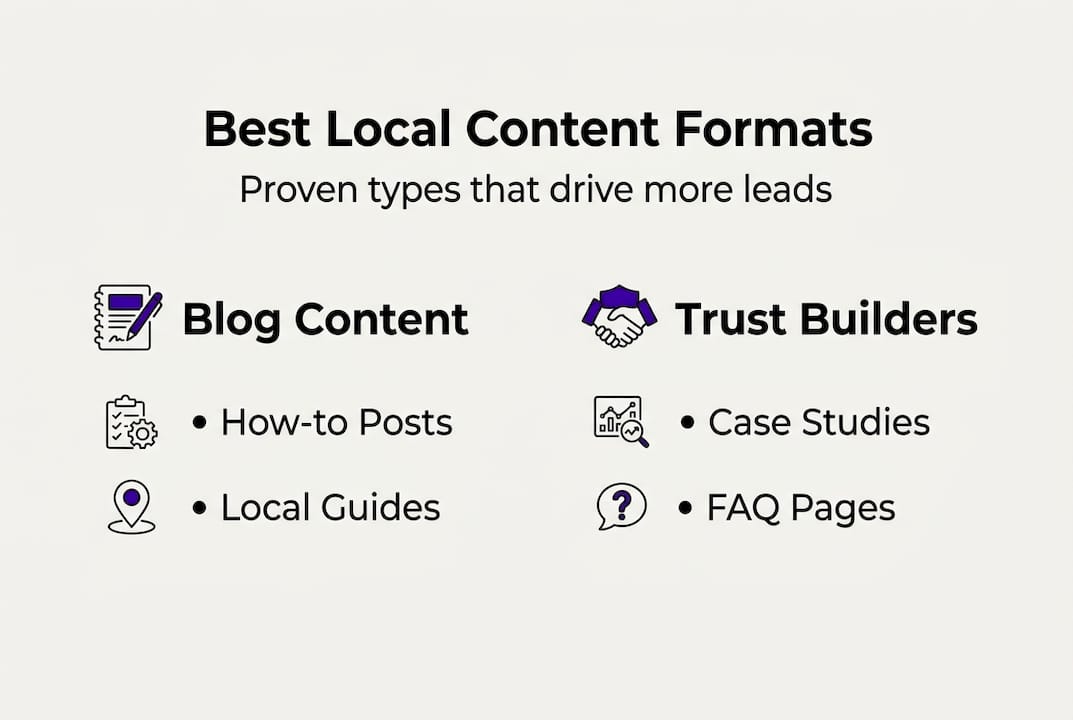
Localized blogging delivers a 3:1 to 5:1 ROI with a 200% to 400% lead increase for local service businesses that publish consistently. That’s not a guarantee, but it’s a realistic benchmark backed by real data.
Here’s how to prioritize your content efforts by industry:
- Legal: Answer the questions clients ask before they call. “What happens if I miss a court date?” or “How long does a workers’ comp claim take?” These posts attract people in active research mode.
- Healthcare: Focus on condition-specific content and local trust signals. Patients want to know you understand their situation before they book an appointment.
- Home services: How-to guides and project cost breakdowns attract homeowners researching a problem. They’re not ready to buy yet, but they’re close.
- All industries: Local case studies showing real results for real clients in your area build credibility faster than any generic testimonial.
Pro Tip: Every blog post you publish for local search can be repurposed. Turn it into an email newsletter, break it into three social posts, or record a two-minute video summary. One piece of content becomes five touchpoints across different channels.
Building a library of useful content through smart blogging strategies compounds over time. Each post adds another entry point for local searchers to find you.


Building a consistent and scalable content system
The biggest reason local businesses fail at content marketing isn’t strategy. It’s consistency. A burst of five blog posts in January followed by nothing until June doesn’t build authority. Search engines and readers both reward regular, reliable publishing.
Here’s a practical framework for building a system that actually holds:
- Set a realistic publishing schedule. Two posts per month beats twelve posts in one month followed by silence. Consistency signals credibility.
- Assign clear accountability. Someone owns content. Whether that’s an in-house team member, a freelancer, or an agency, the responsibility needs a name attached to it.
- Build a topic bank. Collect every question your clients ask. Every service page gap. Every competitor topic you could cover better. That’s your content calendar.
- Track performance from day one. Use Google Analytics or a simple dashboard to connect content visits to form submissions and phone calls.
- Repurpose systematically. Every long post becomes social content, email content, and potentially video content.
Top performers leverage scalable models, technology, and AI workflow guidelines to maintain output without burning out their teams. Using AI in content marketing for topic research, outlines, and first drafts can cut production time significantly without sacrificing quality.
Pro Tip: Connect your content directly to business outcomes by setting up goal tracking in your analytics platform. When you can show that a specific blog post generated eight contact form submissions last quarter, content stops feeling like a cost and starts looking like an investment.
For a deeper look at what to measure, measuring marketing ROI and tracking content ROI give you the specific metrics worth watching. The businesses that win with content aren’t necessarily publishing the most. They’re the ones paying attention to what’s working and doing more of it.
What most local businesses overlook about content marketing
We see the same pattern repeatedly. A local business owner feels pressure to get leads fast, so they go all-in on paid ads. That makes sense in the short term. But months or years later, they’re still 100% dependent on ad spend, and their cost-per-lead hasn’t dropped at all.
Content marketing’s real power is in what it builds over time. A steady publishing cadence, even just twice a month, means you’re gradually owning more search real estate in your local market. Each post is a permanent asset. Ads are a rental. You stop paying, you lose everything.
“The best leads often come from content planted months ago, showing up just when your customer needs you most.”
Small, regular efforts compound if done right. A law firm that publishes two helpful posts per month for two years has 48 indexed pages working for them around the clock. That’s a significant competitive advantage over a firm that only runs ads. Sustainable business growth strategies almost always include a content foundation because it lowers your cost-per-lead while increasing your authority. The businesses that figure this out early have a structural advantage that’s genuinely hard for competitors to replicate quickly.
Amplify your results with expert digital marketing help
Building a content system that consistently generates leads takes strategy, execution, and the right tools. Most local business owners are already stretched thin running their actual business.
That’s where City Web Company comes in. We help local service businesses in legal, healthcare, and home services build content-driven marketing systems that compound over time. From driving local leads through targeted content to managing your full digital presence, our team handles the strategy and execution so you can focus on serving your clients. Explore our digital marketing services or get started with a free consultation today and see what a results-driven content strategy can do for your business.
Frequently asked questions
How does content marketing help local businesses generate leads?
Content marketing attracts qualified prospects by answering their specific questions and building trust before they ever contact you, delivering 3x more leads at 62% lower cost than traditional advertising methods.
Which content types are best for legal, healthcare, or home service businesses?
Localized blog posts, FAQ pages, and client case studies consistently deliver the strongest ROI, with localized blogging generating a 3:1 to 5:1 return and a 200% to 400% increase in leads for local service businesses.
How quickly can content marketing deliver results?
Content marketing typically builds momentum over 3 to 6 months, with results compounding steadily over time as your content library grows and search rankings improve.
What are the main challenges of content marketing for local businesses?
Consistency and measuring ROI are the two biggest hurdles, but scalable content models combined with simple analytics tools make both challenges manageable for businesses of any size.
Recommended
These articles were popular with other readers too: